You can start with a keyboard instrument in any digital audio workstation, or DAW. Use a plain piano or other stable, clearly pitched sound. Avoid heavy chorus, pitch modulation, and huge reverbs at first: they add interesting texture but make the basic listening task harder.
The examples here use Western twelve note equal temperament. They are one widely used musical framework, not a claim that all musical traditions organize pitch this way.
Learn a small set of distances
On a keyboard, a semitone is the move to the immediately adjacent key, black or white. The following starting intervals are easy to build from C:
| Interval | Example above C | Semitones |
|---|---|---|
| Minor third | E flat | 3 |
| Major third | E | 4 |
| Perfect fifth | G | 7 |
| Octave | Next C | 12 |
The octave is particularly useful: the second note sounds higher while retaining a strong sense of the same note class. A perfect fifth feels different from the close comparison between minor and major thirds. The goal is to build a mental sound for each relationship, not merely remember the numbers.
The musictheory.net interval lessons explain interval naming and spelling. Use them alongside listening; counting keys and hearing a relationship are complementary skills.
TRY IT HERE
Build it. Hear it.
Change one note and listen to the relationship.
Ready when you are. Audio starts only when you press Play.
Keep experimenting in the piano LabHear notes one after another, then together
A melodic interval has notes played in sequence. A harmonic interval has notes played simultaneously. Practise both because they present different clues.
First play C, pause briefly, and play E. Sing or hum the second note if comfortable. Then play C followed by E flat. Repeat the pair several times, paying attention to the difference between the two upper notes. Do not worry about absolute pitch: you are learning a relationship.
Now play C and E together, followed by C and E flat together. Listen to the combined colour. The same interval may be easier to identify in one presentation than the other. Keep separate scores so that success in one exercise does not hide difficulty in the other.
A short practice cycle can use four examples: ascending major third, ascending minor third, simultaneous major third, and simultaneous minor third. Change the order rather than always alternating major and minor.
Build chord quality from one changing note
A triad contains three chord tones. For this exercise, use a root, a third, and a fifth:
- C major: C, E, G
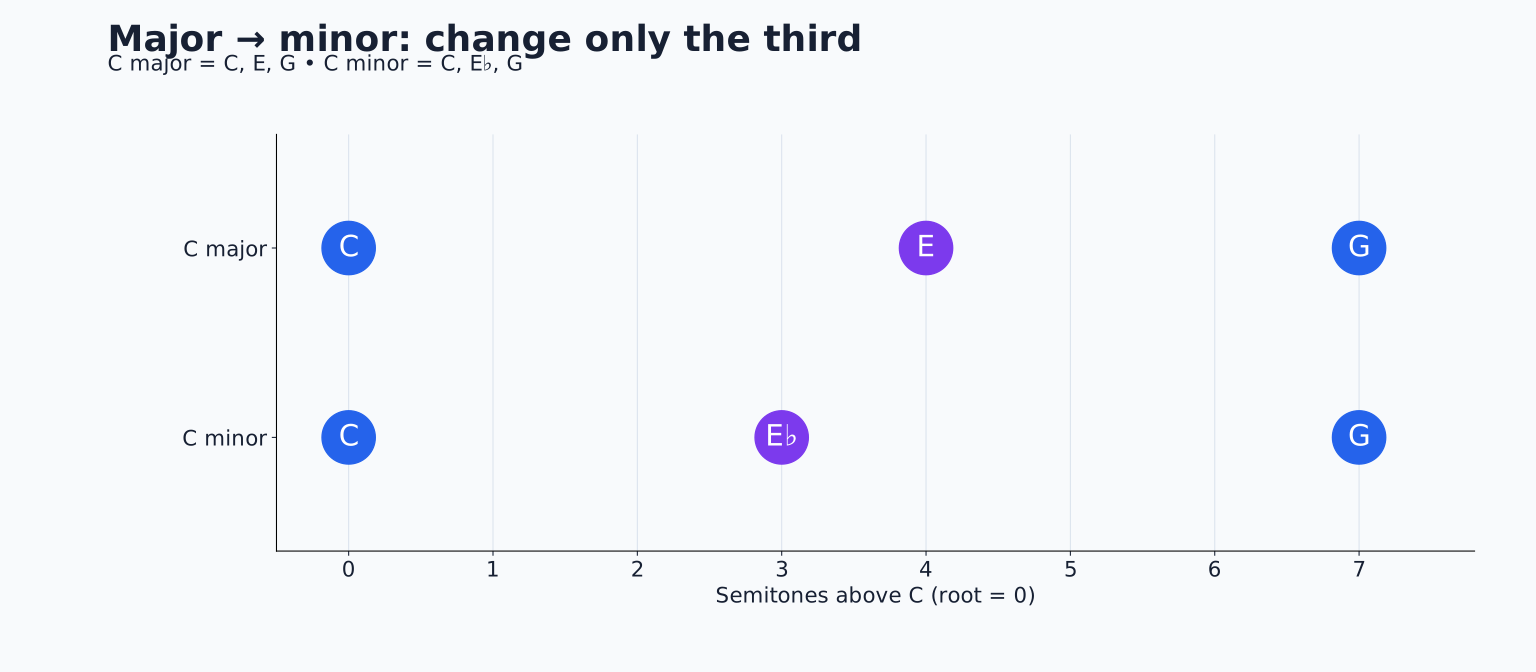
- C minor: C, E flat, G
- C diminished: C, E flat, G flat
- C augmented: C, E, G sharp
Musictheory.net's introduction to chords provides the underlying triad construction. Start by contrasting major and minor only. Keep the root, fifth, instrument, volume, and rhythm identical. That isolates the changed third.
Avoid treating “major equals happy” and “minor equals sad” as definitions. Tempo, register, rhythm, performance, and context can change emotional interpretation. You are identifying a pitch structure; the mood is a broader musical result.
When the major/minor contrast is familiar, add diminished or augmented as a third choice. Introducing all chord types at once often leads to guessing rather than learning.
Make your own blind quiz
Create eight short MIDI clips with either a C major or C minor chord. Give them neutral names such as Test 01 through Test 08. If you program the sequence yourself, return to it later or have a partner shuffle playback so memory of the arrangement is less useful.
Play each chord once, write “major” or “minor,” and then check the notes. Keep the note editor hidden during the attempt. Record not just your score but your confidence. An uncertain correct answer and an immediate correct answer represent different stages of learning.
Next transpose the whole exercise to D: D, F sharp, A for major and D, F, A for minor. Transposition moves all notes by the same distance while preserving the interval structure. If the score collapses, you may have learned the sound of one specific chord instead of the quality.
Expand the register carefully
Play the same triad lower and higher. A low position chord can sound less clear because its notes and overtones interact differently from those in a higher register. That does not change its identity.
Octave labels vary between software packages. One program's C3 may be another's C4. For this exercise, choose a comfortable middle register by listening, and refer to note letters and relative placement rather than assuming every reader sees the same octave number.
After register changes, try another instrument. If you can identify major and minor only on piano, a plain organ or soft synth patch will expose the need for more varied practice. Keep the tone stable before adding distortion or modulation.
Introduce inversions without changing the chord
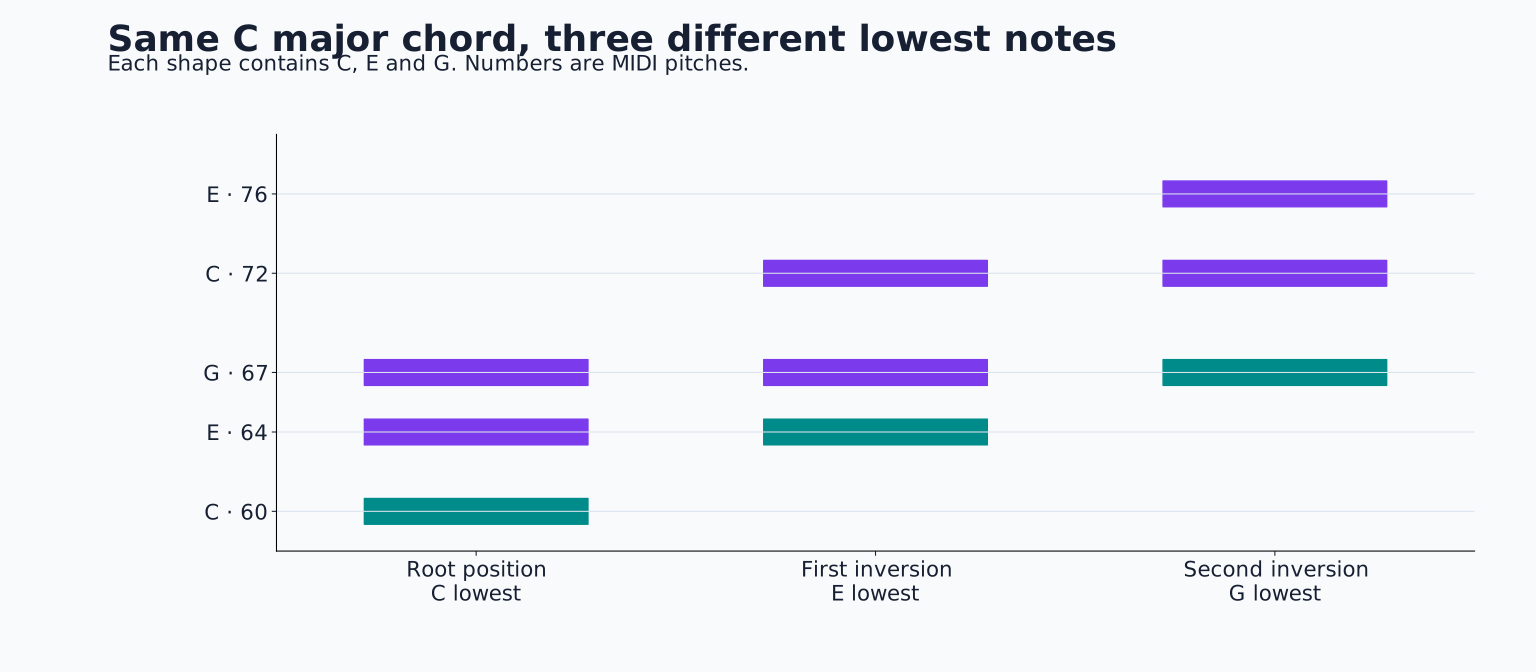
An inversion changes which chord tone is lowest. C, E, G, E, G, C, and G, C, E can all represent C major. Beginners often hear the changed bass note and assume the chord quality has changed.
Play the three voicings slowly. Listen for the common collection of notes, then return to the close major/minor comparison using the same inversion on both sides. For example, compare E, G, C with E flat, G, C. The task is now harder because the root is no longer the lowest sound.
Do not use chord recognition as a reason to force every part into root position. Inversions and wider voicings are useful precisely because they change the sound while preserving harmonic identity.
Put the skill into a musical phrase
Write a four bar progression using C major, A minor, F major, and G major, one chord per bar. Play a simple melody with one note per beat. In the first bar, try E followed by E flat while C major continues underneath. Which note feels more settled in this context? Neither is forbidden; the exercise connects interval hearing to a real harmonic background.
Then mute the melody and sing the bass roots before playing them. This practises anticipation rather than only recognition. If singing is uncomfortable, imagine the sound and check it on the keyboard.
When practice becomes frustrating
Reduce the number of answer choices. Slow down the presentation. Remove distracting effects. Repeat an incorrect example after seeing its notes, then compare it directly with the interval you guessed. That comparison supplies useful feedback; repeatedly taking tests without reviewing mistakes does not.
Short, attentive sessions are preferable to exhausted guessing. You are not trying to prove musical talent. You are building familiarity through repeated, understandable examples.
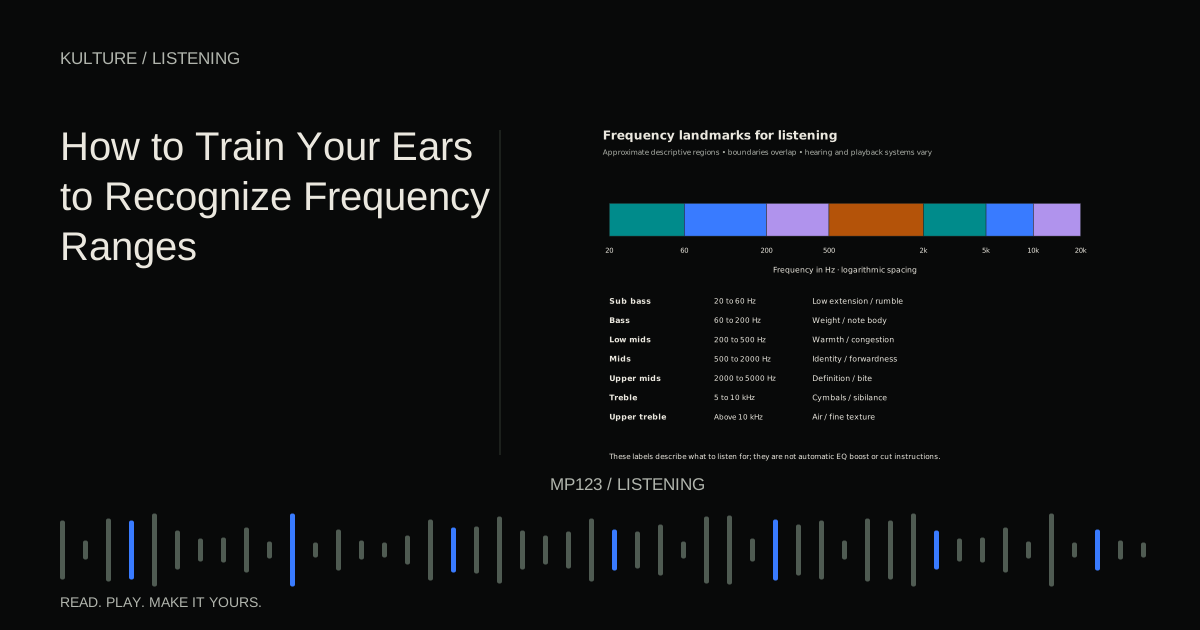
For your next session, identify ten major/minor triads in two different keys, then write a two bar melody containing one deliberate major third and one perfect fifth. Continue with frequency range ear training for tone colour recognition, or return to clearer listening and studio acoustics to improve the conditions in which you practise.
TAKE IT INTO YOUR OWN MUSIC
Your next session.
Reduce the number of answer choices. Slow down the presentation. Remove distracting effects. Repeat an incorrect example after seeing its notes, then compare it directly with the interval you guessed. That comparison supplies useful feedback; repeatedly taking tests without reviewing mistakes does not.
Notes and progress stay in this browser.