Frequency describes how quickly a vibration repeats. Hertz, abbreviated Hz, means cycles per second; 1 kHz means 1,000 Hz. Pitch and frequency are related, but an instrument normally contains many frequencies at once. A bass guitar has low fundamentals and higher harmonics, so hearing it clearly is not only a matter of hearing deep bass.
Give the spectrum useful landmarks
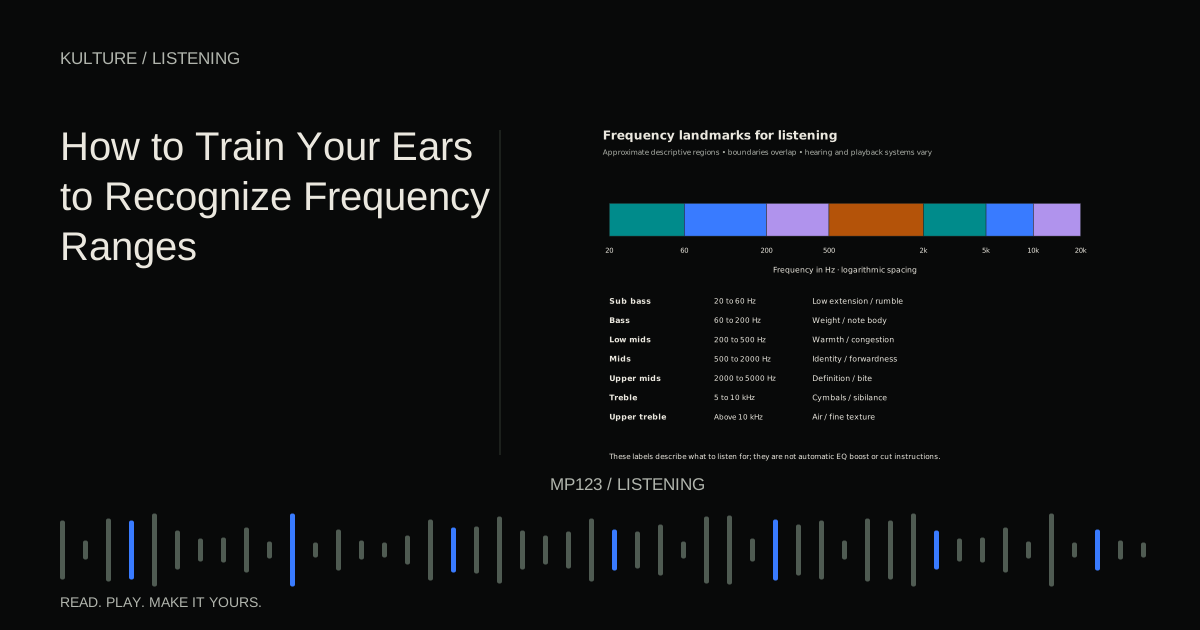
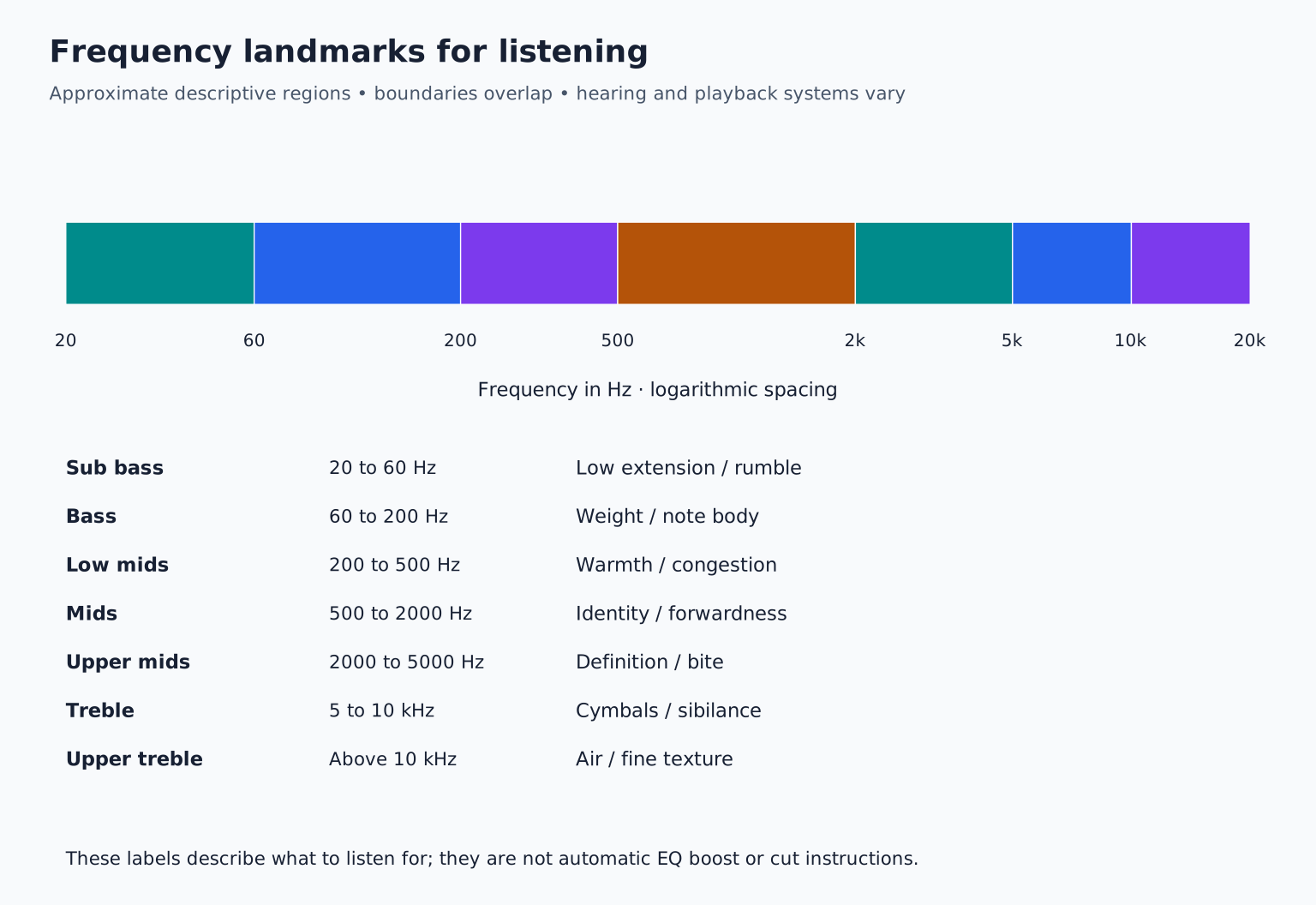
These approximate regions are a vocabulary for practice, not fixed boundaries or automatic EQ instructions:
| Region | Illustrative range | Details to listen for |
|---|---|---|
| Sub bass | 20 to 60 Hz | Very low extension, rumble, the bottom of some kicks and basses |
| Bass | 60 to 200 Hz | Weight, bass note body, some drum resonance |
| Low mids | 200 to 500 Hz | Warmth, thickness, congestion, room tone |
| Mids | 500 Hz, 2 kHz | Instrument identity, nasal or forward qualities |
| Upper mids | 2 to 5 kHz | Definition, bite, consonants, potential harshness |
| Treble | 5 to 10 kHz | Cymbal texture, sibilance, brightness |
| Upper treble | Above 10 kHz | Air, fine noise texture, top end extension |
Different sources and educators divide these regions differently. Their value is that “too thick around the lower mids” gives you a more useful starting point than “bad.” None of the adjectives is automatically negative. Warmth can be exactly what a thin vocal needs.
TRY IT HERE
Find the frequency
Move a bell filter through a harmonic tone and compare bypass.
Ready when you are. Audio starts only when you press Play.
Keep experimenting in the piano LabMake a safe training session
Use a familiar recording you are allowed to play, an EQ with a bell filter, and a gain control after the EQ. A bell filter raises or lowers a region around a centre frequency. Its Q control describes bandwidth: larger Q generally means a narrower region.
Keep monitoring comfortably quiet. Start with broad changes rather than loud test tones or extreme resonant sweeps. A boost can make the output louder, so lower the level as needed. The WHO safe listening resource is a helpful reminder that learning to listen should not involve prolonged high volume exposure.
For the first exercise, use a broad bell around 300 Hz and raise it by an illustrative 3 dB. Toggle the EQ on and off while compensating the overall output by ear. Listen for added thickness across voices, guitars, or keys. Then move the centre to 3 kHz and repeat. The aim is to notice how the character changes, not to declare either setting correct.
Train recognition before precision
Begin with two choices: low mids or upper mids. Create two alternate versions of a ten second passage, one with the 300 Hz change and one with the 3 kHz change. Label the files neutrally and shuffle playback, or ask someone to switch between them without telling you which is active.
Write your answer before revealing the setting. Include a short explanation: “The vocal sounds thicker,” or “The pick attack stands out.” If you get several answers wrong, increase the separation between the two bands or use a more revealing source. Lowering difficulty is better than practising random guesses.
Once these are easy, introduce a bass change and a treble change. Finally reduce the EQ amount. A gradual progression might be broad 4 dB changes, then 2 dB, then 1 dB. Those are training steps, not an assurance that every listener will reliably identify every change.
Practise both boosts and cuts. A cut can be harder to name because it removes information rather than adding an obvious quality. Compare “less low mid thickness” with “more treble” and notice that they can initially sound similar even though the processing differs.
Separate pitch from tone colour
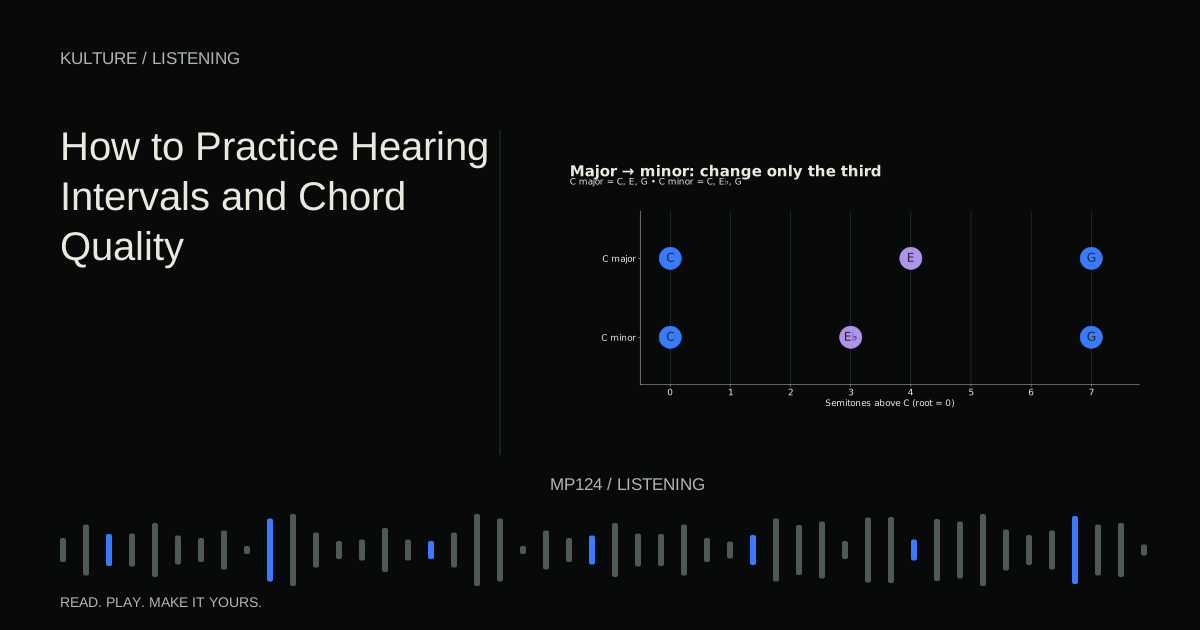
Play C, E, and G on a simple piano sound. Their fundamentals differ. Then play the same C on piano, a bright sawtooth synthesizer, and a muted bass sound. The note identity remains while the spectrum changes.
This distinction matters when diagnosing a bass line. If only one note overwhelms the room, the issue may follow its fundamental or a room resonance. If every note sounds too buzzy, the patch's harmonic balance may be the larger issue. A wide treble cut cannot reliably solve a room specific bass peak.
For related musical listening rather than EQ recognition, use interval and chord quality practice. The two skills reinforce each other, but recognizing a major third is a different task from recognizing an upper mid boost.
Use a spectrum display after making a guess
A spectrum analyser shows the distribution of signal energy across frequency. It can confirm that your EQ is changing the intended region, or reveal a narrow resonance you heard. It cannot decide whether the music is emotionally effective or whether an instrument should be bright.
Hide the display for your first judgment. Afterward, inspect it to connect the visual evidence to the sound. Avoid training yourself to interpret every bump as a fault. Musical notes naturally produce peaks, and the spectrum of a single acoustic instrument need not look flat.
For a technical reference on filtering and analysis, the Room EQ Wizard documentation explains its analysis tools. Room measurements and music spectra answer different questions, so do not substitute one for the other.
Move from isolated sounds to the full arrangement
Practise first on one sustained instrument, then on a short mix. In a mix, masking occurs when one sound makes another harder to perceive. A guitar may seem dull only because a bright synth occupies similar musical space.
Try this original exercise: create a piano chord and a sustained pad on the same notes. Lower the pad's low mids slightly and ask whether the piano becomes easier to follow. Then restore the EQ and simply lower the pad. Which adjustment preserves the mood better? Ear training should help select an appropriate intervention, including no EQ at all.
Troubleshooting your practice
If every example sounds identical, check that the EQ is active and that the source contains energy in the chosen region. A sub bass only tone cannot teach upper treble recognition.
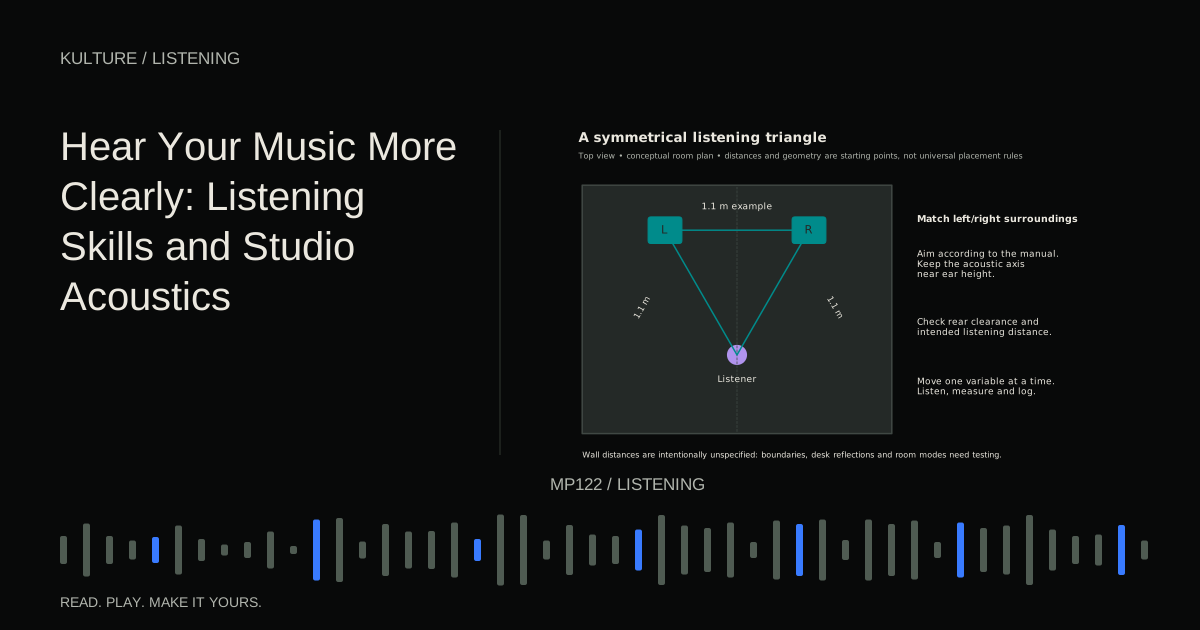
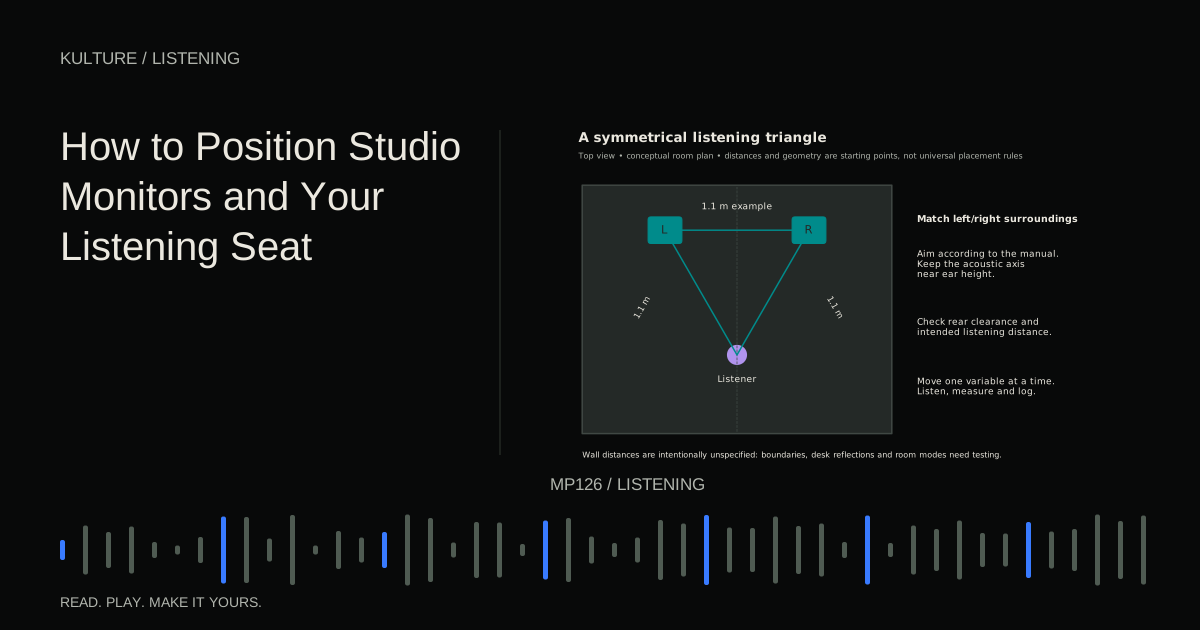
If bass judgments change when you lean forward, investigate the listening position. If the difference is obvious on headphones but inconsistent on speakers, the room may be obscuring it. Start with monitor placement rather than boosting the training signal.
If all boosted examples seem better, level match them more carefully and shorten the comparison. If your guesses worsen after a long session, stop and return later. There is no prize for training through fatigue.
A repeatable weekly exercise
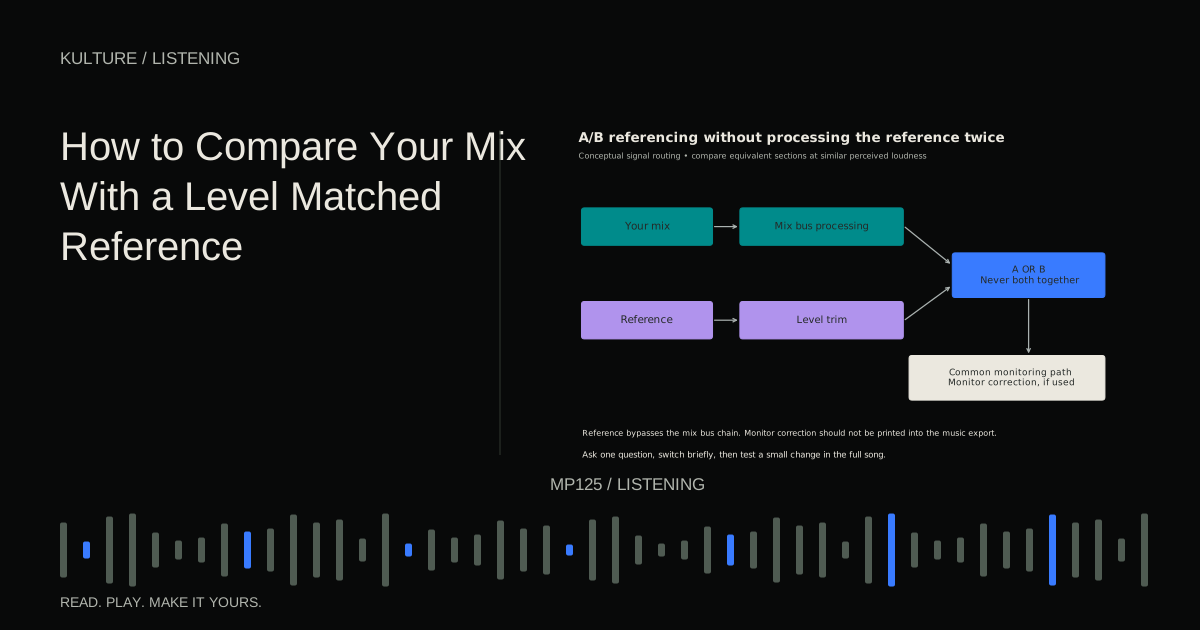
Choose one familiar passage and four broad EQ centres: 100 Hz, 350 Hz, 1.5 kHz, and 6 kHz. Make ten blind comparisons, record your guesses, and review the errors. Next time, practise only the two regions you confused most often. Finish by making one small, deliberate change in your own mix and checking it with a level matched reference. The useful outcome is a better decision, not a perfect score.
TAKE IT INTO YOUR OWN MUSIC
Your next session.
If every example sounds identical, check that the EQ is active and that the source contains energy in the chosen region. A sub bass only tone cannot teach upper treble recognition.
Notes and progress stay in this browser.