This guide builds a listening routine and a practical plan for your space. You do not need to become an acoustician before finishing music. You do need a way to distinguish a problem in the recording from a problem in playback.
Start by asking a smaller question
“Does this sound professional?” is difficult to answer and even harder to act on. Replace it with questions that point toward a decision:
- Can I follow the bass melody throughout the chorus?
- Does the lead vocal stay understandable when the guitars enter?
- Is the snare attack distinct from the wash of reverb?
- Does the chorus feel wider than the verse?
- Is the last note allowed to finish naturally?
Listen once for one question. Stop and write a short observation before reaching for a plugin. This interrupts the common habit of changing several controls because something feels vaguely wrong.
Separate observations from explanations. “The bass disappears on the third note” is an observation. “My room has a cancellation at that frequency” is a hypothesis. The hypothesis may be correct, but the bass patch, arrangement, or note velocity could also be responsible.
TRY IT HERE
Find the frequency
Move a bell filter through a harmonic tone and compare bypass.
Ready when you are. Audio starts only when you press Play.
Keep experimenting in the piano LabBuild a small reference collection
A reference is a familiar recording used as a comparison. Pick three or four recordings with different strengths: one for a clear vocal, one for controlled low end, one for percussion, and one for a sense of space. Obtain playback copies through legitimate means and keep them for listening rather than redistributing them with a session.
Choose references reasonably close to your instrumentation and intention. A sparse piano piece is not a sensible density target for a crowded synth arrangement. It can still be a useful reference for how a natural fade feels.
For each track, write a few landmarks: “The bass note at 0:42 is clear but not huge,” or “The lead stays centred while background parts spread sideways.” Specific landmarks are easier to recall than an impression of polish.
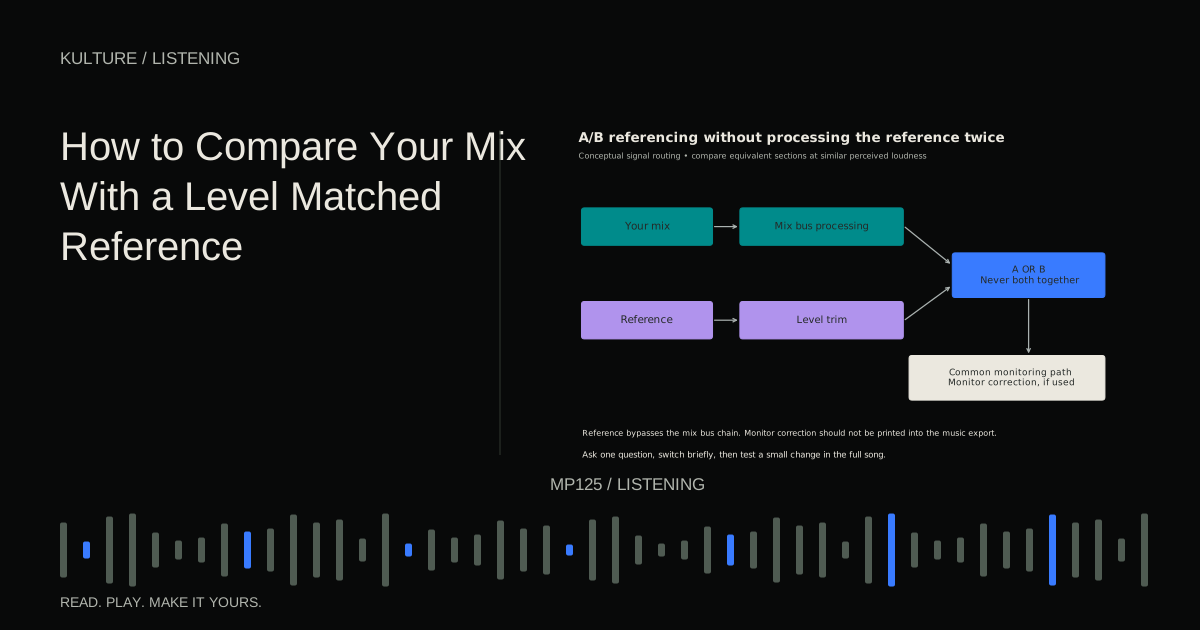
Reduce the louder file until comparisons feel approximately equal in loudness. Otherwise extra level can masquerade as extra clarity. Use level matched referencing before drawing conclusions about EQ or compression.
Learn the room without buying anything
Your speakers send sound directly to you and into the room. Reflections arrive from nearby surfaces. At low frequencies, the interaction between source, boundaries, and listening position can create strong peaks and dips. A bass note can change dramatically when you move your head or chair.
Try a simple diagnostic. Play a familiar bass line quietly at a comfortable level. Listen from the usual position, then move the chair a small distance forward. Repeat a small distance backward. If the same notes change strongly, the room is affecting the judgment. Do not immediately compensate by changing the song.
Now compare headphones. Headphones remove the speaker to room path, but introduce their own frequency response, fit, and stereo presentation. Agreement between two imperfect systems is stronger evidence than either system alone.
Genelec's room acoustics guidance explains placement and reflection control. Use it to understand the principles rather than copy a photograph of a studio whose dimensions differ from yours.
Establish a repeatable listening position
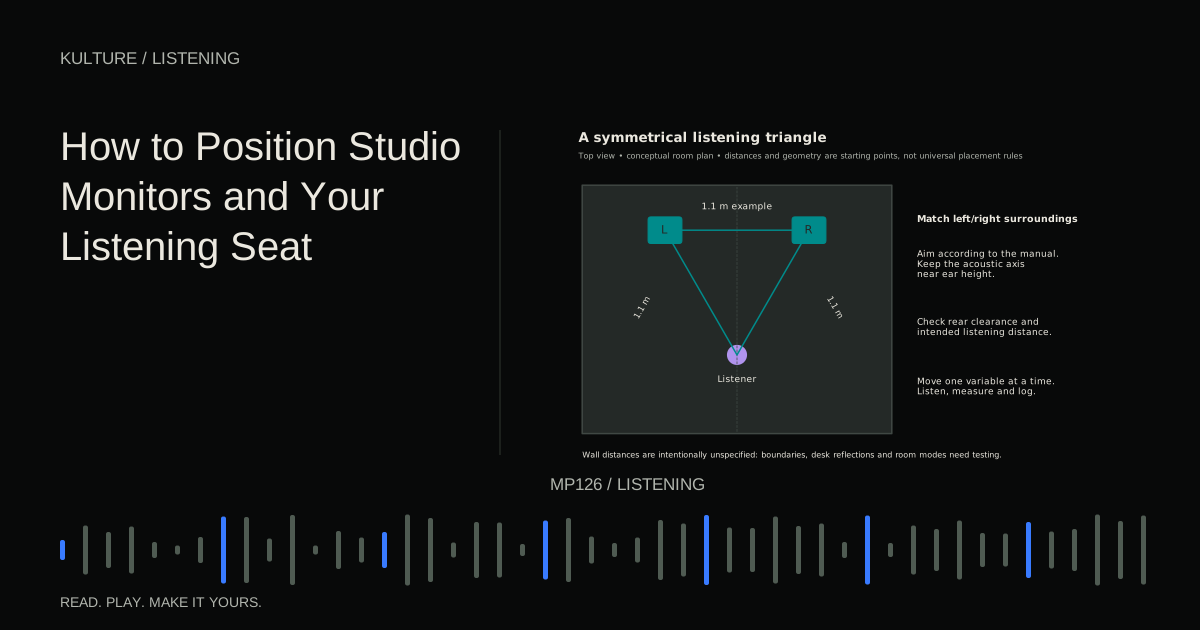
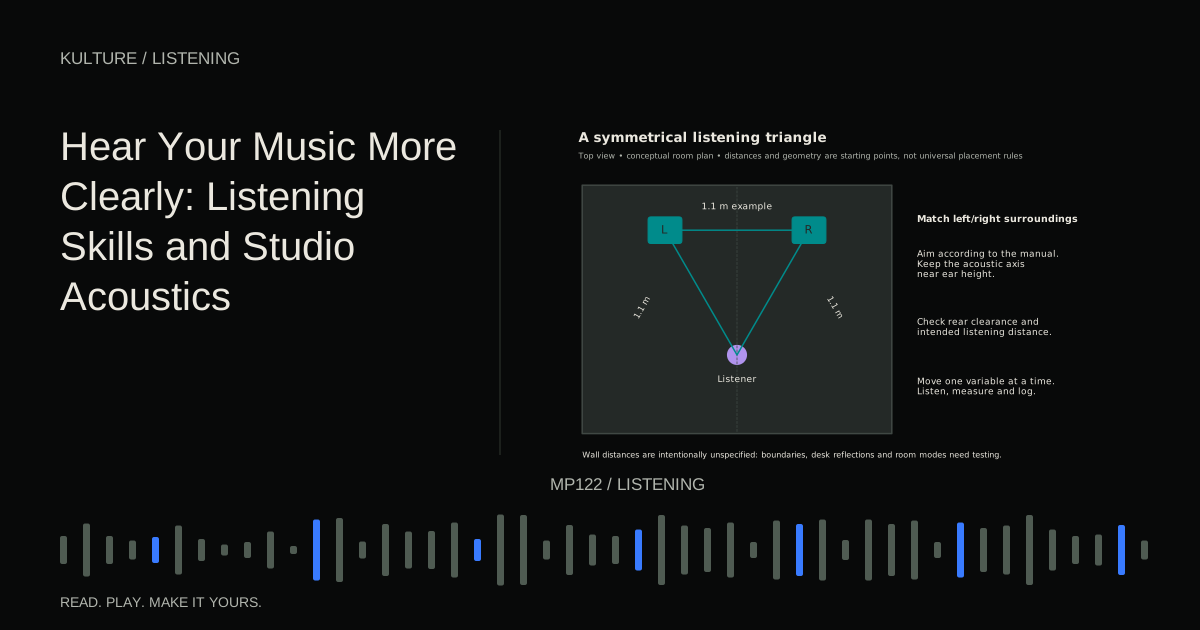
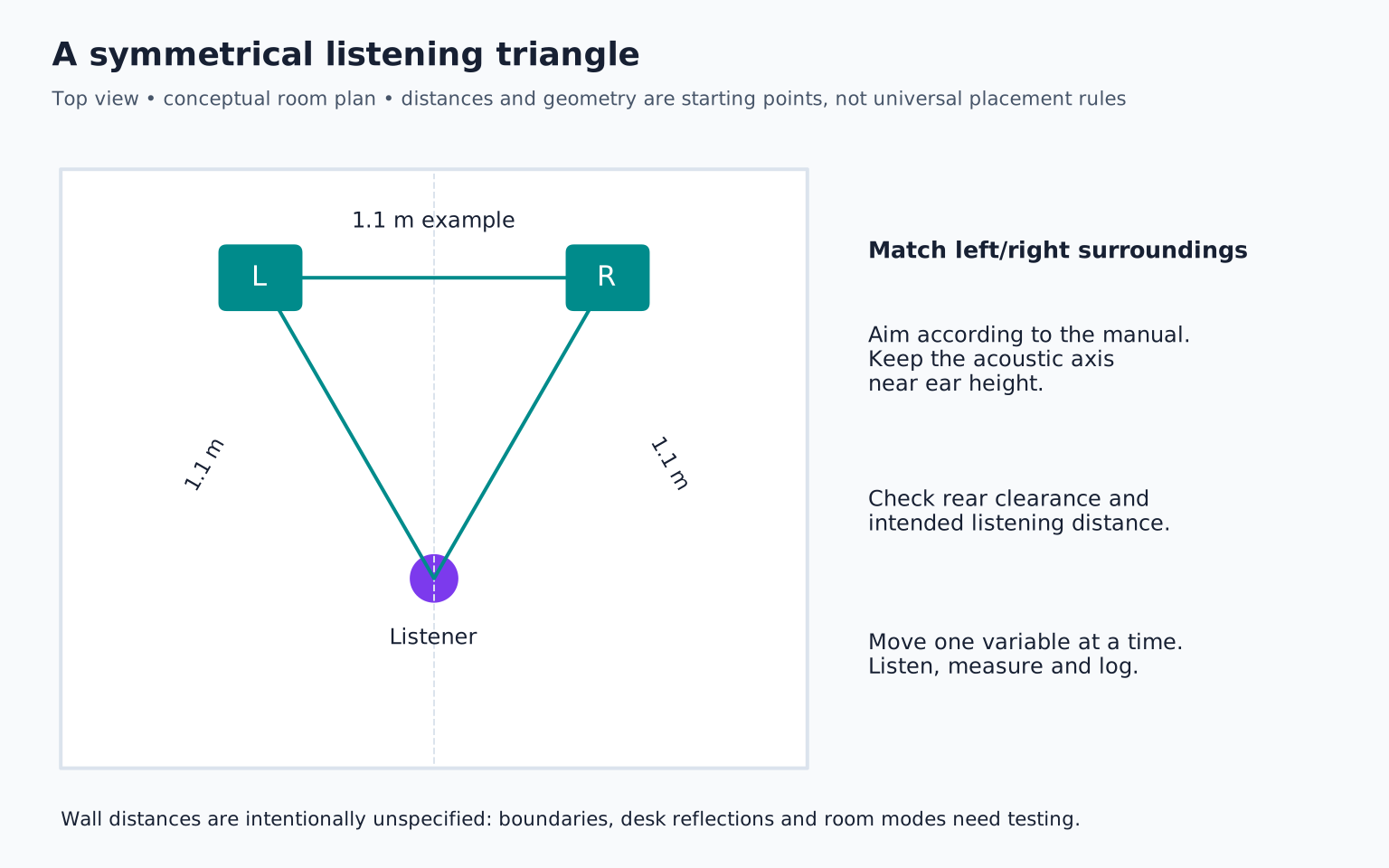
Start with left right symmetry. Place the two speakers at comparable distances from the side boundaries where practical. Sit on the centre line between them. Aim the speakers according to their manuals and use the manufacturer's intended listening axis and orientation.
A roughly equilateral triangle is a useful stereo starting geometry: the distance between speakers is similar to the distance from each speaker to your head. It is a starting point, not a guarantee of a smooth bass response. Furniture and room dimensions still matter.
Avoid making one speaker live in a corner while the other opens into a large adjacent space if another arrangement is possible. Keep the area between the speakers and your ears reasonably clear. A large screen or reflective desk can interfere with the direct sound.
Mark promising positions with removable tape. Measure changes so that “the old setup was better” can become a reproducible comparison. See monitor and seat positioning for a detailed procedure.
Treatment and isolation solve different problems
Acoustic treatment changes how sound behaves inside a room. Absorbers can reduce reflections and ringing. Soundproofing, more accurately called sound isolation, reduces transmission between spaces. It often involves construction, sealing, mass, and structural separation.
A handful of thin foam tiles will not reliably stop bass reaching a neighbour. Equally, sealing a door does not necessarily make the listening position more accurate. Before spending money, identify whether the complaint is “I cannot judge my mix” or “sound travels through the building.” You may have both problems, requiring different solutions.
Do not cover every surface by reflex. A room with very little treble reflection can still have uncontrolled low frequency ringing. The result may feel dull yet remain difficult to mix in. The treatment versus soundproofing guide explains how to separate these jobs.
Turn ear training into production decisions
You can practise hearing three things independently:
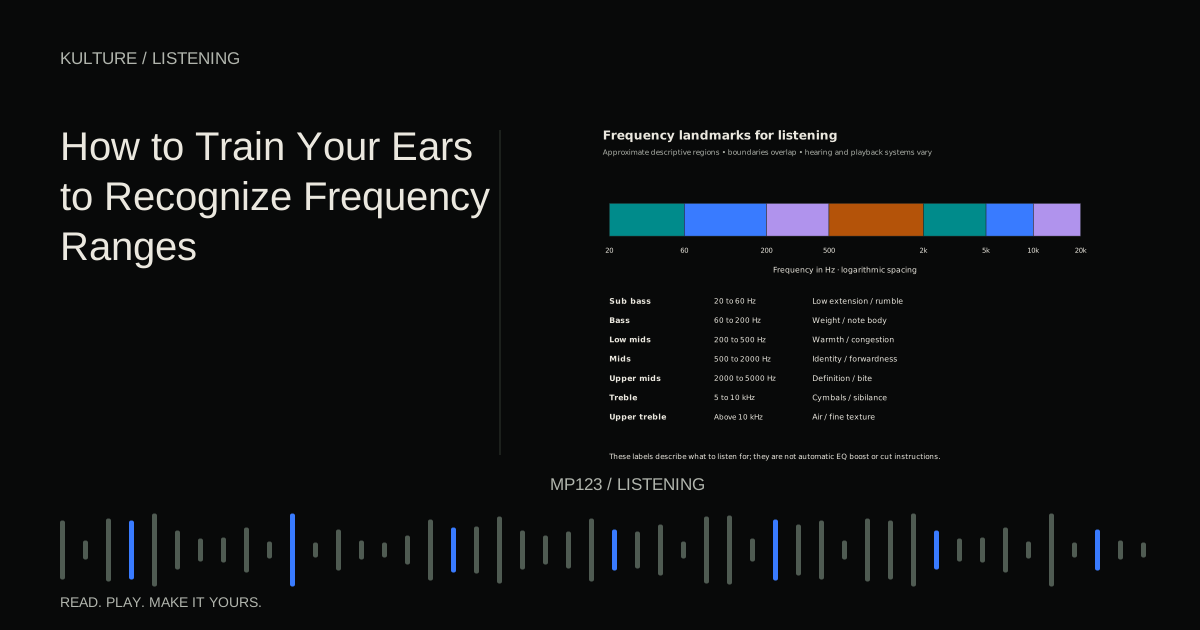
Frequency balance: Use a broad equalizer, or EQ, to make a small tonal change to a familiar recording. Can you describe the change without watching the control? Start with broad categories such as bass, low midrange, upper midrange, and treble.
Dynamics: Compare a short passage before and after gentle compression at matched output level. Listen for attack, sustain, and recovery. A compressor changes gain over time; its usefulness is not determined by how far a meter moves.
Space: Compare a dry instrument with the same instrument sent to reverb. Listen for the initial sound, the gap before the ambience, and the decay after the note stops. Then judge it in the arrangement rather than only in solo.
These exercises are more useful when you identify the smallest change you can reliably hear. Huge boosts teach recognition, but subtle changes are closer to everyday mixing.
A practical twenty minute listening session
Begin with two minutes of a familiar reference at a comfortable level. Listen to the overall balance without adjusting anything.
Spend five minutes on your own chorus. Write three observations maximum. For example: “The vocal becomes less clear when the pad enters,” “The kick is shorter than the bass,” and “The final cymbal cuts off.”
Choose one observation and spend five minutes testing it. To investigate the vocal, lower the pad briefly rather than immediately boosting the vocal's treble. If the words return, arrangement or masking may be the issue.
Spend three minutes comparing the changed and unchanged versions at similar levels. Then use another playback system for a short check. End by saving the version and documenting what changed. Leave unresolved questions for a fresh session rather than trying to solve them by turning up the volume.
Know when to stop listening
Your ears and attention are not measuring instruments with unlimited operating time. The World Health Organization's safe listening guidance links risk to sound level and exposure duration, recommends breaks, and advises professional help for persistent ringing or hearing difficulties. A software fader position is not a measurement of the sound level at your ears.
If everything starts sounding dull, harsh, or inexplicably wrong, take a quiet break. Do not compensate for fatigue by making increasingly large EQ moves. A good session can end with one well supported improvement rather than a dozen uncertain changes.
Your next exercise
Choose a sixty second passage and make a listening log with four headings: musical focus, frequency balance, dynamics, and space. Record one observation under each. Compare on speakers and headphones, marking which observations persist. Work first on the persistent problem that most affects the song. That is the beginning of reliable listening: a clear question, a controlled test, and a decision you can explain.
TAKE IT INTO YOUR OWN MUSIC
Your next session.
Begin with two minutes of a familiar reference at a comfortable level. Listen to the overall balance without adjusting anything.
Notes and progress stay in this browser.