Before processing either sound, listen to their timing, pitch content and duration. Many kick and bass conflicts begin in the arrangement.
Hear the difference in their jobs
A kick may include a click, a rapidly changing pitch and a low tail. A bass note usually has a more stable pitch that communicates harmony. However, a long 808 style kick can also function as bass, so the categories are not absolute.
Decide which sound supplies the deepest sustained weight in your track. If both have long, powerful low tails, they may compete. One option is a short punchy kick with a sustained bass. Another is a long tonal kick with a shorter, higher bass part.
Do not remove useful low end from one simply because a diagram says kick and bass must occupy separate frequency bands. Their spectra can overlap successfully when timing, level and musical function are compatible.
For the underlying distinction, see What Is an 808?.
TRY IT HERE
Give the bass some space
Tap steps to add rests. Change the register or slide.
Ready when you are. Audio starts only when you press Play.
Keep experimenting in the piano LabBuild a controlled comparison
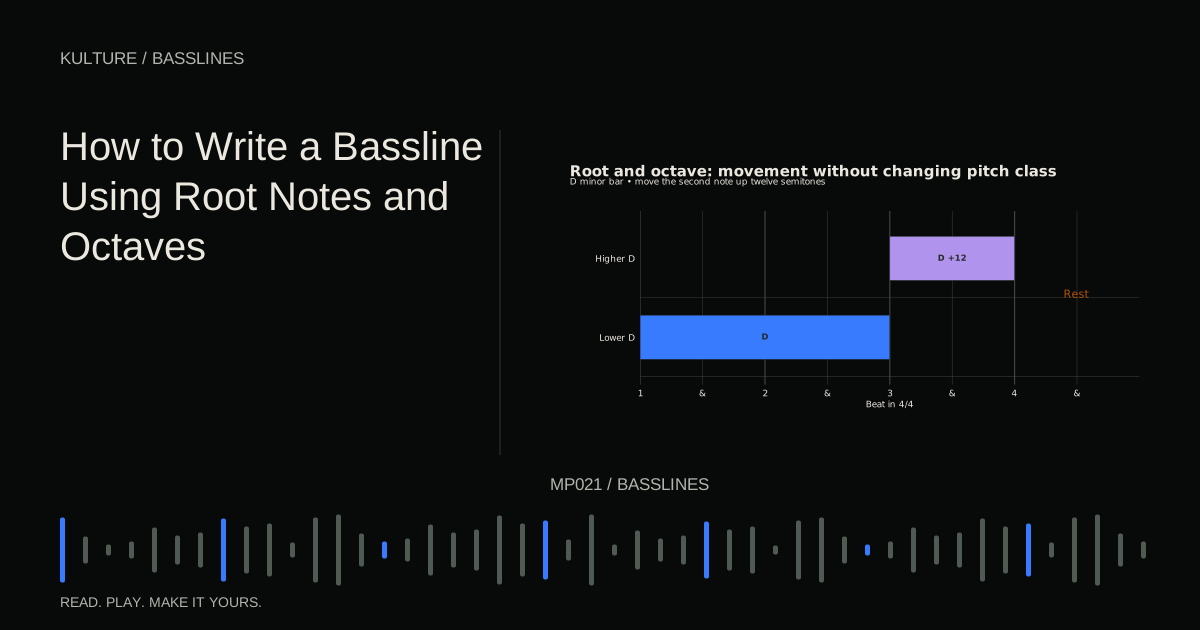
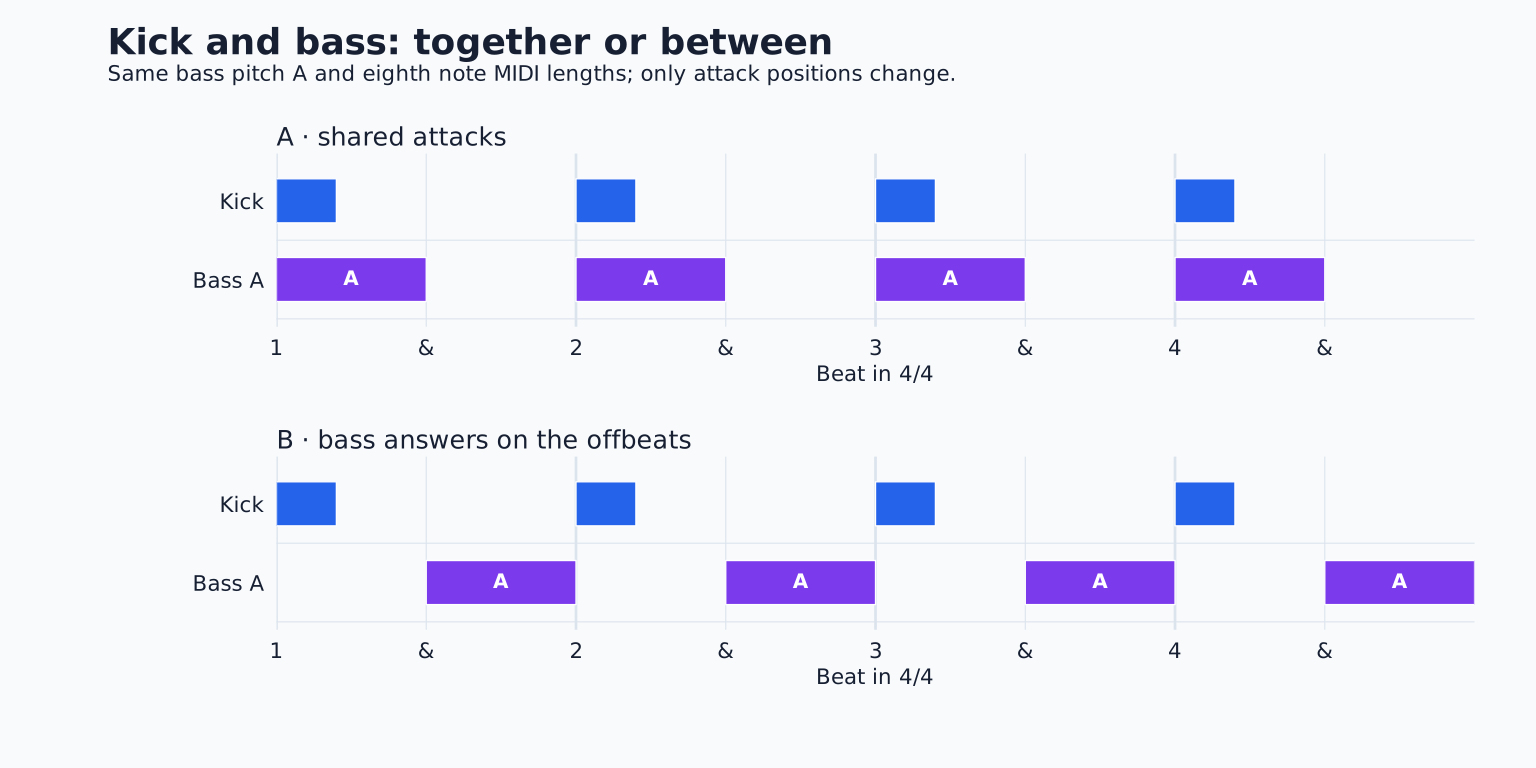
Create two bars at 120 BPM in 4/4. Put kicks on all four beats. Add a bass note on each beat, initially lasting an eighth note. Use one pitch, such as A, and a simple bass sound.
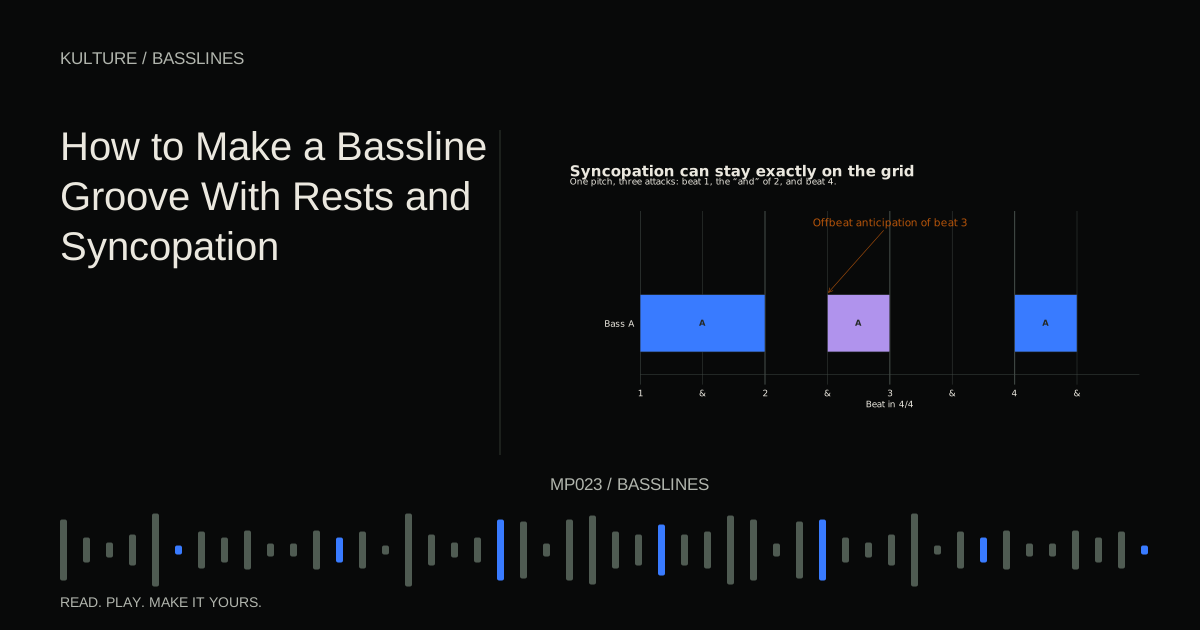
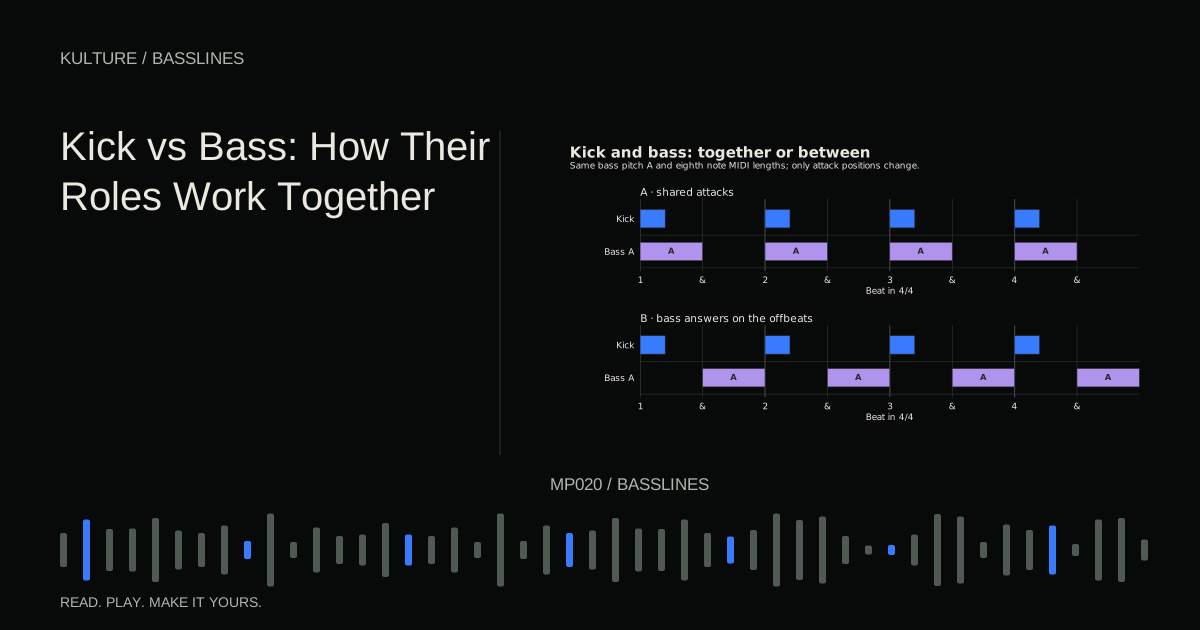
Version A has bass and kick attacks together. In version B, move the bass notes to the “and” after each beat. Keep their lengths and levels unchanged. Version A emphasizes combined attacks; version B creates a call and response pattern.
Neither is the correct version for every track. Listen for whether the kick retains its identity and whether the bass rhythm supports the intended movement. At this stage, avoid changing equalization or adding sidechain compression, so you can hear the arrangement difference clearly.
Note length determines overlap
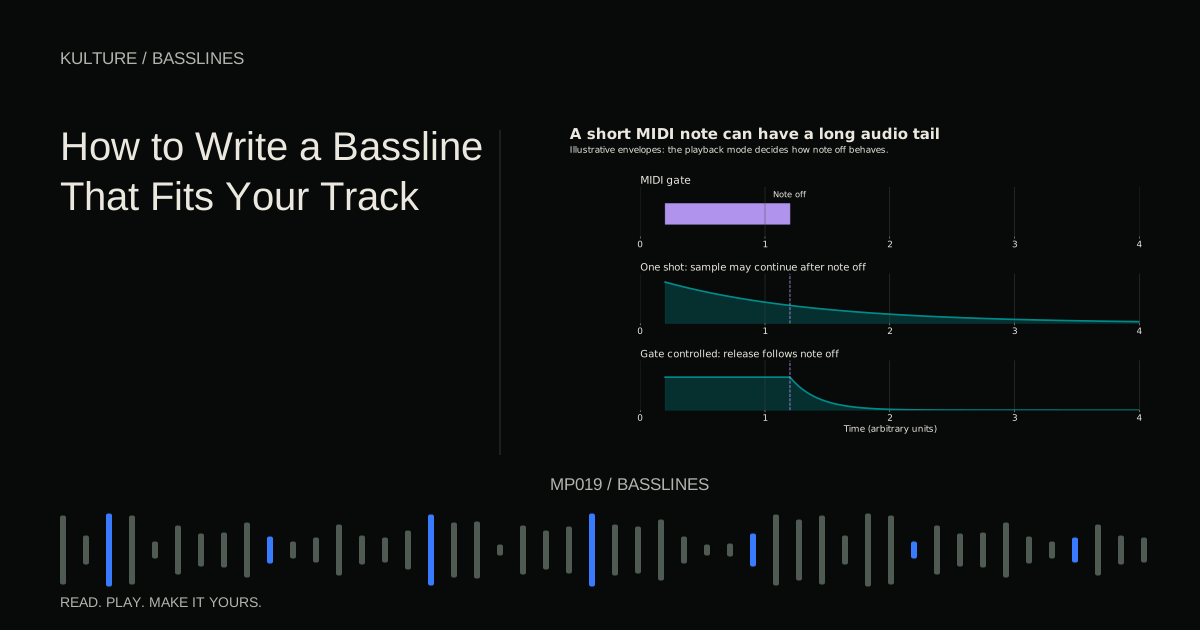
In version B, an eighth note bass beginning on an offbeat ends at the next beat in MIDI. But its release tail may continue into the next kick. Shorten the bass note or release slightly and compare.
At 120 BPM, an eighth note lasts 250 milliseconds. That provides a time reference, not a mandatory envelope setting. A fast staccato line and a slow legato line need different shapes, even at the same tempo.
If the kick's tail is also long, shorten it or try a different kick before aggressively cutting the bass. You are designing the combined low frequency envelope: when energy rises, how long it stays and when it clears.
A useful test is to mute the kick and then restore it. The combined part should gain an intentional impact, not merely a blurry increase in low frequency level.
Understand masking without chasing every overlap
Frequency masking means one sound makes another harder to perceive. Two low end parts may mask one another when their important energy overlaps in time and frequency. iZotope's frequency masking guide explains the concept and why arrangement context matters.
A spectrum analyzer can reveal where energy sits, but it cannot decide the musical hierarchy for you. A visible overlap is not automatically a problem. Ask whether the kick's attack disappears, the bass melody becomes hard to follow, or the low end changes unpredictably.
Try lowering one sound slightly before making narrow equalizer cuts. A level imbalance is often simpler than a complex spectral problem. Then try a different octave or articulation for the bass if the arrangement allows it.
Use equalization for a specific conflict
If both sounds remain crowded after timing and length edits, identify the region where one needs priority. You might reduce some bass energy around the kick's strongest body, or reduce excess low tail in the kick so a sustained bass note remains clearer.
There is no universal crossover frequency. The useful region depends on the samples, bass notes and desired character. Sweep an equalizer gently while listening in context, then use only as much reduction as the problem requires.
Check the full bass phrase, not one note. A bassline's fundamental changes with pitch, so an equalizer cut that helps one note may weaken another. If the conflict only happens at certain moments, dynamic processing may be more suitable than a permanent cut.
Sidechain compression is timed level control
A sidechain compressor can reduce the bass when the kick triggers its detector. The kick is the control signal; the bass is the sound being reduced. This can create subtle clearance or an obvious pumping effect.
For a starting experiment, place a compressor on the bass and select the kick as its external detector input. Use a fast enough attack to catch the relevant overlap, then adjust release so the bass returns naturally before its next important note. Begin with modest gain reduction and increase only if the desired groove needs it.
iZotope's kick and bass guide discusses separation approaches in this context. The controls and routing vary by plugin, so consult your compressor's manual rather than copying a menu path from another application.
If the bass seems to disappear, the release may be too long, the reduction too deep or the kick triggers too frequent. If it clicks or flutters, the gain change may be too abrupt for the low frequency waveform. Listen to the envelope, not only the meter.
Phase and polarity are not magic switches
When low frequency waveforms overlap, their relative phase affects the combined result. Polarity inversion flips the waveform's sign; it is not the same as a continuously adjustable phase alignment tool.
Try polarity inversion as a comparison if the combined low end becomes unexpectedly weak. But test several bass notes and repeated hits. A setting that improves one moment may not improve the entire phrase, especially when the bass changes pitch or oscillators begin at varying phases.
Avoid aligning every kick to every bass cycle by eye. It can change the groove, and the relationship may change again on the next note. Source choice, envelopes and purposeful separation are often more robust first steps.
Check the arrangement at realistic density
Add the chords, lead and percussion. A bass sound that needed extra harmonics in isolation may now crowd the midrange. A kick that seemed overly clicky alone may become appropriately clear once the track is full.
If the kick and bass work together but the mix still feels muddy, inspect low notes in pads, reverbs and other instruments. The problem may involve more than the two tracks you have been staring at.
Keep playback comfortable and compare at similar levels. Louder processing can disguise a loss of punch, so compensate output gain when auditioning changes.
A practical decision sequence
Work through one eight bar section in this order: choose roles, adjust levels, edit note timing, edit tails, then test equalization or ducking if necessary. Save a version before each major change.
For your exercise, make one simultaneous kick and bass groove and one alternating groove from the same sounds. Choose the stronger arrangement before adding processing. Then apply only the smallest corrective step needed. Continue with How to Make a Bassline Groove With Rests and Syncopation to solve more of the relationship through composition.
TAKE IT INTO YOUR OWN MUSIC
Your next session.
Work through one eight bar section in this order: choose roles, adjust levels, edit note timing, edit tails, then test equalization or ducking if necessary. Save a version before each major change.
Notes and progress stay in this browser.