A note being “in key” is useful information, but it does not guarantee that it will sound settled over every chord. The current harmony and the note's timing matter.
Make a chord tone map
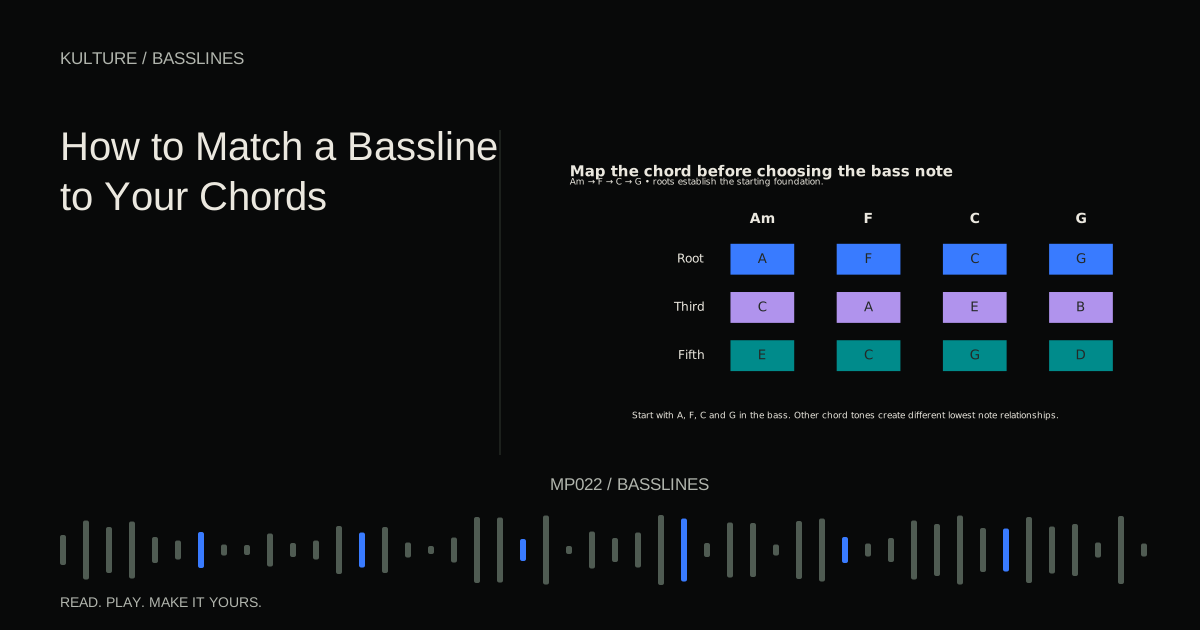
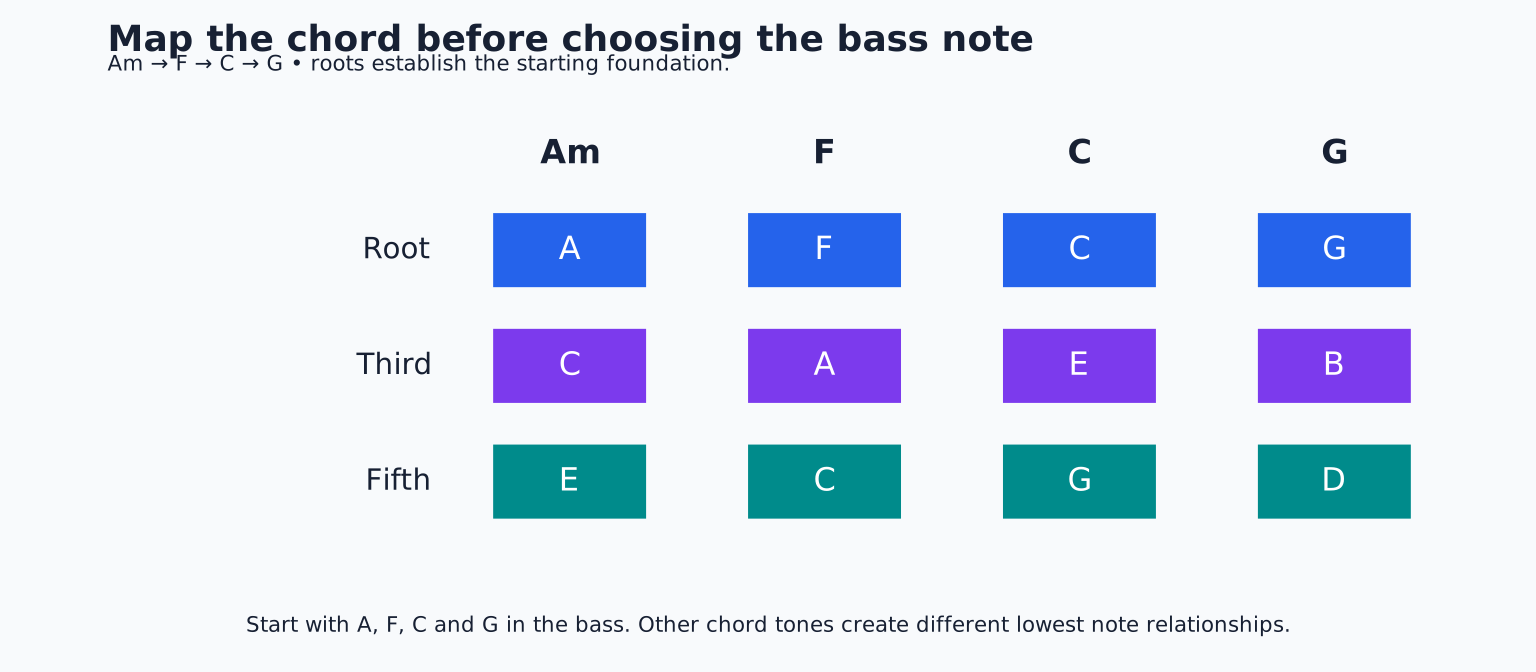
Use the progression Am, F, C, G. Write out its notes before programming bass:
| Chord | Root | Third | Fifth |
|---|---|---|---|
| Am | A | C | E |
| F | F | A | C |
| C | C | E | G |
| G | G | B | D |
These are chord tones: the notes that define each triad. Open Music Theory's triad chapter provides the formal construction reference. If the table is unfamiliar, work through How to Build Major and Minor Chords first.
All four chords use notes from the C major/A natural minor collection. However, B is a chord tone over G but not over F. Its effect changes when the harmony changes underneath it.
TRY IT HERE
Give the bass some space
Tap steps to add rests. Change the register or slide.
Ready when you are. Audio starts only when you press Play.
Keep experimenting in the piano LabEstablish roots on the arrivals
Create one chord per bar in 4/4. Put A, F, C and G in the bass on the first beat of their respective bars. Hold each for two beats and leave the rest empty.
The first beat is not always the most important place in every style, but it is a clear learning anchor. Listen to how the roots reinforce the chord changes. Then move the F bass note to beat 2 while the F chord still begins on beat 1. The harmony may briefly feel less grounded because its bass arrival is delayed.
You can use that delay deliberately, but first learn to hear it. Matching is not only choosing a pitch; it is choosing when that pitch confirms the chord.
Add fifths as contrasting chord tones
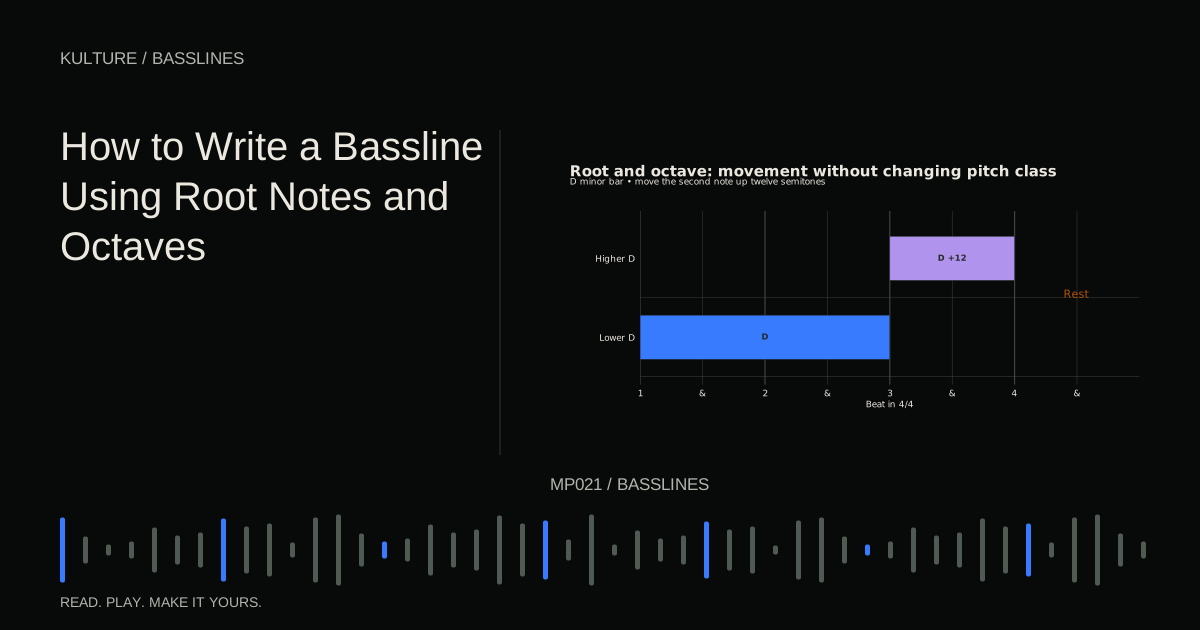
In each bar, place the fifth on beat 3 for one beat. The line becomes A, E, F, C, C, G and G, D. Keep the roots lower and choose nearby fifths rather than jumping unnecessarily across several octaves.
A fifth often gives useful movement without strongly changing the chord's major/minor identity. It is still a different bass note, though. If held under a full chord, it changes the lowest note relationship and can affect the sense of stability.
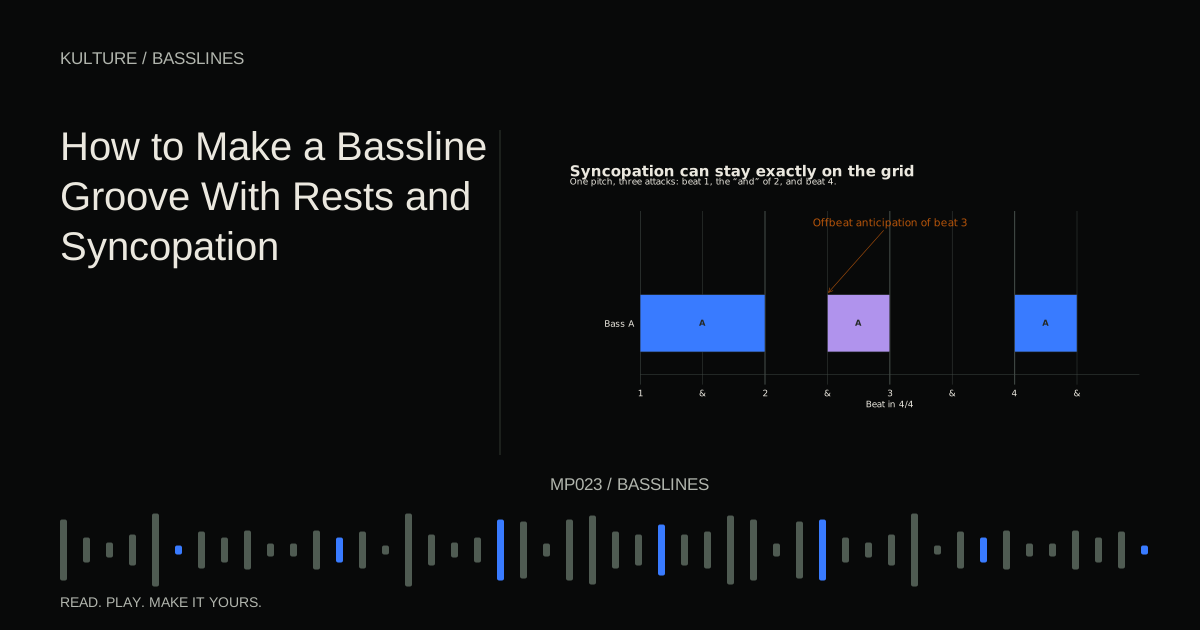
Now shorten the fifth to an eighth note and move it to the “and” of beat 3. It becomes more of a rhythmic answer than a new harmonic foundation. Duration and placement determine how much structural weight a note receives.
Use thirds with intention
Over Am, C is the minor third; over F, A is the major third. Try putting each third in the bass for a whole bar while keeping the original chord above it. You hear first inversion sonorities rather than simple root position harmony.
These can create smoother bass movement. For example, under C, G, Am, a bass line C, B, A uses the third of G in the middle, producing the common G/B relationship. The bass descends by step while the chord roots move differently.
Do not mistake the lowest note of an inverted upper chord for its root. A keyboard voicing E, G, C is still C major. Whether the overall texture has C, E or another pitch lowest depends on the bass part too.
For more on that distinction, see Chord Inversions and Voice Leading.
Connect anchors with passing notes
A passing note moves between more stable notes, commonly by step. Suppose the bass moves from F to G across a chord change. You can place a short F sharp immediately before G as a chromatic approach. It is outside C major, but its brief motion into G can make the destination clear.
Start with a simpler diatonic approach, using only scale notes. In the final G bar of Am, F, C, G, play G briefly on the last eighth note before the loop returns to A. That step into A can connect the phrase smoothly.
Then compare a G sharp approach into A. It creates a semitone pull but may clash with a sustained G major chord above it. Keep it short, consider leaving a gap in the upper chord, and judge whether the tension belongs in the track.
The rule is not “outside notes are fine if short.” The useful question is whether the listener can understand their destination and whether the resulting color fits the arrangement.
Anticipate a chord carefully
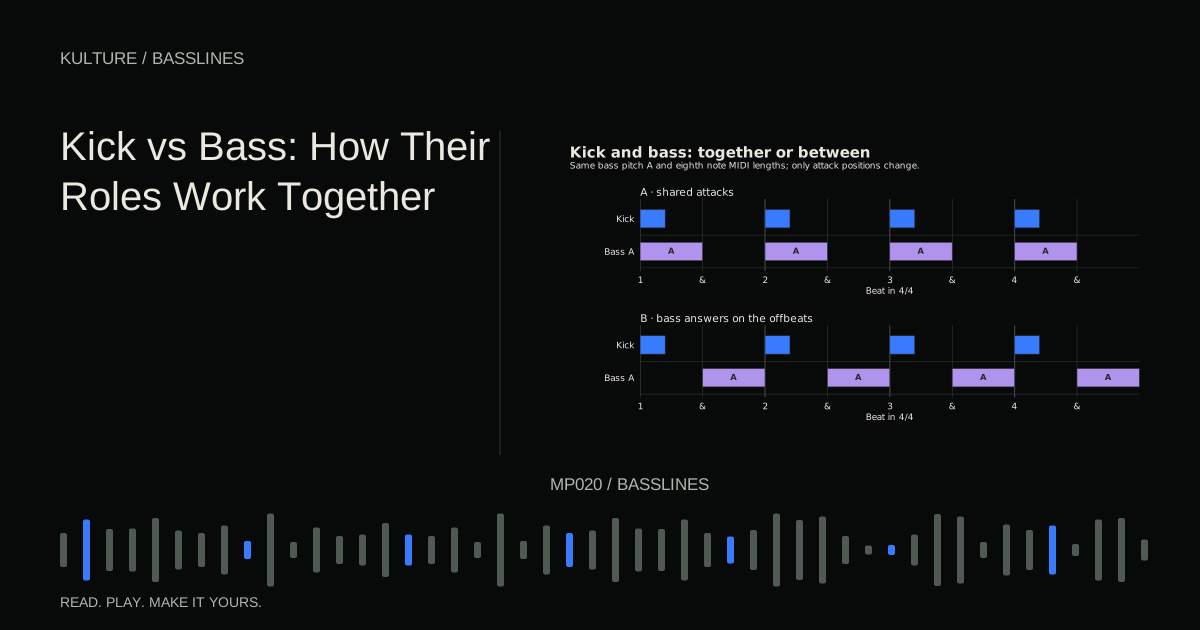
An anticipation plays the next harmony's note before the chord formally changes. Try starting the F bass on the “and” of beat 4 in the A minor bar, then holding it into the F bar.
This can pull the track forward. It can also create a brief F against Am color that changes the transition. Listen to the full chord and melody at that moment. If they sustain conflicting notes prominently, the anticipation may feel heavier than intended.
A clean way to test it is to shorten the A minor chord before the early F. Then compare with the chord held through. The same bass note can feel like a smooth lead in in one arrangement and a deliberate dissonance in another.
Check what happens when chords change under a held bass
A repeated or sustained bass note beneath changing harmony is often called a pedal tone or pedal point. It can create continuity and tension. For example, hold A beneath Am, F, C, G and listen to how the same bass pitch changes function.
A is the root of Am, the third of F, an added sixth against C, and a different color against G. It is not equally settled in every bar. This is why copying one bass note through an entire progression should be an intentional decision, not a shortcut assumed to be harmonically neutral.
If you like the pedal effect, arrange around it. If you want each chord to feel clearly grounded, return to the roots at important points.
Troubleshoot an apparently wrong note
First, play the bass with a plain piano sound. If the pitch relationship is correct there, inspect the original instrument's tuning, sample root or pitch modulation. A long 808 with a falling attack can also make pitch identification less obvious.
Second, solo the bass with only the current chord. Remove melody and effects temporarily. Is the problem a specific note, a long overlap, or the timing of the chord change?
Third, try three edits separately: move the note by an octave, shorten it, or replace it with the root. If only shortening helps, the pitch may be useful as a passing event but too strong as an anchor.
Ableton's bassline playground can help you compare simple pitch patterns outside a dense mix.
Write one deliberate eight bar line
Use Am, F, C, G twice. On the first pass, play roots and fifths. On the second, add one third based inversion and one brief approach note. Mark which notes are anchors and which are transitions in your own notes.
Listen through the bar lines and remove any transition that distracts from the chord movement. Then continue with Rests and Syncopation so your harmonically correct line also has a clear rhythmic personality.
TAKE IT INTO YOUR OWN MUSIC
Your next session.
Use Am, F, C, G twice. On the first pass, play roots and fifths. On the second, add one third based inversion and one brief approach note. Mark which notes are anchors and which are transitions in your own notes.
Notes and progress stay in this browser.