Before adding more notes, decide where the bass should leave space. The gaps often explain the rhythm as strongly as the sounds.
Start with a deliberately plain pattern
Set a project to 100 BPM in 4/4. Use one bar of A notes on beats 1, 2, 3 and 4, each lasting one beat. Add a kick on beats 1 and 3 and a snare on 2 and 4.
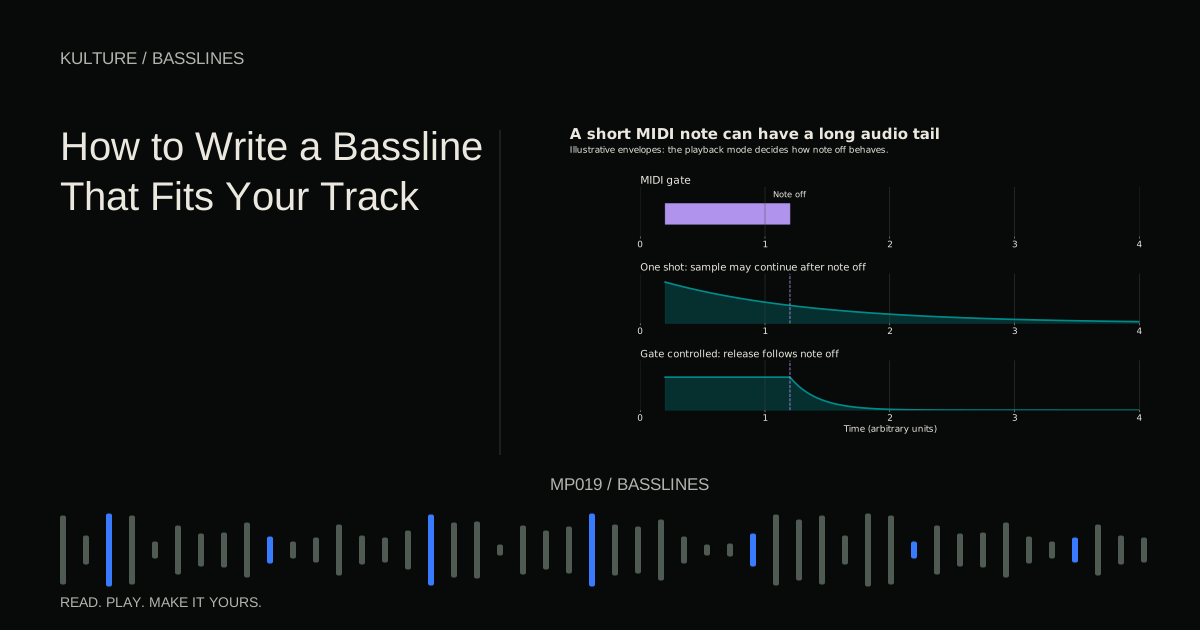
This gives you a stable baseline. Use a bass patch that stops reasonably quickly after note release. If the sound ignores MIDI length and plays a complete sample, change to a suitable envelope controlled mode before testing rests.
Ableton's bassline lesson offers an interactive reference for low melodic patterns. For counting subdivisions, see Beats, Bars and BPM.
TRY IT HERE
Give the bass some space
Tap steps to add rests. Change the register or slide.
Ready when you are. Audio starts only when you press Play.
Keep experimenting in the piano LabHear a rest as part of the phrase
Delete the bass note on beat 2. Leave everything else unchanged. The snare now arrives with less bass activity beneath it. Restore that note and instead delete beat 4. The gap leads into the next bar rather than opening the middle of the bar.
These two versions have the same number of notes, but their phrasing differs. A rest has a location and a duration, not merely an absence of effort.
Now shorten all remaining bass notes to eighth notes. The pattern becomes more articulated. If you still hear continuous bass, the release is too long for this exercise or the sample is not following note off messages.
Do not judge the result by the editor alone. Listen for actual silence, or at least a meaningful reduction in energy, between attacks.
Move an attack to an offbeat
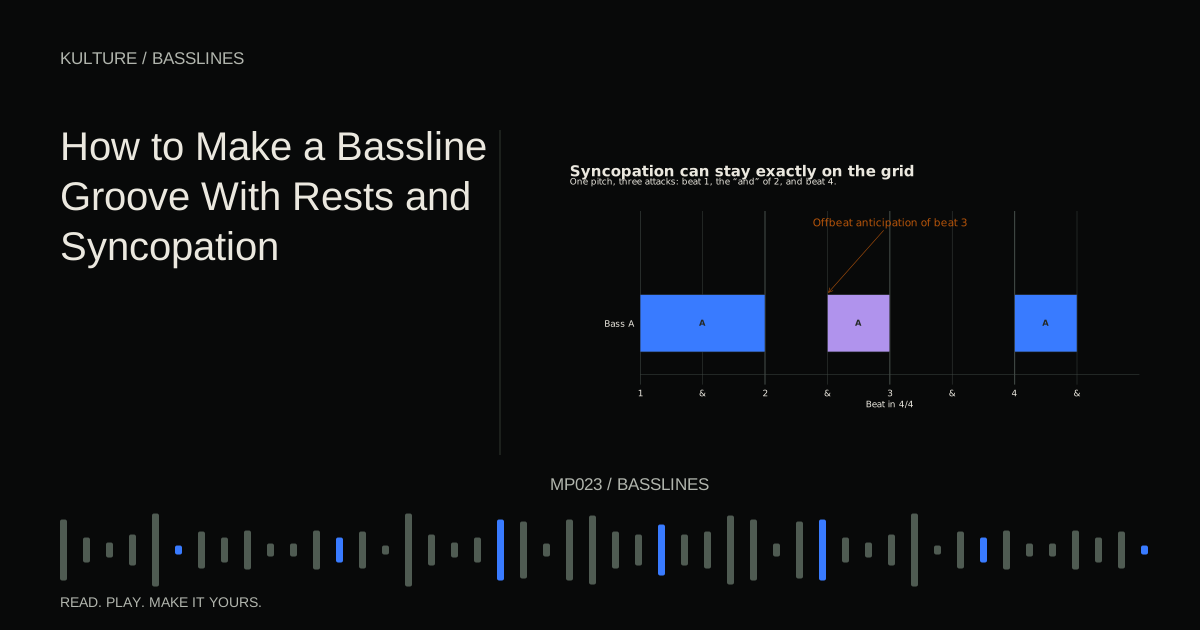
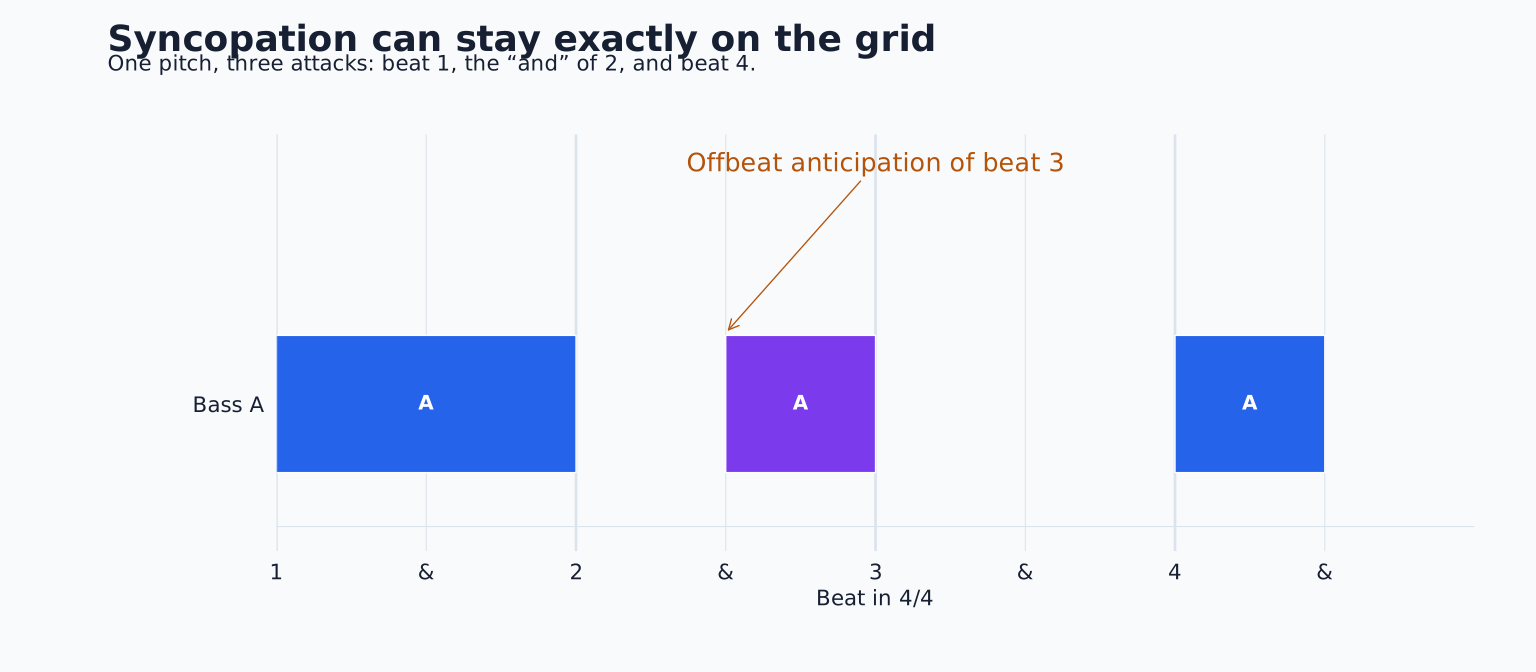
Put an A on beat 1 for one beat. Put the next A on the “and” after beat 2 for half a beat. Add a final A on beat 4 for half a beat.
Count “1 and 2 and 3 and 4 and.” The middle attack occurs between main beats. If it is emphasized relative to the surrounding pulse, it creates syncopation. The notes can remain perfectly aligned to the grid; syncopation does not require loose timing.
Compare that middle note on beat 3 instead. The syncopated version anticipates beat 3, while the straight version lands on it. Listen to whether the kick on beat 3 feels like a reply or a shared accent.
Use note endings to create different grooves
Keep the same three attack positions, but change their lengths. Version A uses short eighth notes. Version B holds the first note until just before the second attack. Version C lets the offbeat note continue across beat 3.
The attack rhythm is identical, but the perceived motion changes. Sustaining across a strong beat can reinforce syncopation because the sound begins earlier and carries through the expected accent. Short notes produce a more detached, percussive feel.
This is one reason copying note starts from a reference is not enough to reproduce its groove. Articulation, meaning how notes begin and end, is part of the performance.
Put the kick and bass in conversation
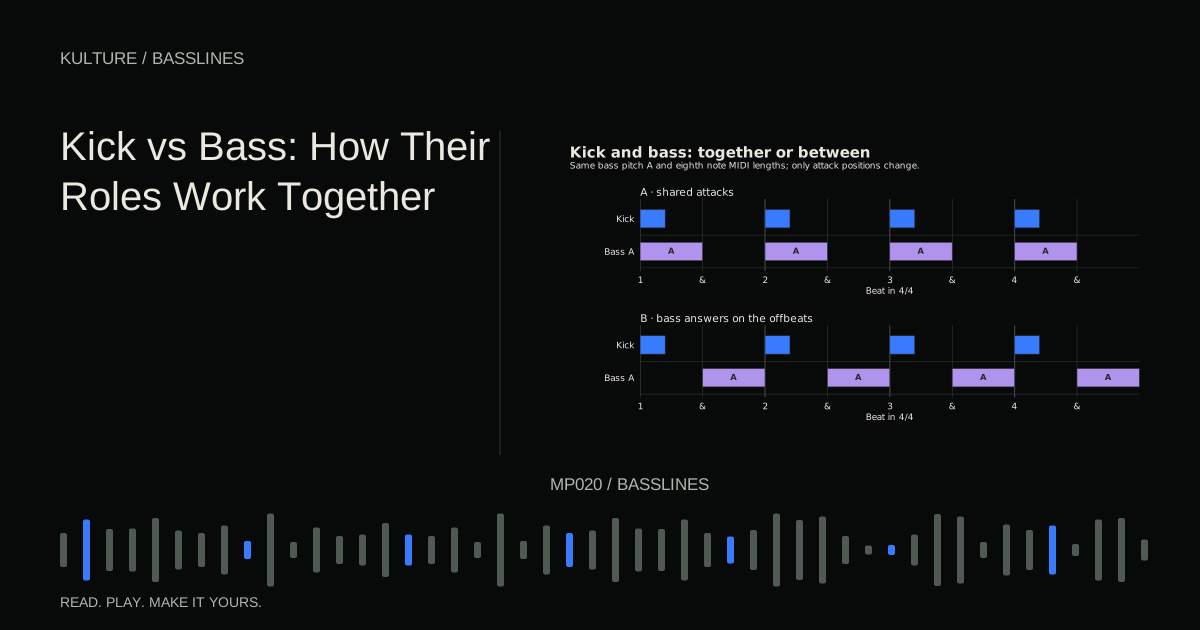
Try two approaches. In the first, the bass attacks with the kick on beat 1, then answers between kicks. In the second, remove the beat 1 bass attack and begin on the “and” after beat 1.
The delayed entry can feel light or propulsive, but it may weaken the harmonic arrival if the chord changes at the bar line. You can preserve clarity by keeping the first bar's root on beat 1 and using the delayed version in the second bar.
Do not force every kick to have a matching bass note. Equally, do not assume every overlap is bad. Some grooves depend on the combined attack. Kick vs Bass explains how their sound shapes influence the result.
Build a two bar question and answer
Use this original pattern on one pitch:
| Bar | Attack positions | Suggested durations |
|---|---|---|
| 1 | Beat 1; and of 2; beat 4 | One beat; half beat; half beat |
| 2 | Beat 1; and of 3 | One beat; half beat |
Bar 1 has three attacks, while bar 2 leaves more room. The second bar answers the first through subtraction. Repeat the pair and listen to the longer phrase.
Now add a short pickup on the “and” of beat 4 in bar 2. It leads back toward the first bar. Keep or remove it based on how strongly you want the loop to pull forward.
If every phrase ends with a pickup, the effect can become predictable. Leaving the final gap occasionally can make the next downbeat feel stronger.
Add pitch only after the rhythm works
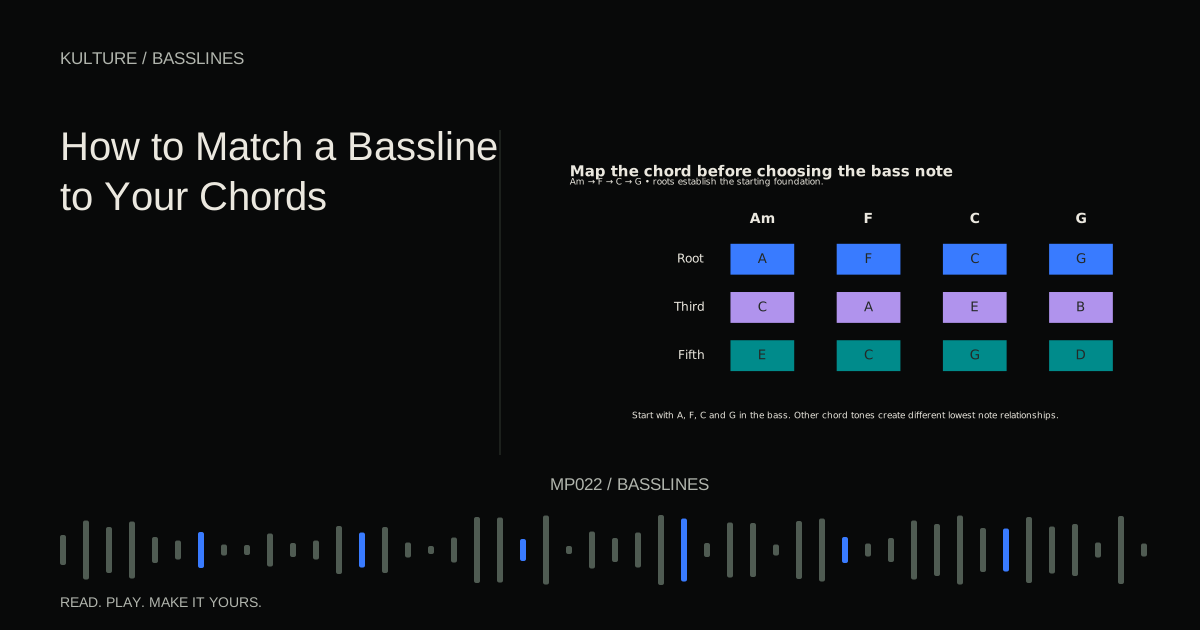
Move the same rhythm through Am, F, C, G using the roots A, F, C and G. Keep the attack positions unchanged. The harmony now changes, but the rhythmic identity stays recognizable.
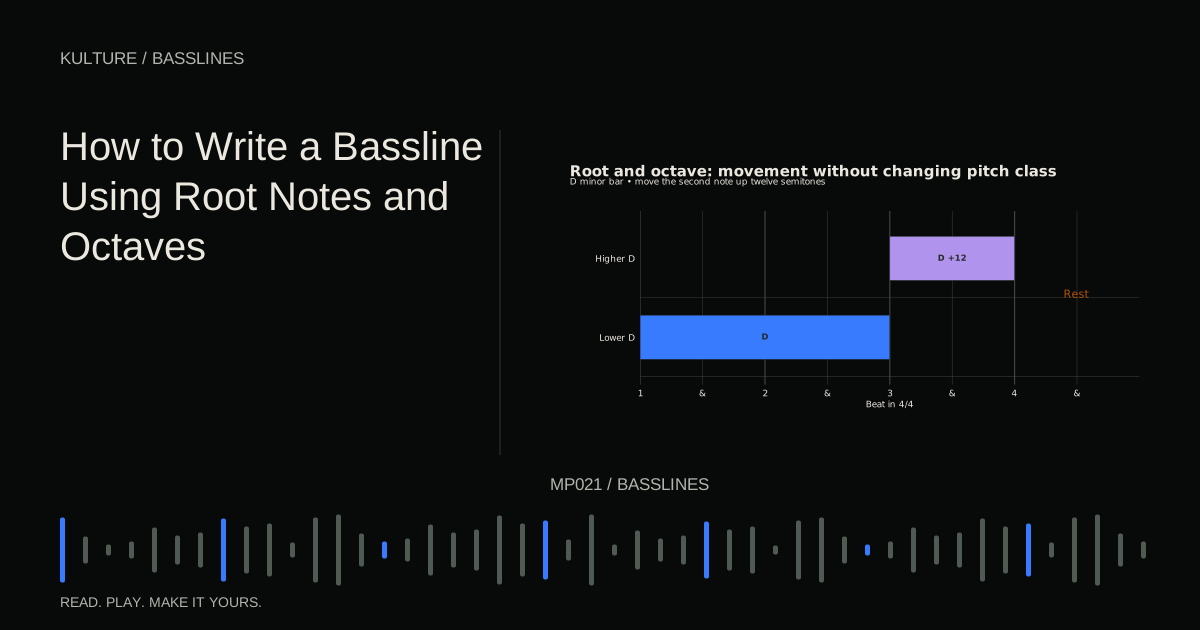
Add an octave to only one short offbeat note. If that makes the gesture too prominent, return it to the lower register. A higher note often attracts more attention, so pitch variation can unintentionally alter the accent pattern.
If the line feels busy after adding chords, remove a bass event. The arrangement has gained harmonic information, and the bass may no longer need as much rhythmic activity to keep the listener engaged.
Distinguish swing from syncopation
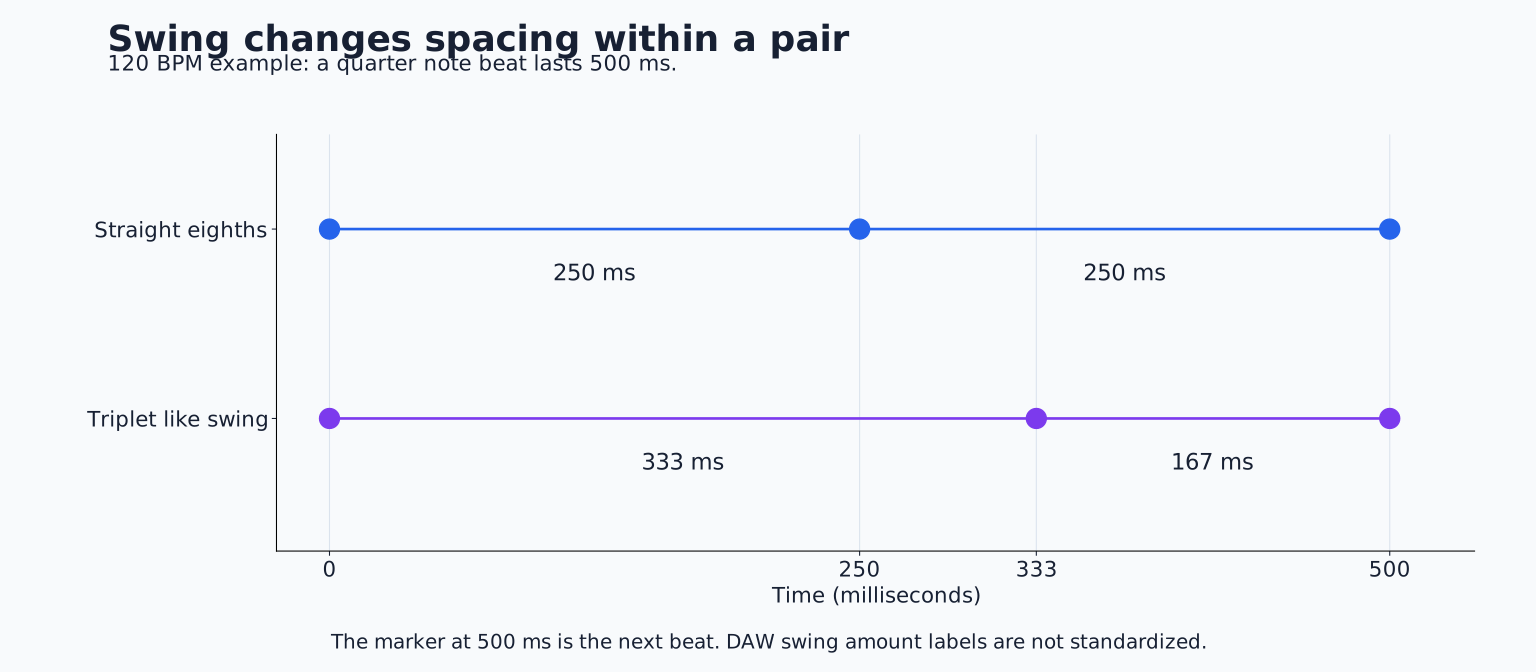
A syncopated note can sit exactly on a straight eighth note offbeat. Swing changes the spacing within repeated subdivisions. You can have straight syncopation, swung syncopation, or swing with relatively simple accent placement.
Try a small swing amount only after choosing the pattern. Check whether the bass follows the same feel as the hats. If the bass and drums seem to disagree, reduce the swing or apply a related timing pattern to the supporting lane.
Ableton's groove documentation is a useful reference for separating timing changes from velocity changes. Do not assume a percentage from one application means the same timing in another.
Fix the common problems
If the line feels rushed, remove pickups or move one attack back to a main beat. If it feels sluggish, shorten a long note or place a brief anticipation before an arrival. If it feels choppy, connect one pair of notes rather than lengthening everything.
If rests do not create enough contrast, check reverb, delay and release tails. Those effects may fill the gaps you intended to hear. If the pattern feels unpredictable, repeat its main gesture more consistently before adding variation.
If the bass conflicts with a vocal, try placing its busiest moments between vocal phrases. Groove is an arrangement relationship, not a property you can fully judge with one track soloed.
A one note groove exercise
Write four versions of a two bar A bassline using no more than five attacks per version. Change only attack positions and durations. Choose the best version with drums, then move it through your chord roots.
Finally, delete one note from the chosen pattern and compare. Keep the deletion if it makes the remaining accents clearer. Continue with Why Your Bassline Sounds Boring when you need phrase development rather than a denser basic groove.
TAKE IT INTO YOUR OWN MUSIC
Your next session.
Write four versions of a two bar A bassline using no more than five attacks per version. Change only attack positions and durations. Choose the best version with drums, then move it through your chord roots.
Notes and progress stay in this browser.