A track can have low peaks and still sound dense, or tall peaks and a relatively quiet average. Understanding that distinction helps you avoid mastering by one number.
Begin with full scale
In digital audio, dBFS means decibels relative to full scale. For conventional fixed point PCM audio, 0 dBFS represents the maximum available sample level. Negative numbers indicate levels below that reference.
This is not a measure of sound pressure at your ears. A file peaking at -1 dBFS can play quietly or dangerously loudly depending on the amplifier, speakers, headphones, and volume setting. Do not use a DAW meter as a hearing exposure meter.
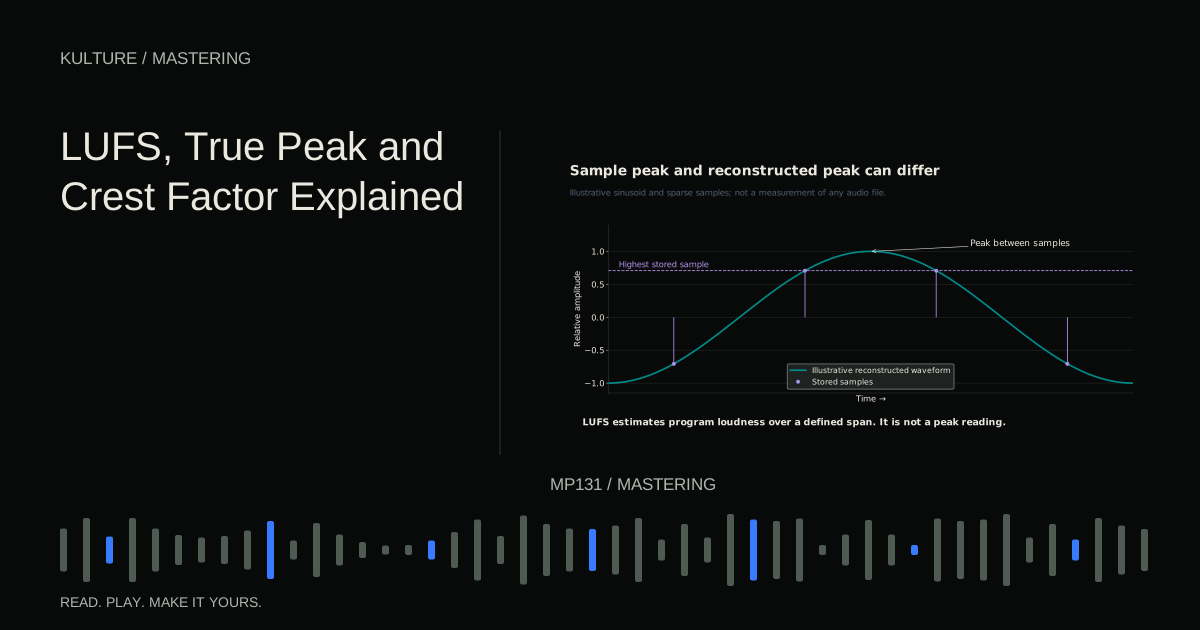
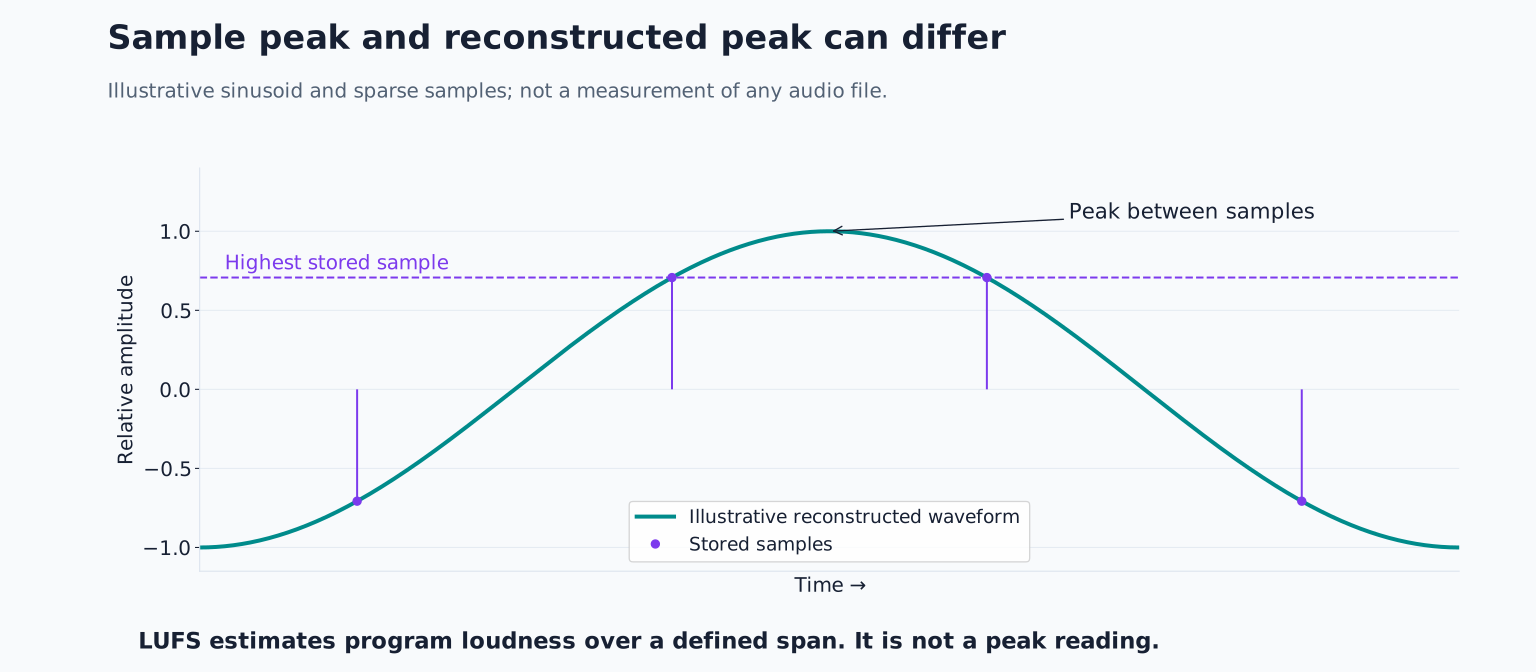
A sample peak meter looks at stored sample values. The waveform reconstructed between those samples can reach a higher level. That is the reason true peak measurement exists.
TRY IT HERE
Explore the transfer curve
See how threshold and ratio change a steady input level.
Ready when you are. Audio starts only when you press Play.
Keep experimenting in the stem splitter LabWhat true peak tells you
True peak, often displayed as dBTP, estimates peaks of the reconstructed continuous signal rather than only inspecting individual samples. Implementations typically use oversampling or related reconstruction methods to estimate those intervening values.
ITU R BS.1770 defines standardized algorithms for loudness and true peak measurement. Different meter quality and settings can affect the precision of the estimate, so use a trustworthy meter and the required delivery method.
A file whose sample peaks remain below zero can still have true peaks closer to or above zero. Lossy encoding can also alter peaks. This is why delivery guidance often specifies true peak headroom rather than simply asking that samples do not clip.
True peak does not identify every type of distortion. A distorted guitar can have low true peaks, and an overcompressed mix can remain safely below its ceiling. The meter reports level, not artistic or technical innocence.
What LUFS tells you
LUFS stands for loudness units relative to full scale. Its purpose is to estimate perceived program loudness more usefully than peak measurement alone. It includes frequency weighting and channel treatment rather than counting the tallest sample.
Common displays include momentary, short term, and integrated loudness. Momentary reacts over a short window; short term provides a somewhat slower view; integrated summarizes the measured program using the method's gating behaviour. Check your meter's documentation for its exact display implementation.
Integrated loudness is meaningful only when you know what was measured. A reading from the loudest chorus is not the integrated loudness of the whole song. Reset the meter and play the complete intended program when you need a full track value.
If an unchanged signal is attenuated by 3 dB, its measured loudness will ordinarily fall by about 3 LU, subject to measurement span and gating effects. LU is a relative loudness difference; LUFS is an absolute reading relative to full scale.
Why two equal LUFS songs can feel different
Loudness measurement is useful, but musical perception depends on more than the summary value. Spectral balance, transient shape, arrangement, and listening level affect the experience.
A bright, dense guitar track and a sparse bass heavy piece may share an integrated number while drawing attention differently. One may contain a long quiet introduction and a very loud chorus. Another may remain steady throughout.
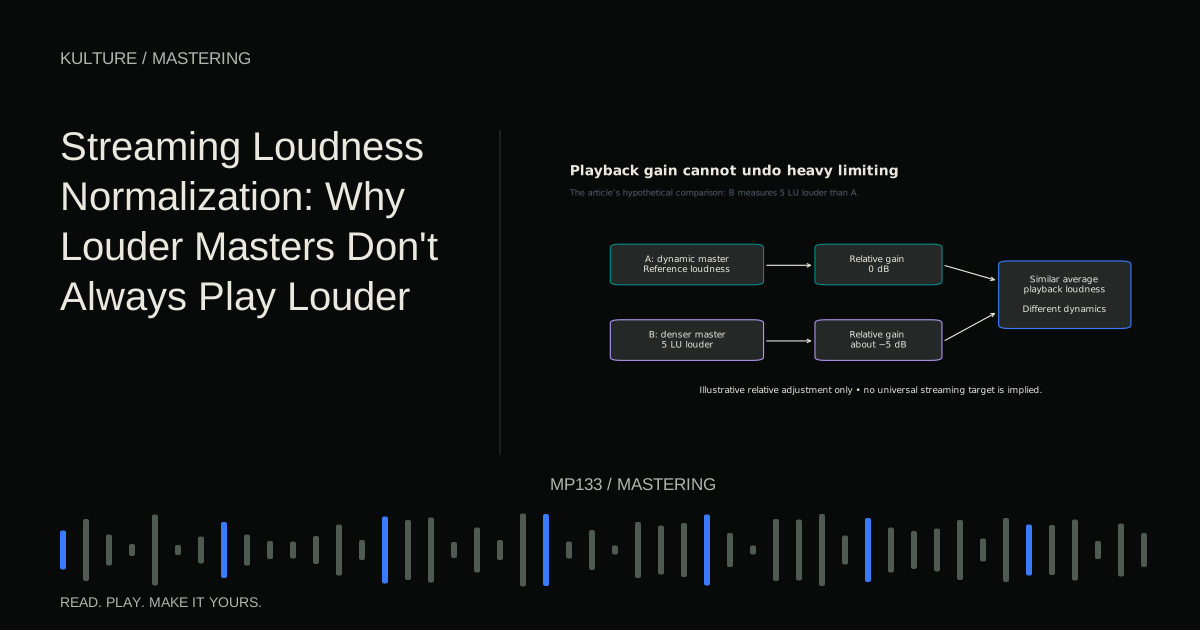
Inspect short term behaviour and listen to comparable sections. Do not force the whole song into a target by flattening every contrast. See streaming normalization for how playback adjustment interacts with the master.
Crest factor measures peak to average relationship
Crest factor is commonly the difference in decibels between a peak amplitude and RMS amplitude measured over a defined interval. RMS means root mean square, an average related measure of signal magnitude.
For a simple illustration, if a signal's peak is -2 dBFS and its RMS level over the same chosen span is -14 dBFS, the crest factor is 12 dB. This says the peak sits 12 dB above that average measure.
Meter conventions matter. Some RMS displays use calibration offsets, and peak definitions or time windows can differ. Compare results from the same method rather than assuming every plugin's crest factor number is interchangeable.
Do not confuse crest factor with peak to loudness ratio, often abbreviated PLR. PLR compares a peak measure with a loudness measure such as integrated LUFS. It can be useful, but LUFS and RMS are not identical quantities.
A practical three version experiment
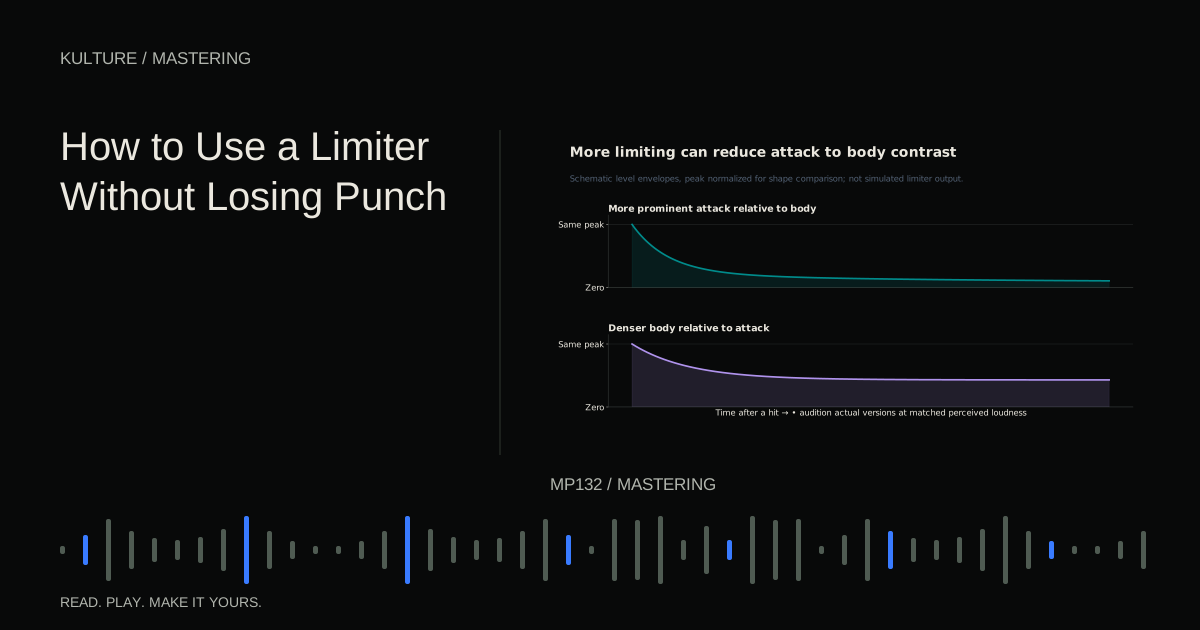
Create a short drum and bass loop with clear kick and snare attacks. Export an unprocessed version. Make a second version with moderate limiting and a third with much heavier limiting. Keep the output ceiling consistent for the experiment.
Measure each version over the same span. The heavily limited version will often show a higher average loudness and a smaller peak to average difference. Now lower its playback gain until it matches the unprocessed version's perceived loudness.
Listen to the snare's leading edge and the bass between hits. Has the stronger limiting made the groove more exciting, or merely denser? Does the kick still feel separate? The numbers explain part of the change, but the musical comparison determines whether it helped.
FabFilter's limiter documentation illustrates how timing and lookahead affect transient handling. Other limiters use different designs, so do not transfer settings blindly.
Use the meters to answer specific questions
Use integrated LUFS when checking a complete delivery or comparing overall program loudness. Use short term readings to inspect section to section behaviour. Use true peak to check a ceiling and conversion headroom. Use crest factor or PLR to describe aspects of dynamics, with the method clearly identified.
None of these creates a universal mastering target. A streaming recommendation, a broadcast specification, and an artistic preference are different things. Follow the actual destination requirement while preserving the intended music.
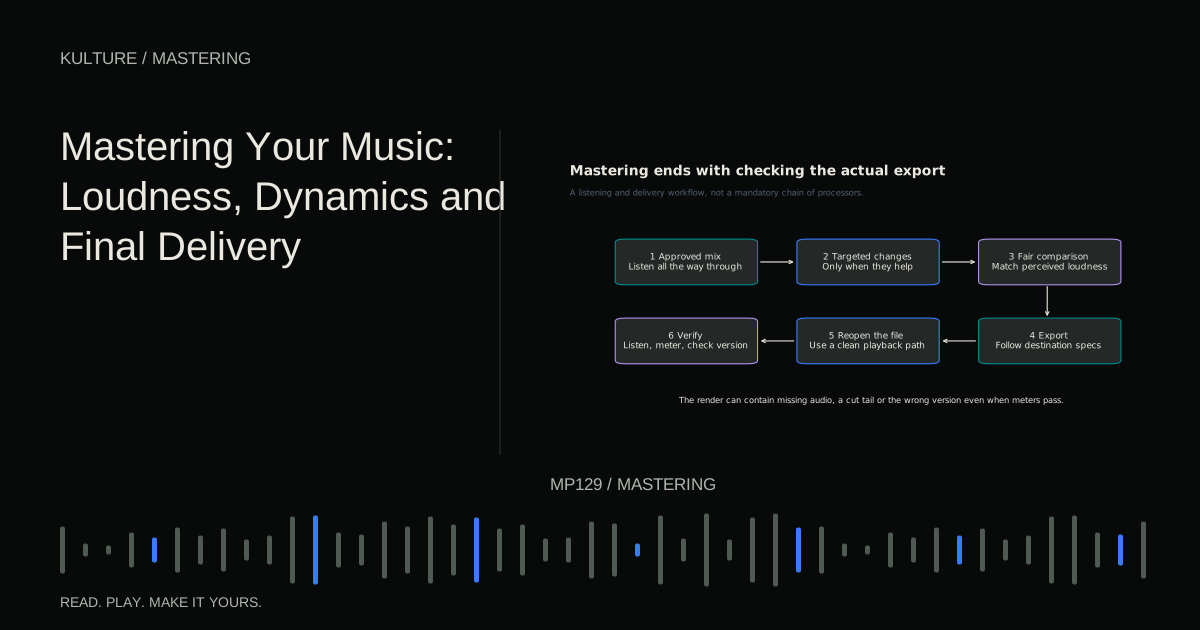
For your exercise, measure one verse and one chorus separately, then the whole track. Record the span and meter mode beside every number. Explain why the results differ before making a change. Continue with limiting without losing punch to apply the measurements to a real decision.
TAKE IT INTO YOUR OWN MUSIC
Your next session.
Create a short drum and bass loop with clear kick and snare attacks. Export an unprocessed version. Make a second version with moderate limiting and a third with much heavier limiting. Keep the output ceiling consistent for the experiment.
Notes and progress stay in this browser.