Normalization does not mean all recordings sound identical, and it does not establish one universal mastering target. Services, playback modes, devices, and user settings differ. Master for the intended sound and delivery requirements, then understand what playback adjustment may do.
Separate the master from the playback gain
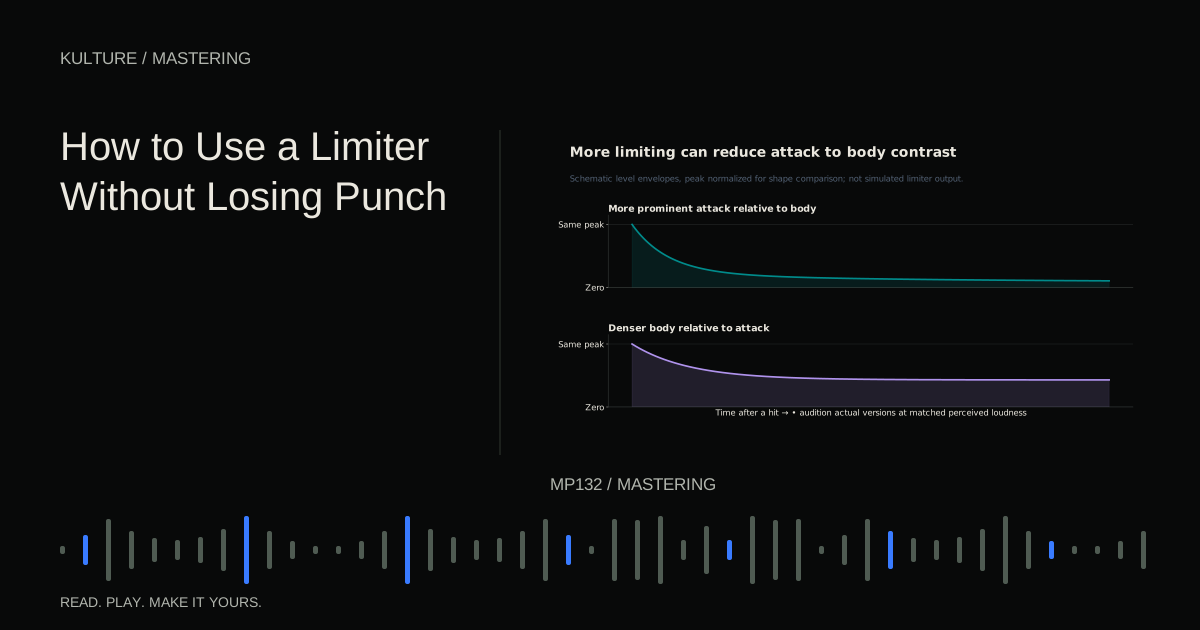
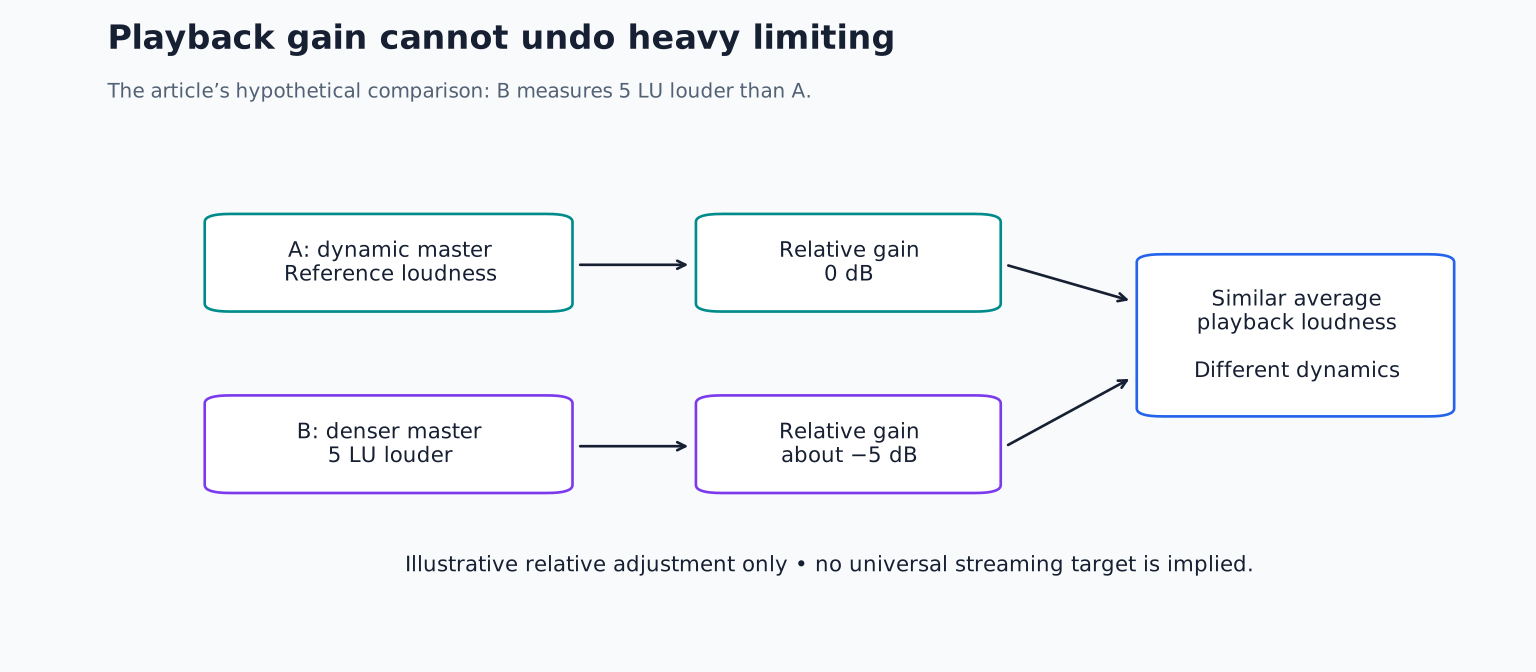
The master is the audio you deliver. Playback gain is an adjustment made when it is played. Turning a loud master down does not reverse compression, restore clipped peaks, or lengthen a kick attack that was flattened during mastering.
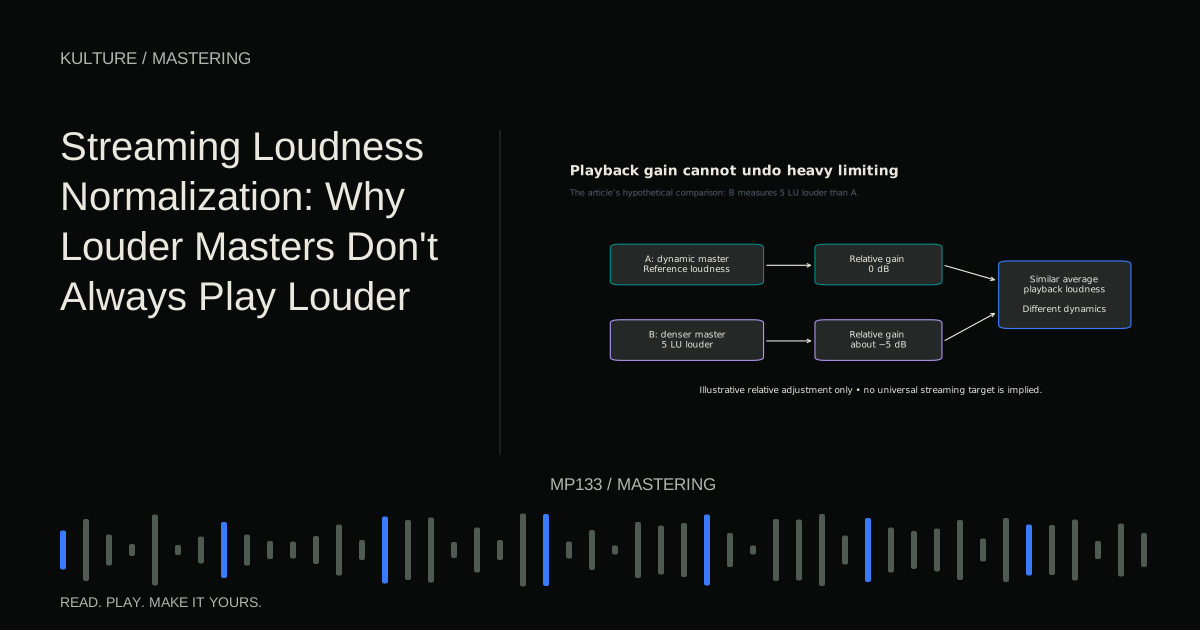
Imagine two versions of a song. Version A is more dynamic; version B has been limited harder and measures 5 LU louder. If playback normalization lowers B by about 5 dB relative to A, their average loudness may become similar. B still has its altered transient shape and density.
That is why a loudness advantage can disappear while the processing cost remains. It does not follow that all limiting is bad. Dense, controlled dynamics can be an intentional part of a sound. The point is to choose that sound consciously.
TRY IT HERE
Explore the transfer curve
See how threshold and ratio change a steady input level.
Ready when you are. Audio starts only when you press Play.
Keep experimenting in the stem splitter LabUnderstand what the loudness number represents
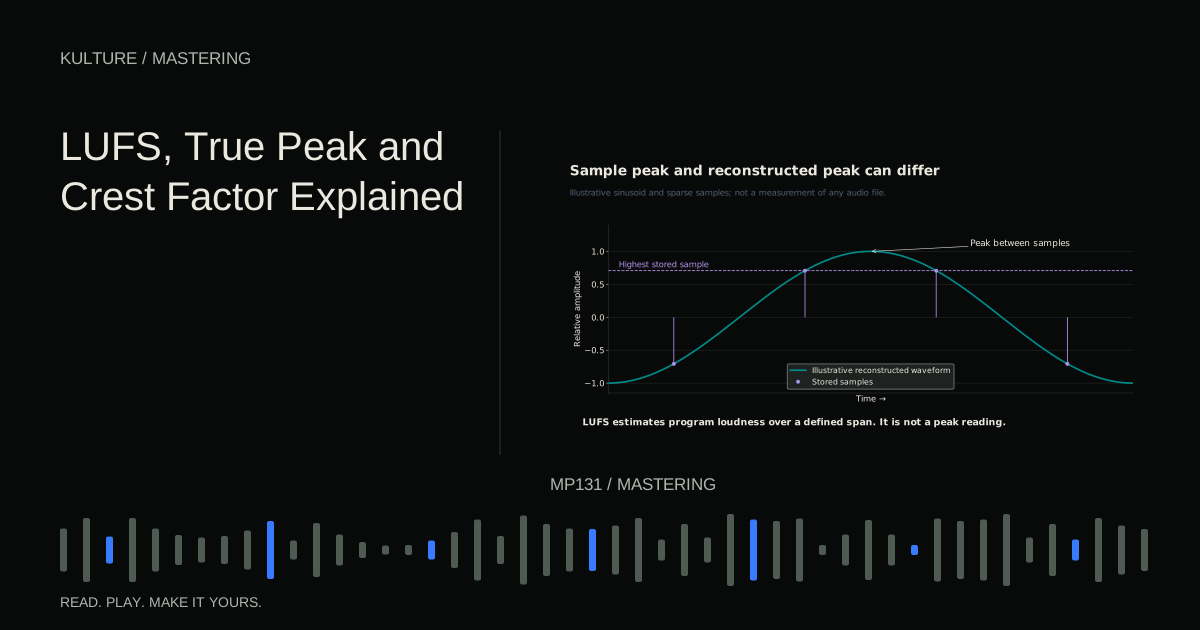
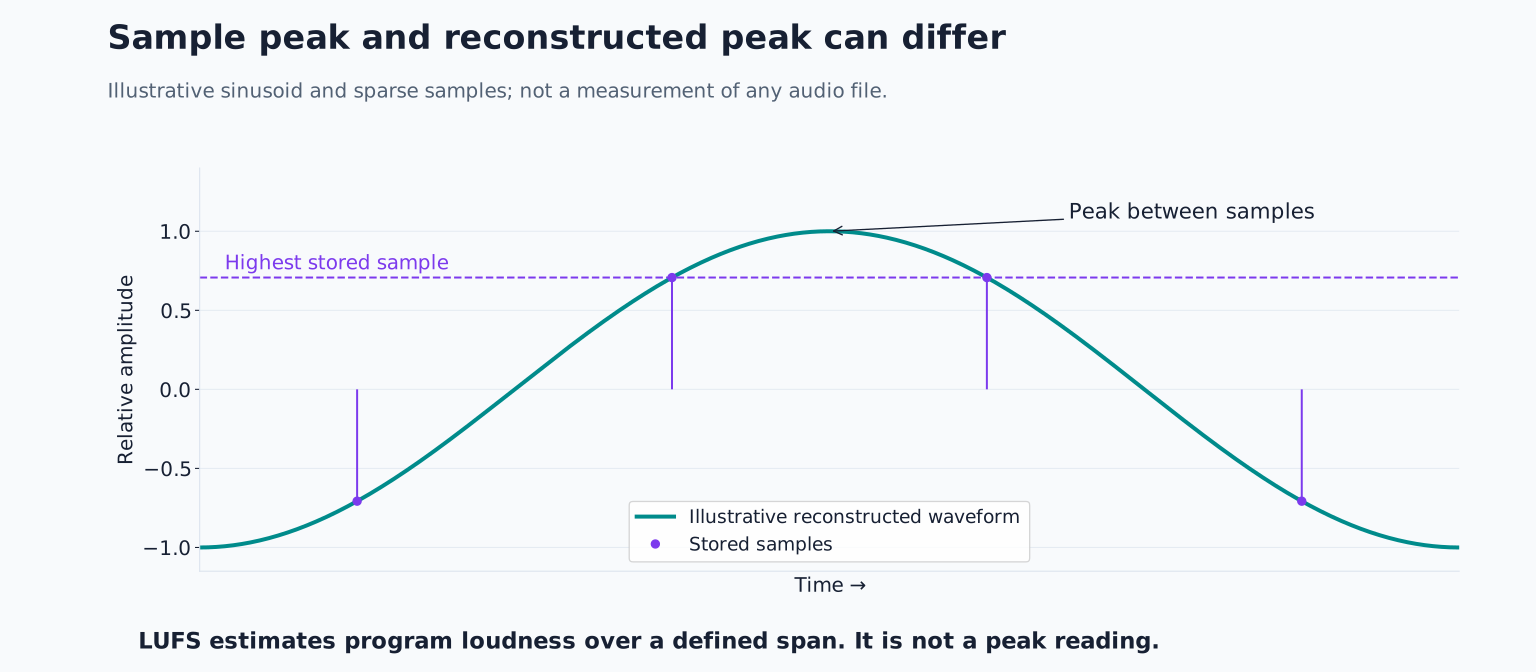
LUFS is a loudness measurement relative to digital full scale. Integrated LUFS summarizes the measured program using a standardized method. It differs from a peak reading and from the position of a volume slider.
The ITU R BS.1770 standard provides the measurement foundation. A service can use loudness measurements within its own playback policy, which may include limits on upward gain or different handling of albums and playlists.
Do not compare a full song integrated value with a chorus only reading. A long quiet introduction can influence the whole track result. For more detail, read LUFS, true peak, and crest factor.
A service example, not a universal rule
As checked in October 2026, Spotify's official normalization guidance describes a normal playback reference of -14 LUFS, album and individual track handling, and device related exceptions. It also provides its own true peak and mastering recommendations.
Those details describe Spotify's documented behaviour at the time of checking. They do not prove that every service uses the same reference, that every listener enables normalization, or that every connected device implements it identically. Recheck the destination's current documentation before release.
The -14 figure is therefore useful context, not a universal rule that every song must be mastered to precisely -14 LUFS. A track can be musically appropriate above or below it, subject to delivery requirements and the consequences of the chosen processing.
Why quiet tracks may not be raised all the way
A dynamic recording may have relatively low average loudness but peaks near the available ceiling. Raising it enough to meet a target could push those peaks too high. A playback system may limit upward gain or use other behaviour defined by its policy.
For a simple hypothetical example, a track measures -20 LUFS and peaks at -2 dBTP. Raising it by 6 dB would place the estimated peak around +4 dBTP if no dynamics processing intervened. That is not a safe assumption for ordinary playback headroom.
This example is arithmetic, not a statement that every service applies the same solution. Check the service's actual policy. The important lesson is that average level and peak headroom constrain different things.
Album context can matter
An album may contain a loud single, a quiet interlude, and a spacious closing piece. Applying one gain adjustment to an album can preserve the intended differences between songs. Adjusting each track independently in a playlist can produce a different relationship.
Do not force every song to the same integrated number merely because it may appear in a playlist. That can damage the album experience. Instead, establish intentional track relationships during EP or album mastering, and test both continuous and isolated listening.
A quiet interlude should still work as a quiet interlude. It does not need to compete with the densest chorus on the record.
Make your own normalization comparison
Export two mastering versions of one track. Keep the arrangement and tonal processing identical, changing only the amount of limiting. Measure the same full song span in each.
If version B measures 4 LU louder, lower its playback gain by roughly 4 dB as a starting comparison. Refine the match by ear on equivalent sections. Now listen to the snare, bass, vocal consonants, and sense of space.
Ask whether the denser version has a useful character at equal loudness. Perhaps it gives a deliberately aggressive texture. Perhaps it merely sounds smaller. This test is more informative than looking at two waveforms and choosing the fuller rectangle.
Keep the listening level comfortable. Do not turn both versions up repeatedly because normalized playback initially seems less exciting than the loud preview.
Leave room for encoding and delivery
Streaming delivery often involves processing or encoding into additional formats. Reconstructed peaks can change, and a ceiling that looks safe in a sample peak meter may not describe the complete situation.
Follow the destination's current true peak guidance and the distributor's accepted file specifications. Do not deliberately push peaks against zero simply because a normalization system may later turn the track down. Playback gain does not guarantee that every earlier conversion stage is protected.
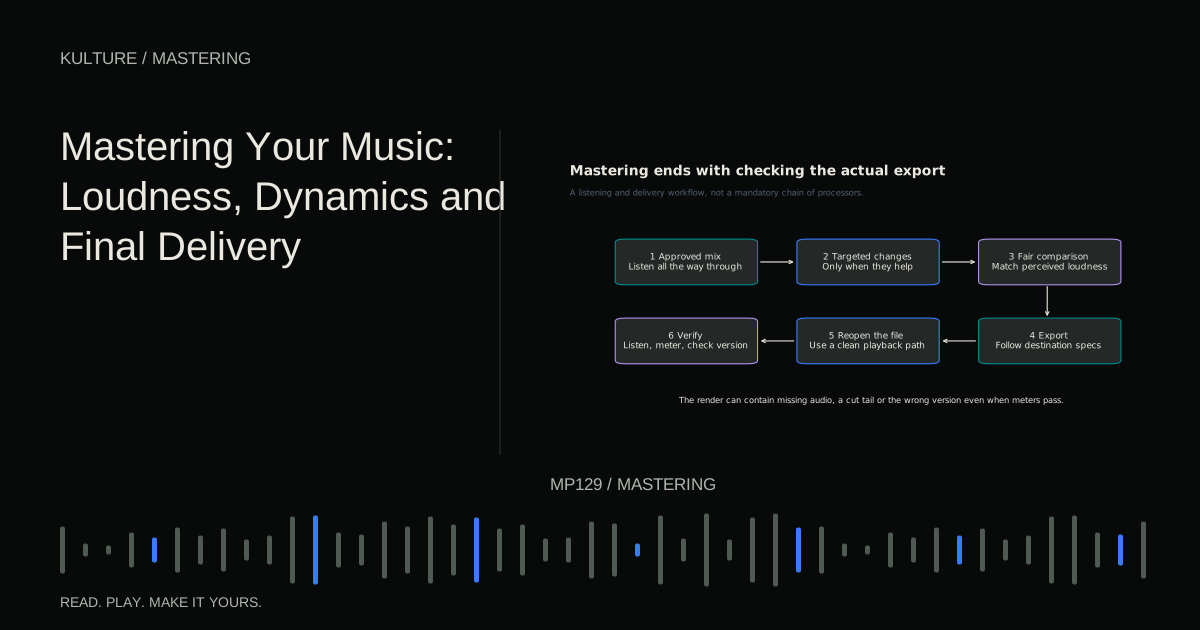
Use a clean, high quality source file rather than transcoding a lossy preview back into WAV. The mastering delivery overview covers final file checks.
Common conclusions to avoid
“Normalization makes mastering irrelevant” is wrong because balance, dynamics, sequencing, and quality control still matter.
“Louder masters are always worse” is also wrong because density can be intentional and appropriate. The question is the cost and benefit for the music.
“Every service will play my track at exactly the same loudness” overstates what a measurement and playback policy can guarantee. Perception, settings, and devices still vary.
Your exercise is to compare two masters at equal loudness and choose based on musical behaviour. Write down the destination's current delivery requirements separately from your artistic loudness choice. Keeping those two decisions distinct makes mastering more deliberate and less dependent on a single internet number.
TAKE IT INTO YOUR OWN MUSIC
Your next session.
As checked in October 2026, Spotify's official normalization guidance describes a normal playback reference of -14 LUFS, album and individual track handling, and device related exceptions. It also provides its own true peak and mastering recommendations.
Notes and progress stay in this browser.