These examples concern Western seven note scales in twelve tone equal temperament. Other scale systems and musical traditions organize pitch differently.
The two patterns
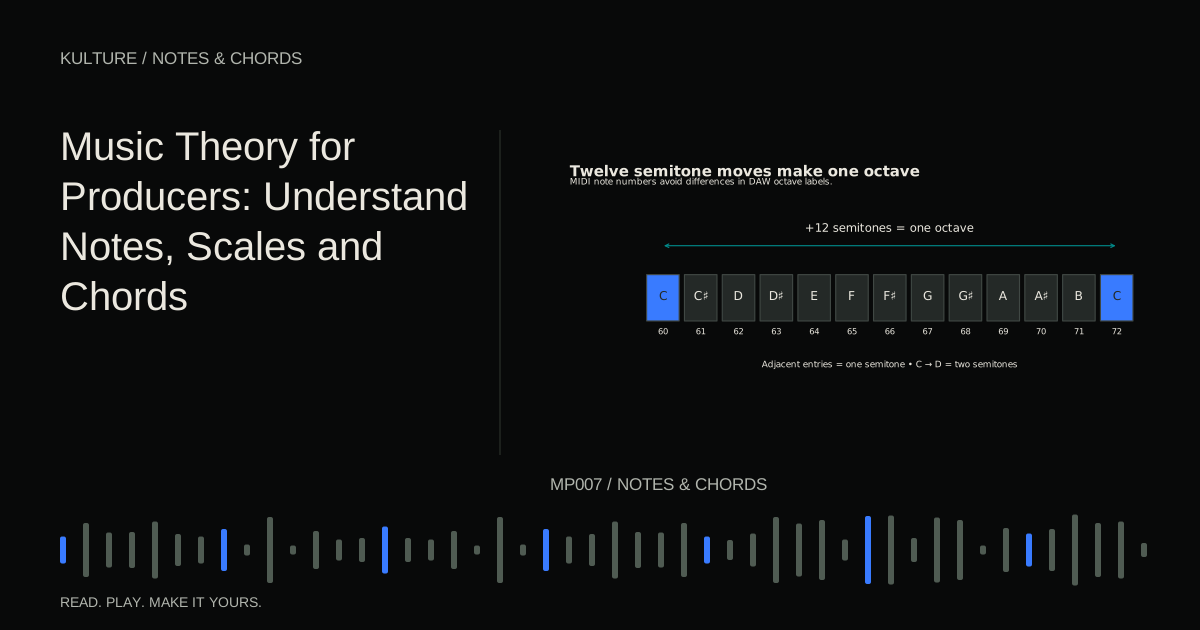
A half step, or semitone, moves to the next adjacent piano key, including black keys. A whole step moves two semitones. Starting from a tonic, the scale's home note, use these distances:
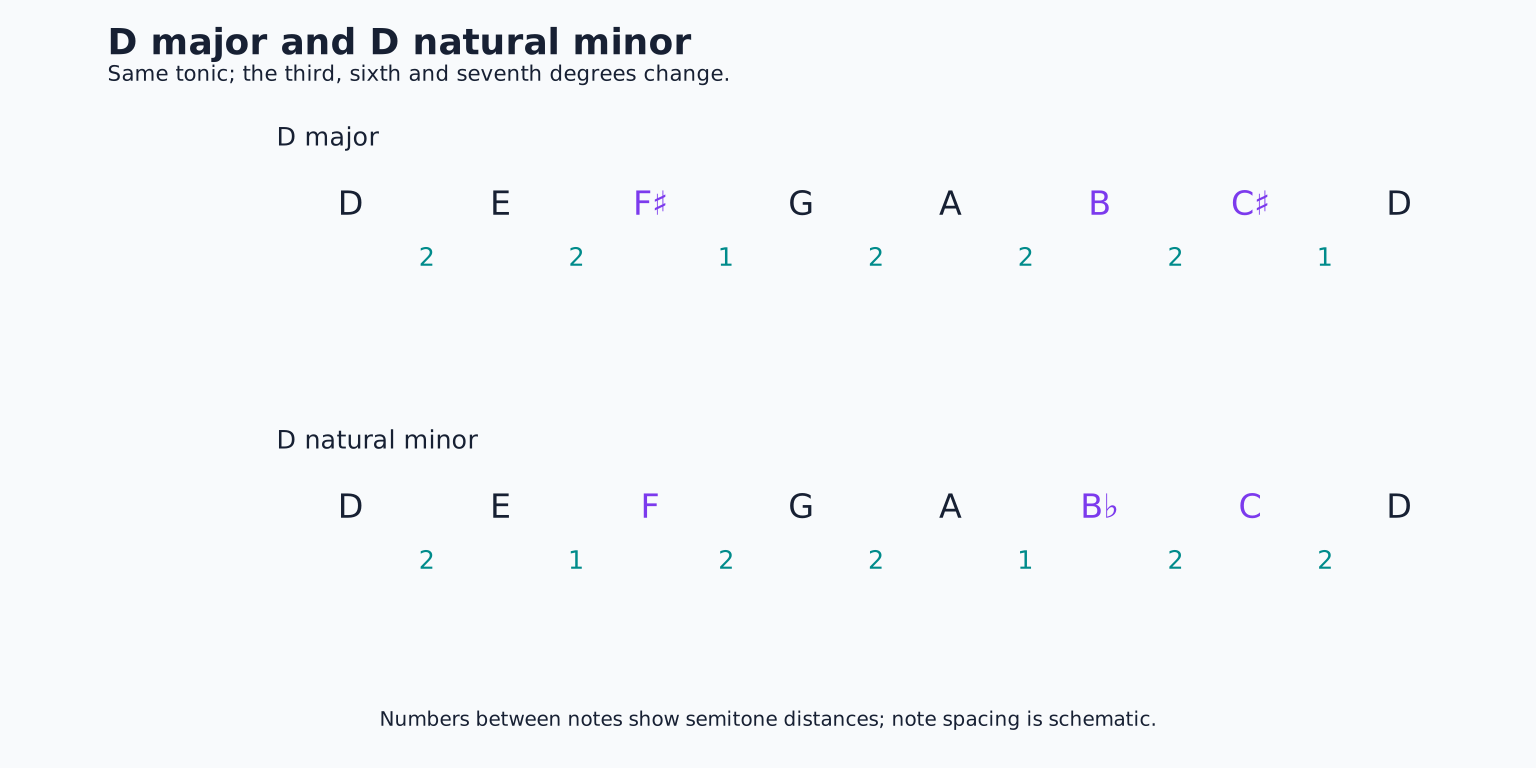
- Major: 2, 2, 1, 2, 2, 2, 1
- Natural minor: 2, 1, 2, 2, 1, 2, 2
Each list adds to twelve semitones and returns you to the tonic one octave higher. Ableton's major scale builder and minor scale builder let you inspect these patterns interactively.
The pattern matters more than the first note. A major scale can begin on any pitch. White keys are not inherently major, and black keys are not inherently minor.
TRY IT HERE
Build it. Hear it.
Change one note and listen to the relationship.
Ready when you are. Audio starts only when you press Play.
Keep experimenting in the piano LabBuild D major one move at a time
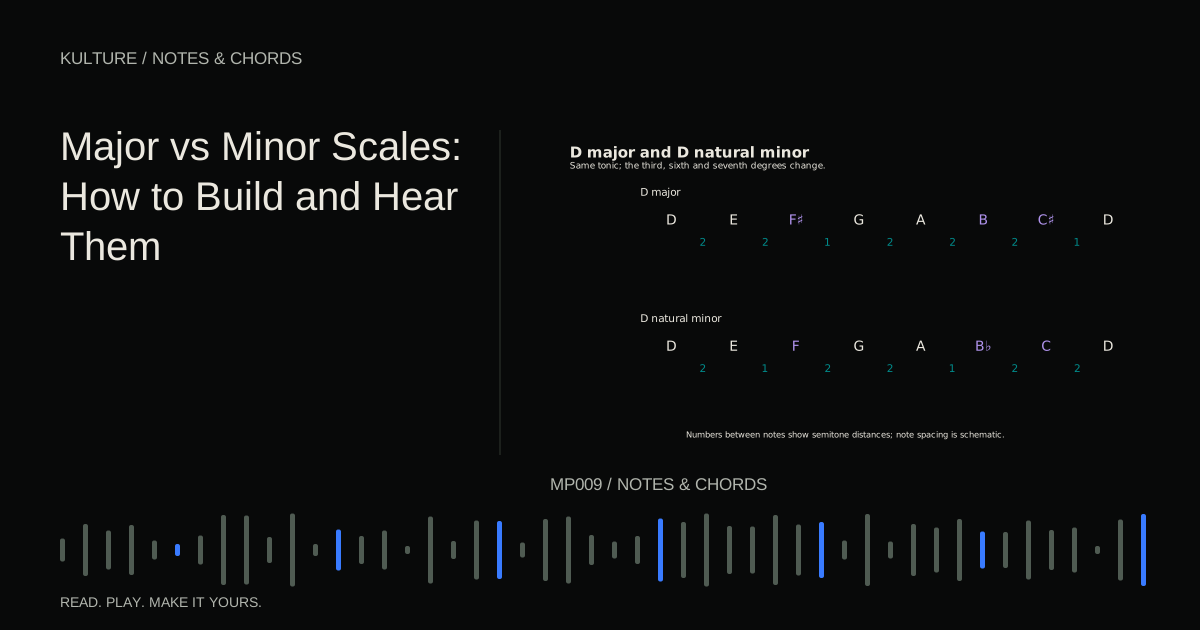
Start on D. Move two semitones to E, two to F sharp, one to G, two to A, two to B, two to C sharp and one to D. Your result is:
D, E, F sharp, G, A, B, C sharp, D.
Use one instance of each letter name before repeating D. Calling F sharp “G flat” here would obscure the sequence of scale degrees, even though the keyboard pitch is the same in equal temperament.
Create an eight note run in a piano roll, one note per eighth note, going from the lower D to the higher D. An eighth note lasts half a quarter note beat. At a moderate tempo, listen for where the closer half step movements occur: F sharp to G, and C sharp to D.
Then reverse the run. The scale is the same descending. Do not change its notes simply because the direction changes.
Turn D major into D natural minor
Keep D as the tonic. Lower the third, sixth and seventh scale degrees by one semitone:
| Degree | D major | D natural minor |
|---|---|---|
| 1 | D | D |
| 2 | E | E |
| 3 | F sharp | F |
| 4 | G | G |
| 5 | A | A |
| 6 | B | B flat |
| 7 | C sharp | C |
The minor scale is D, E, F, G, A, B flat, C, D. Duplicate your major run and make only those three changes. Alternate the two versions with the same sound and loudness.
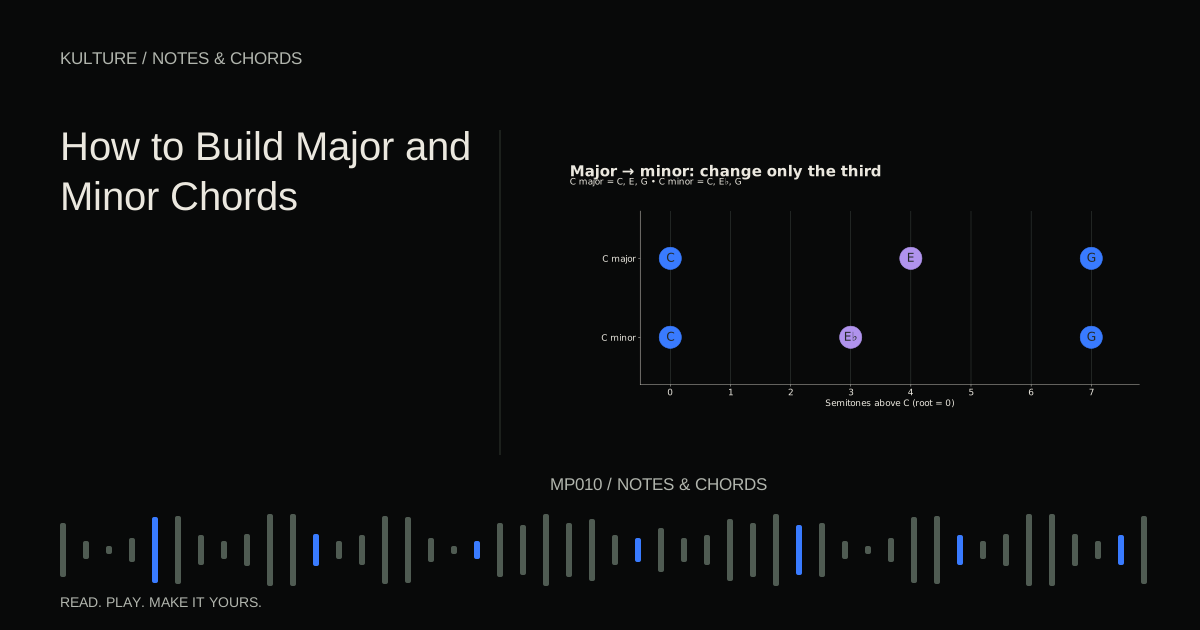
These are parallel scales: they share a tonic. Parallel comparison is especially useful for learning the sound of scale quality because the starting pitch stays constant. The changed third is easy to hear when you alternate D, F sharp, A with D, F, A, the major and minor tonic triads.
Relative scales share notes, not a home
C major and A natural minor contain the same seven pitch classes: C, D, E, F, G, A and B. They are relative major and minor. Their notes match, but their tonic differs.
Play A, C, E, C, then hold A over a low A drone. Next play C, E, G, E, then hold C over a low C drone. You have used the same overall white key collection while changing which note and chord feel central.
Starting a melody on A does not, by itself, prove it is in A minor. Endings, bass movement, repeated notes and harmonic emphasis all contribute. A short ambiguous loop may genuinely support more than one interpretation. You do not have to force a single label before you can produce it.
This distinction helps when a DAW's key detector offers several possibilities. Treat its result as a hypothesis. Listen for the pitch that feels like a point of arrival and compare it with the underlying chords.
Make a musical comparison instead of only a scale run
Set up a two bar phrase in D major. In bar 1, place D on beat 1, F sharp on beat 2, A on beat 3 and F sharp on beat 4. In bar 2, play E on beat 1, C sharp on beat 2 and D across beats 3 and 4.
Duplicate it. In the copy, lower F sharp to F and C sharp to C. Keep every rhythm and duration unchanged. Add a low D to both versions if the tonal home is unclear.
The first version has a leading tone, C sharp, a semitone below D. The natural minor version uses C, a whole tone below D. Listen to how the approach to the last D changes. Neither is automatically better. The first may feel more directed; the second may feel more open or less urgent in this particular phrase.
Now make the minor version faster and more rhythmically active than the major version. Notice how emotional labels become less tidy. Scales influence the palette, while the complete arrangement shapes the result.
Natural minor is not the only minor vocabulary
Minor key music often changes scale degrees for harmonic or melodic reasons. Harmonic minor raises the seventh degree of natural minor. In D, that changes C to C sharp. It allows an A major chord, A, C sharp, E, to point strongly toward D minor.
The classical ascending melodic minor form raises both sixth and seventh degrees; descending exercises traditionally return to natural minor. Jazz usage often treats the raised sixth, raised seventh collection as a scale in both directions. You do not need to memorize every application before writing a minor song. The practical lesson is that a C sharp in D minor is not automatically a mistake.
If your DAW's scale filter removes such a note, the filter may be following natural minor rather than your actual harmonic intention. A highlighted scale is assistance, not an authority over what your track is allowed to contain.
When the right notes still sound wrong
First check the chord underneath the melody. A scale tone can create a strong clash when held against a particular chord tone. Try shortening it, moving it to a weaker rhythmic position or resolving it by step. If the tension is useful, keep it.
Next check the sound. A bass sample mapped to the wrong root can play the wrong pitch even when the MIDI is correct. Heavy pitch modulation can also blur a comparison. Use a plain piano to confirm the notes before changing the composition.
Finally, avoid writing by the highlighted rows alone. A random sequence of allowed notes can lack direction. Repetition, rests and phrase endings help listeners understand which pitches matter.
A focused practice session
Make one four note motif in G major using G, B, D and A. Write a parallel G minor version by changing B to B flat. Keep the rhythm identical, then add an ending using F sharp for major and F for natural minor. Describe the difference without using only “happy” or “sad.”
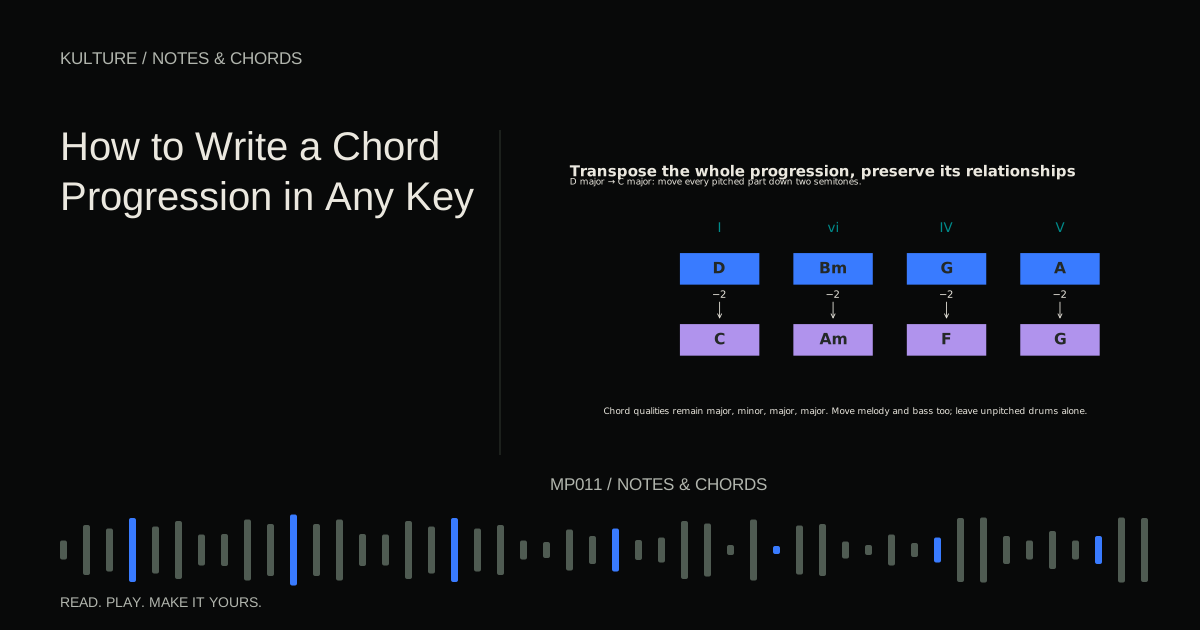
Next learn How to Write a Chord Progression in Any Key. If semitone counting is still awkward, revisit Notes, Semitones and Octaves before adding more scale names.
TAKE IT INTO YOUR OWN MUSIC
Your next session.
Make one four note motif in G major using G, B, D and A. Write a parallel G minor version by changing B to B flat. Keep the rhythm identical, then add an ending using F sharp for major and F for natural minor. Describe the difference without using only “happy” or “sad.”
Notes and progress stay in this browser.