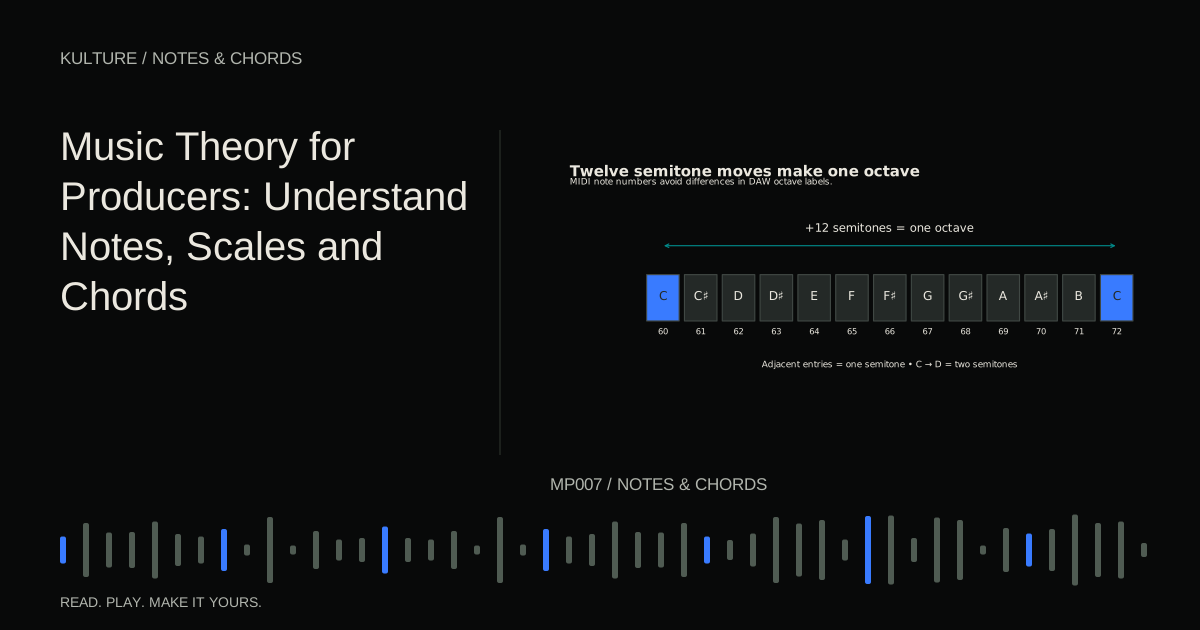
You can use the formulas in any piano roll. The important detail is to count every semitone, including black key pitches, and count the root as zero.
What the three notes do
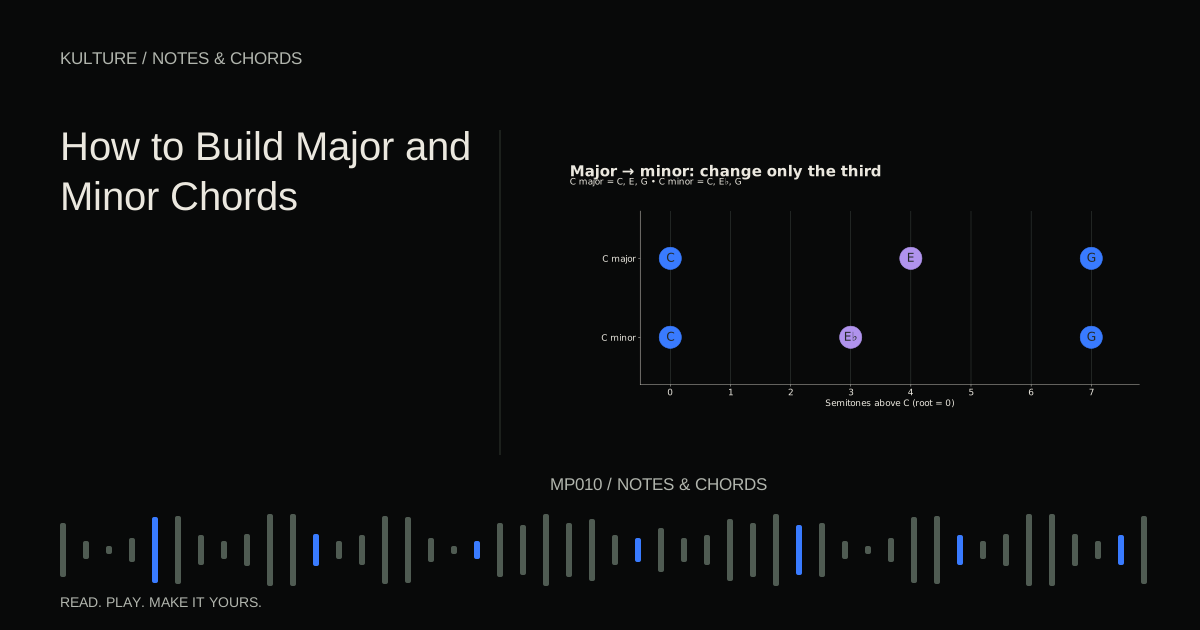
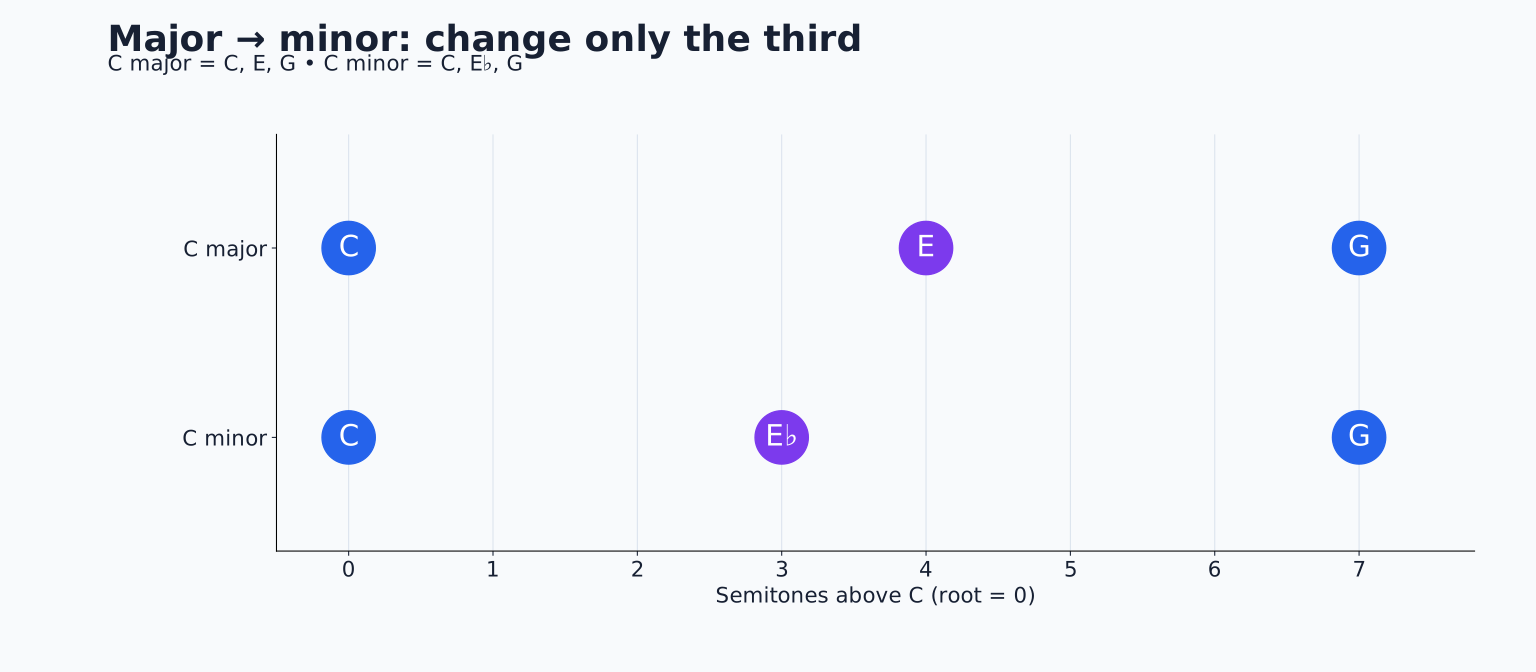
The root gives the chord its letter name. The third determines whether this basic triad is major or minor. The fifth completes the familiar shape. In C major, C is the root, E is the third and G is the fifth. In C minor, the third changes to E flat.
“Third” and “fifth” describe intervals, or distances between notes. They are not instructions to count three or five semitones. A major third spans four semitones; a minor third spans three. The perfect fifth used in both these triads spans seven.
The Open Music Theory triads chapter explains the distinction between a chord's root, quality and spacing. Here, we will use those ideas to construct and hear several original examples.
TRY IT HERE
Build it. Hear it.
Change one note and listen to the relationship.
Ready when you are. Audio starts only when you press Play.
Keep experimenting in the piano LabBuild C major without a chord tool
Load a piano sound and draw a C in a middle register. Add an E four rows above it and a G seven rows above it. Make all three notes begin together and last two beats.
If your editor displays MIDI numbers, use 60, 64 and 67. These numbers avoid differences in octave naming between applications. You may see note 60 labeled C3 or C4 depending on the software; the relative distances are what matter.
Play the chord. Then play the three notes one after another. This is an arpeggio: the notes of a chord presented successively. Hearing both versions helps you recognize that a chord is a relationship between pitches, not merely a block shape in the editor.
Duplicate the chord and lower only E to E flat, MIDI note 63. Keep C and G fixed. Alternate C major and C minor at the same level. You have changed one note, so the difference you hear is easy to attribute to the third.
Apply the method beyond white keys
Now build E major. Start on E, count four semitones to G sharp, then seven semitones from E to B. The result is E, G sharp, B. For E minor, lower G sharp to G.
Try B flat major: B flat, D and F. Its minor version is B flat, D flat and F. A chord can contain black keys and still be major, or contain only white keys and be minor. Keyboard color is not chord quality.
Use this small reference as a check, not a substitute for counting:
| Root | Major triad | Minor triad |
|---|---|---|
| D | D, F sharp, A | D, F, A |
| F | F, A, C | F, A flat, C |
| A | A, C sharp, E | A, C, E |
| E | E, G sharp, B | E, G, B |
If you consistently produce a strange sound, make sure you measured the fifth from the root. Adding seven semitones above the third creates a different structure.
Learn the spelling as well as the shape
Triads use alternating letter names. An A chord uses A, some kind of C and some kind of E. That is why A major is spelled A, C sharp, E rather than A, D flat, E, even though C sharp and D flat use the same key in equal temperament.
Correct spelling becomes useful when you compare chords across a key. You can see which scale degrees are present and which have changed. If your DAW displays only sharps, do not panic when a theory example uses flats. Match the sounding pitch and keep the intended spelling in mind.
To understand where the available chord notes come from, see Major vs Minor Scales. A scale and a chord are related, but they are not interchangeable: a seven note collection offers several different triads.
Build chords inside a key
Write the C major scale: C, D, E, F, G, A, B. Starting on C, take one note, skip one, take one, skip one, take one. You get C, E, G. Starting on D gives D, F, A, which is D minor.
Repeat the process to get C, Dm, Em, F, G, Am and B diminished. The last chord, B, D, F, has a smaller fifth and is outside the major/minor pair taught here. You do not need to use it in your first progression, but knowing it exists prevents you from assuming every scale degree produces the same chord quality.
A plain letter such as C usually means a major triad in chord symbols. Cm or Cmin means minor. In informal chord charts, Am means A minor; it does not mean “a chord in the key of A minor.” A song in A minor can contain many different chords.
Make the chord playable in your arrangement
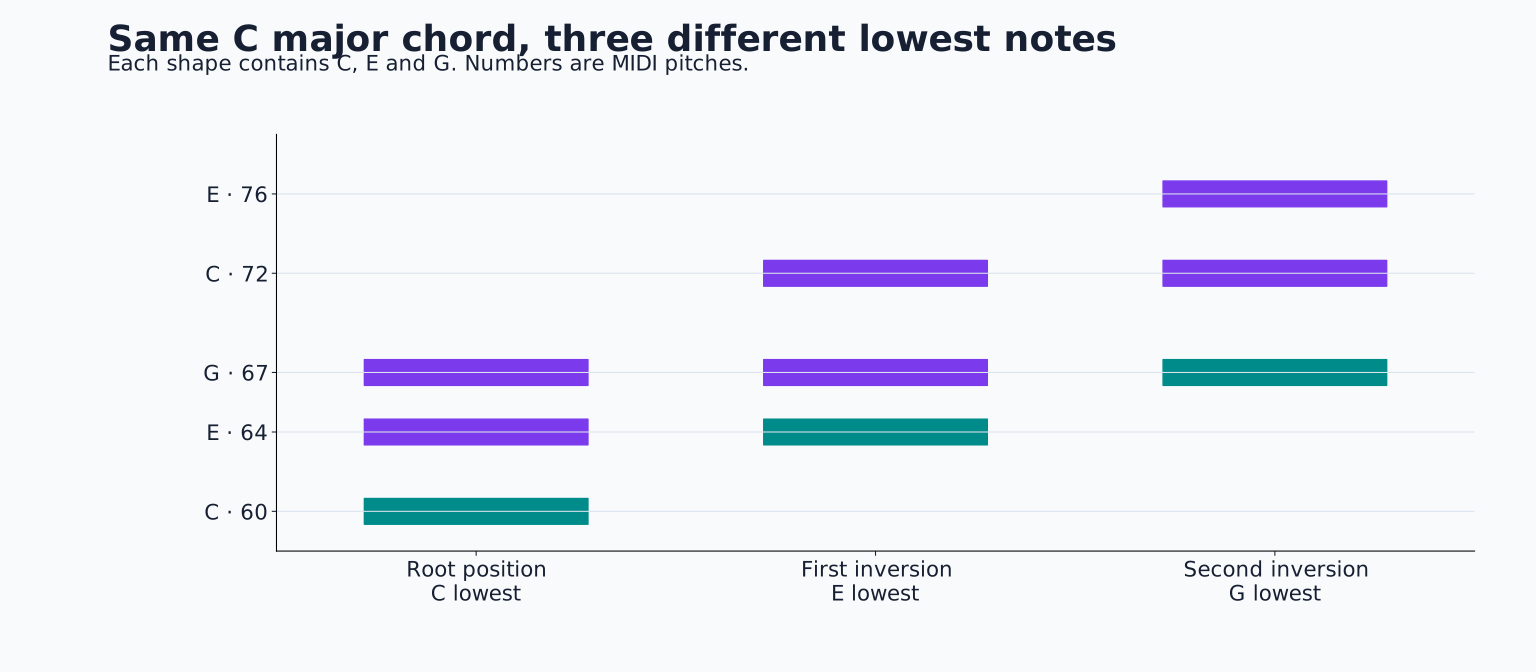
A chord's identity survives changes in octave. C, E, G and E, G, C contain the same pitch classes, although their lowest notes differ. These arrangements are inversions. Wider spacing, such as C in one register and E and G higher up, changes the voicing.
Low, closely packed triads can become cloudy, especially with a thick synth. Before applying equalization, move the whole chord upward or place only the root in the bass. The arrangement may become clearer immediately.
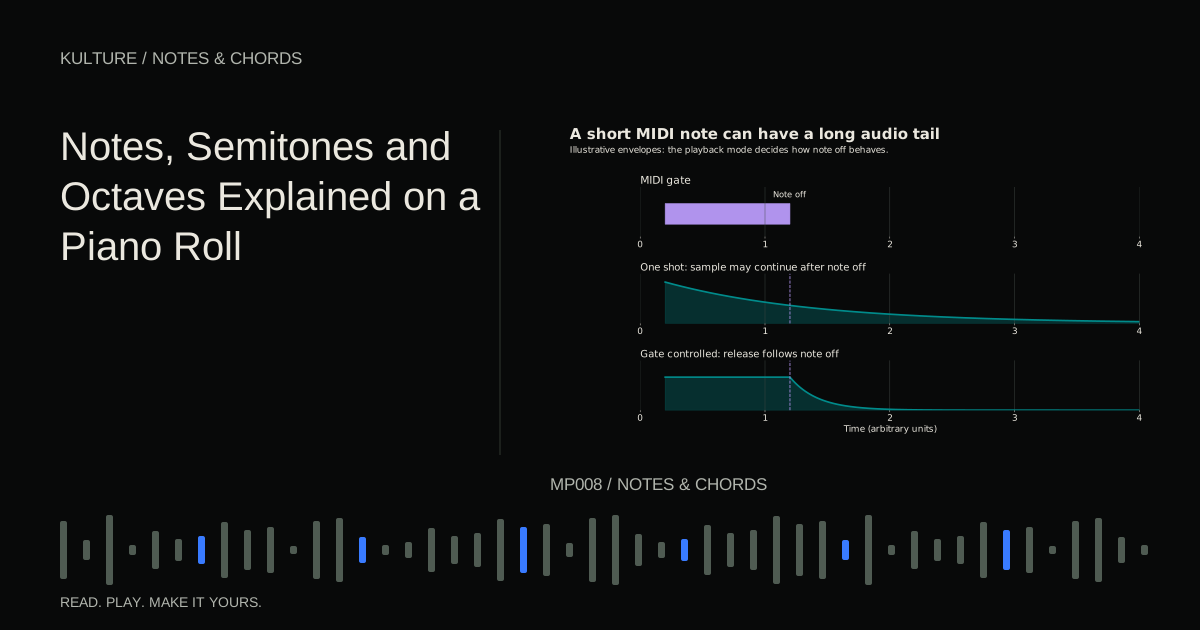
Also test duration. A two beat piano chord naturally decays; a two beat sustained synth may remain dense throughout. If the chords overwhelm a vocal or melody, try shorter stabs or fewer repeated attacks rather than simply lowering every frequency with processing.
A four bar practical example
Set a four bar loop at a comfortable tempo. Put D minor in bar 1, B flat major in bar 2, F major in bar 3 and C major in bar 4. Use D, F, A, B flat, D, F, F, A, C and C, E, G.
First hold each chord for its full bar. Then try two short attacks per bar, on beat 1 and the “and” after beat 3. Keep the harmony unchanged. The rhythmic version may feel like a different track even though the chord names are identical.
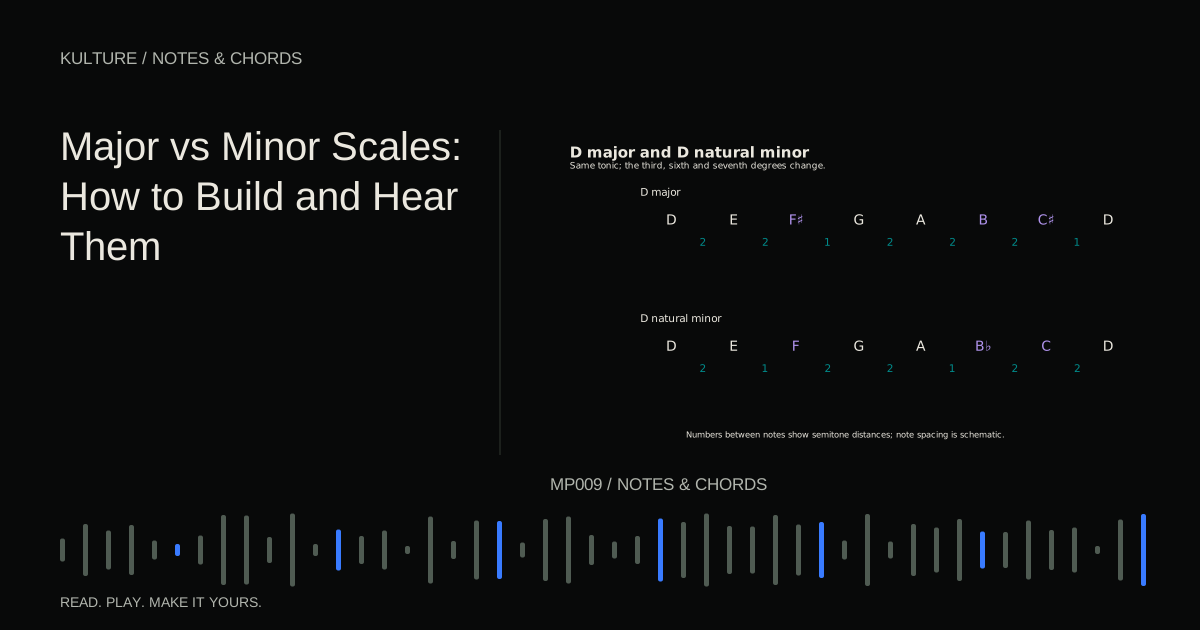
Finally, replace D minor with D major by raising F to F sharp. The resulting color comes from a note outside the original D natural minor collection. It may be attractive or disruptive depending on the melody. Listen in context rather than accepting or rejecting it solely because of a scale label.
Common mistakes and a short exercise
If the chord sounds unexpectedly thin, one note may be muted or outside the instrument's playable range. If it sounds like a melody instead of a chord, the starts may not align. If the major/minor comparison seems unchanged, a layered instrument may be adding its own third or the sound may be too distorted to hear the difference clearly.
Build major and minor versions of D, E and A without using a chord preset. Play each pair, then hide the piano roll and identify which version is playing. End by combining any three of those chords into a four bar sequence. Continue with Chord Inversions and Voice Leading to make the transitions smoother.
TAKE IT INTO YOUR OWN MUSIC
Your next session.
Set a four bar loop at a comfortable tempo. Put D minor in bar 1, B flat major in bar 2, F major in bar 3 and C major in bar 4. Use D, F, A, B flat, D, F, F, A, C and C, E, G.
Notes and progress stay in this browser.