This guide uses Western twelve tone equal temperament, the tuning system behind most default software instruments. It is a useful starting framework, not a description of every musical tradition. The goal is to make a small piece you understand well enough to change deliberately.
Start with sound, then learn its name
Load a plain piano or gently sustained synthesizer. Avoid a preset with an arpeggiator, which automatically generates notes, or a huge delay that obscures what you play. Make a four bar MIDI clip at 100 beats per minute in 4/4 time. MIDI contains performance instructions; the instrument turns those instructions into sound.
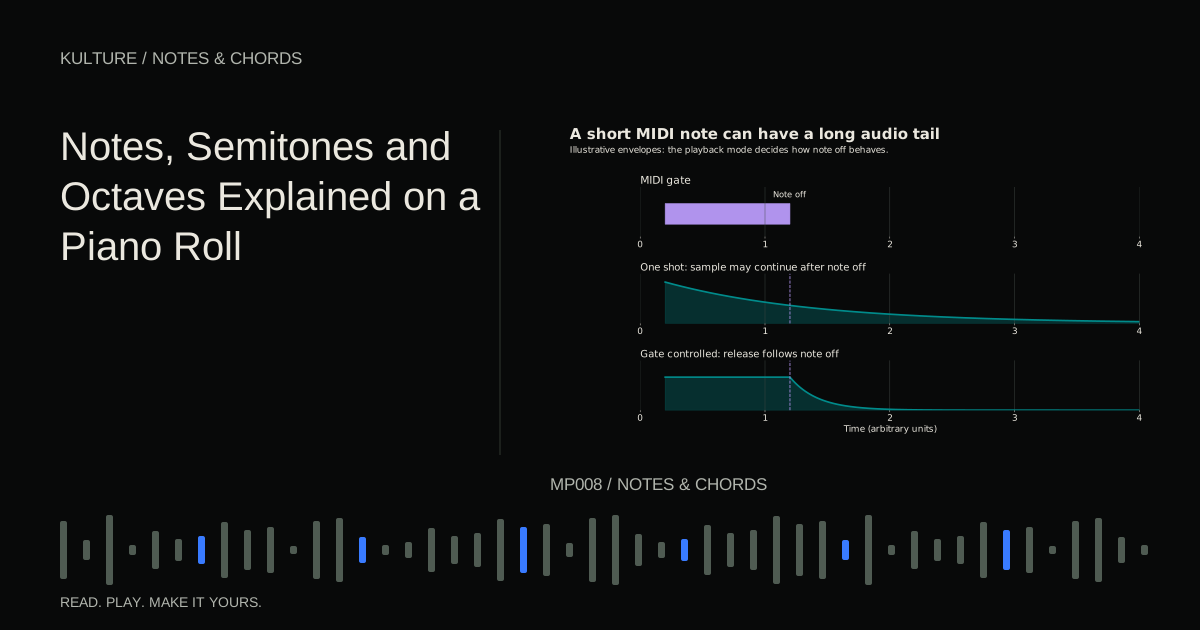
The piano roll has two main dimensions. Left to right is time. Bottom to top is pitch, the quality we hear as low or high. Each horizontal row represents a note. The width of a rectangle usually represents its held duration, although an instrument's envelope can make the audible sound shorter or longer.
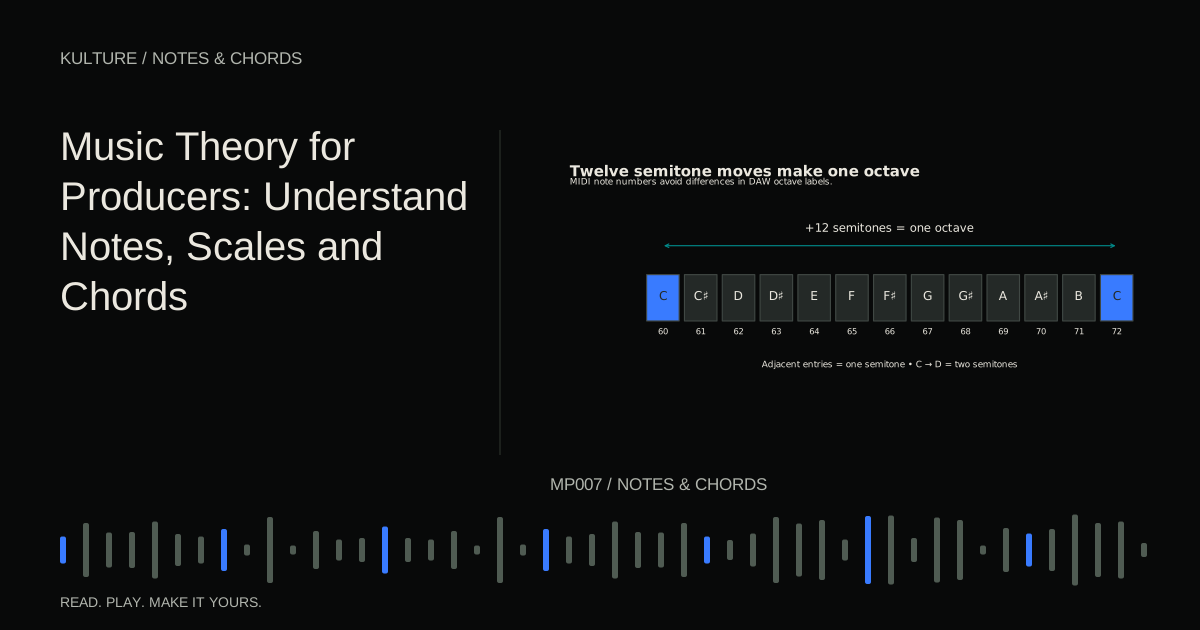
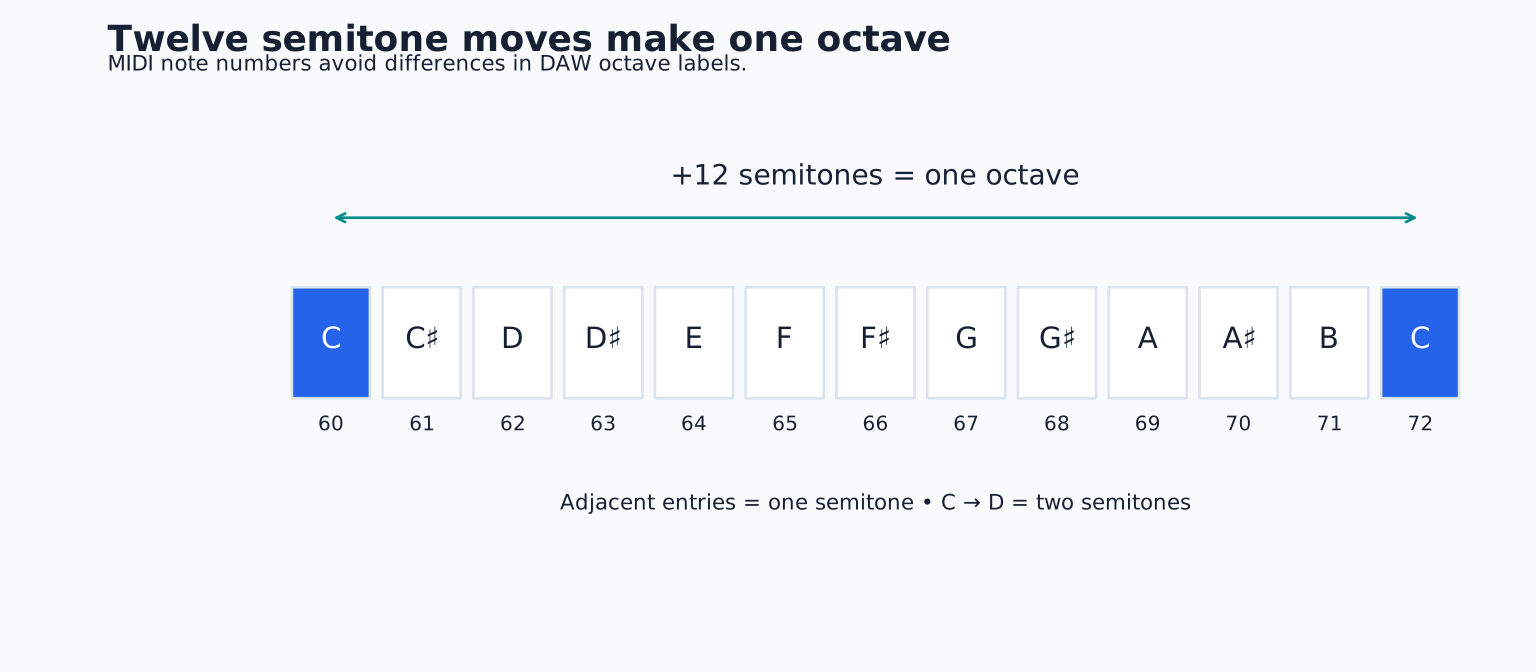
Click C, then the next C above it. They have a similar identity but different height. That distance is an octave. Now move a note up one row at a time, counting every row, including black key pitches. Twelve semitone steps reach the next C. A semitone is the distance between adjacent keys; a whole tone is two semitones.
For a visual introduction, Ableton's pitch lesson lets you explore pitch before attaching a large vocabulary to it. Our piano roll note guide explains octave labels and note numbers in more detail.
TRY IT HERE
Build it. Hear it.
Change one note and listen to the relationship.
Ready when you are. Audio starts only when you press Play.
Keep experimenting in the piano LabA scale gives your notes a shared reference
A scale is an ordered set of pitches. A key goes further: it establishes a tonal home, called the tonic, and relationships around that home. Selecting a scale in a DAW highlights notes; it does not automatically make a convincing phrase.
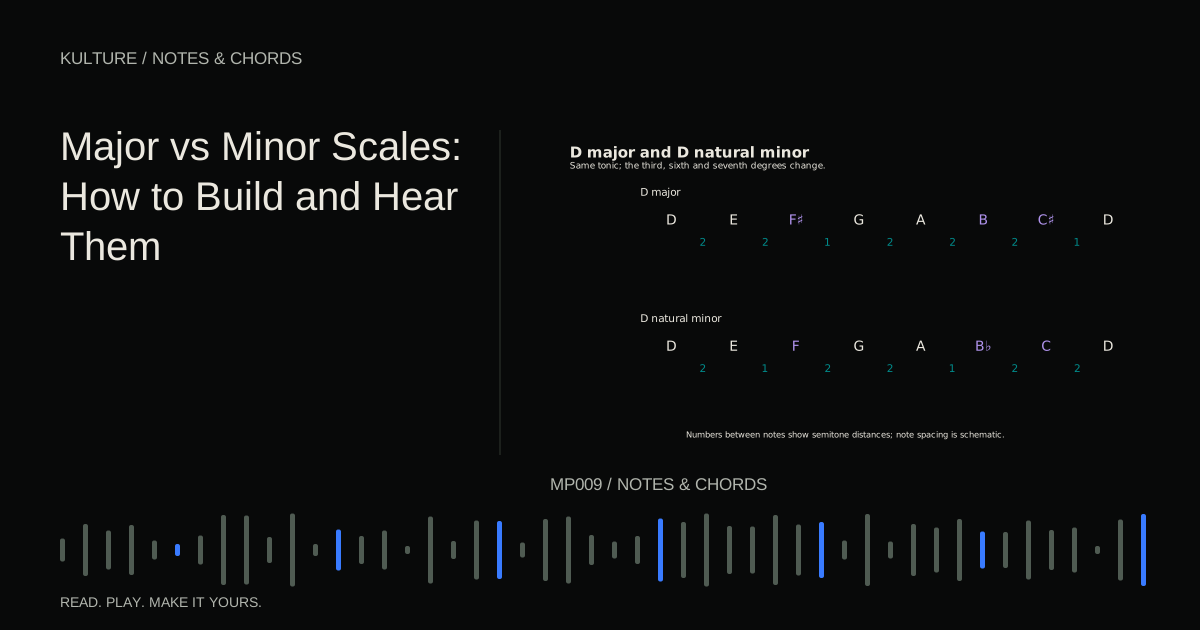
Start with C major: C, D, E, F, G, A, B. These happen to be the white keys. The spaces between them are not all equal. C to D is two semitones, but E to F is one. The major scale spacing is 2, 2, 1, 2, 2, 2, 1, returning to the tonic an octave higher. You can check this visually in Ableton's major scale builder.
Write C, D, E, G as quarter notes in the first bar. In 4/4, each quarter note occupies one of the four main beats. Write G, E, D, C in the second bar. Play both bars repeatedly. The last C may feel settled because of its position and the surrounding pattern, not merely because C is the first letter you typed.
Now hold a low C underneath both bars. This sustained reference, often called a drone, makes the tonal home clearer. Try ending the phrase on D instead. Nothing has broken. You have made an ending that may feel less final.
Intervals describe relationships
An interval is the distance between pitches. You can describe it in semitones or with names such as third and fifth. From C to E is four semitones, a major third. C to E flat is three semitones, a minor third. C to G is seven semitones, a perfect fifth.
The name contains information about letter spelling as well as distance. For your first production exercises, counting semitones is an easy way to check the result. Later, correct spelling helps you see how a chord belongs to a key.
Try C followed by E, then C followed by E flat. Keep instrument, rhythm and loudness unchanged. This isolates the pitch relationship. Descriptions such as bright, dark, open or tense can help you remember what you hear, but they are associations rather than fixed emotional laws.
Build a chord from three notes
A chord combines pitches heard together. A triad has three distinct chord tones: root, third and fifth. The root names the chord; it is not necessarily the lowest note in every arrangement.
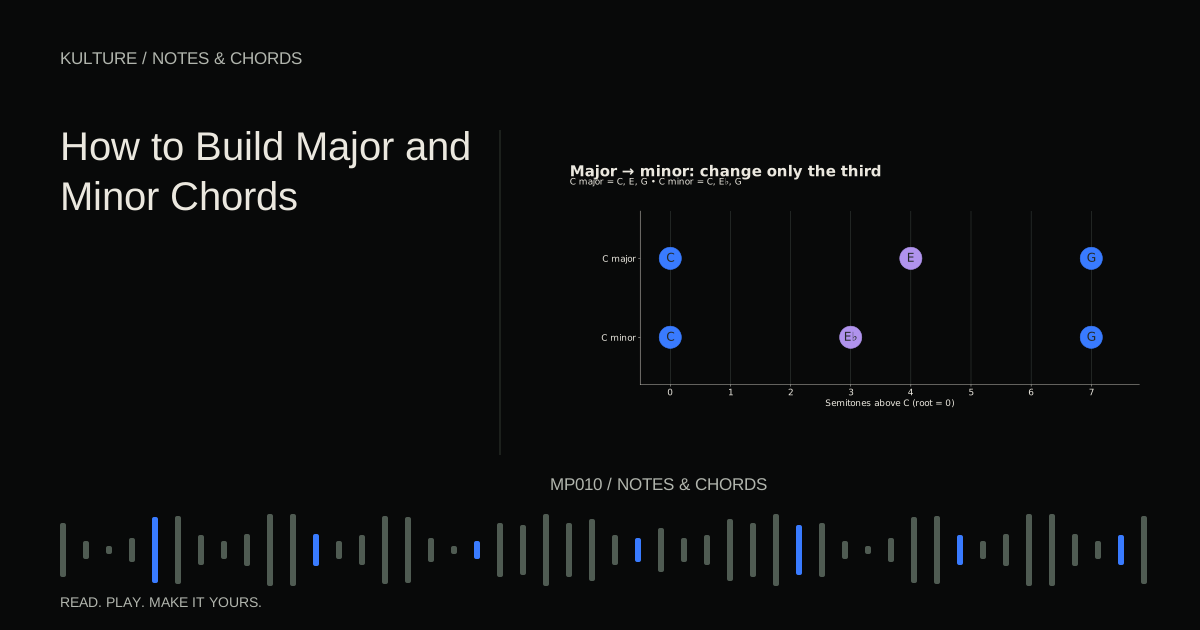
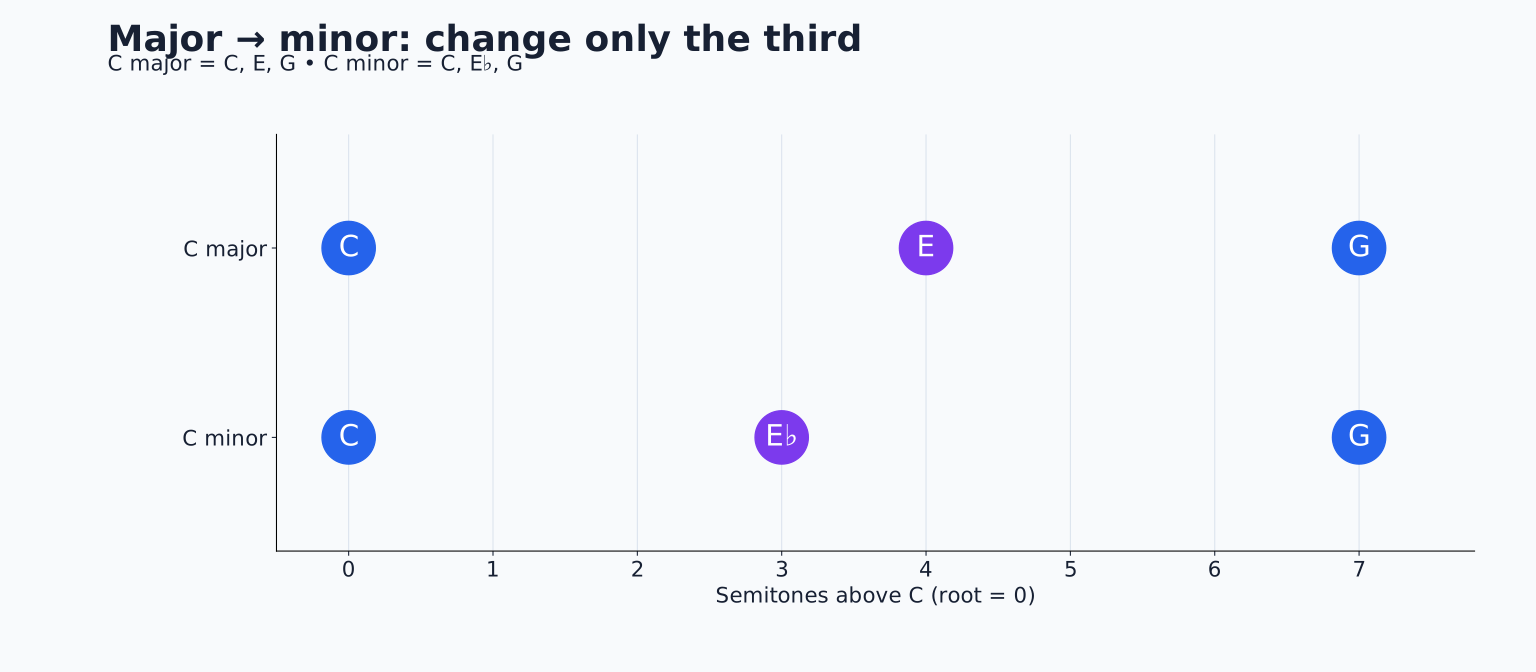
Create C major by placing C, E and G at the same start time. Relative to C, the offsets are 0, 4 and 7 semitones. Change E to E flat while keeping C and G. You now have C minor, with offsets 0, 3 and 7. This is a powerful listening comparison because only one pitch changes.
Next build A minor with A, C and E. Notice that a minor chord does not require black keys. Chord quality depends on the distances between its notes. The Open Music Theory triads chapter provides a formal reference for triad construction and identification.
A thick sound is not necessarily a more complicated chord. Playing C in three octaves adds weight but does not add new pitch classes. Adding D, by contrast, adds another distinct harmonic ingredient.
Turn isolated chords into a progression
A chord progression is a sequence of chords. Put these four chords into your clip, one per bar:
| Bar | Chord | Notes |
|---|---|---|
| 1 | C major | C, E, G |
| 2 | A minor | A, C, E |
| 3 | F major | F, A, C |
| 4 | G major | G, B, D |
Start in a middle register, where the notes are clear. Avoid placing the complete triads extremely low, where their overtones can sound crowded. Keep all chords the same duration initially.
Listen to the change from G back to C when the clip loops. Then swap bars 2 and 3. The note collection is still C major, but the journey changes. Theory offers a way to label and compare these choices; it does not choose the best sequence for your song.
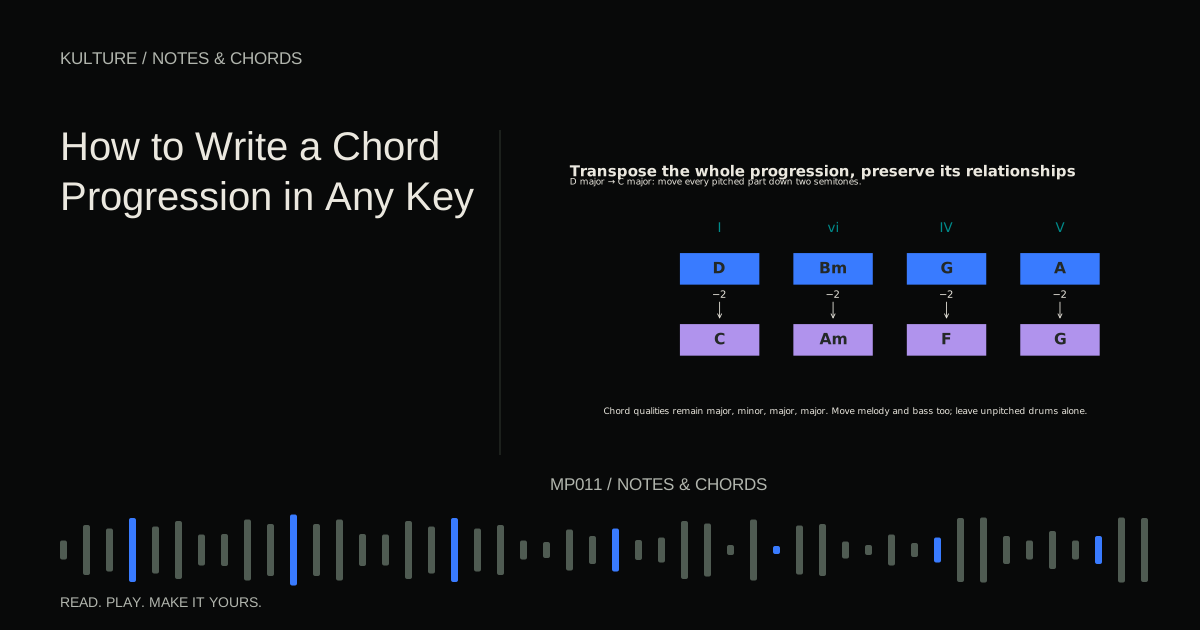
Scale degrees number the notes of the key. In C major, C is 1, D is 2 and so on. Roman numerals can label chords: this progression is I, vi, IV, V. Uppercase marks major and lowercase marks minor in this notation. The same pattern in D major is D, Bm, G, A.
Give the chords a rhythm and a bass
Held chords teach harmony clearly, but rhythm makes them part of a track. Shorten each chord so it plays on beat 1 for one beat, then again on the “and” after beat 2 for half a beat. Count “1 and 2 and 3 and 4 and.” The second chord attack falls between main beats.
On another instrument, play one root note per bar: C, A, F, G. Put these below the chords and use a simple bass sound. You have separated harmonic color from low frequency foundation. Leave the chord instrument out briefly: the bass still outlines the progression, although it does not specify major versus minor by itself.
If the bass feels overwhelming, first lower its level and shorten its notes. Do not immediately add effects. A strong arrangement often comes from choosing when each part plays.
Make a melody that responds to the harmony
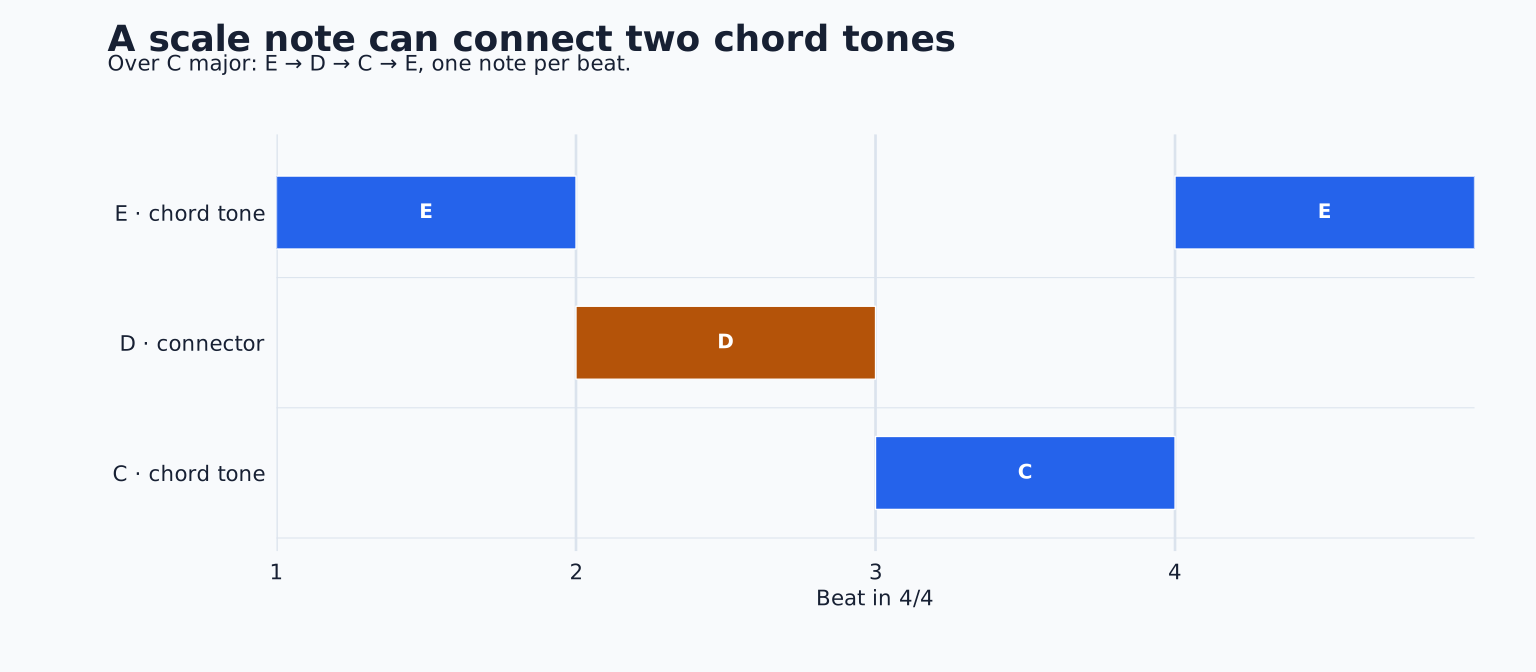
Return to your C, D, E, G idea. Over the first C chord, C, E and G are chord tones, while D is a note from the scale outside that triad. A short D between C and E can feel like motion; a long D can become a deliberate color.
Try this four bar melody, with each listed note lasting one beat:
- C chord: E, G, E, D
- A minor chord: C, E, C, A
- F chord: A, C, A, G
- G chord: B, D, B, G
All notes belong to C major, but each bar emphasizes its current chord. The melody repeats a shape while adjusting to the harmony. This is one practical bridge between scale knowledge and songwriting.
Diagnose the common beginner problems
If a note sounds unexpectedly wrong, confirm the instrument is not transposed and the sample is mapped correctly. Then check the actual chord underneath it. Being in the scale does not make every possible note equally settled over every chord.
If everything sounds correct but dull, change rhythm before adding more notes. Put a rest after the first two melody notes. Hold the last note longer. These edits create phrasing without requiring additional theory.
If the chords jump around, move individual chord notes by octaves to keep them nearby. This is voicing work, developed in Chord Inversions and Voice Leading. If the theory feels overwhelming, isolate one question: can you hear the difference between the two versions you just made?
Your first theory to track exercise
Save three versions of the four bar idea. Version one uses the held chords and root bass. Version two adds the melody. Version three changes only the chord rhythm and includes at least one melodic rest. Listen without looking at the piano roll and describe the difference in one sentence each.
Then transpose the entire pitched arrangement up two semitones. C major becomes D major, and the relationships stay intact. Leave unpitched drums alone. If the new version sounds worse, the cause may be instrument range rather than a theory error. That observation is the point: theory becomes useful when it helps you connect a visible edit to an audible result.
TAKE IT INTO YOUR OWN MUSIC
Your next session.
Save three versions of the four bar idea. Version one uses the held chords and root bass. Version two adds the melody. Version three changes only the chord rhythm and includes at least one melodic rest. Listen without looking at the piano roll and describe the difference in one sentence each.
Notes and progress stay in this browser.