Begin with a small motif rather than an entire complicated melody. Then change one feature at a time: ending, rhythm, register, harmony, articulation or sound.
Identify the hook's essential feature
A motif is a short musical idea. Its identity might lie in a rhythm, a repeated pitch, an interval leap or a distinctive sound. If you do not know what makes it recognizable, it is easy to vary away the very thing that works.
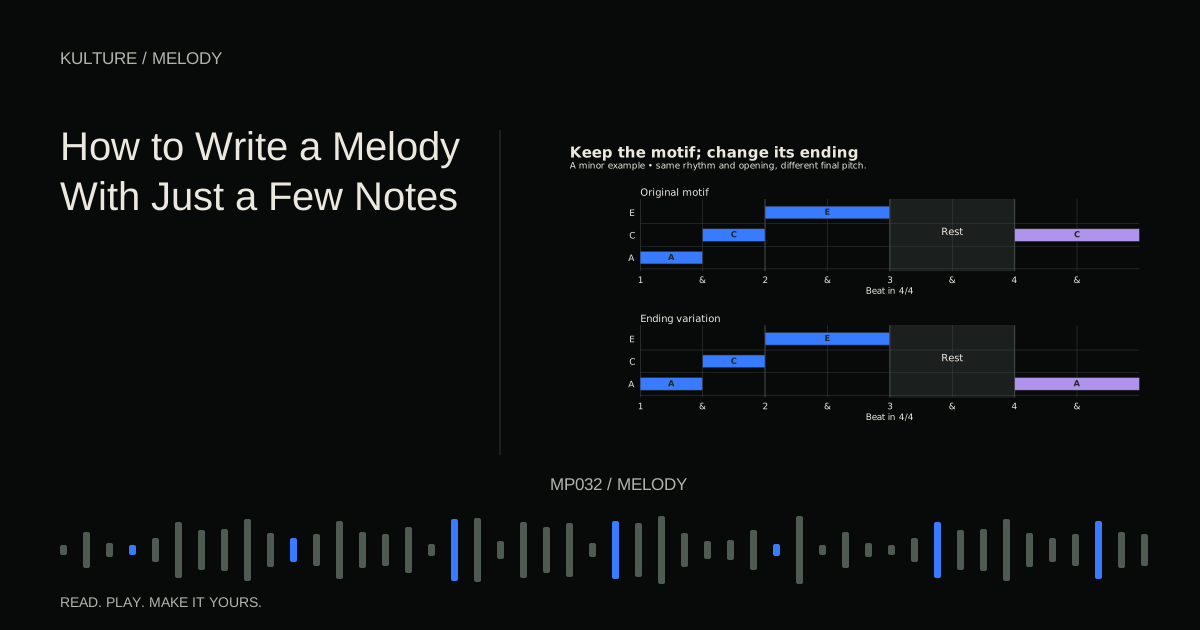
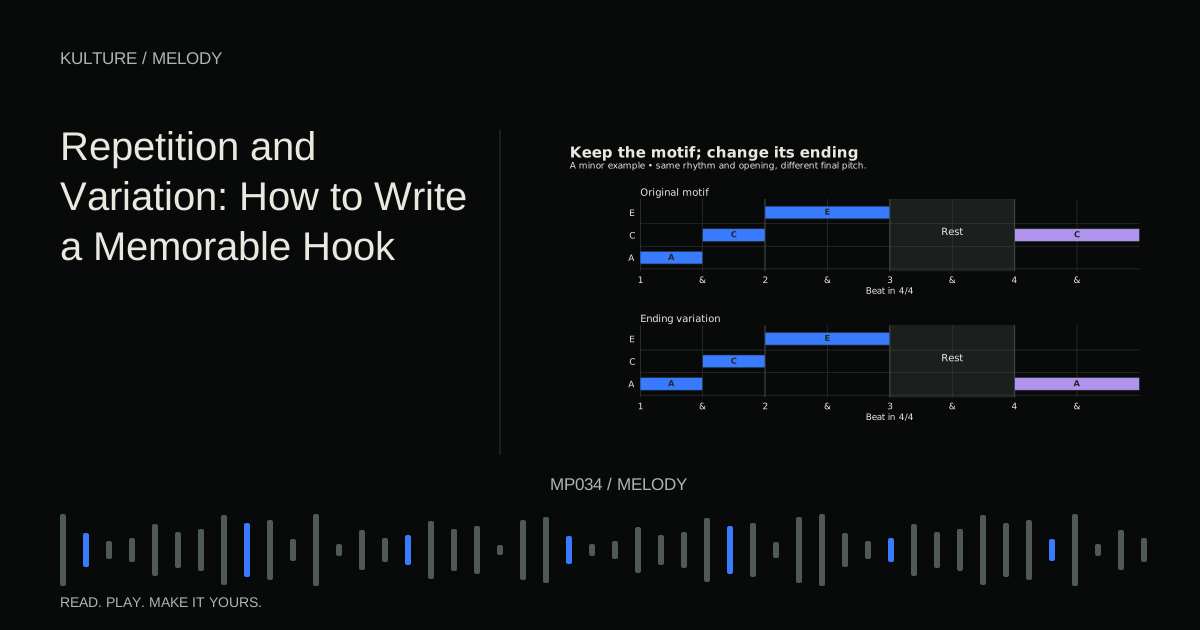
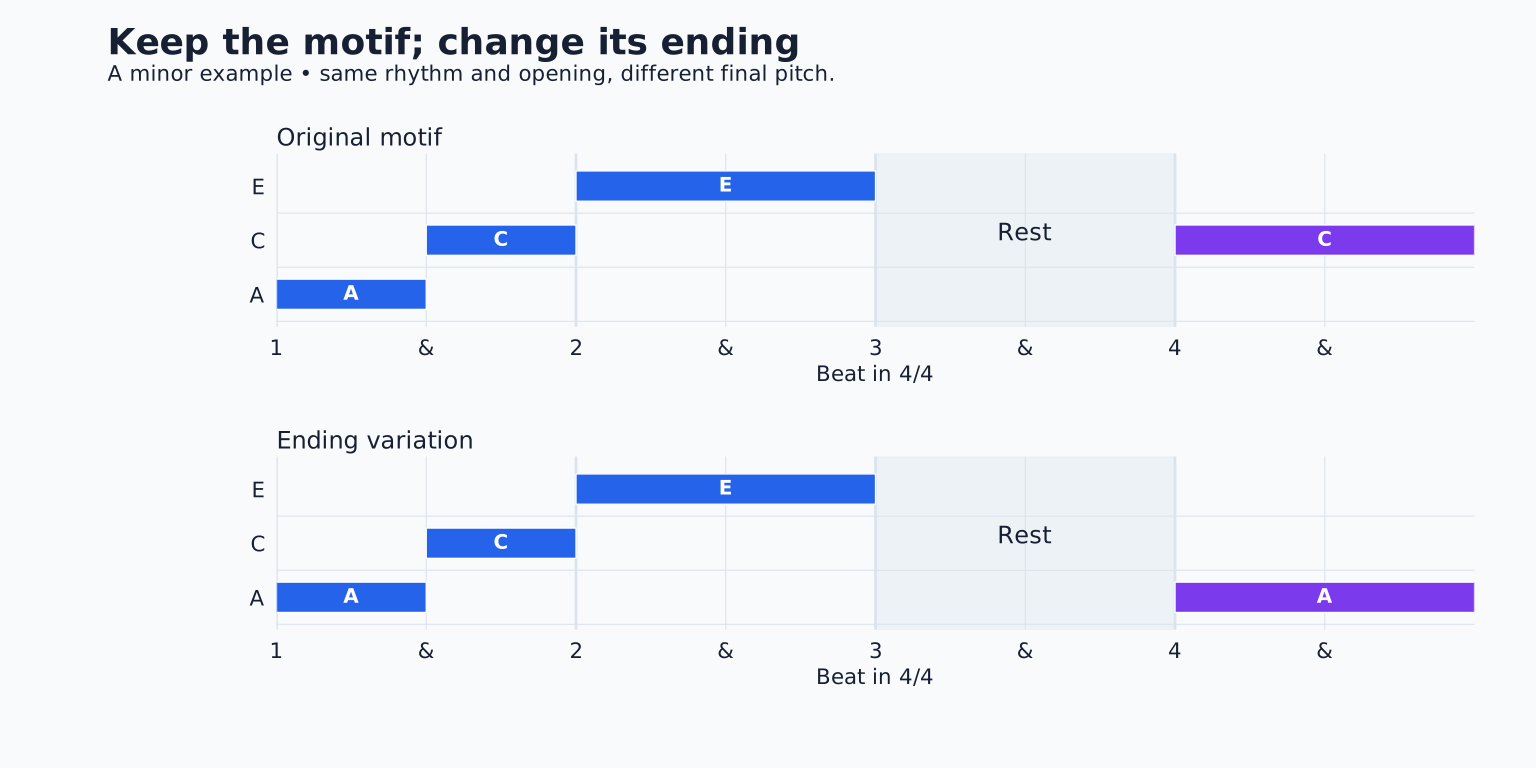
Create a one bar motif in A minor at 100 BPM. Play A on beat 1 for half a beat, C on the “and” of beat 1 for half a beat, E on beat 2 for one beat, rest on beat 3, and C on beat 4 for one beat.
Hum it without the instrument. Notice the quick, quick, long opening and the gap before the final note. Those rhythmic features may be as important as the A, C, E rise.
Ableton's melody introduction offers a useful starting framework for pitch patterns. The exercise here keeps the material small so changes are easy to hear.
TRY IT HERE
Write a small phrase
Choose notes on the grid. Leave a little space.
Ready when you are. Audio starts only when you press Play.
Keep experimenting in the piano LabRepeat before varying
Repeat the motif for two bars without changes. This may feel overly simple while you are staring at the editor, but the listener is hearing it for the first time. Repetition gives them a chance to learn its shape.
Now repeat it four times. Ask when you begin to expect the ending. That expectation is the resource a variation uses. If the motif changes before it is recognizable, the listener may not perceive a variation at all.
Do not confuse your own fatigue after looping a phrase fifty times with the audience's experience. Take a short break and listen from the start of the arrangement before deciding the hook needs constant alterations.
Change only the ending
In the fourth bar, replace the final C with A and hold it through the end of the bar. The first three events remain familiar, while the ending becomes more settled over A minor.
Try a second ending on G instead. It may feel more open and encourage another repetition. The right ending depends on whether you want closure or continuation at that point.
This creates an A, A, A, B phrase structure: A is the original motif and B is its altered ending. The letters describe versions, not musical pitches. You can also use A, B, A, B for a regular two bar cycle or A, A, B, A for a brief departure and return.
Keep the rhythm, change the notes
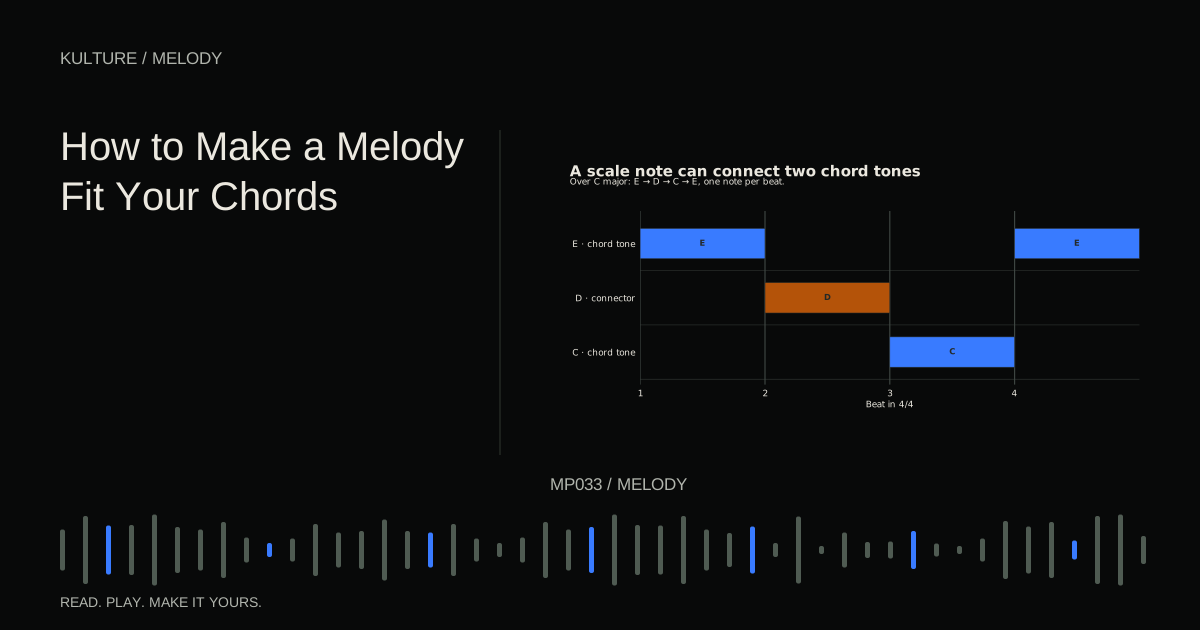
Move the motif through Am, F, C, G while keeping its rhythm. Over Am, use A, C, E, C. Over F, try A, C, F, C. Over C, use G, C, E, C. Over G, try G, B, D, B.
The opening rhythm and pause connect the bars even though their notes change. This is useful when a hook needs to follow a chord progression without becoming four unrelated melodies.
Listen to the contour too. If one version suddenly leaps much farther than the others, it may attract extra attention. That can be a deliberate climax, but it should not happen accidentally because you chose the nearest visible note without considering register.
For harmonic decisions, see How to Make a Melody Fit Your Chords.
Keep the notes, change the rhythm
Return to A, C, E, C and move the final C from beat 4 to the “and” after beat 3. The pitch sequence is unchanged, but the ending arrives earlier. Alternatively, delay the whole motif by one beat, making sure the phrase still fits the intended bar or crosses it deliberately.
Ableton's “Ride” variation lesson explores how changing a pattern's starting position changes its relationship to a steady beat. This is a useful reminder that a hook's identity includes its placement against the pulse.
When shifting a motif, listen to the drums and chord changes. A note that was stable on one chord may become a tension if it now falls after the next chord begins. Rhythmic variation can create harmonic consequences.
Use subtraction as a memorable change
Remove the final note in the fourth bar. The listener expects it, and the missing event creates a small opening. Let a drum fill, vocal answer or bass pickup occupy that space, or leave it empty.
You can also reduce a hook to its first two notes in a verse, then reveal the complete version in the chorus. This makes the fuller hook feel like a development rather than an unrelated new idea.
Subtraction is especially useful when the arrangement is already dense. Adding another layer may make the hook less distinct, while removing an expected event can make the remaining shape more noticeable.
Change register or sound at the right scale
Moving the motif up an octave can create a section level lift. Doing it every other note may turn the motif into a different gesture. Choose the timescale deliberately.
Likewise, a brighter synth or a doubled layer can distinguish the second chorus. But compare at a similar level, because a louder version may seem more exciting for reasons unrelated to the hook itself.
Keep a recognizable core sound when introducing a new layer. If the melody, rhythm, register and timbre all change together, listeners may no longer connect the new version with the original. Sometimes that contrast is desirable, but it is closer to introducing another idea than varying the first.
Build a hierarchy of changes
Use small changes within a phrase and larger changes between sections. For example, a different final note can mark bar 4, an octave lift can mark the chorus, and a stripped two note version can mark the breakdown.
This gives the arrangement a readable scale. If every bar contains the largest possible change, there is little room left for the chorus to feel important.
Write a simple map before editing: bars 1 to 4 establish the hook, bars 5 to 8 alter the ending, the next section removes it, and the chorus brings it back with a brighter articulation. The map should support the song, not force every track into a fixed structure.
Test memorability without overclaiming it
After a short break, try singing or tapping the hook from memory. If only the effect sound remains in your mind, that may still be a valid sonic hook. If you intended a melodic hook, simplify the pitch pattern and check whether its rhythm is distinctive enough.
This is a practical self test, not a guarantee of commercial appeal or a universal law of memory. Different listeners notice different features, and context matters.
If possible, compare versions without looking at their names. Labels such as “improved” or “final” can bias your choice. Listen to how each version enters and leaves the surrounding arrangement, not only to the isolated loop.
Finish a controlled set of variations
Make four eight bar versions from one motif. Version one repeats it plainly. Version two changes only the final note. Version three removes one expected event. Version four changes register only in the second half.
Choose the smallest change that gives the phrase the direction it needs. Then save the unused versions as alternatives rather than combining every idea into one crowded hook.
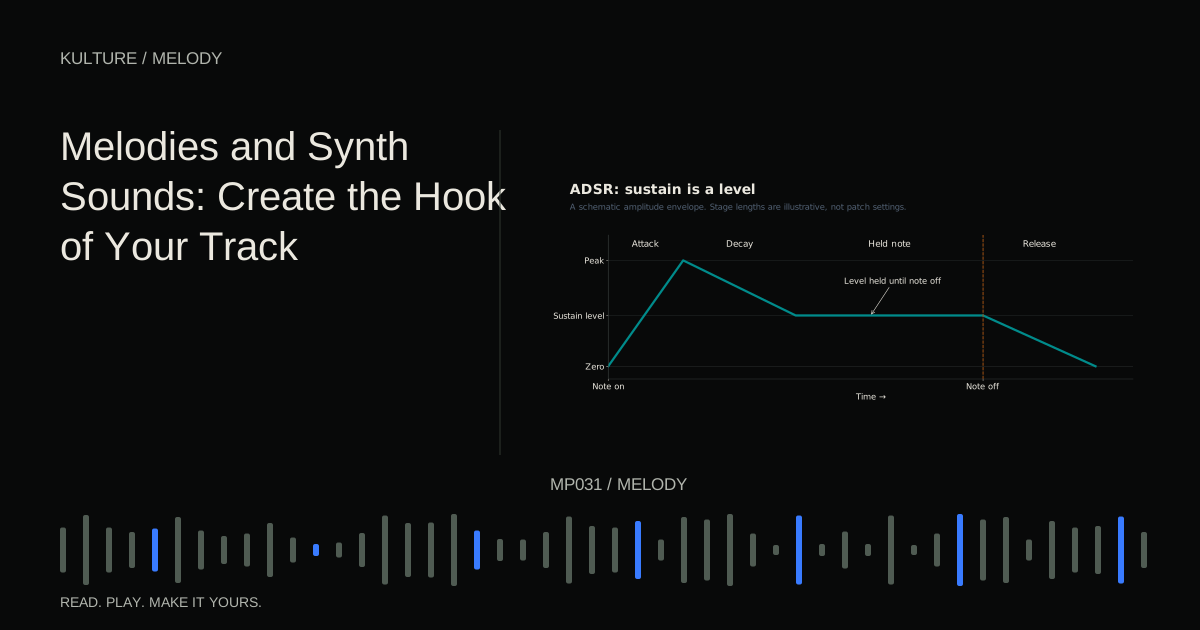
For your next step, use Melodies and Synth Sounds to match the chosen motif with an instrument whose attack, sustain and tone make its identity easy to hear.
TAKE IT INTO YOUR OWN MUSIC
Your next session.
Make four eight bar versions from one motif. Version one repeats it plainly. Version two changes only the final note. Version three removes one expected event. Version four changes register only in the second half.
Notes and progress stay in this browser.