This guide builds a four bar hook from a few notes, develops it into eight bars, and then tests three synth treatments. You can follow it in any DAW with a piano roll and a basic synthesizer.
Decide what the hook needs to do
A hook is a memorable feature of a track. It might be a melody, rhythm, lyric, bass riff or distinctive sound. Here, the hook is a short lead melody that should stand out above drums, bass and chords.
Before writing, choose its role. Is it answering a vocal, carrying an instrumental chorus, or adding a small recurring signature? An answering hook needs gaps. A chorus lead may need a stronger contour and a wider register. A signature sound may need only two notes and a recognizable rhythm.
Ableton's melody introduction provides an interactive starting point for pitch patterns. Our exercise uses an original motif so you can hear how individual changes affect its identity.
TRY IT HERE
Write a small phrase
Choose notes on the grid. Leave a little space.
Ready when you are. Audio starts only when you press Play.
Keep experimenting in the piano LabStart with a neutral sound
Load a simple piano or a soft, uncomplicated synth. Avoid an arpeggiator, heavy delay or a preset that changes pitch automatically. Those features can generate attractive movement, but they make it harder to tell which part of the hook you actually wrote.
Set four bars in 4/4 at 100 BPM. Use C, Am, F, G, one chord per bar. Keep the chords quiet and sustained. The shared pitch collection is C, D, E, F, G, A and B.
You do not need to use all seven notes. Limiting your choices makes rhythm and contour easier to hear. Begin with E, G and A in a middle to high register, above the bass and most of the chord weight.
Write a one bar motif
Use these events in the first bar over C major:
| Position | Note | Duration |
|---|---|---|
| Beat 1 | E | Half a beat |
| And of beat 1 | G | Half a beat |
| Beat 2 | E | One beat |
| Beat 3 | Rest | One beat |
| Beat 4 | G | Half a beat |
| And of beat 4 | A | Half a beat |
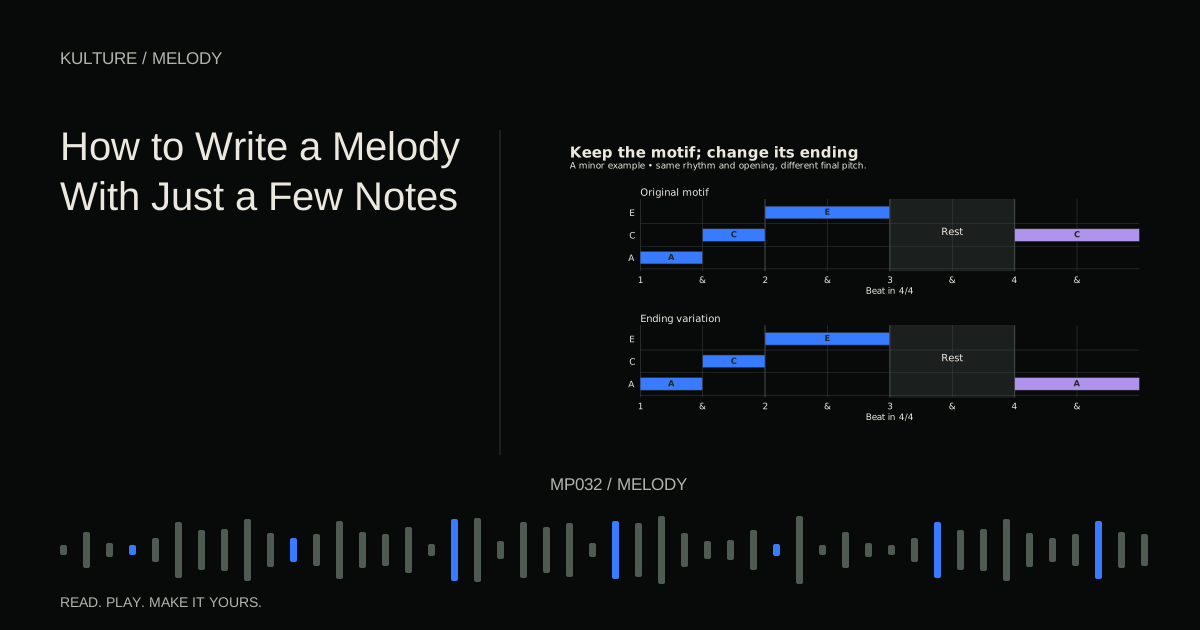
Count through the rest rather than rushing to the last two notes. The gap is part of the motif. The E, G, E opening creates a recognizable shape; the final G, A gesture leads forward.
Play the motif repeatedly. Can you hum it after stopping playback? If not, simplify it or make the rhythm more distinctive before adding more notes. Memorability is not guaranteed by any formula, but this is a useful practical test.
Fit the motif to changing chords
In bar 2 over A minor, keep the same rhythm but use E, A, E, then G, E for the final pair. In bar 3 over F, use F, A, F, then G, A. In bar 4 over G, use G, B, G, then D, G.
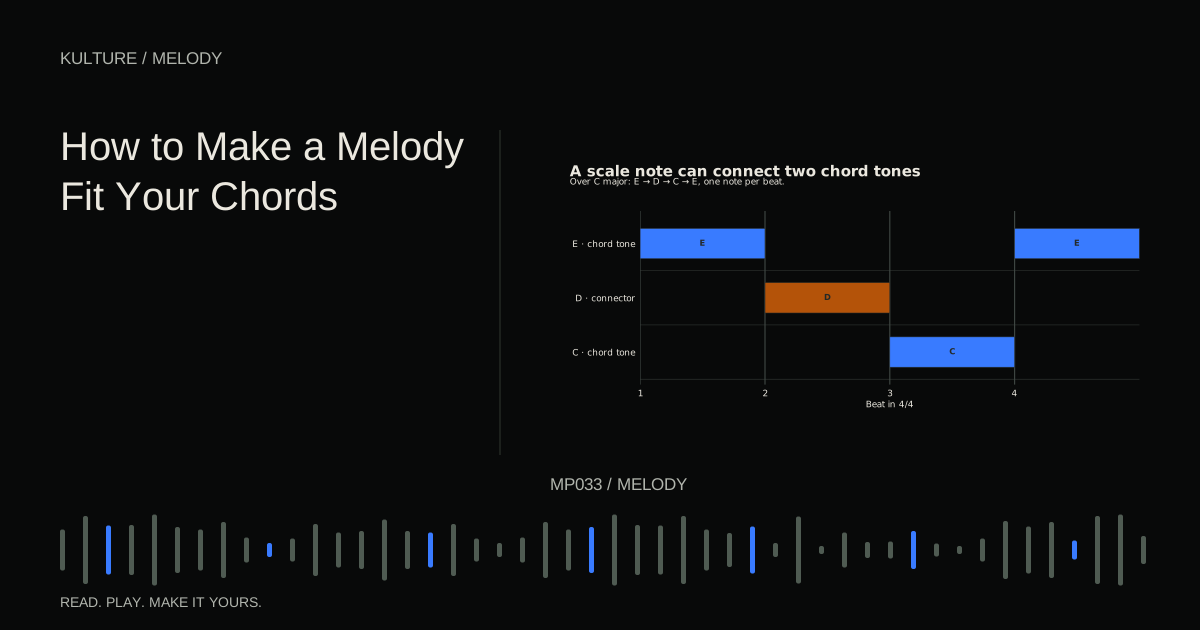
These versions preserve the rhythm while adapting the main notes to each chord. The G and A passing gestures create different colors in context. Listen to sustained notes and phrase endings most carefully, because they carry more harmonic weight than brief connectors.
You can also keep the original motif unchanged over all four chords and compare. It may produce attractive repeated note tension. Matching chords does not require every melody note to be a chord tone, but understanding the relationship helps you choose the tension deliberately.
For a more focused approach, see How to Make a Melody Fit Your Chords.
Shape a larger phrase
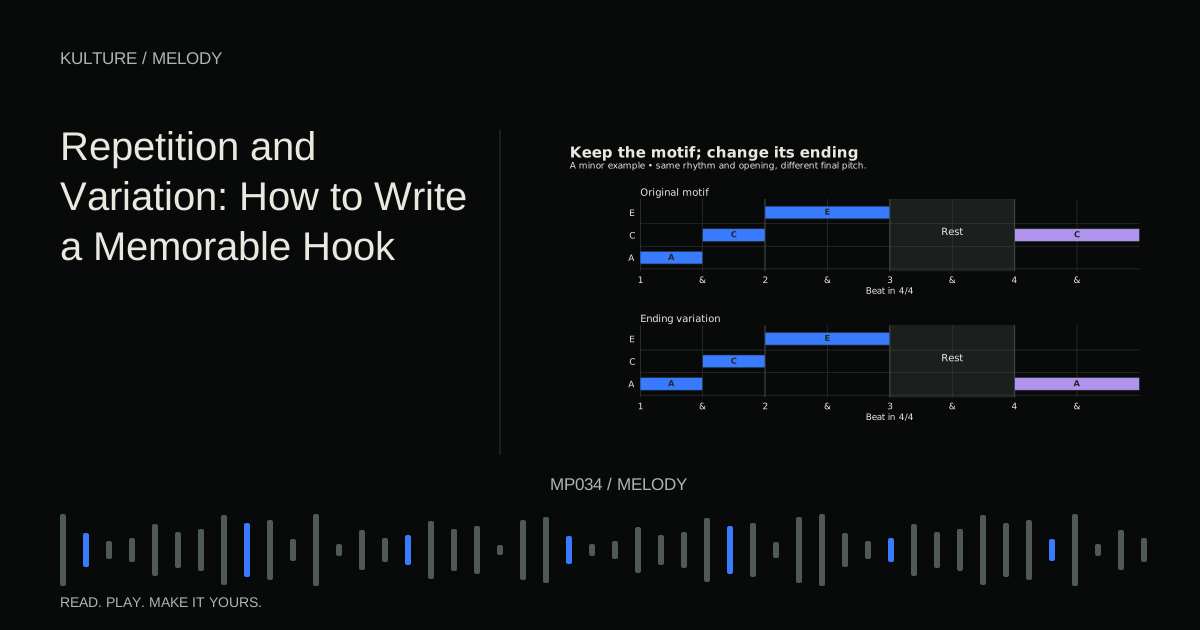
Duplicate the four bars. In the second pass, keep bars 5 and 6 familiar. In bar 7, move the first A you choose to emphasize an octave higher, or hold one note longer. In bar 8, end with a sustained C if you want a stronger return toward the opening C harmony.
Check that the final C does not create an unwanted held clash against the G chord before the loop returns. You can delay it until the next downbeat, shorten the G chord, or choose B or G as the final note instead. The phrase ending and the chord timing must work together.
The goal is a recognizable first half and a purposeful second half change. If every repetition has a different rhythm, different notes and different register, you may have written several unrelated ideas rather than one developed hook.
Ableton's melody variation exercise offers another way to explore changed starting positions and pitch relationships while retaining a limited musical world.
Match the synth envelope to the rhythm
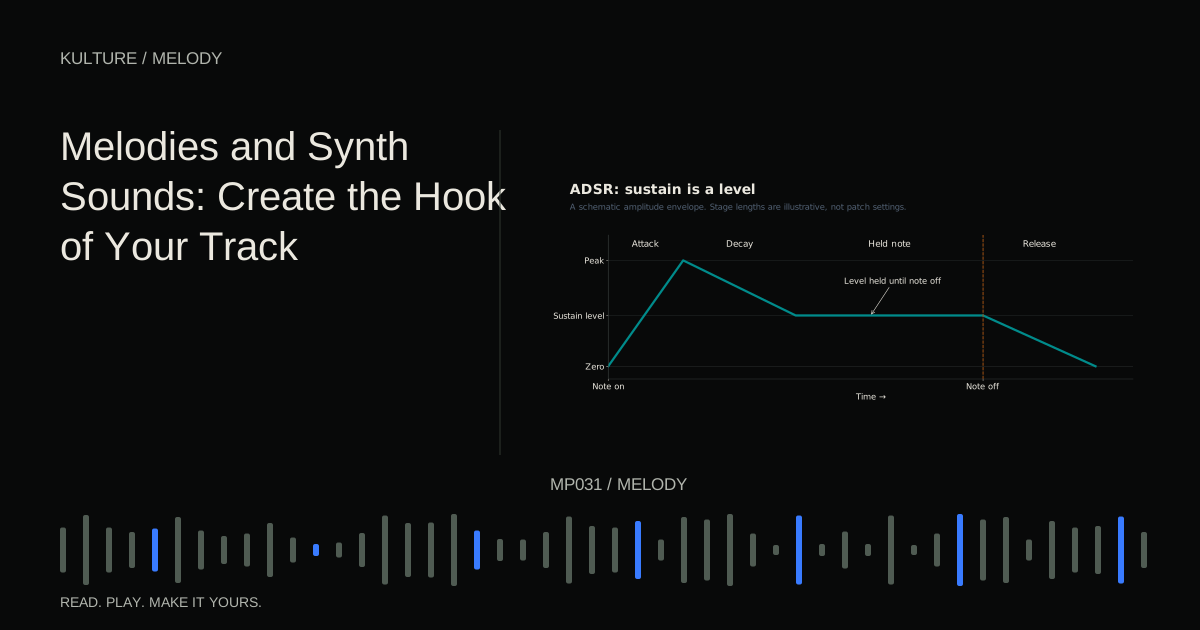
An oscillator generates a repeating sound source. A filter changes its frequency balance. An amplitude envelope shapes its loudness over time. A low frequency oscillator, or LFO, creates repeating modulation, such as a gentle change in pitch or brightness.
You do not need to master every synthesis method for this hook. Begin with one oscillator, a low pass filter and an amplitude envelope. The Ableton instrument reference documents these building blocks in its synths; the same concepts appear in many instruments.
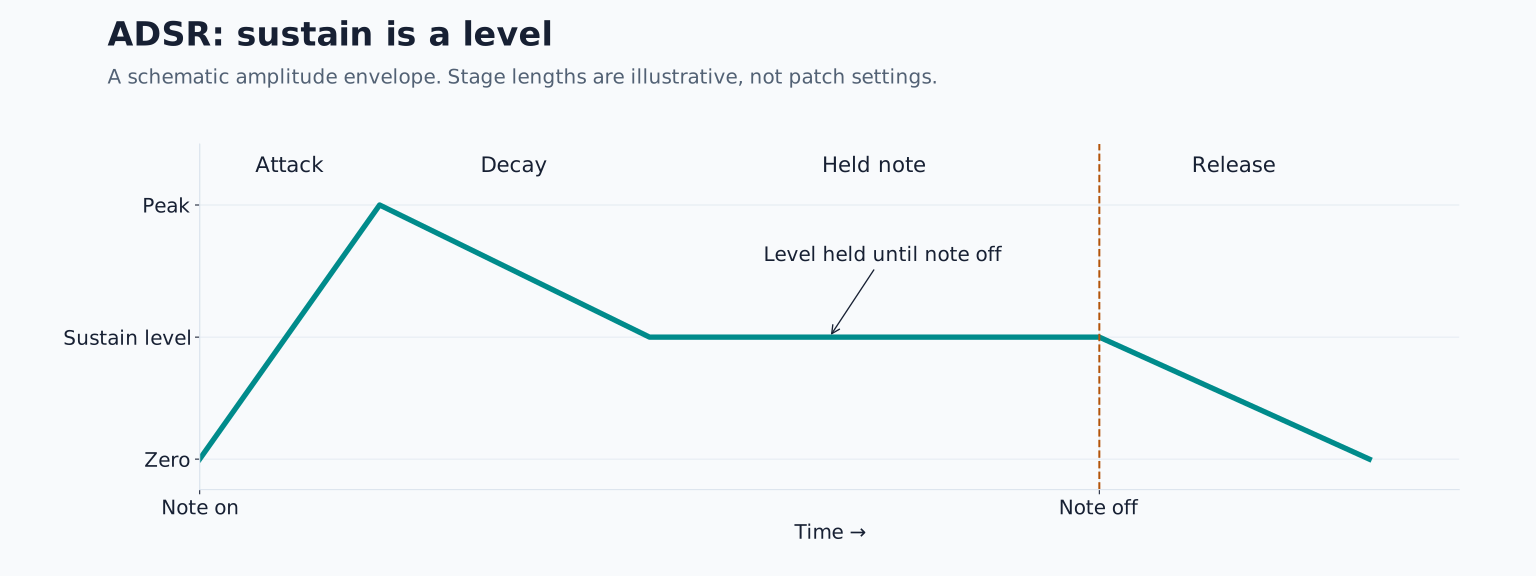
For a pluck, use a quick attack, a decay that lets the note fade, little or no sustained level, and a short release. For a lead, retain enough sustain to hear held notes. For a pad like version, use a slower attack and longer release, but expect to simplify or lengthen the melody so its notes do not disappear into overlap.
The settings should follow the phrase. A half beat note at 100 BPM lasts 300 milliseconds. If your attack takes most of that time, the note may end before it becomes prominent.
Choose brightness for the arrangement
A bright saw like sound can cut through a busy mix, but it can also compete with vocals, hats and upper chord notes. A smoother waveform or lower filter cutoff may give the hook a clearer role without making it louder.
Try the same melody with a soft tone, a bright pluck and a sustained lead. Match perceived level before choosing. Ask which version makes the rhythm easiest to understand and which leaves room for the other important part.
Do not confuse a huge solo sound with a useful arrangement sound. A wide preset with several detuned layers may occupy more space than the hook needs. One focused voice can communicate the melody more directly.
Add modulation sparingly
A small amount of vibrato, periodic pitch movement, can add expression to held notes. Delaying its onset can keep the attack clear. Modulating filter brightness can make a sustained tone feel alive without changing its pitch.
Start with one modulation destination and a shallow amount. If the melody becomes hard to sing back, the sound may be moving too much. Random pitch motion can also make chord relationships seem wrong even when the MIDI notes are correct.
For deeper sound construction, continue with Synthesizers Explained. Keep the musical motif simple while learning a new sound design control.
Use delay as an arrangement part
A delay repeats the sound after a chosen interval. Those echoes occupy rhythmic space, so they can fill the motif's rests or answer it. Begin with a quiet delay and compare an eighth note repeat with a quarter note repeat.
If the echoes obscure the final G, A gesture, reduce their level, shorten their feedback or choose a different interval. Feedback controls how much repeated signal recirculates, affecting the number and duration of echoes.
Do not automatically remove every gap with effects. The rest in beat 3 may be what makes the hook breathe. A dry version can be more memorable if its rhythm is clearer.
Test the hook in the full track
Bring the bass and drums back to their intended levels. If the hook vanishes, first check register and competing notes. Moving it an octave may help, but it may also become too sharp or intrusive. Removing an upper chord note can be a better solution.
If the hook seems repetitive, change its final bar or its entrance rather than rewriting every repetition. If it feels disconnected, match its accents to a useful part of the groove while preserving some contrast.
If it sounds impressive but unmemorable, return to the neutral instrument. Can you still recognize the musical idea? If not, simplify the note pattern and rebuild the sound around it.
Finish one hook in three forms
Save the eight bar melody as a plain instrument version, a pluck version and a sustained lead version. Listen to each after a short break, with the arrangement playing. Choose the version whose phrasing and role are clearest.
Then make one intentional contrast for the next section: remove the hook, lower its register, or reduce it to its opening gesture. A hook often becomes more effective when the arrangement gives listeners a chance to miss it. For further development, read Repetition and Variation.
TAKE IT INTO YOUR OWN MUSIC
Your next session.
Save the eight bar melody as a plain instrument version, a pluck version and a sustained lead version. Listen to each after a short break, with the arrangement playing. Choose the version whose phrasing and role are clearest.
Notes and progress stay in this browser.