Start with a short motif you can hum. Repeat enough of it to establish an identity, then change one detail when the phrase needs movement.
Choose a small, useful note set
For an A minor exercise, use A, C and E. These are the notes of the A minor triad. Add G later if you want one extra color. You do not need to use every note of the scale to establish a musical idea.
Load a plain piano or soft lead and create two bars at 100 BPM in 4/4. Put a quiet A minor chord or low A beneath it. That background makes the tonal center easier to hear.
Ableton's melody lesson introduces melodies as pitch patterns you can explore interactively. If the chord notes are unfamiliar, begin with How to Build Major and Minor Chords.
TRY IT HERE
Write a small phrase
Choose notes on the grid. Leave a little space.
Ready when you are. Audio starts only when you press Play.
Keep experimenting in the piano LabWrite rhythm on one note first
Use A for every event. Place a half beat note on beat 1, another on the “and” of beat 1, a one beat note on beat 2, and a one beat note on beat 4. Leave beat 3 empty.
Count “1 and 2 and 3 and 4 and.” The first two notes are quick, the third is longer, then a gap leads to the last note. Even without pitch changes, this is a recognizable rhythmic gesture.
Try moving the last note to the “and” after beat 3. The phrase now anticipates beat 4. Choose the version you prefer and keep it fixed while adding pitches. Changing rhythm and pitch simultaneously makes the comparison less clear.
Give the rhythm a contour
Change the four notes to A, C, E, C. The line rises through the first three events and then falls. Contour describes this general shape, independent of the exact intervals.
Now try E, C, A, C with the same rhythm. It begins high, falls and returns slightly upward. The pitches are identical as a collection, but the direction changes the phrase's character.
Try a third version, A, A, E, C. Repeated notes at the beginning make the leap to E more noticeable. You have created three different melodies from the same small palette without adding complexity.
Choose one based on how it fits the groove, not on which uses the widest range. A small repeated shape can be easier to remember than constant movement.
Make a two bar answer
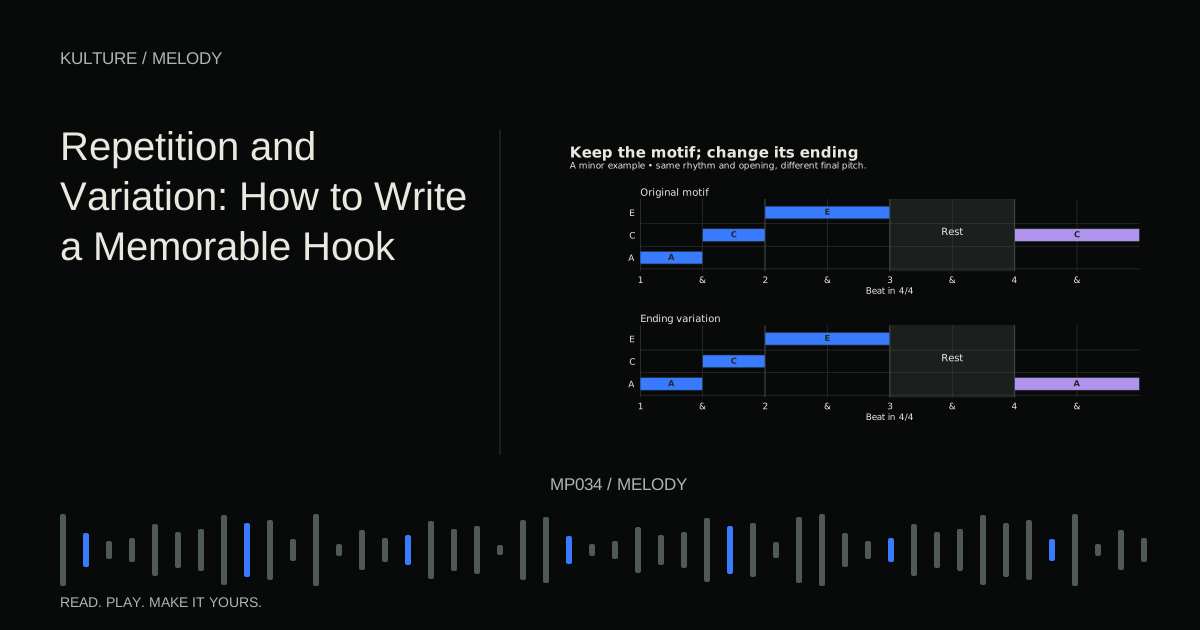
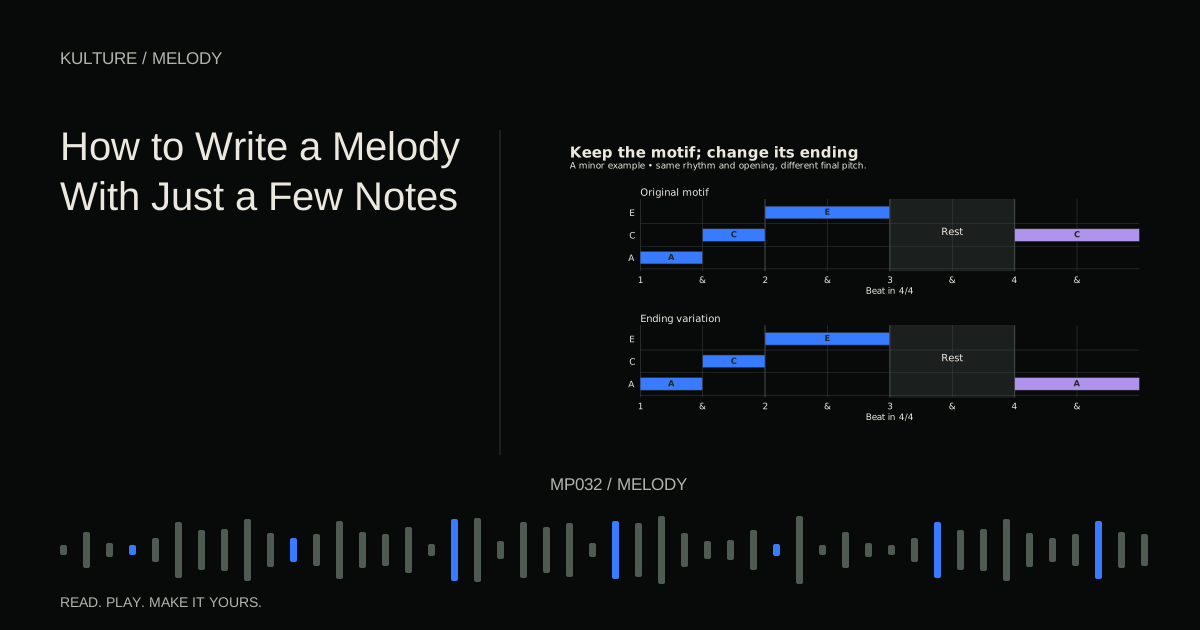
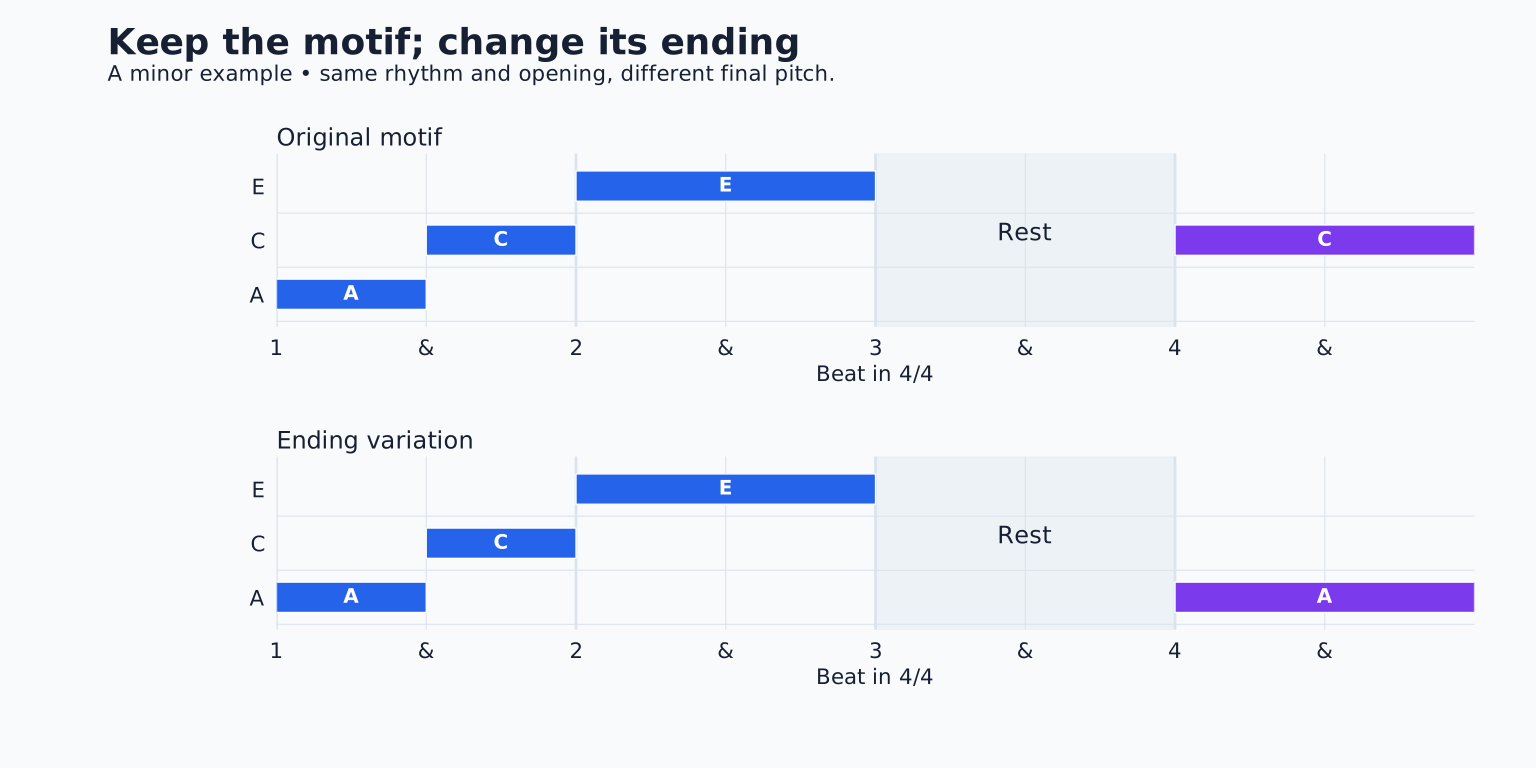
Repeat your chosen first bar in bar 2, but change the final note to A and hold it longer if space allows. The second bar now sounds more settled against the A minor background.
For example, bar 1 uses A, C, E, C, while bar 2 uses A, C, E, A. Keep the opening rhythm identical. The listener recognizes the beginning and notices the new ending.
You can also answer through silence. Remove the last note in bar 2 and let the phrase pause. That may feel more open, especially if another instrument responds in the gap.
Do not assume a melody must fill the entire loop. A short phrase followed by space can become a stronger hook than continuous notes.
Use one new note with a specific job
Add G only in the second bar, just before the final A. In A natural minor, G sits a whole tone below A. It can act as a brief approach that makes the return to A easier to hear.
Keep the G short initially. Then hold it and compare. The longer version may feel less resolved or create a different emotional color. The note itself is not good or bad; its duration and destination change its role.
If you prefer the three note version, keep it. A new note should earn its place by improving the phrase, not merely by increasing variety. Major vs Minor Scales explains the larger collection when you are ready to expand.
Use repetition at the right level
You can repeat a pitch, a rhythm, a contour or an entire motif. These are different kinds of familiarity. Repeating the rhythm while changing notes can connect phrases across different chords. Repeating the notes while changing the ending can create a call and response effect.
Try four bars in an A, A, A, B structure, where A means your original motif and B means the altered ending. The first three bars establish an expectation; the fourth changes it.
Then try A, B, A, B. The variation becomes part of a regular two bar cycle. Neither structure is automatically better. Choose the one that fits the size of your song phrase.
Ableton's variation exercise explores how limited pitch material can support different pattern interpretations and starting positions.
Keep the sound from hiding the melody
A very slow synth attack can make short notes hard to hear. A long release or heavy delay can fill the rests and blur the rhythm. Choose an articulation that makes your written note lengths audible.
Try the melody on a pluck and a sustained lead. The pluck emphasizes attacks; the lead emphasizes held pitches and connections. Adjust durations to suit the instrument rather than assuming one MIDI performance should work unchanged on every preset.
If the melody only seems interesting with a complex arpeggiated preset, distinguish your written notes from the automatic notes generated by the instrument. Both can be useful, but knowing the difference gives you control over the hook.
Adapt the idea to changing harmony
Place the melody over Am, F, one chord per bar. A and C belong to both chords; E belongs to Am and creates an added major seventh color against F. That color may be attractive, but it is not the same relationship in both bars.
Try changing E to F in the F bar while preserving the rhythm. Compare the more chord focused version with the repeated note version. This is a practical way to hear why a melody can remain in one scale yet interact differently with each chord.
Continue with How to Make a Melody Fit Your Chords when the progression becomes more complex.
A short completion test
Stop playback and hum the two bar phrase. If you cannot recall it, simplify one element or repeat its main gesture more clearly. This is a personal writing check, not a scientific guarantee that everyone will remember it.
Then play it with the full arrangement. Does the rest leave useful space? Does the final note feel like the ending you intended? Does one pitch sound unnecessarily high or low for the instrument?
For your exercise, make three melodies using only A, C and E and the same two bar length. Give one a rising shape, one a falling shape and one repeated note opening. Choose one, add a single G only if needed, and finish a four bar phrase before searching for more notes.
TAKE IT INTO YOUR OWN MUSIC
Your next session.
Stop playback and hum the two bar phrase. If you cannot recall it, simplify one element or repeat its main gesture more clearly. This is a personal writing check, not a scientific guarantee that everyone will remember it.
Notes and progress stay in this browser.