Start by identifying the chord underneath each phrase. Then pay special attention to long notes, accented notes and endings, because they often define the listener's harmonic impression.
Map the harmony before editing the melody
Use C, Am, F, G, one chord per bar. Write the chord tones:
- C major: C, E, G
- A minor: A, C, E
- F major: F, A, C
- G major: G, B, D
The Open Music Theory triad reference explains how these three note structures are built. A chord tone is simply a note belonging to the current chord; it is not necessarily the song's tonic.
For example, B belongs to G major even though the overall progression may center on C. F belongs to the C major scale but not to a plain C major triad. Scale membership and chord membership answer different questions.
TRY IT HERE
Write a small phrase
Choose notes on the grid. Leave a little space.
Ready when you are. Audio starts only when you press Play.
Keep experimenting in the piano LabWrite a melody using only landing notes
Create four bars at 100 BPM in 4/4. Put E over C, E over Am, F over F and G over G. Hold each note for two beats, then leave two beats of silence.
This plain line already follows the harmony. E stays common across the first two chords, then rises to F and G. Play it with the chords and listen to the changing context under the repeated E.
Now change the second E to C. Both notes belong to A minor, but the contour changes. One version stays still before rising; the other dips and then climbs. Harmonic fit does not decide the melody's shape for you.
Choose the version whose direction supports your phrase. You are establishing anchors, not writing the final melody in one pass.
Connect anchors by step
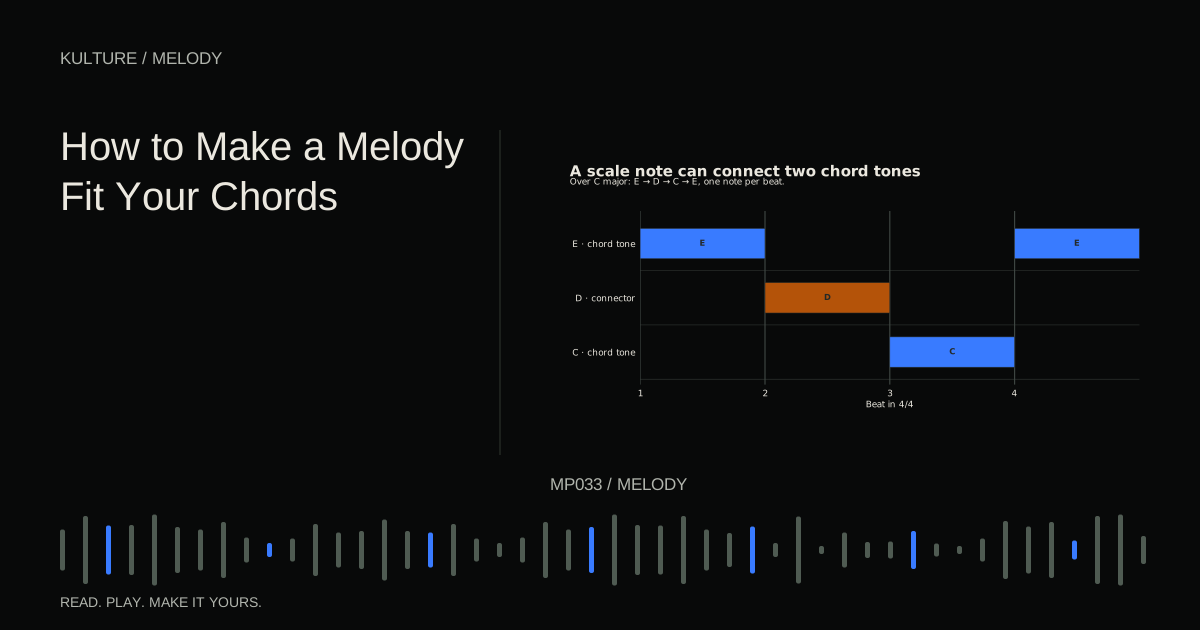
Between E and F, you can simply move directly. Between C and F, try D and E as short connecting notes. Keep the destination F longer or more accented so the line's direction remains clear.
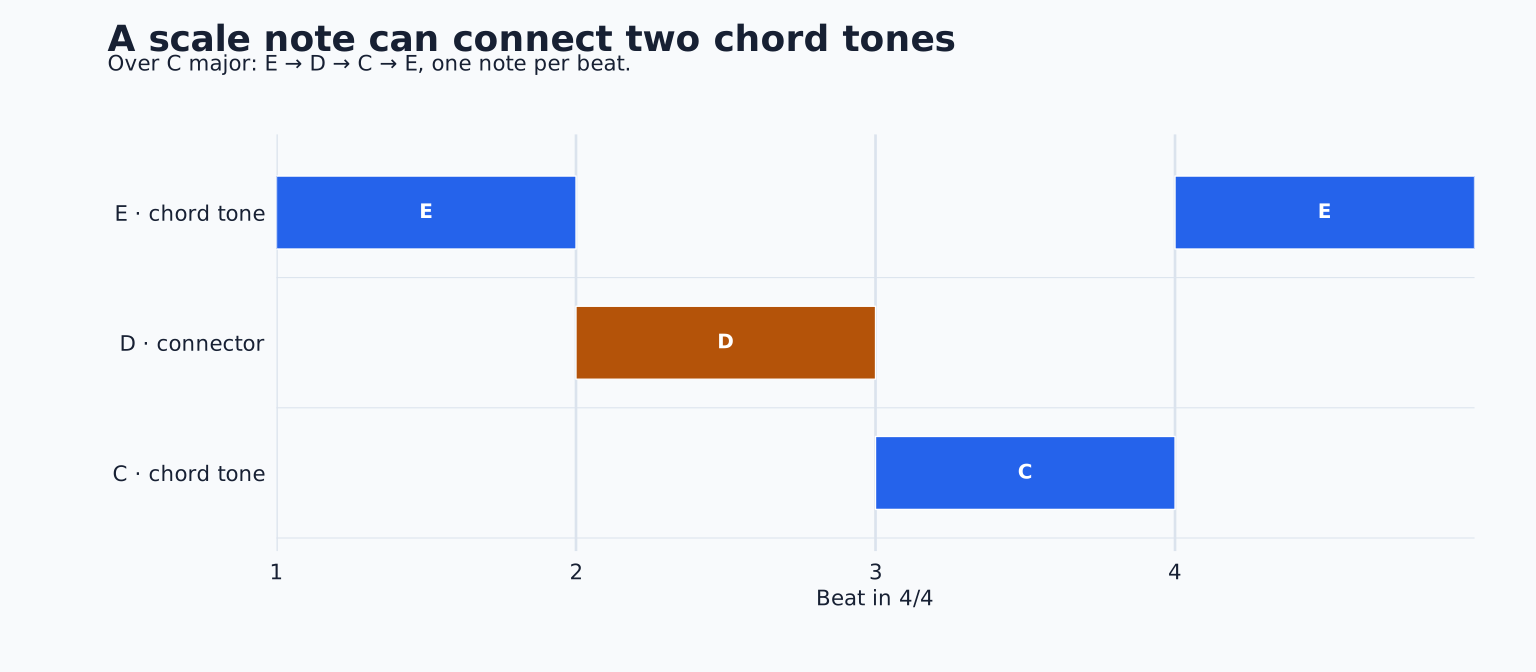
For a concrete first bar over C major, play E on beat 1, D on beat 2, C on beat 3 and E on beat 4. D is a scale note outside the C triad, but its movement between chord tones can sound natural.
Now delete the C and final E, leaving E on beat 1 and D held across beats 2 to 4. The same pitch becomes a more prominent harmonic color. This demonstrates why duration matters: a brief connector and a sustained tension are different compositional events.
Do not treat non chord tones as mistakes to remove automatically. Decide whether their tension has a useful role and whether the surrounding phrase makes their direction understandable.
Try a neighbor note
A neighbor note moves away from a stable pitch and returns to it. Over C major, play E, F, E, with F shorter than the surrounding E notes. The F creates a small upper neighbor motion.
Try E, D, E as a lower neighbor version. Compare the two over the same chord. The upper and lower neighbors have different interval relationships to the chord tones, even though both return to E.
If the F sounds too sharp or crowded against a sustained E in the chord instrument, shorten it, move it to a weaker rhythmic position, or change the chord voicing. You can also keep the tension if it suits the music. The goal is intentional listening, not eliminating every close interval.
Let a note continue across a chord change
Hold E from the C bar into the A minor bar. It remains a chord tone in both, creating continuity. Now hold G from C into Am. G is no longer part of the basic Am triad, so it adds a different color.
A sustained note can connect harmony or create tension depending on what changes underneath it. If you want a clear resolution, move the G to E or A after the chord change and listen to the release of tension.
Do not label every held non chord tone a suspension automatically; traditional theory uses that term for specific preparation and resolution patterns. For production, the practical question is whether the held note's changing relationship is audible and purposeful.
Build a complete four bar example
Use quarter notes unless a duration is specified:
| Chord | Melody |
|---|---|
| C | E, G, E, D |
| Am | C, E, C, A |
| F | A, G, F held for two beats |
| G | G, A, B, D |
The first two bars share a similar shape. The third descends to a stable F. The fourth climbs through A, a non triad scale tone, toward B and D, both G chord tones.
Loop back to E over C. Does the D to E motion feel like a convincing return? Try ending the G bar on B instead and compare. Both endings use chord tones, but they lead differently into the next phrase.
Ableton's melody playground is useful for hearing similar pitch pattern experiments outside a dense production.
Sometimes change the chord instead
If you love a melody note but dislike its harmony, the melody does not always have to move. Try another chord that supports the note. For example, a long A may feel more settled over Am or F than over a plain G triad.
Changing the chord also changes the bass and the song's direction, so audition the whole phrase. Do not replace harmony solely to remove every tension; the tension may be what gives the melody character.
You can also change the voicing. Removing a directly competing upper chord tone can make a melody note clearer without changing the chord's basic identity. Chord Inversions and Voice Leading explains how register and spacing affect this relationship.
Check register, tuning and sound before rewriting
A melody can appear harmonically wrong because the instrument is transposed, a sample is mapped incorrectly, or a preset adds parallel pitches. Play the line on a plain piano to verify the written notes.
If the notes work there, inspect the sound. Heavy detuning, pitch envelopes or delayed echoes can create additional pitches and overlaps. A long release can carry the old melody note into the next chord unintentionally.
Register matters too. A close clash high in the arrangement may sound expressive, while the same interval low down can sound dense. Move the melody or chord voicing by an octave and compare before changing the actual pitch classes.
Practice with anchors and connectors
Take a four bar melody and mark its longest or most accented note in each bar. Compare each with the chord tone map. Keep the notes you like, but identify which are stable chord tones and which create tension.
Then write a second version using only chord tones for those anchors, while allowing short connecting notes between them. Compare the original and revised versions in context. Choose based on the desired expression, not the number of notes that pass a theoretical checklist.
For a simpler starting melody, use How to Write a Melody With Just a Few Notes. Once the harmony works, develop its identity with Repetition and Variation.
TAKE IT INTO YOUR OWN MUSIC
Your next session.
A neighbor note moves away from a stable pitch and returns to it. Over C major, play E, F, E, with F shorter than the surrounding E notes. The F creates a small upper neighbor motion.
Notes and progress stay in this browser.