The technique appears in many musical traditions. In production, its practical value is that it gives parts clear turns and relationships. Instead of several instruments playing continuously, each has a reason to enter and a reason to leave space.
Hear the conversation before adding complexity
A call does not have to sound literally like a question, and a response does not have to resolve every tension. The essential feature is the perceived relationship between phrases.
Try singing a short pattern and answering it with claps. If the clap rhythm feels connected to what you sang, you already have the basic mechanism. If it feels like an unrelated interruption, repeat one rhythmic feature or place the response more clearly in the gap.
Berklee's discussion of musical exchange across traditions notes call and response as an important musical relationship. The exercises here are original production studies, not claims to represent a specific cultural practice.
TRY IT HERE
Write a small phrase
Choose notes on the grid. Leave a little space.
Ready when you are. Audio starts only when you press Play.
Keep experimenting in the piano LabWrite a two bar melodic conversation
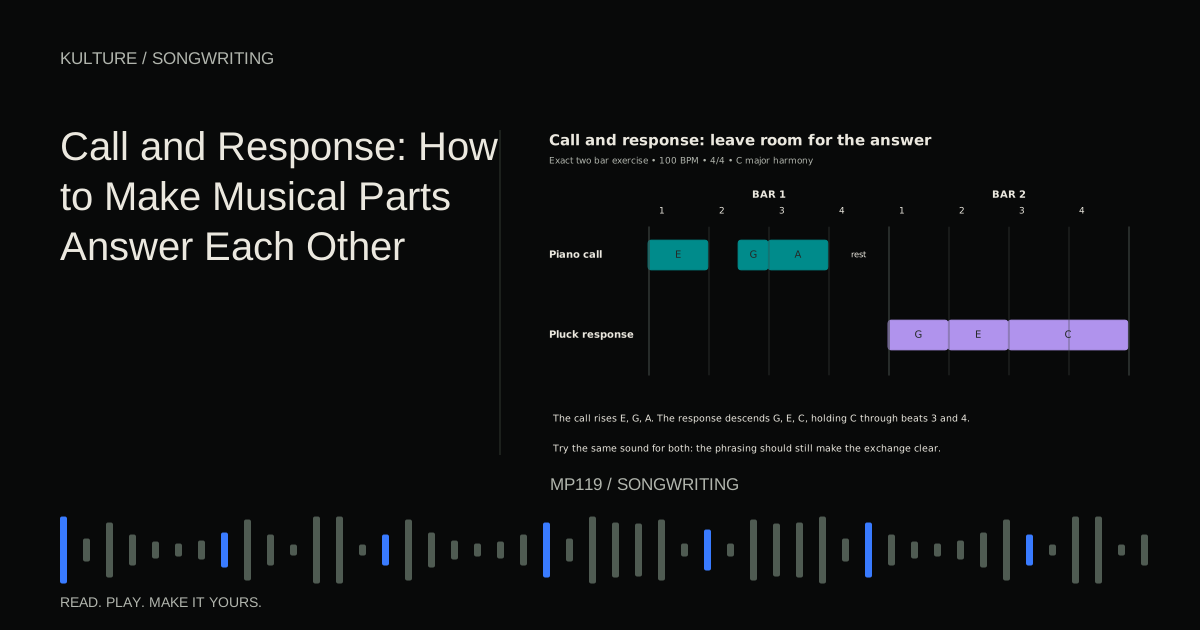
Set 100 beats per minute in 4/4 and hold a C major chord. Use a piano for the call and a softer pluck for the response.
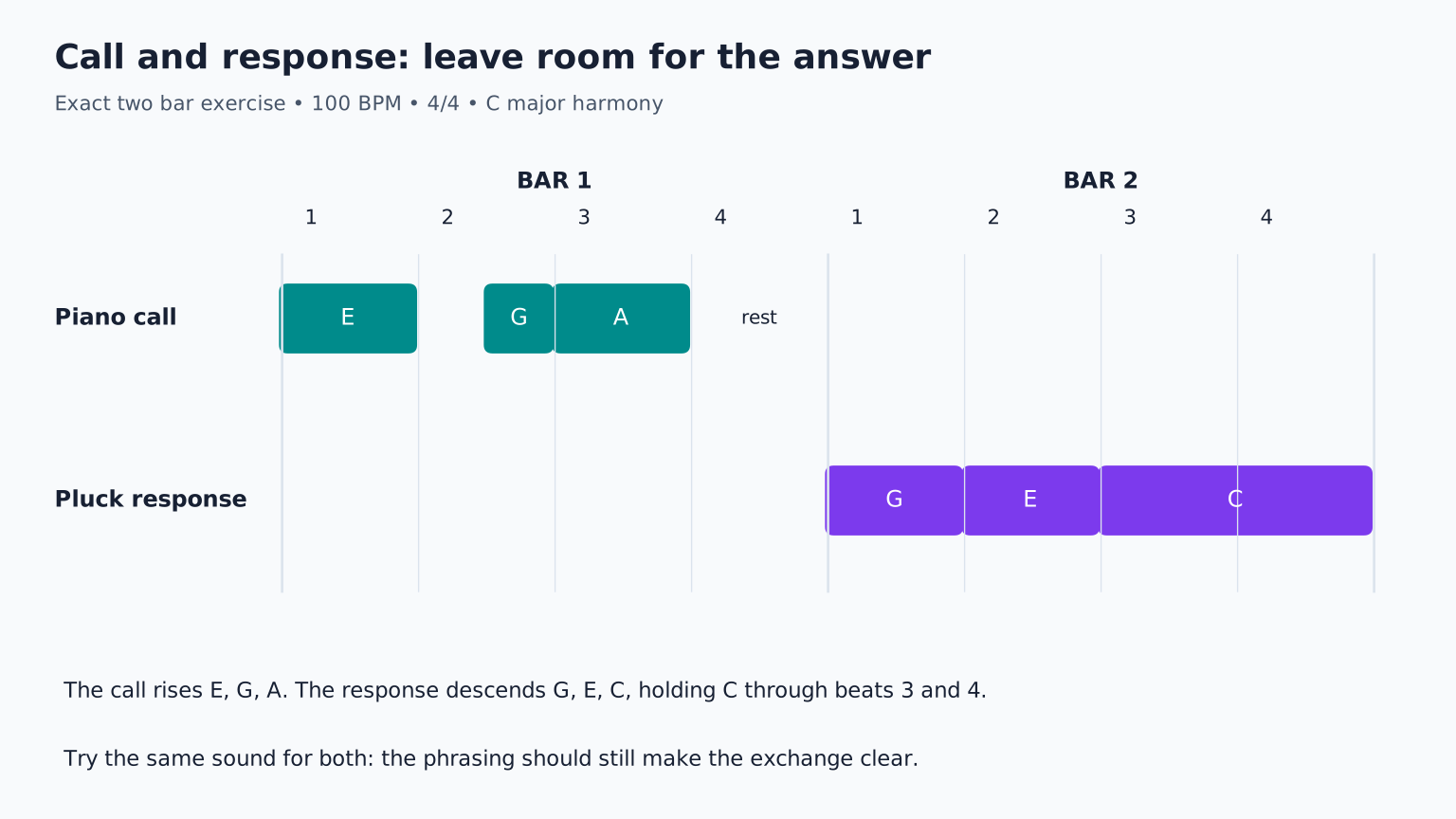
In bar 1, play E on beat 1 for one beat, G on beat 2 and for half a beat, and A on beat 3 for one beat. Leave beat 4 empty. In bar 2, answer with G on beat 1, E on beat 2, and C held from beat 3 to the end.
The call rises from E to A; the response descends toward C. The instruments take separate bars, so their roles are easy to hear. Keep the response slightly quieter at first, then compare equal levels if you want a more balanced exchange.
Now play both phrases with the same sound. If the relationship remains clear, the composition is doing the work. Different timbres can reinforce the dialogue, but they are not a substitute for phrasing.
Make four kinds of response
Echo: repeat E, G, A with the same rhythm, perhaps lower or softer. This reinforces the call and can feel communal or insistent.
Completion: use G, E, C as above, giving the phrase a more settled ending.
Contrast: answer with one held C rather than several short notes. The change in density makes the response feel calm or decisive.
Challenge: answer with a rising G, A, B and leave it unresolved. The exchange now invites another phrase instead of closing immediately.
These functions depend on harmony and context. A B over C major may feel tense, but the same note over G major has a different role. Listen to the complete phrase rather than assigning emotional labels to isolated notes.
Put responses inside vocal gaps
Record an original vocal line such as “Stay until the morning,” ending before beat 4 of a two bar phrase. Place a short guitar response only after the final sung syllable. Try two notes, E, G, rather than a long solo.
If the singer's breath is expressive, leave it audible instead of filling every gap. The response should feel like an answer to the line, not an attempt to eliminate all silence.
When the next vocal begins, stop or simplify the response. A delay tail may continue, but check that it does not obscure the new words. If the instrumental starts before the vocal ends, decide whether that overlap creates useful anticipation or competition.
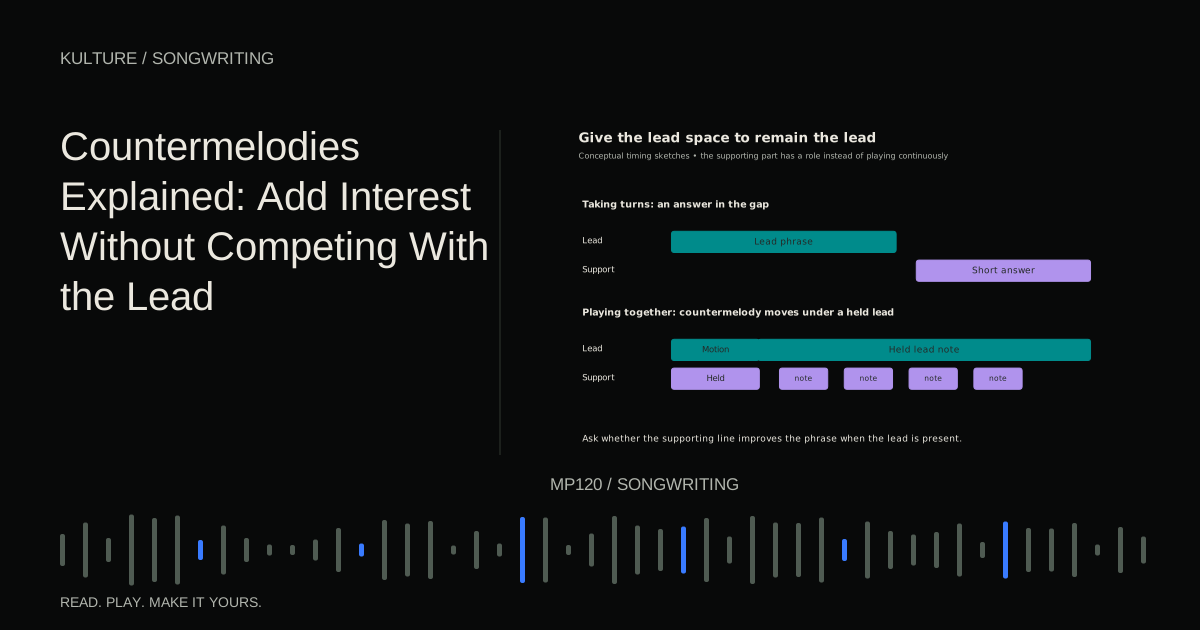
This is different from a countermelody, which often operates simultaneously with the lead. The boundary is flexible, but the arrangement question is clear: are the parts taking turns or speaking together? See countermelodies for the simultaneous case.
Let bass and drums answer each other
Call and response can be entirely rhythmic. At 120 BPM, place a kick on beat 1 and a short bass note on 1 and. Add a snare on beat 2 and a bass response on 2 and. Leave beat 3 simpler, then use a percussion pickup into beat 4.
Do not make every drum hit trigger a bass note. That creates doubling rather than a conversation. Try muting the bass and clapping its rhythm in the drum gaps. If the pattern feels purposeful, restore the pitched sound.
A four bar example can use a stable bass call for three bars and a drum fill as the answer in bar 4. Keep the bass quiet or absent during the fill so the response has room. The whole phrase then breathes on a larger timescale.
Use register and articulation to separate roles
Register is where a part sits in pitch: low, middle, or high. A low call and high response are easy to distinguish, but the pitch gap should still suit the song. Two similar sounds in the same register may need more separation in rhythm or articulation.
Articulation describes how notes begin, sustain, and end. A short pluck can answer a held vocal. A sustained pad can answer a sharp rhythmic figure. These differences can create conversation without drastic panning or volume changes.
Check the exchange in mono. If it only makes sense when one part is hard left and the other hard right, improve the musical distinction rather than relying entirely on stereo placement.
Develop the exchange across sections
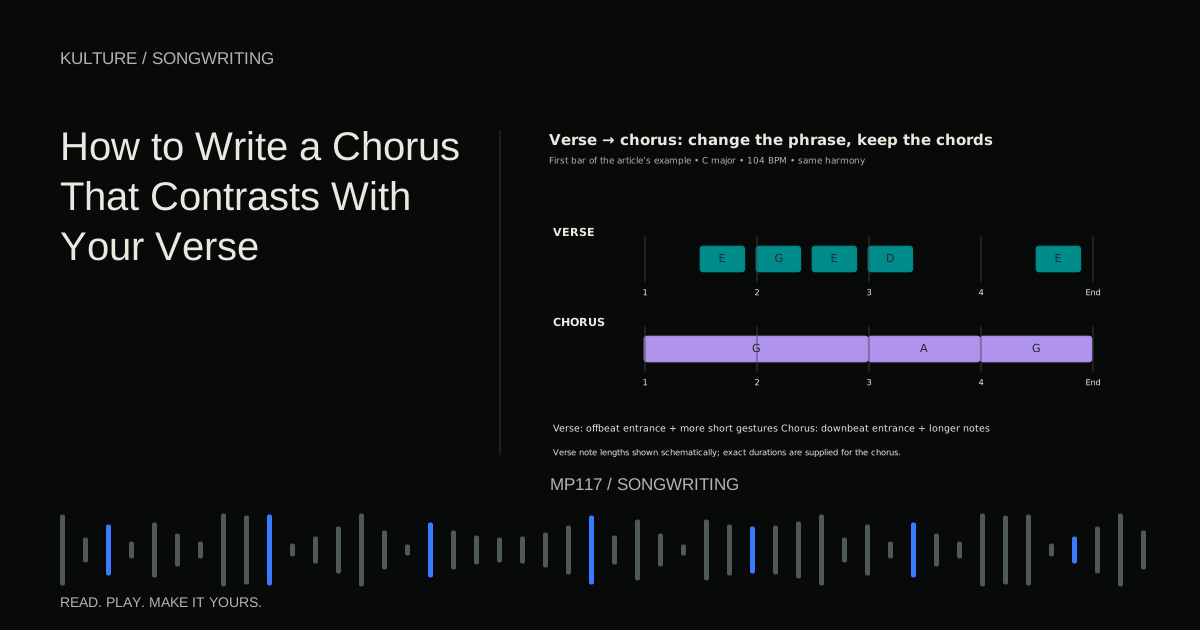
In a verse, let the response be short and understated. In a chorus, repeat the same response with a fuller backing vocal group or a higher register. In a final chorus, change its ending while keeping the familiar opening rhythm.
Another approach is to reverse the roles: the instrumental phrase introduced earlier becomes the call, and the singer answers it. This can make a bridge or outro feel connected to the song while changing perspective.
Avoid adding a new response to every repetition. Familiarity lets the listener anticipate and enjoy the answer. Variation matters more after the relationship has been established.
Diagnose an exchange that does not work
If the answer sounds unrelated, preserve one feature from the call: rhythm, contour, interval, or final note. If both parts compete, shorten the overlap or make one less active. If the exchange feels predictable, change only the final answer in a longer phrase.
If the response weakens the main hook, remove it from the hook's first appearance. Let listeners learn the lead before adding commentary. Silence can be the best answer at a crucial moment.
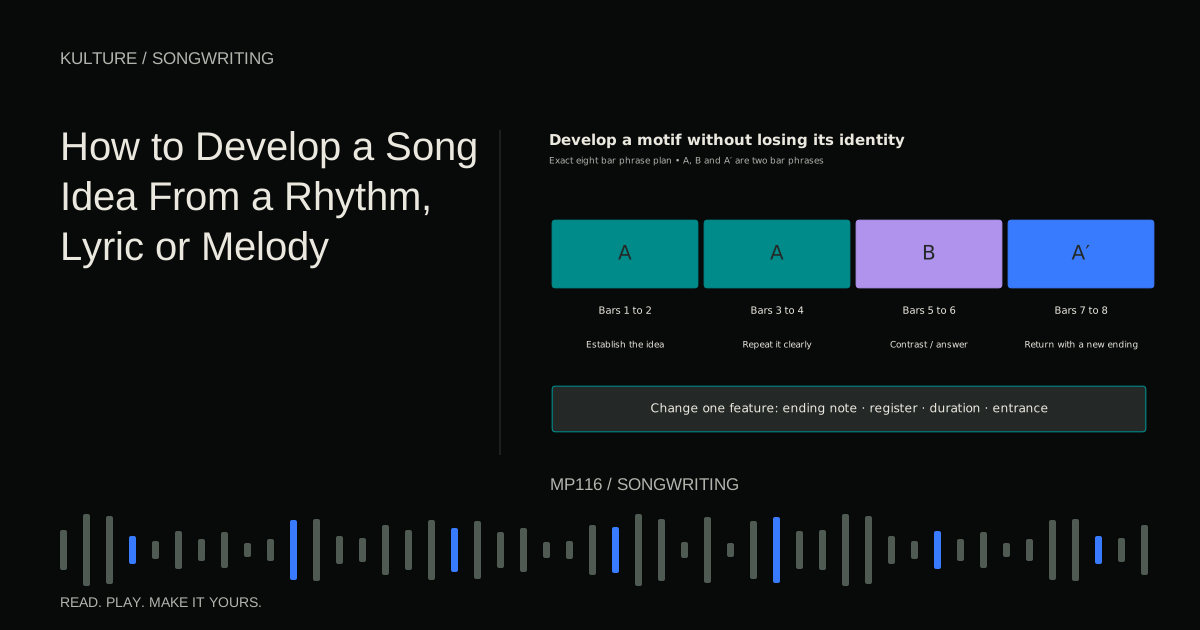
For practice, write one two bar call and four different responses using the same chord. Arrange them into an eight- or sixteen bar passage, choosing a clear order of stability and tension. Then apply the best response to an existing track and compare with the version without it. Continue with song idea development to turn that conversation into a larger form.
TAKE IT INTO YOUR OWN MUSIC
Your next session.
If the answer sounds unrelated, preserve one feature from the call: rhythm, contour, interval, or final note. If both parts compete, shorten the overlap or make one less active. If the exchange feels predictable, change only the final answer in a longer phrase.
Notes and progress stay in this browser.