Begin by describing the verse you already have. Is its melody low or high, busy or spacious, conversational or sustained? Does it begin before the beat or on it? Contrast is relative: you cannot choose an effective opposite until you know the starting condition.
Make a contrast inventory
Write a short list of the verse's features. For example: eight bars, mostly eighth notes, narrow range around E and G, phrases beginning after beat 1, C, G, Am, F harmony, and detailed narrative lyrics.
Now choose two features for the chorus to change. You might use longer notes and a higher opening pitch while keeping the chords. Or keep the register but make the rhythm simpler and the lyric more direct.
Berklee's melody writing guidance identifies controllable features such as duration, rests, phrase length, and starting position. Use those as practical levers rather than assuming a chorus needs an entirely new sound palette.
TRY IT HERE
Write a small phrase
Choose notes on the grid. Leave a little space.
Ready when you are. Audio starts only when you press Play.
Keep experimenting in the piano LabWrite a verse that leaves room above it
Set 104 beats per minute in 4/4. Use C major, G major, A minor, and F major, one bar each. Repeat for an eight bar verse.
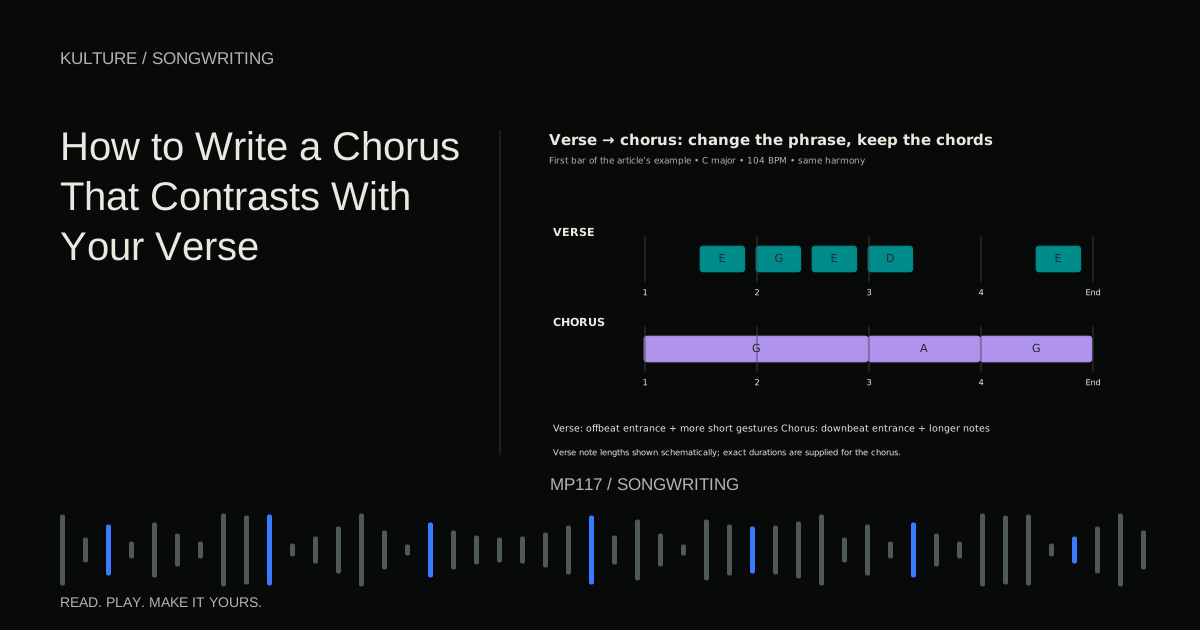
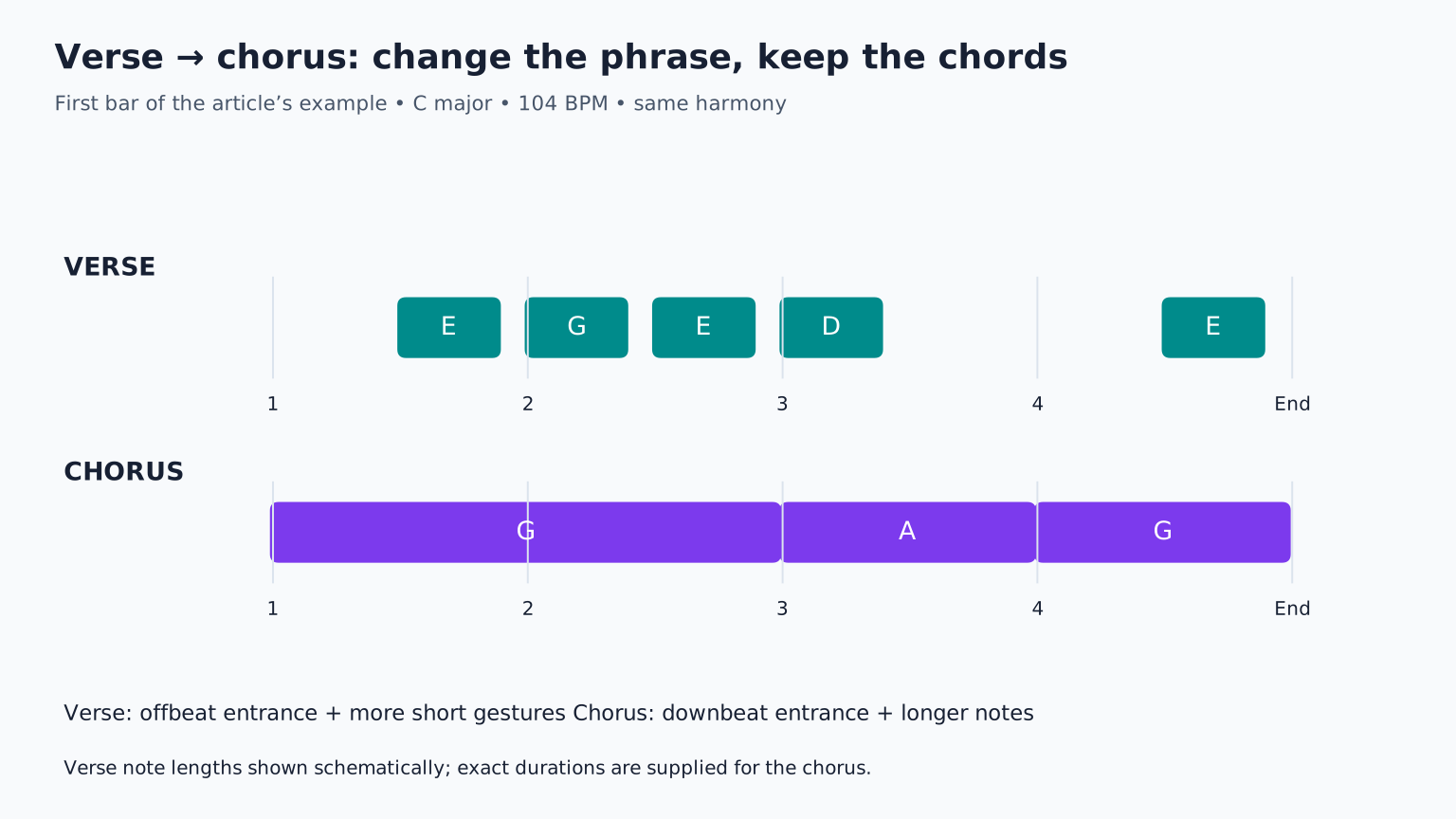
Make a two bar verse motif: E on beat 1 and, G on beat 2, E on 2 and, D on beat 3, and E on 4 and. In the second bar, use D on 1 and, G on beat 2, and D on beat 3, then rest.
Keep the melody in a comfortable lower middle register. The phrase starts after the downbeat and uses several short notes. Repeat its rhythm with small pitch changes over the next chords. This gives the verse a recognizable identity while reserving longer, higher gestures for later.
If your existing verse already reaches the singer's highest comfortable notes, a chorus cannot simply keep climbing. You may need to lower the verse or choose a different kind of contrast.
Build the chorus with fewer, longer gestures
Keep the same chord loop for the first experiment. Start the chorus on G at beat 1, hold it for two beats, then sing A on beat 3 and G on beat 4. In the next bar, hold B from beat 1 to beat 3, then move to G.
Over A minor, use C held for two beats, then B, A on beats 3 and 4. Over F, hold A, then resolve to G or F depending on the desired sense of continuation or closure.
Adjust the entire melody to the singer's range. The contrast comes from longer durations, clearer downbeat entrances, and a higher contour than the verse, not from any sacred octave number.
Listen with only keyboard and voice. If the chorus is still distinct, the composition is doing useful work. If it only feels different after a huge drum fill, the underlying contrast may need attention.
Give the lyric a different level of focus
A verse can show details, while a chorus states what those details mean. For an original example, a verse might describe an empty station, a late train, and a phone that stays silent. The chorus could center on “I'm still waiting here.”
The title phrase should be easy to hear and remember. That does not mean every chorus must use simple emotions or generic wording. It means the main statement deserves rhythmic and melodic space.
Speak the chorus aloud. Which words carry meaning? Give those words strong positions, longer notes, or expressive pitch changes. Avoid stretching an unimportant connecting word merely because it fills the melody.
Berklee's prosody discussion connects these choices to the song's expressive purpose. A hesitant chorus may deliberately retain instability; a resolved chorus may settle rhythmically and harmonically.
Change harmony only if it helps
If the same chord loop works, keep it. Contrast can come entirely from melody and phrasing. To test a harmonic change, reorder the chorus to F, C, G, Am. The opening F gives the section a different starting color without leaving C major.
Another option is changing harmonic rhythm, the rate at which chords change. A verse with one chord per bar could lead to a chorus that holds each chord for two bars, creating more room for long melody notes. Or the reverse can create urgency.
Do not add complex chords merely to make the chorus “more advanced.” A plain triad under a strong title note can communicate more directly than a dense voicing that competes with the singer.
Use arrangement to reveal the contrast
Once the melody works, support it. Remove an upper layer from the verse and reserve it for the chorus. Let the bass become simpler beneath the longer vocal notes. Add a backing harmony only on the title's final word.
You can also make the chorus smaller. If the verse is busy, drop to voice and one instrument at the chorus entrance, then rebuild. The listener notices a meaningful change in focus even though fewer tracks are active.
Avoid filling every vocal rest with a lead lick. The chorus's spaces can help the main phrase register. A response is useful when it reinforces the hook, not merely because the timeline has an empty area.
Make the entrance feel earned
A pre chorus can prepare the arrival, but it is optional. Try a four bar lead in with D minor for two bars and G for two. Let the melody rise or repeat an unresolved phrase, then land clearly in the chorus.
Alternatively, end the verse with a short rest and begin the chorus immediately. Compare both. If the pre chorus repeats information the verse already supplied, the direct transition may be stronger.
Listen from several bars before the boundary. A chorus that sounds impressive when looped may arrive awkwardly after the actual verse.
Evaluate and revise
If the chorus feels flat, identify which dimensions genuinely changed. If it feels disconnected, restore a shared rhythmic fragment, chord tone, or lyrical image. If it feels strained, adjust the key or melody rather than expecting production to repair an uncomfortable performance.
Your exercise is to write two choruses over the same verse: one higher and sustained, one lower and sparse. Keep the lyric's central idea consistent. Choose by expressive impact rather than loudness. Then use song structure to place the winning chorus and lyric setting to refine its delivery.
TAKE IT INTO YOUR OWN MUSIC
Your next session.
If the chorus feels flat, identify which dimensions genuinely changed. If it feels disconnected, restore a shared rhythmic fragment, chord tone, or lyrical image. If it feels strained, adjust the key or melody rather than expecting production to repair an uncomfortable performance.
Notes and progress stay in this browser.