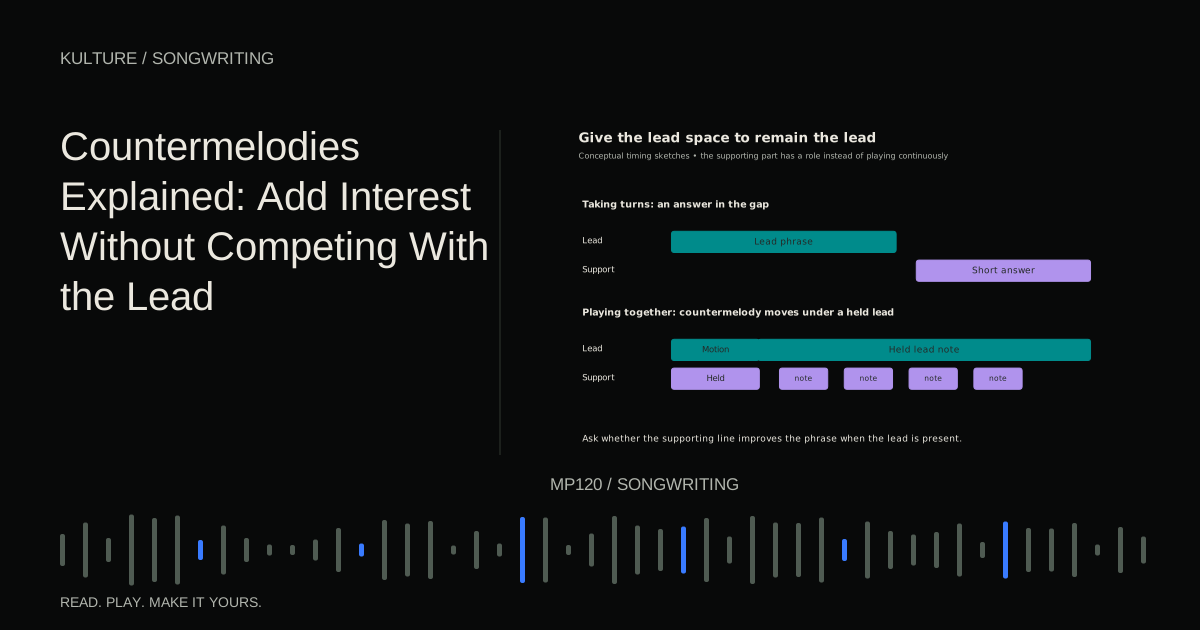
The common mistake is adding accompaniment before understanding the seed. A strong fragment can disappear beneath chords, drums, and effects that pull in unrelated directions. Record the original idea first, even as a rough voice memo or a single MIDI line.
Identify the seed's defining feature
Listen to the fragment and describe it concretely. Perhaps it begins before the beat, repeats one word, leaps upward then falls, or leaves an unusually long silence. That feature is worth preserving while you experiment.
A motif is a short musical idea that can recur and develop. It may be defined by rhythm, pitch contour, or both. Berklee's melody writing article discusses using motifs, repetition, and controlled variation. The exercises below apply those ideas to original material.
Choose one route first. You can combine rhythm, lyric, and melody later, but isolating the starting point makes its strengths easier to hear.
TRY IT HERE
Write a small phrase
Choose notes on the grid. Leave a little space.
Ready when you are. Audio starts only when you press Play.
Keep experimenting in the piano LabRoute one: start with a rhythm
Set a comfortable tempo, such as 96 beats per minute in 4/4. Tap this one bar rhythm on one sound: a hit on beat 1, a hit on 2 and, a hit on beat 3, and a hit on 4 and. Let the first and third hits feel stronger.
Repeat it twice. Then make an answer by removing the last hit and holding the third sound longer if the instrument allows it. You now have a two bar phrase with repetition and a small difference.
Assign pitches in A minor: E, G, A, G in the first bar; E, G, A held in the second. Play it on a plain piano or sing it. The rhythm remains the identity, while the pitches give it contour.
Try two harmonies underneath. Version A holds A minor across both bars. Version B uses A minor in the first bar and F major in the second. The same melody can feel different because its notes relate differently to the chord. Choose the harmony that supports the phrase's intended mood.
Do not add a full drum arrangement yet. A metronome or simple pulse is enough to test whether the motif works.
Route two: start with a lyric
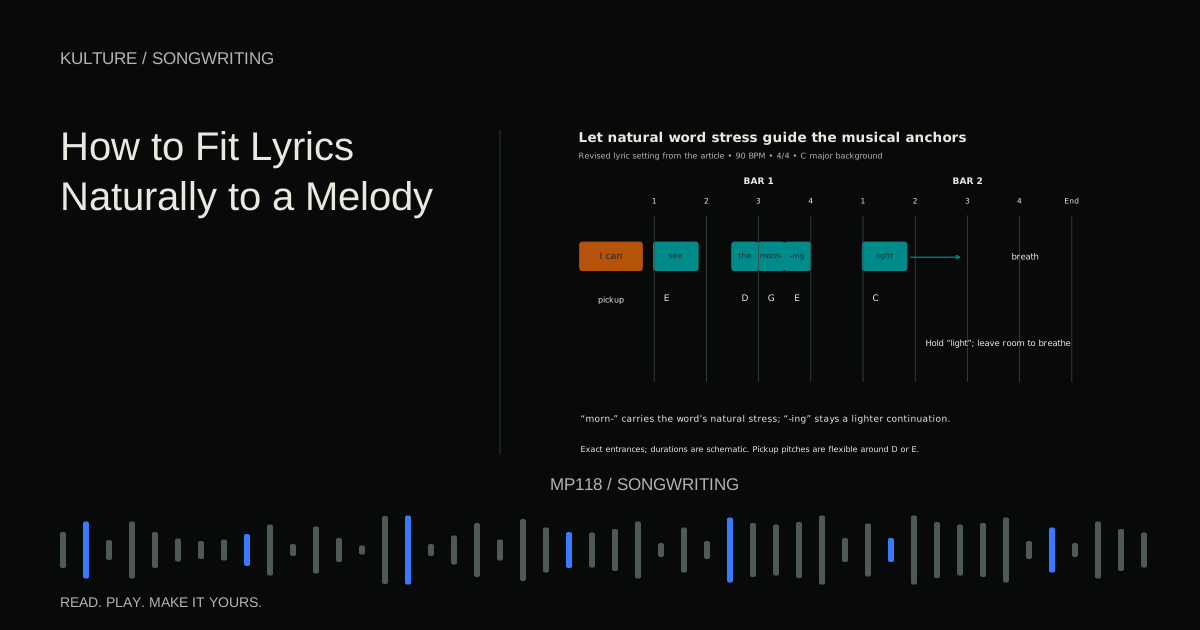
Use an original phrase such as “I left a light beside the door.” Speak it naturally several times. Mark the words you actually stress: “left,” “light,” and “door” are likely candidates, depending on meaning.
Tap a pulse while speaking. Let unstressed words fall between stronger beats rather than forcing every syllable to equal length. For example, “I” can be a pickup before beat 1, “left” can land on beat 1, “a” between beats, “light” on beat 2, and the remaining words can lead toward a longer “door.”
Now sing the phrase mostly on one note. This lets you test rhythm and natural stress without a complicated melody. Once the language flows, raise the pitch on “light” or lengthen “door” to emphasize the idea.
Write a response that adds information instead of merely restating the line. “The room stayed dark until the dawn” introduces a consequence. Whether those exact words belong in your song is secondary; the method is to let one line create a reason for the next.
Berklee's natural language discussion explores the connection between speech and songwriting. Use that connection as a listening tool, not a prohibition against expressive departures from normal speech.
Route three: start with a melody
Sing or play G, A, C, B, A in a comfortable register. Use a longer C in the middle so the phrase has a clear high point. Record it before deciding on chords.
Listen for where it wants to rest. If A feels like home, try A minor underneath. If C feels like home, try C major. A few notes can fit more than one harmonic interpretation, so your first chord choice need not be final.
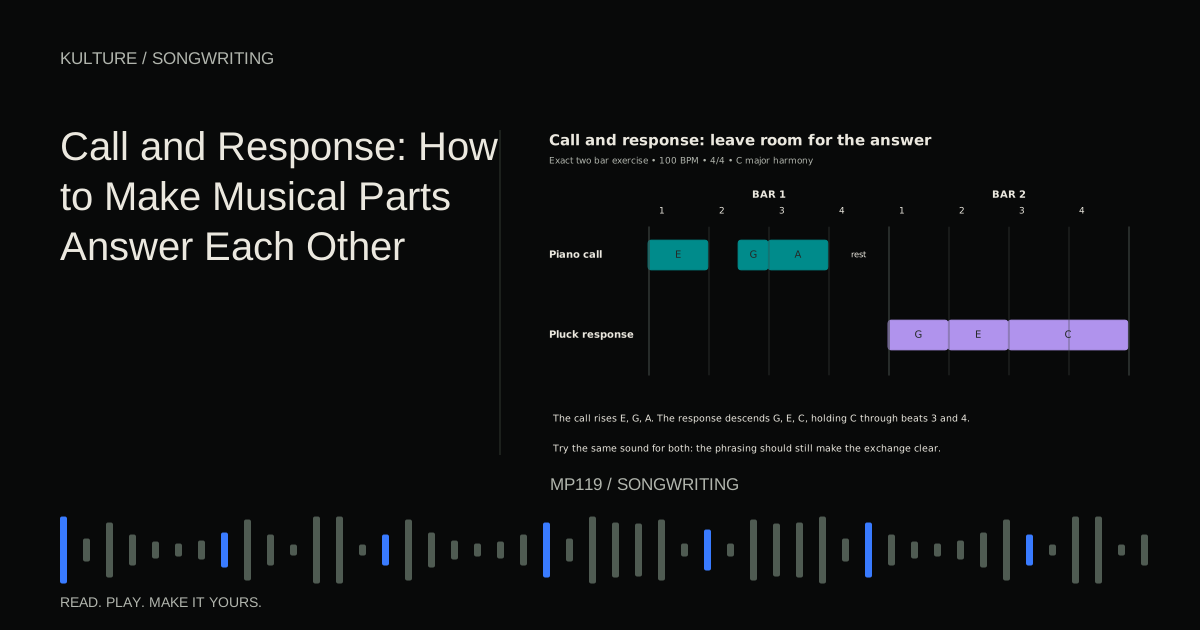
Create an answer using G, E, D, C, with the final C held. The first phrase rises and partially returns; the second descends toward a more settled ending. Compare the pair over C major, then over A minor moving to F major.
Do not judge the melody solely by whether every note belongs to the current chord. Passing notes and tensions can be expressive. Start with stable notes at important arrivals, then hear whether the connecting notes make sense.
Expand the phrase without losing it
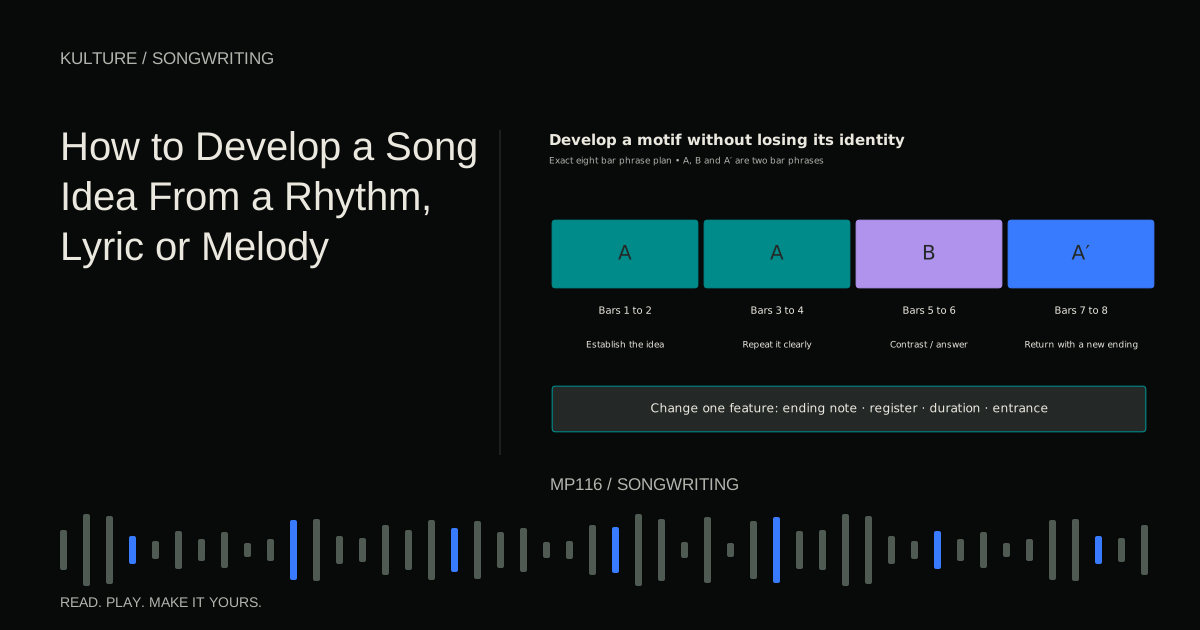
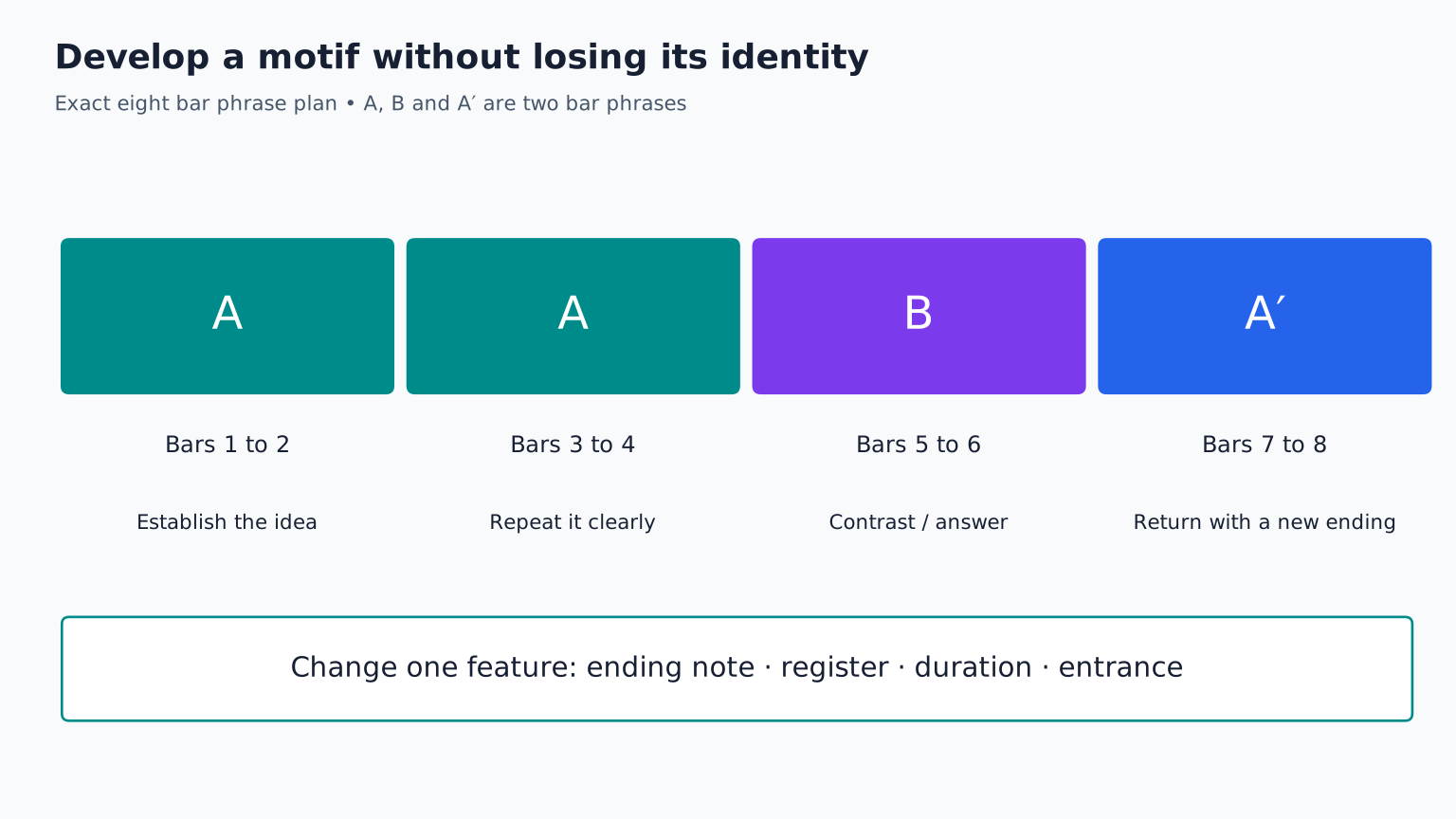
Turn a two bar idea into eight bars using A, A, B, A prime. Here A is the original phrase, B is a contrasting answer, and A prime is a recognizable return with one changed ending.
For the rhythm led example, repeat the first two bars, move the answer higher in bars 5 to 6, then return to the original register in bars 7 to 8 with a longer final A. This creates a small arc from familiarity through contrast to resolution.
Change only one or two features at a time: ending note, register, duration, or starting position. If every repetition has new pitches, new rhythm, and new harmony, the listener may never learn what the idea is.
Decide what role the idea wants
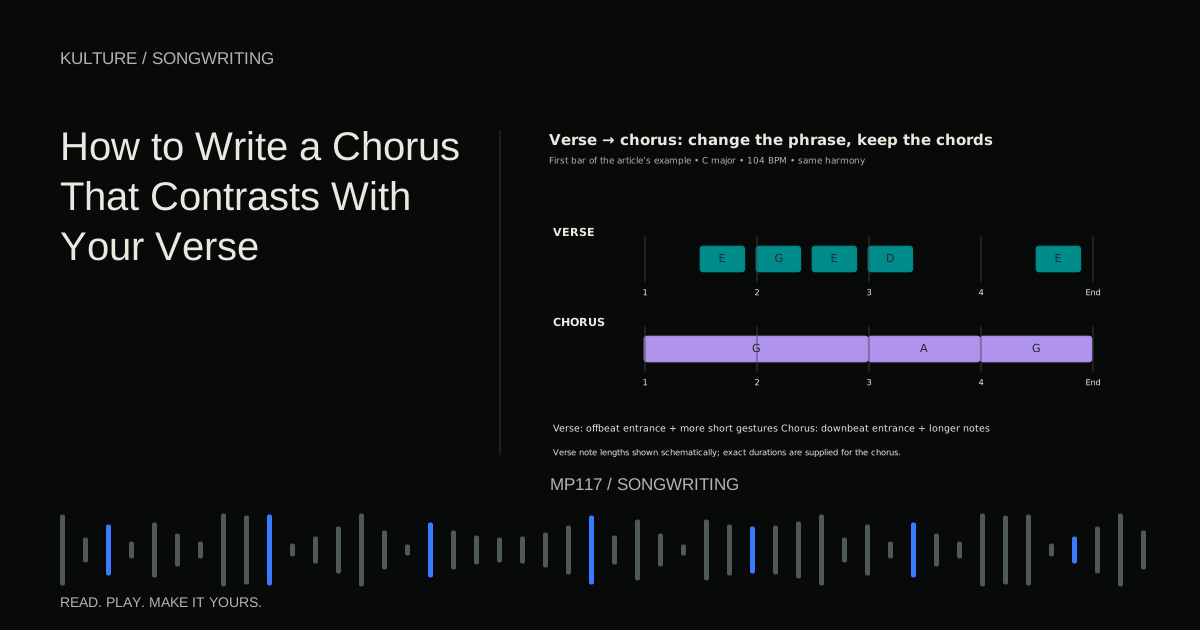
A short, repeatable phrase may suit a chorus or instrumental hook. A wordier, conversational idea may suit a verse. A rhythmically unsettled fragment may work as a pre chorus that points toward something more stable.
These are tendencies, not rules. Test the idea in two roles. Sing it as the main statement, then as a lead in to another phrase. Ask where its energy feels most convincing.
If the seed is an instrumental groove, you can still develop contrast through register, texture, or silence rather than inventing lyrics. The principle is the same: establish, vary, and return.
Troubleshoot before adding layers
If the idea feels forgettable, simplify its rhythm or repeat its strongest feature more clearly. If it feels monotonous, alter the ending of every second phrase. If it feels forced, return to the original recording and check what was lost during editing.
If chords overwhelm it, use fewer chord changes. If the lyric fights the melody, speak the line again and revise the syllables or note rhythm. A song develops through choices, not through protecting the first draft from every change.
Your exercise is to develop three eight bar sketches from the same seed: rhythm led, lyric led, and melody led. Keep the original fragment audible in all three. Choose the version with the clearest identity, then continue with chorus contrast and memorable hooks.
TAKE IT INTO YOUR OWN MUSIC
Your next session.
If the idea feels forgettable, simplify its rhythm or repeat its strongest feature more clearly. If it feels monotonous, alter the ending of every second phrase. If it feels forced, return to the original recording and check what was lost during editing.
Notes and progress stay in this browser.