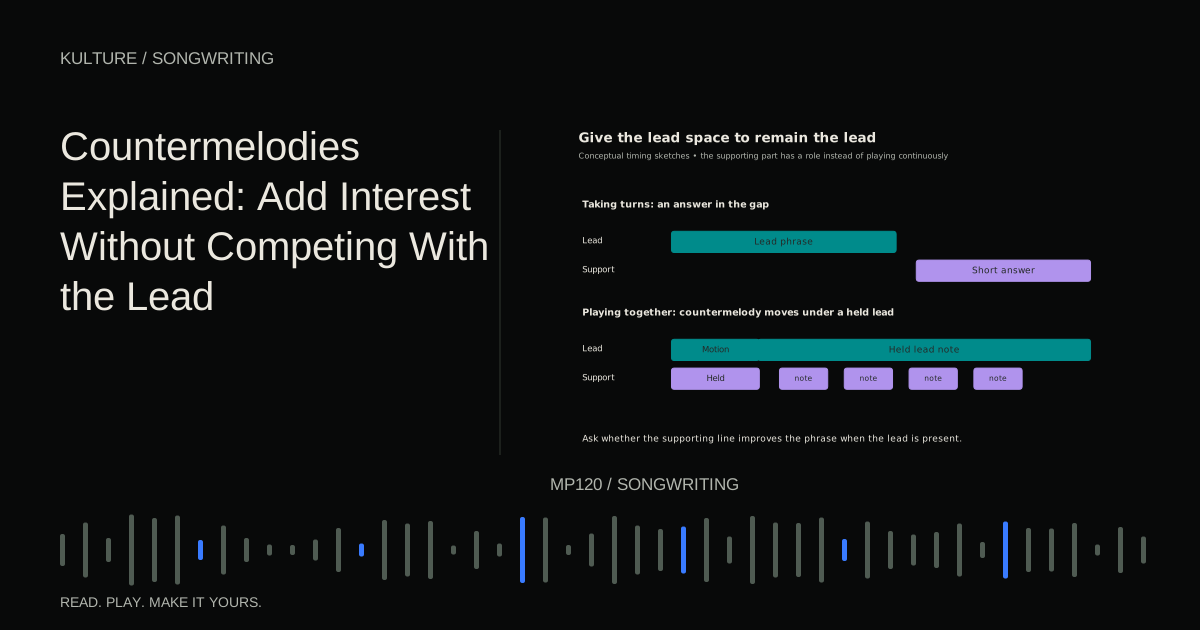
A harmony part often follows the lead's rhythm closely at another pitch. A countermelody is usually more independent in rhythm or contour. A fill mainly occupies a gap. These categories can overlap; the useful question is what the second line contributes when both are heard together.
Understand the lead before writing another line
Identify the lead's busiest moments, held notes, important arrivals, and rests. Mark the words or notes the listener must hear clearly. Those are constraints for the countermelody.
If the lead is already rhythmically dense and wide ranging, the secondary line may need to sustain or remain silent. If the lead holds long notes, the secondary line has more room to move. Adding another equally busy melody is rarely the easiest starting point.
Use a plain instrument while composing so an attractive sound does not disguise clashes. You can choose a richer timbre after the notes and rhythm work.
TRY IT HERE
Write a small phrase
Choose notes on the grid. Leave a little space.
Ready when you are. Audio starts only when you press Play.
Keep experimenting in the piano LabA four bar worked example
Set 92 beats per minute in 4/4. Use C major, A minor, F major, and G major, one chord per bar. Put the lead in a comfortable upper register with this phrase:
- Bar 1: E on beat 1, G on beat 2, A held across beats 3 to 4.
- Bar 2: G on beat 1, E held across beats 2 to 3, rest on beat 4.
- Bar 3: A held across beats 1 to 2, G on beat 3, F on beat 4.
- Bar 4: D on beat 1, G held across beats 2 to 4.
First play the lead and chords alone. Notice that the sustained A in bar 1 is a color note against C major rather than a chord tone; it can be expressive, but the accompaniment should not make it unintentionally harsh.
Now add a lower secondary line: C held through beats 1 to 2 of bar 1, then E on beat 3 and G on beat 4. In bar 2, hold C through beat 3, then move to E on beat 4. In bar 3, use F on beat 1, E on beat 2, and D held through beats 3 to 4. In bar 4, use B on beat 1 and D held through the remaining beats.
These are starting notes, not a finished composition to accept uncritically. Listen to each simultaneous interval. If the passing E over F major feels too exposed, shorten it or move it to a weaker subdivision. If the secondary D in bar 3 makes the harmony too unresolved, change it to C.
Coordinate motion rather than copying blindly
When two lines rise or fall together, they move in similar motion. When they move in opposite directions, they use contrary motion. When one stays while the other moves, the motion is oblique. The University of Puget Sound's theory text explains these categories.
In production, contrary and oblique motion can help the lines feel independent. If the lead rises, try a secondary line that holds a note or descends. Do not force opposite movement at every moment; that can sound mechanical too.
Parallel movement is not universally wrong. It can create a deliberate harmonized sound. The point is to know whether you want an independent line or a coordinated layer, and choose the movement accordingly.
Let rhythm determine attention
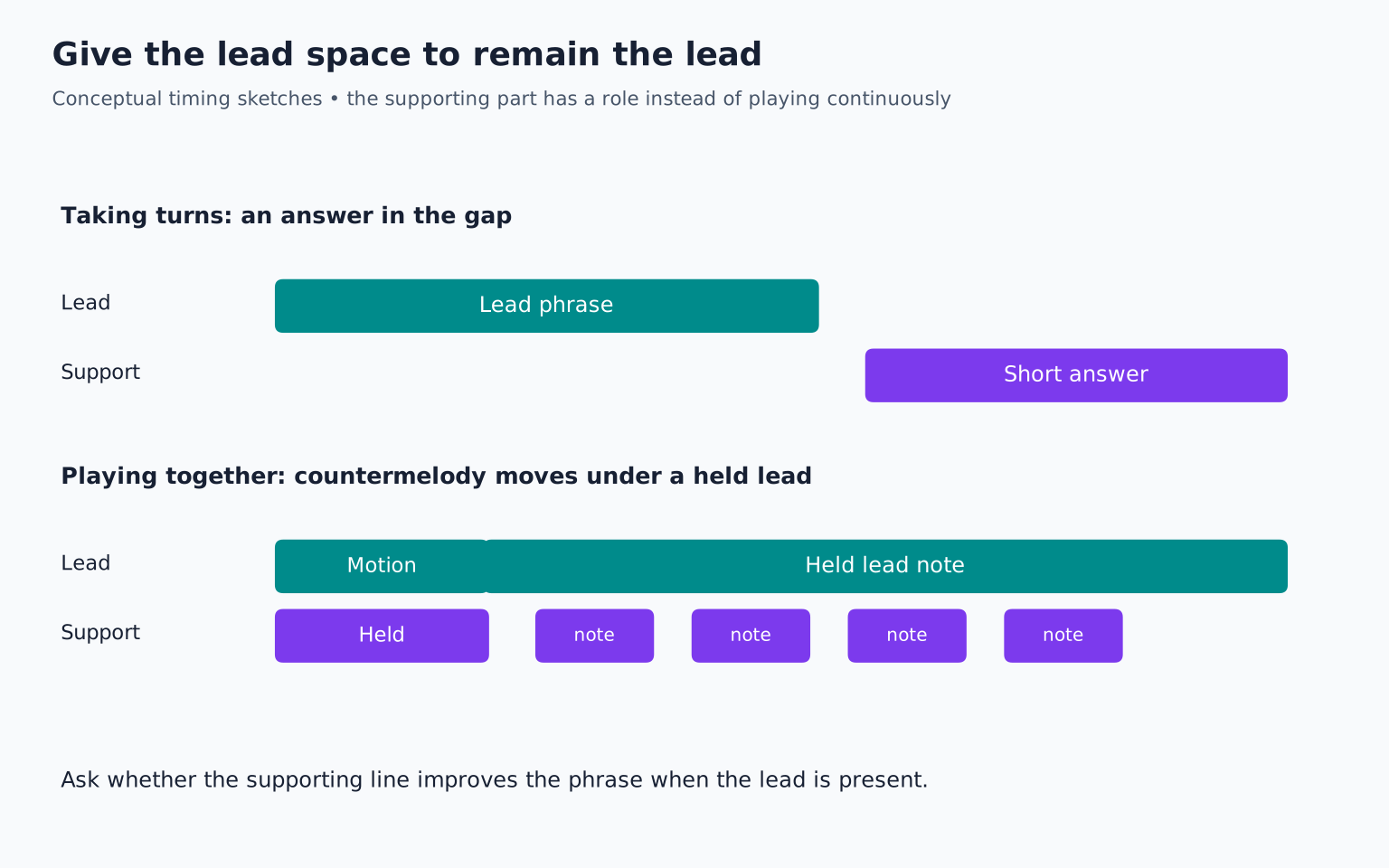
A new attack attracts attention. If the countermelody attacks on every lead syllable, both parts ask to be heard at once. Try starting the secondary note after the lead's attack, or moving during a held vowel rather than under a consonant.
In the example, make the bar 1 secondary E begin on 3 and instead of beat 3. The lead's A arrives first, then the lower line moves beneath it. That small change can clarify hierarchy without changing pitches or volume.
Use rests. A countermelody need not play throughout the chorus. It might appear only in bars 3 to 4 of an eight bar phrase, or only in the final chorus. Selective presence can make it feel like development rather than permanent clutter.
Choose register and timbre carefully
Keep the secondary line away from the lead's most important register where practical. A low cello like synth beneath a high vocal can be distinct, but do not push it so low that its notes become muddy with the bass.
Choose complementary articulation. A soft sustained line can support a rhythmic lead; a short pluck can add movement beneath a held melody. If both sounds have bright, sharp attacks, level balance alone may not resolve the competition.
Panning can help separation, but check mono compatibility and musical clarity. Do not make an essential countermelody vanish through an extreme widening effect. Its role should remain understandable when the stereo image narrows.
Test harmony at important moments
Listen especially to downbeats, long notes, and phrase endings. Those moments make clashes more noticeable. A passing dissonance may work beautifully when it resolves, while the same interval held for a full bar may change the song's emotional direction.
You do not need every simultaneous note to form a basic chord. But you should hear where tension comes from and where it goes. If you cannot identify why a passage sounds unsettled, slow it down and play only the two melodies over a simple bass root.
Avoid applying strict historical counterpoint rules as universal production laws. Those systems are valuable within their styles, but a contemporary track may intentionally use parallel intervals, clashes, or sustained color tones.
Decide whether the line earns its place
Mute the countermelody and listen to the full section. Then restore it at a restrained level. Does it deepen the phrase, clarify a response, or make the return feel developed? Or does it merely make the arrangement busier?
If the lead becomes less memorable, simplify the secondary line before boosting the lead. Remove its first note, reduce its range, or save it for the second half. If the song works better without it, keep the idea for another section or another track.
For practice, write three countermelodies to the same lead: one mainly sustained, one moving in the lead's gaps, and one using contrary motion. Compare them in context and retain only the strongest. Continue with call and response when the parts should take turns, and voice leading to improve harmonic connections.
TAKE IT INTO YOUR OWN MUSIC
Your next session.
Set 92 beats per minute in 4/4. Use C major, A minor, F major, and G major, one chord per bar. Put the lead in a comfortable upper register with this phrase:
Notes and progress stay in this browser.