
Start by speaking the lyric before singing it. Everyday speech already contains accents, pauses, and changes in pitch. Those patterns are useful raw material, even when the final melody deliberately transforms them.
Hear stress before counting syllables
Consider the original phrase “I can see the morning light.” It has seven syllables, but they are not equally important. Depending on the meaning, “see,” “morning,” and “light” may carry the main stresses. The first syllable of “morning” is naturally stronger than the second.
If a melody emphasizes “-ing” with the highest, longest note while burying “morn,” the word may sound awkward. That can be an intentional effect, but it should be a choice you can hear and explain.
Berklee's discussion of natural music in language explores this connection between speech and song. Use natural stress as a starting point rather than treating it as an unbreakable rule.
TRY IT HERE
Write a small phrase
Choose notes on the grid. Leave a little space.
Ready when you are. Audio starts only when you press Play.
Keep experimenting in the piano LabBuild a spoken rhythm on a simple pulse
Set a metronome to 90 beats per minute in 4/4. Speak the phrase over two bars. Try this placement:
| Position | Syllable |
|---|---|
| Pickup before bar 1 | I |
| Bar 1, beat 1 | can |
| Bar 1, beat 2 | see |
| Bar 1, beat 2 and | the |
| Bar 1, beat 3 | morn- |
| Bar 1, beat 3 and | -ing |
| Bar 2, beat 1 | light |
Hold “light” and leave the rest of bar 2 for a breath. This is only one setting. Notice that “can” receives a downbeat even though it may be less important than “see.” You can soften “can,” move it into the pickup, or change the rhythm if the emphasis feels wrong.
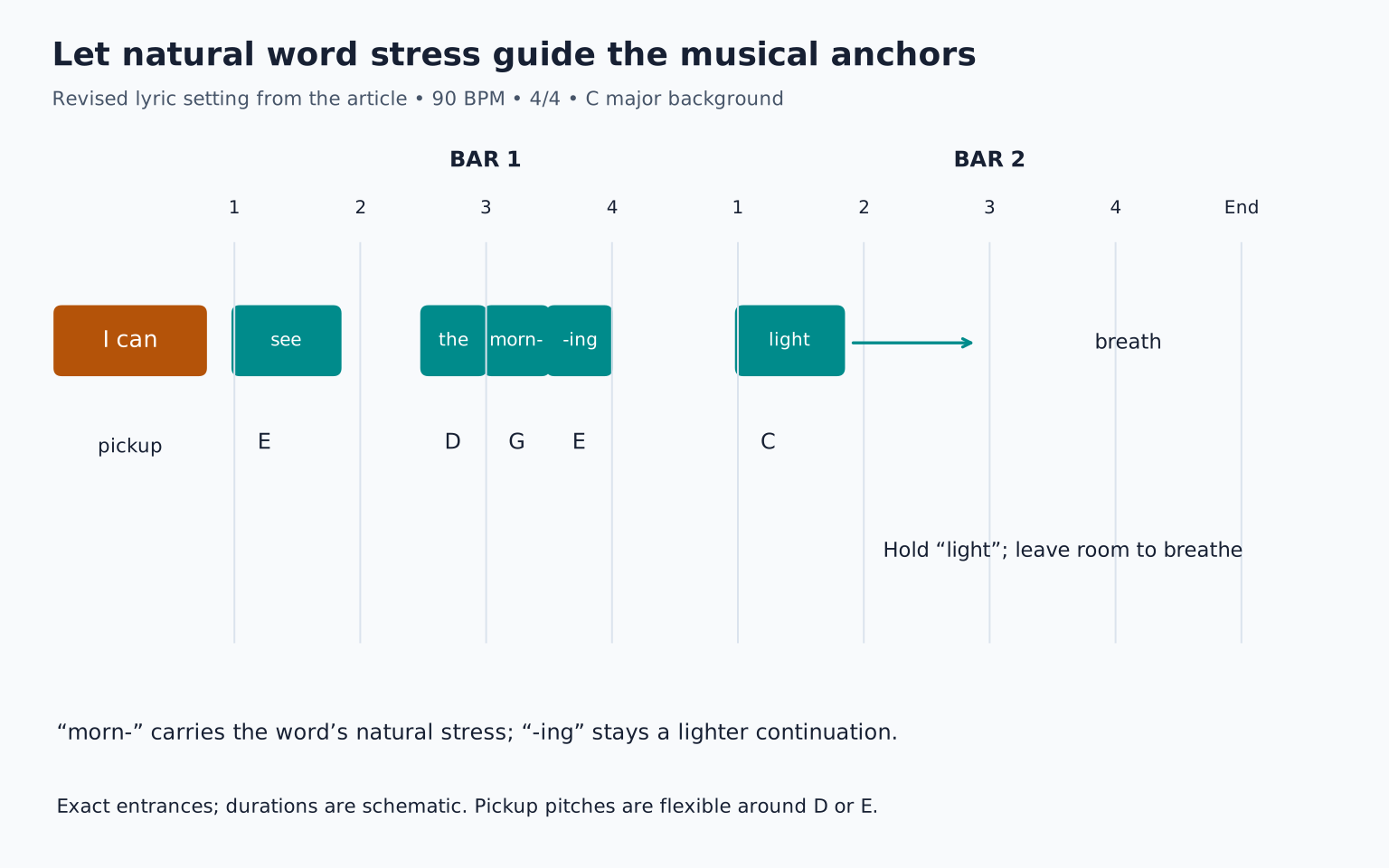
A useful revision is to sing “I can” as two quick pickup syllables before beat 1, put “see” on beat 1, “the” on 2 and, “morn-” on beat 3, “-ing” on 3 and, and “light” on the next bar's beat 1. Now the musical anchors support the more important words.
Add pitch after the words flow
Use C major as a simple harmonic background. Sing “see” on E, “the” on D, “morn-” on G, “-ing” on E, and “light” on C. Keep the pickup around D or E. The rise to G emphasizes “morning,” and the final C can feel settled over a C chord.
Try another version where “light” stays on G. That may feel more open, depending on the harmony. The best ending depends on whether the lyric is a conclusion or an invitation to the next line.
Record both versions. Listening back often reveals stress problems that are hard to notice while concentrating on singing. Do not judge only by whether the MIDI notes belong to the scale.
Revise the lyric and melody together
Suppose your line is “I can finally see the beautiful morning light,” but the melody has room for seven comfortable syllables. You have several choices: remove words, extend the phrase, subdivide some notes, or change the melody.
Shortening to “I can see the morning light” preserves the central image. If “finally” is essential to the story, use “Now I see the morning light” or give “finally” its own rhythmic space. Do not preserve every adjective merely because it appeared in the first draft.
Likewise, do not protect the melody from all revision. A longer note can become two shorter notes, or a phrase can begin with a pickup. Lyric setting is a collaboration between language and music, not a contest where one must always surrender.
Understand syllabic and melismatic settings
A syllabic setting generally gives one note to each syllable. A melismatic setting stretches one syllable across several notes. Both can be expressive.
For “light,” try singing C, D, E, D, C on the vowel before closing the final consonant. Keep the word recognizable and let the run serve the emotion. If you articulate a new “t” on every note, the word will fragment unnaturally.
Use melisma where there is enough breath and time. A long run on an unimportant word can distract from the main idea. A simple sustained note may communicate more clearly.
Account for vowels, consonants, and breath
Vowels carry sustained pitch; consonants help define words and rhythmic attacks. A note that begins with a strong consonant may feel later than its written position if the vowel arrives after the beat. Sing the line naturally and adjust the musical placement to the performance.
Long notes should be comfortable in the singer's range and on the chosen vowel. If a word becomes difficult at the melody's highest point, consider changing the note, key, vowel bearing word, or phrase shape. Do not assume the singer can solve every mismatch through effort.
Leave breathing opportunities. Mark where you can comfortably inhale while preserving meaning. If the only breath falls inside a word or at an emotionally awkward point, revise the phrase rather than relying on editing to conceal an impossible live line.
Preserve meaning across line breaks
A rhyme can make a line satisfying, but it should not force unnatural word order or obscure the story. Read the lyric as plain speech. If it sounds strange, decide whether the strangeness is expressive or merely serving the rhyme.
Berklee's prosody article frames the broader goal as alignment between musical elements and expression. A syncopated stress can convey uncertainty or insistence; a settled long note can convey resolution. The same technical choice can mean different things in different songs.
Troubleshoot with three recordings
Record the lyric spoken, sung on one pitch, and sung with the melody. If it fails in speech, revise the wording. If speech works but one pitch singing fails, revise the rhythm. If rhythm works but the melody feels strained or distorted, revise pitch or range.
This isolates the problem more effectively than adding vocal effects. Compression and reverb can improve presentation, but they cannot reliably make an awkward sentence feel natural.
For practice, set the same two line lyric three ways: conversational, sustained, and syncopated. Keep the meaning intact and note which words become most prominent. Choose the setting that supports the song's intention, then continue with developing a song idea and chorus contrast.
TAKE IT INTO YOUR OWN MUSIC
Your next session.
Record the lyric spoken, sung on one pitch, and sung with the melody. If it fails in speech, revise the wording. If speech works but one pitch singing fails, revise the rhythm. If rhythm works but the melody feels strained or distorted, revise pitch or range.
Notes and progress stay in this browser.