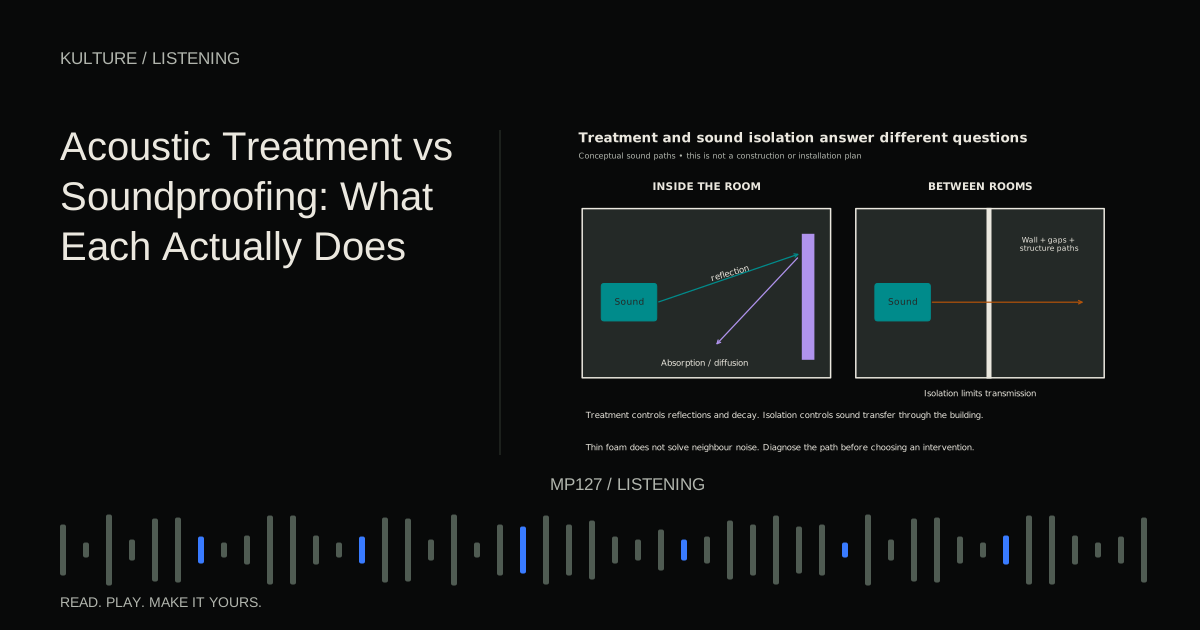
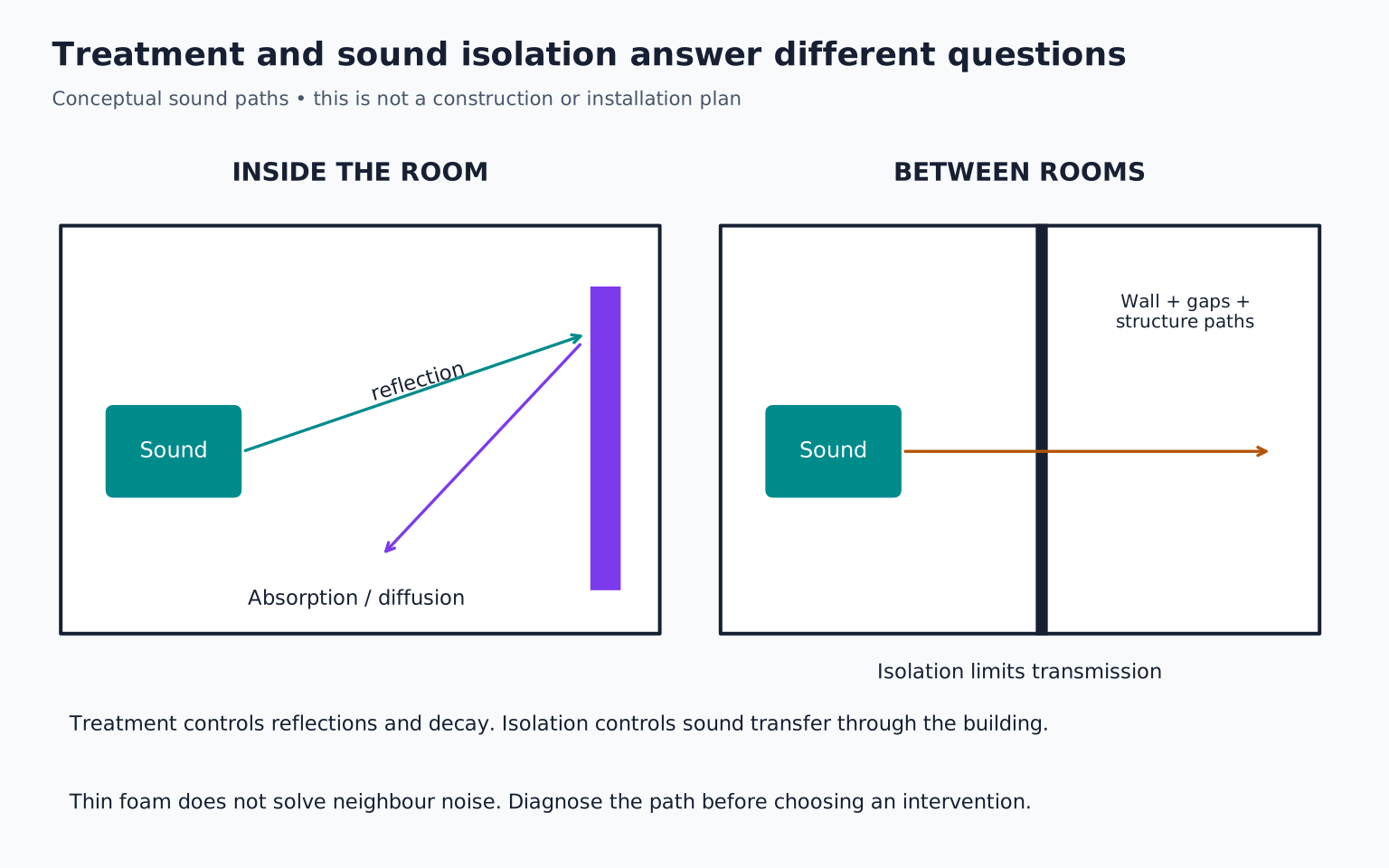
If your recordings sound echoey or your bass balance is hard to judge, investigate treatment and placement. If neighbours hear your kick drum through the wall, investigate transmission paths and isolation. Thin foam attached to a wall is not a dependable answer to both problems.
Diagnose the complaint in ordinary language
Write down what happens, where it happens, and when. “The room sounds bad” is too broad. Better descriptions include:
- Spoken words produce a rapid fluttering echo between two bare walls.
- One bass note booms at the desk but disappears near the doorway.
- Guitar recordings contain a hard, short room reflection.
- Speech from the next room is audible through the door gap.
- Low frequency music is heard downstairs even when the door is closed.
The first three point toward the listening or recording environment. The last two point toward sound transmission. A room can have excellent internal acoustics while still leaking sound, or strong isolation while sounding unpleasant inside.
TRY IT HERE
Move the listening position
Explore geometry, not a measurement of your actual room.
Ready when you are. Audio starts only when you press Play.
Keep experimenting in the piano LabWhat absorption does
An absorber reduces reflected sound energy in the range where it is effective. Porous absorbers, such as appropriately designed mineral fibre or fibreglass panels, work through air movement within the material. Their performance depends on thickness, construction, mounting, and frequency.
Thin materials generally have more limited low frequency effectiveness than substantial treatment. This is why covering a room with lightweight foam can reduce high frequency reflections while leaving bass problems obvious. You may create a dull room that still has uneven low end.
Genelec's room acoustics guidance discusses absorption, diffusion, and placement as parts of a room wide approach. Use product test data and installation guidance rather than judging effectiveness by a panel's colour or marketing photograph.
Absorbers can be useful at early reflection points, behind or around recording positions, and in locations chosen to address low frequency behaviour. Their placement should follow the actual problem. A decorative panel placed wherever wall space is available may not affect the reflection that troubles you.
What diffusion does
A diffuser redistributes reflections rather than primarily absorbing them. A properly designed diffuser can help retain a sense of liveliness while reducing strong directional reflections over its working range.
A bookshelf may scatter some frequencies, but that does not make it equivalent to a tested diffuser. Diffusers also have distance and frequency requirements. Placing one immediately behind your head in a tiny space is not automatically beneficial.
Beginners usually gain more from sensible speaker placement and targeted absorption than from buying diffusion first. Measure and listen before deciding that the room needs to be “more live.”
What isolation requires
Sound can travel through airborne paths, such as a door gap, and through structure, such as floors and wall framing. It can also travel around a treated partition through adjoining surfaces. These indirect routes are often called flanking paths.
Isolation may involve sealing gaps, adding suitable mass, separating structures, controlling vibration, and designing doors, windows, and ventilation appropriately. The details interact. Adding material to one wall may accomplish little if the weakest path is an unsealed door or a connected ceiling void.
For construction level work, use an acoustics professional or qualified building team. Do not casually modify fire rated assemblies, electrical systems, structural supports, or ventilation. A room that traps heat or blocks an exit is not an acceptable studio improvement.
Canada's National Research Council soundPATHS resource illustrates the distinction between direct and flanking transmission. Product ratings should be read in the context of tested assemblies, not treated as a promise for an entire existing room.
Why bass is especially difficult
Low frequency sound has long wavelengths and can excite room resonances and building structures. A light surface treatment that changes claps or speech may have little influence on bass transmission.
This creates a common misunderstanding: after installing panels, the room sounds less echoey, so you expect neighbours to hear less music. The panels may have improved the internal sound while doing relatively little to the dominant transmission path.
For shared housing, practical operating changes may matter more than small treatment purchases. Lower speaker levels, use headphones when appropriate, avoid late night subwoofer use, and agree on suitable hours. These are management strategies, not claims that headphones or reduced volume solve every noise issue.
A three problem example
Imagine a bedroom studio with a desk against one wall. The vocal recording sounds boxy, the bass response changes with chair position, and a housemate hears music through the door.
First, test the recording position and microphone distance. Move the performer away from an obvious hard corner and compare a short phrase. A well positioned portable absorber may help the reflection problem.
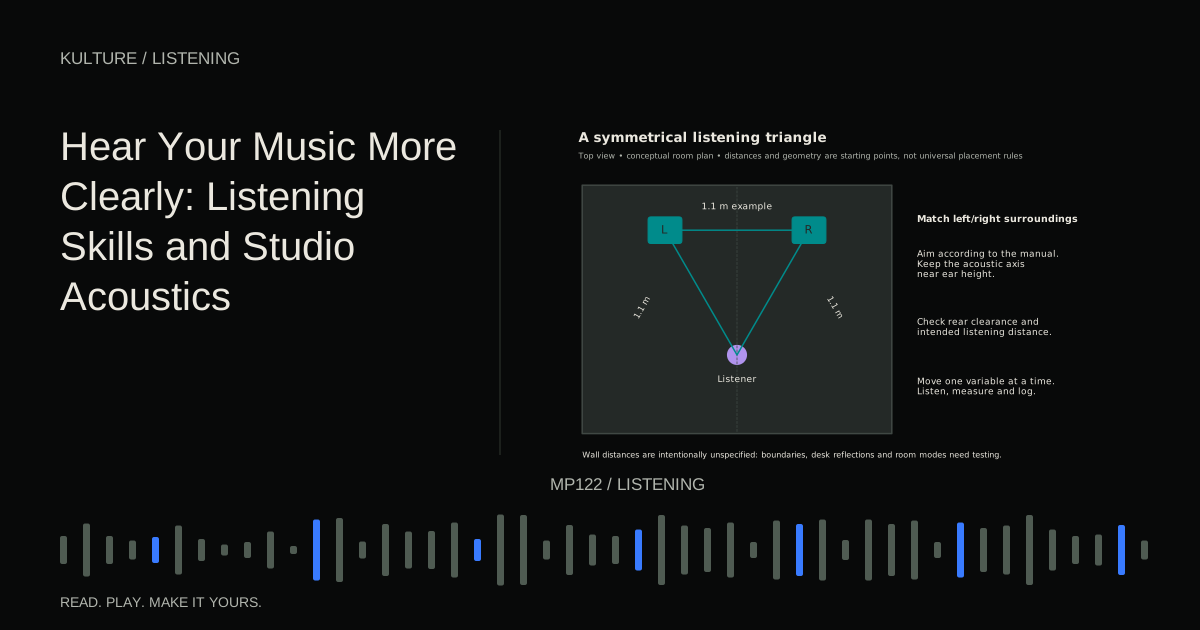
Second, move the speakers and chair systematically. A change in geometry may improve bass consistency without buying anything. See monitor positioning.
Third, inspect the door path and discuss permissible building changes with the owner or a qualified professional. Do not assume that the absorber used for vocals will stop transmission. Each complaint has a different test and a different likely remedy.
Read acoustic claims critically
Ask what was tested, at which frequencies, and in what mounting condition. A single “noise reduction” percentage can hide important limitations. An absorption rating is not a whole room isolation rating. A laboratory wall assembly rating is not proof that your room, with its doors and flanking paths, will achieve the same result.
For low frequency problems, look beyond a summary number. Ask for frequency dependent data and whether the proposed treatment is intended for absorption, isolation, or vibration control. If the seller cannot distinguish those functions, pause before purchasing.
Avoid claims such as “soundproof your room with twelve tiles” unless they are supported by relevant testing and a clearly limited meaning of soundproofing.
Plan improvements in an economical order
Start by identifying the exact problem. Then try free, reversible changes: placement, listening level, microphone position, and scheduling. Document the result.
Next, measure where useful. Room EQ Wizard's documentation supports room response measurement, but a single frequency response sweep is not a professional building isolation test. Use the right test for the question.
Finally, choose targeted treatment or seek construction advice. Prioritize the change most likely to address the main problem instead of buying a visually matching set of panels.
Your exercise is to make two lists: “sound inside my room” and “sound travelling between rooms.” Put each complaint in the appropriate list and propose one reversible test for it. Continue with room measurement and acoustic priorities once you know which internal listening problem matters most.
TAKE IT INTO YOUR OWN MUSIC
Your next session.
Imagine a bedroom studio with a desk against one wall. The vocal recording sounds boxy, the bass response changes with chair position, and a housemate hears music through the door.
Notes and progress stay in this browser.