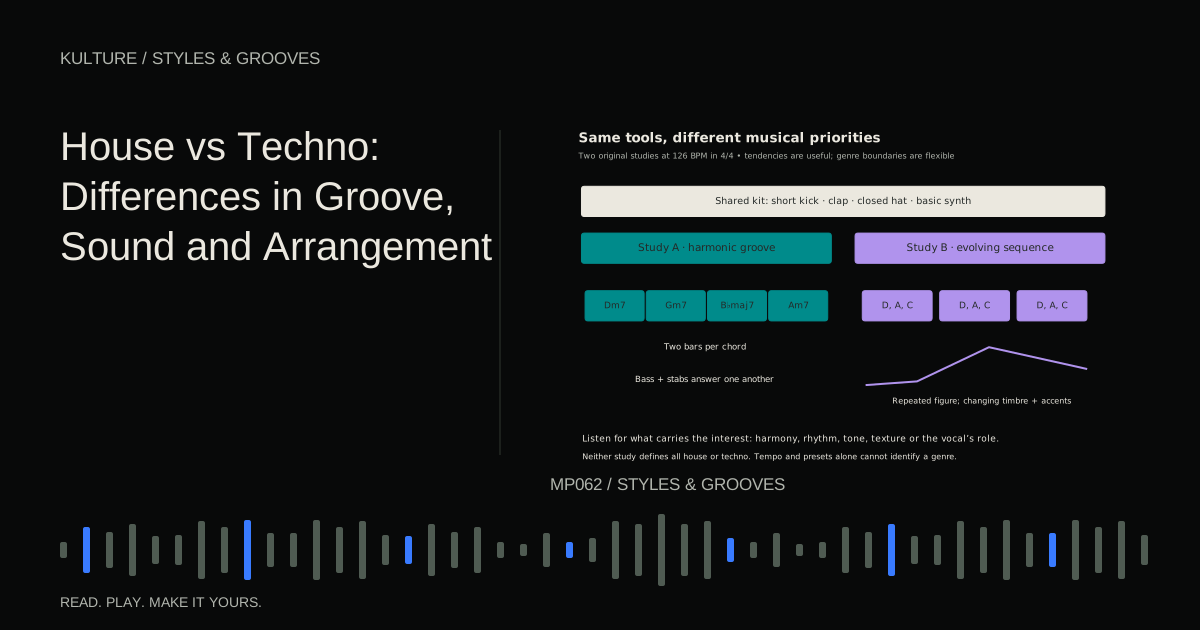
Do not identify either genre solely by tempo, darkness, or the presence of a four on the floor kick. A soulful techno track and a minimal house track can overturn those shortcuts immediately.
Listen for what the track asks you to follow
In a house track, you might naturally follow a bassline answering a chord stab, a recurring vocal phrase, or a syncopated piano pattern. In a techno track, you might follow how a small synth figure changes color, how percussion phases against the pulse, or how a texture gains intensity.
These are tendencies, not opposing laws. Native Instruments' house introduction and techno introduction describe overlapping production tools. Use the comparison below to hear priorities directly instead of memorizing stereotypes.
TRY IT HERE
Find the pocket
Tap the grid, change the tempo and hear your pattern.
Ready when you are. Audio starts only when you press Play.
Keep experimenting in the beat maker LabOne kit, two original studies
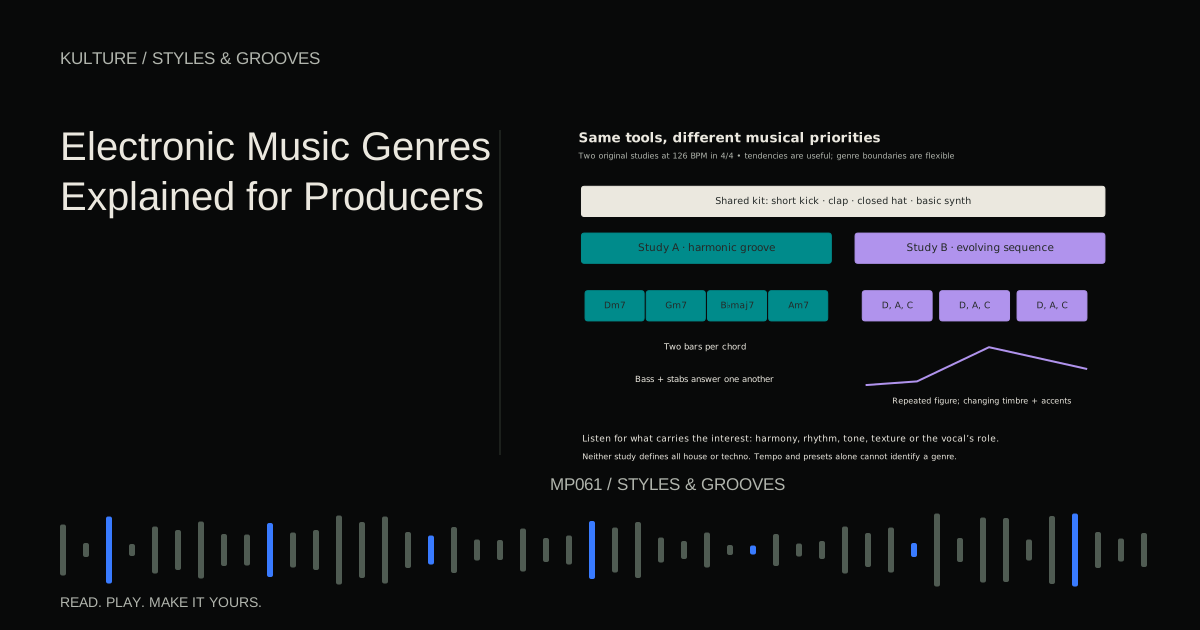
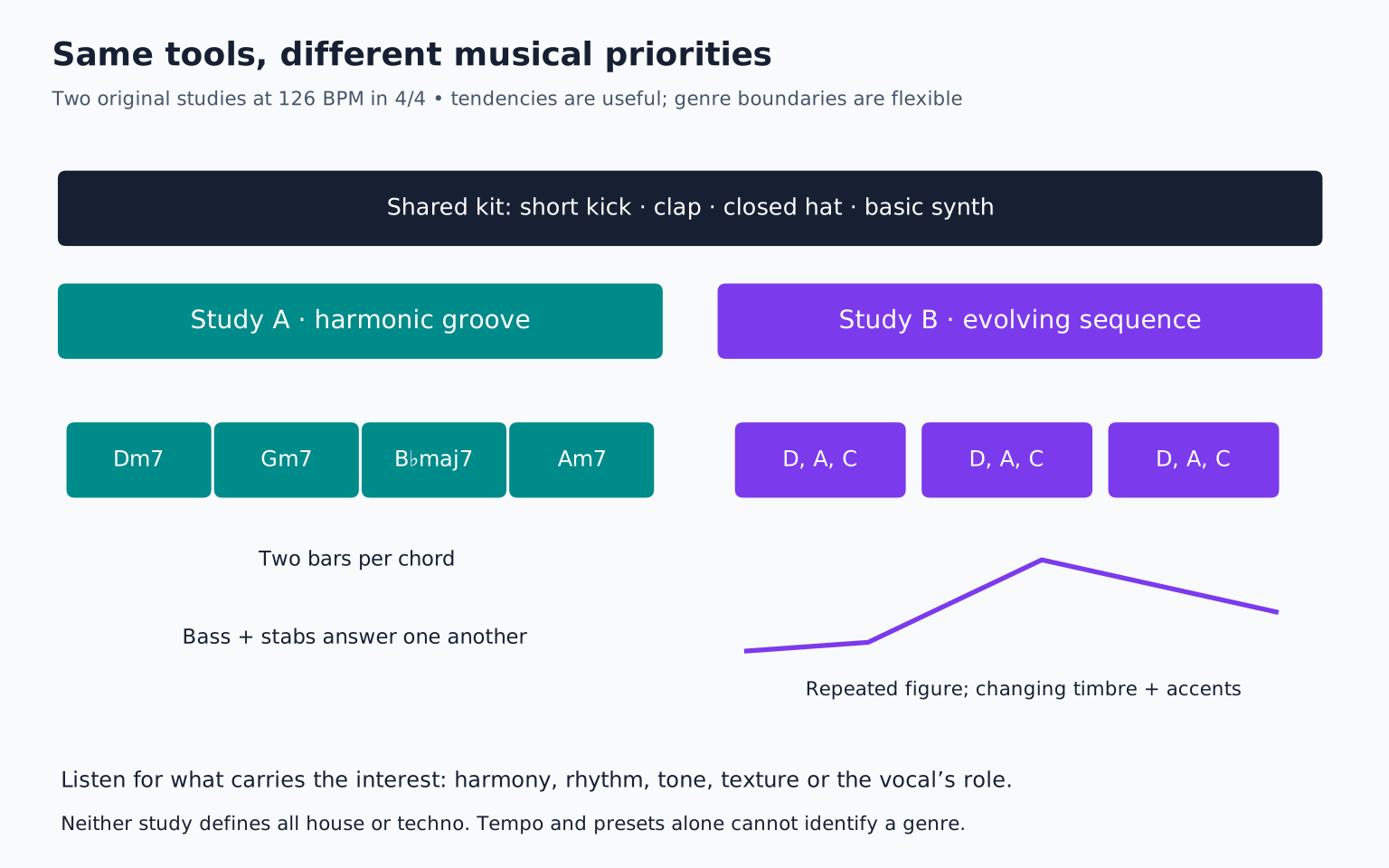
Create two projects at 126 beats per minute in 4/4. Use the same short kick, clap, closed hat, and basic synth in both. A bar contains four beats; each beat can be divided into four sixteenths, counted “1 e and a.” Keep playback levels similar so one example does not win simply by being louder.
Study A: harmonic groove
Place the kick on beats 1, 2, 3, and 4. Add a clap on 2 and 4 and a hat on each “and.” Make a two bar bass rhythm: a short root on beat 1, another root on 2 and, a fifth on 3 and, and an octave root on 4 a in the second bar only.
Use four chords, two bars each: D minor seventh, G minor seventh, B flat major seventh, and A minor seventh. Their notes are D, F, A, C, G, B flat, D, F, B flat, D, F, A, and A, C, E, G. Put the bass roots below and voice the chord notes in a middle register.
Play the chords on 1 and and beat 3, with the second stab slightly softer. Leave the last beat of every second bar clear for the bass pickup. The musical interest comes from the chord movement and the conversation between bass and stabs.
On the second eight bar pass, add a short melodic response only in the gaps. Keep it simple: A, C, D over D minor, then D, F, G over G minor. The melody follows the harmony without becoming a constant solo.
Study B: evolving sequence
Keep the same quarter note kick. Remove the clap initially. Program a closed hat on eighth notes, with stronger offbeats. Add a metallic percussion hit every three sixteenths over a two bar region, then let the sequence restart. This creates shifting accents against the four beat bar without changing the time signature.
Use a short D, A, C synth figure. Place D on beat 1, A on 1 a, C on 2 and, D on 3 e, and A on beat 4. Repeat the notes, but change the strongest accent every four bars. Hold the tonal center on D instead of changing chords.
Across sixteen bars, gradually open the synth's low pass filter and then close it partway. A low pass filter reduces upper frequencies; moving it changes the apparent brightness. Add a clap only for the final eight bars, then remove the kick for one beat before the full pattern returns.
Here, development comes mainly from accent, texture, and the interaction of cycles. The notes barely change, but the experience can still evolve.
What the experiment does and does not prove
Study A leans toward a chord led house approach. Study B leans toward a sequenced techno approach. They do not prove that seventh chords belong only to house or that techno must stay on one note. Change the sound palette and phrasing, and either study could move toward another style.
The exercise is valuable because it holds the kit and tempo constant. You can hear how composition and arrangement affect the result. Buying a “techno kick” or “house bass” preset cannot make those decisions for you.
Groove is more than swing
Swing changes the relative timing of alternating subdivisions. Velocity changes the strength of notes. Note length controls overlap and space. Sample attack and decay affect whether a hit feels sharp, late, soft, or sustained.
A straight house groove can feel excellent. A techno groove can use substantial shuffle. Rather than applying a global swing preset automatically, choose one layer to move and compare. Keep the main kick stable while delaying selected hats slightly. If the groove weakens, reduce the offset or change the hat accents.
The relationship between bass duration and kick decay matters in both styles. A long kick and long bass may blur together. Shortening one part can produce a clearer groove before any equalization or sidechain processing is added.
Arrangement reflects the track's purpose
Both styles can use DJ friendly intros and outros, long phrases, breakdowns, and recurring peaks. Neither requires a dramatic build before every return.
For Study A, try introducing the chord progression early, then withholding the melody until the first main section. For Study B, reveal the sequence immediately but gradually change its timbre and surrounding percussion. One approach builds anticipation around a new musical part; the other builds attention around transformation of an existing part.
A vocal led house song may use familiar verse and chorus functions. A techno track may develop almost continuously. But those are possibilities, not genre borders. Ask how much repetition your particular material rewards.
Avoid three misleading shortcuts
“House is happy, techno is dark” ignores the emotional range of both. “Techno needs rumble” confuses one bass production technique with an entire genre. “House is slower” is unreliable because tempo ranges overlap and scenes evolve.
Rumble is a sustained, often processed low texture that can be derived from reverberated percussion. It is optional. A clean bass sequence, a short low pulse, or carefully chosen kick can provide a different low end foundation.
Your listening and production exercise
Make sixteen bars of each study, then swap only the bass and synth parts while preserving the drums. Describe what changes and what remains recognizable. Next, choose three actual tracks in each tradition and compare their use of harmony, accents, and development. Avoid treating one famous track as the definition of a whole genre.
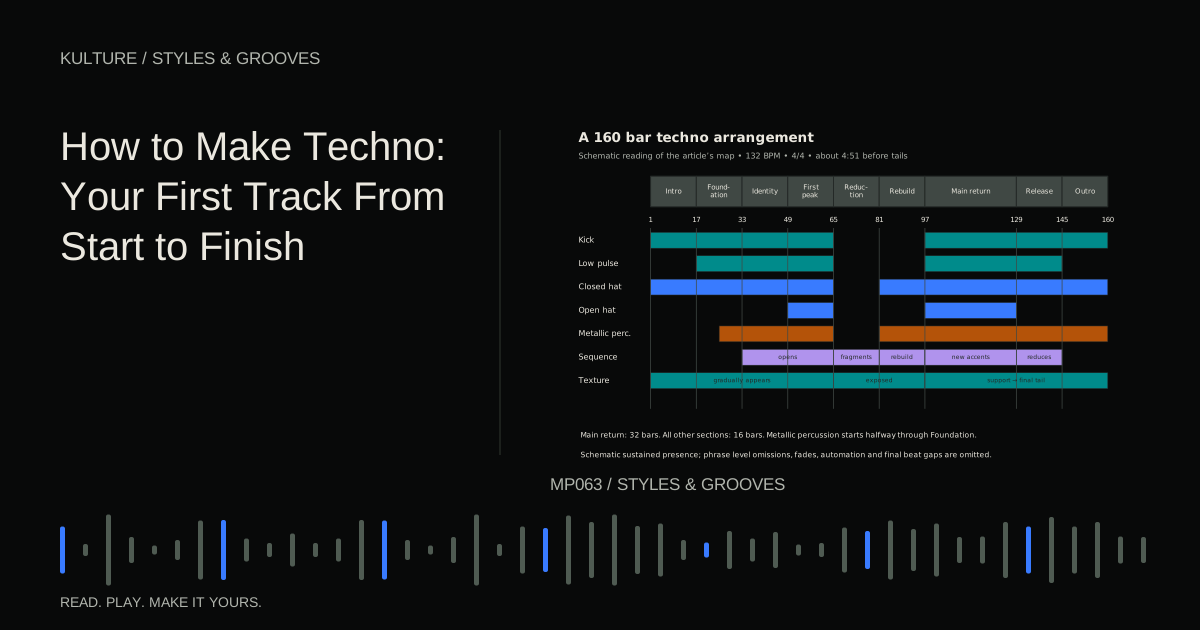
When ready to expand the experiment, follow the complete techno track walkthrough or the house production tutorial. The goal is to understand musical choices well enough to make your own.
TAKE IT INTO YOUR OWN MUSIC
Your next session.
Make sixteen bars of each study, then swap only the bass and synth parts while preserving the drums. Describe what changes and what remains recognizable. Next, choose three actual tracks in each tradition and compare their use of harmony, accents, and development. Avoid treating one famous track as the definition of a whole genre.
Notes and progress stay in this browser.