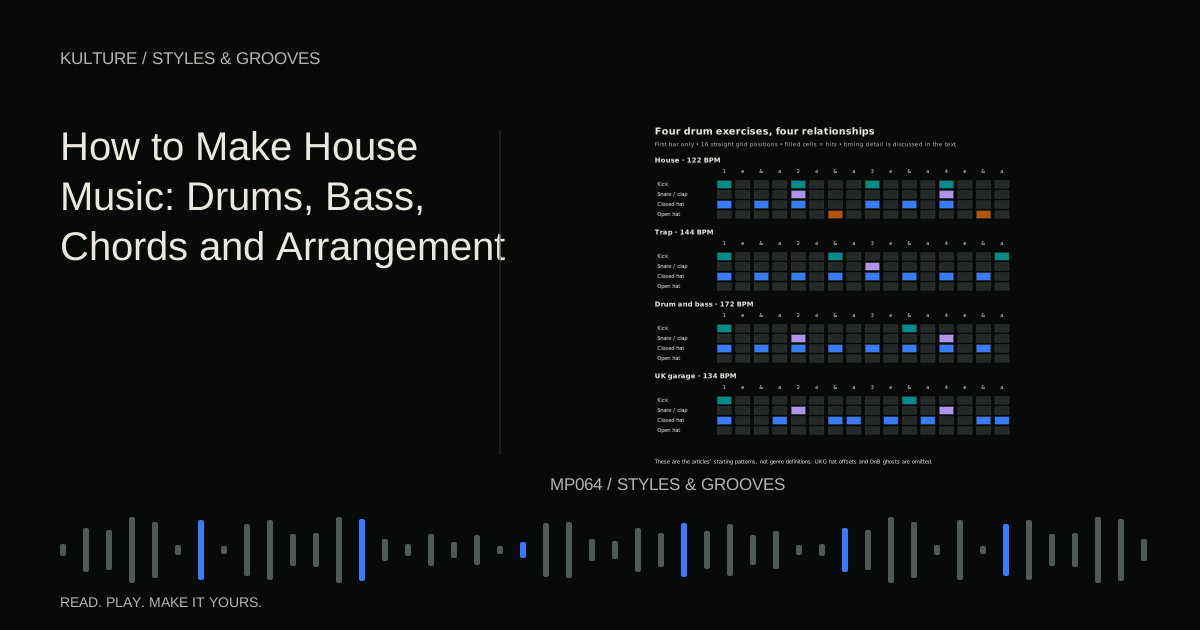
This original example uses 144 beats per minute in 4/4, with a half time feel. You could represent a similar musical pulse at 72 BPM with different grid values; the sound matters more than the displayed number. The exercise is a spacious instrumental designed to leave room for a vocalist.
Begin with a short melodic scene
Choose a restrained piano, bell, or plucked synth. Use F natural minor: F, G, A flat, B flat, C, D flat, E flat. Make four bars with F minor for two bars and D flat major for two. The chord notes are F, A flat, C and D flat, F, A flat.
Play a single note motif above the chords: C on beat 1, A flat on beat 2 and, G on beat 3, and F on beat 4 and. In the next bar, play C on beat 1 and hold A flat from beat 3 to the end. Over D flat, change the first C to D flat and retain the descending response.
Keep the chord layer sparse, perhaps one soft sustained chord per bar. If the melody already implies the harmony clearly, omit the chord track entirely. A dark mood does not require several dissonant layers or an elaborate progression.
Waves' trap production guide discusses common production components. The exact notes and rhythm here are independent practice material.
TRY IT HERE
Find the pocket
Tap the grid, change the tempo and hear your pattern.
Ready when you are. Audio starts only when you press Play.
Keep experimenting in the beat maker LabHear the half time backbeat
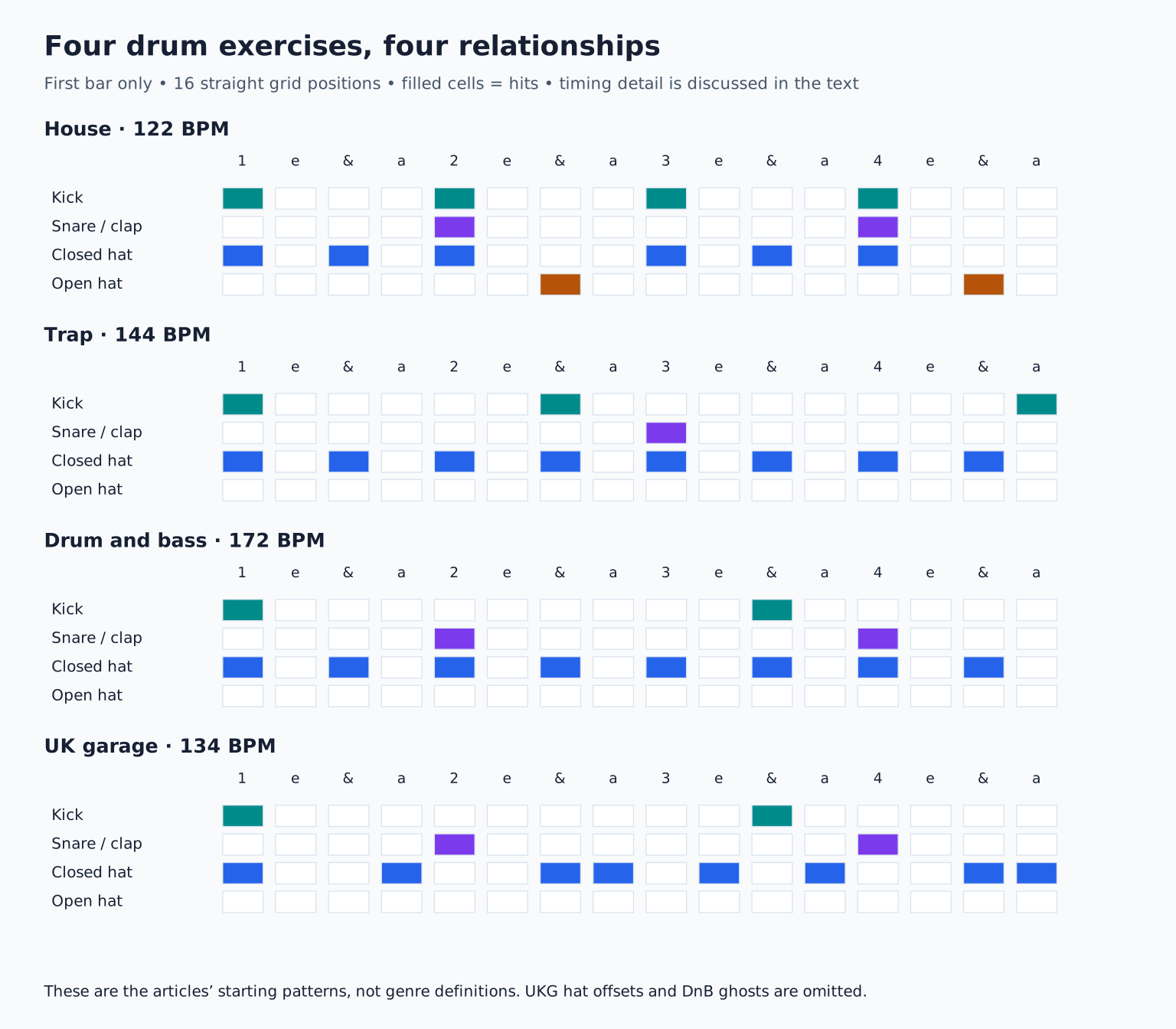
Put the main snare or clap on beat 3 of every bar at 144 BPM. Compared with snares on beats 2 and 4, this creates a slower feeling backbeat against the fast grid.
Make a two bar kick pattern:
| Bar | Kick positions |
|---|---|
| 1 | 1, 2 and, 4 a |
| 2 | 1 and, 2 a, 4 |
Count each beat as “1 e and a.” The “a” is the fourth sixteenth subdivision. Keep the kick short initially so its tail does not compete with the 808 you will add later.
Add one quiet rim or secondary snare on bar 2, beat 4 and. If it distracts from the main snare, remove it. Secondary hits should make the pattern speak, not obscure where the main backbeat falls.
Program hats with hierarchy
Begin with closed hats on eighth notes. Alternate their strength slightly, and leave a gap on bar 2, beat 2 and. That gap makes the following detail more noticeable.
At the end of bar 2, replace the final eighth note hat with four thirty second notes occupying the same span. Make the first strongest and the others softer. This is a fast straight roll, not a triplet.
For a separate variation, place three evenly spaced hits across one quarter note beat. Those are eighth note triplets. Compare the triplet gesture with the straight thirty second roll. They divide time differently; switching the grid to “triplet” does not mean every note now has swing.
Use one roll per two or four bars while learning. Constant rolls make accents less meaningful and can crowd the space where a rapper's consonants would sit. Change hat pitch sparingly if the sampler supports it, checking that the result still feels like percussion rather than a competing tune.
Tune the 808 before writing its line
In current production language, an 808 often means a sustained pitched bass derived from or inspired by the Roland TR 808 bass drum. It is not synonymous with the entire original drum machine.
Load a suitable bass sample in a sampler. Identify the stable pitch after the initial pitch drop, using your ears and a tuner where useful. Set the sample's root note correctly so playing F actually produces F. A sample labelled “C” can still need verification.
Use monophonic playback so new notes replace previous ones rather than creating low frequency chords. Check whether the instrument's one shot mode ignores MIDI note length. If it does, choose an envelope controlled mode or adjust the sample envelope to obtain deliberate note endings.
The detailed 808 tuning lesson covers this process before arrangement becomes complicated.
Give the bass its own phrasing
Over the first F minor bar, place F on beat 1 for one beat, F on 2 and for a half beat, and C on 4 a for a sixteenth. In bar 2, use F on 1 and, hold it through beat 2, then leave the snare region mostly clear. Add E flat on beat 4 as a short approach to D flat.
Over the D flat bars, use D flat as the anchor and A flat as a brief upper response. Do not force the bass to follow every kick. Let the kick add punctuation while some bass notes sustain independently.
Try one glide in the fourth bar: start on D flat and slide to F near the end. Portamento means moving continuously between pitches. Instruments differ in whether overlapping notes, a special slide command, or a glide setting triggers it. Confirm the behavior in your instrument rather than drawing overlapping notes blindly.
If the slide hides the next downbeat, shorten it or lower the destination. The bass phrase should remain understandable even when the effect is removed.
Make a vocalist friendly arrangement
Create 96 bars at 144 BPM, about 2 minutes 40 seconds. Use an 8 bar intro, 16 bar hook, 24 bar verse, 16 bar hook, 24 bar verse, and 8 bar ending. These labels describe intended functions; adapt them to the artist's actual phrasing.
In the verse, remove the chord layer and reduce hat rolls. In the hook, restore the fuller melodic texture and an extra high response. Add a one beat drum gap before one hook, but let the other arrive with a simple vocal or melodic pickup.
Keep important fills away from likely vocal line endings until you have a guide performance. A beat can sound exciting alone yet leave no room for a song.
Balance and troubleshoot
If the 808 disappears on small speakers, consider a modest harmonic layer or saturation rather than simply boosting sub frequencies. Saturation adds harmonics; it can also change peak level, so compare with output loudness matched.
If kick and 808 fight, inspect note timing, sample attack, and tail lengths first. If the 808 clicks, check abrupt sample boundaries and envelope settings. If it becomes a chord, inspect polyphony and overlapping notes. If the melody feels buried, remove competing midrange layers before boosting it sharply.
Export the full beat and listen for the bass's actual notes, not only its weight. Your exercise is to make a second version with half the hat rolls and one fewer melodic layer. Decide whether the remaining space makes the rhythm more persuasive. Continue with 808 pattern writing and track finishing.
TAKE IT INTO YOUR OWN MUSIC
Your next session.
If the 808 disappears on small speakers, consider a modest harmonic layer or saturation rather than simply boosting sub frequencies. Saturation adds harmonics; it can also change peak level, so compare with output loudness matched.
Notes and progress stay in this browser.