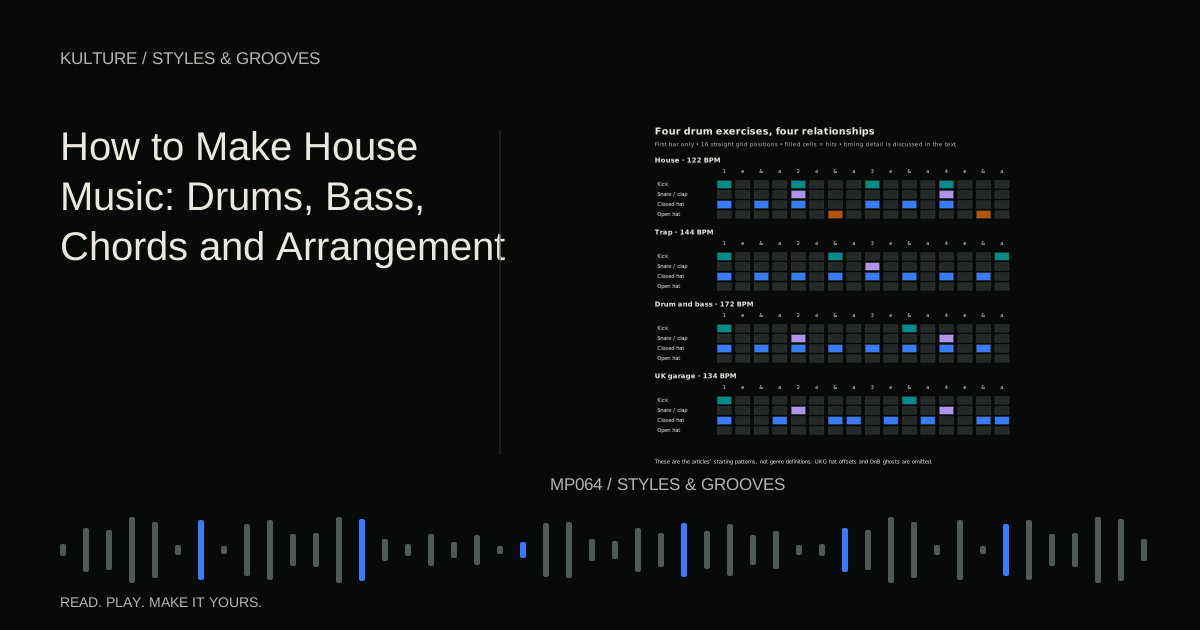
This original exercise makes a warm, chord led house track at 122 beats per minute in 4/4. It uses stock drums, a simple bass, and electric piano or organ style chords. House has many branches, so treat this as one musical approach rather than a universal formula. Native Instruments' house overview offers another production example and background.
Establish a pocket with four sounds
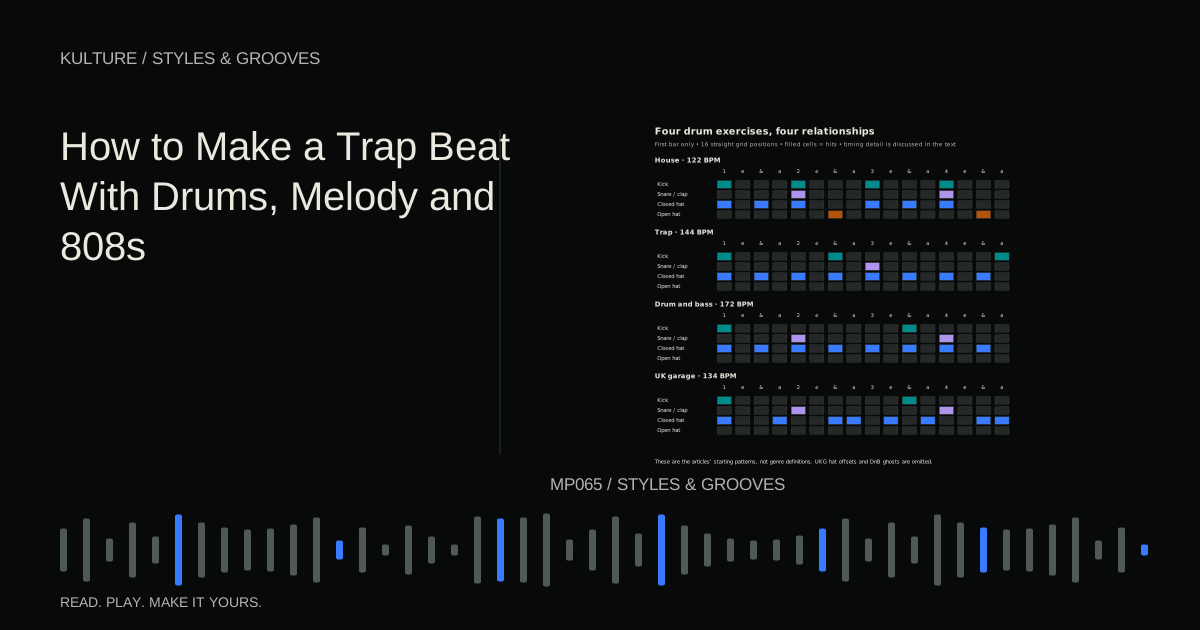
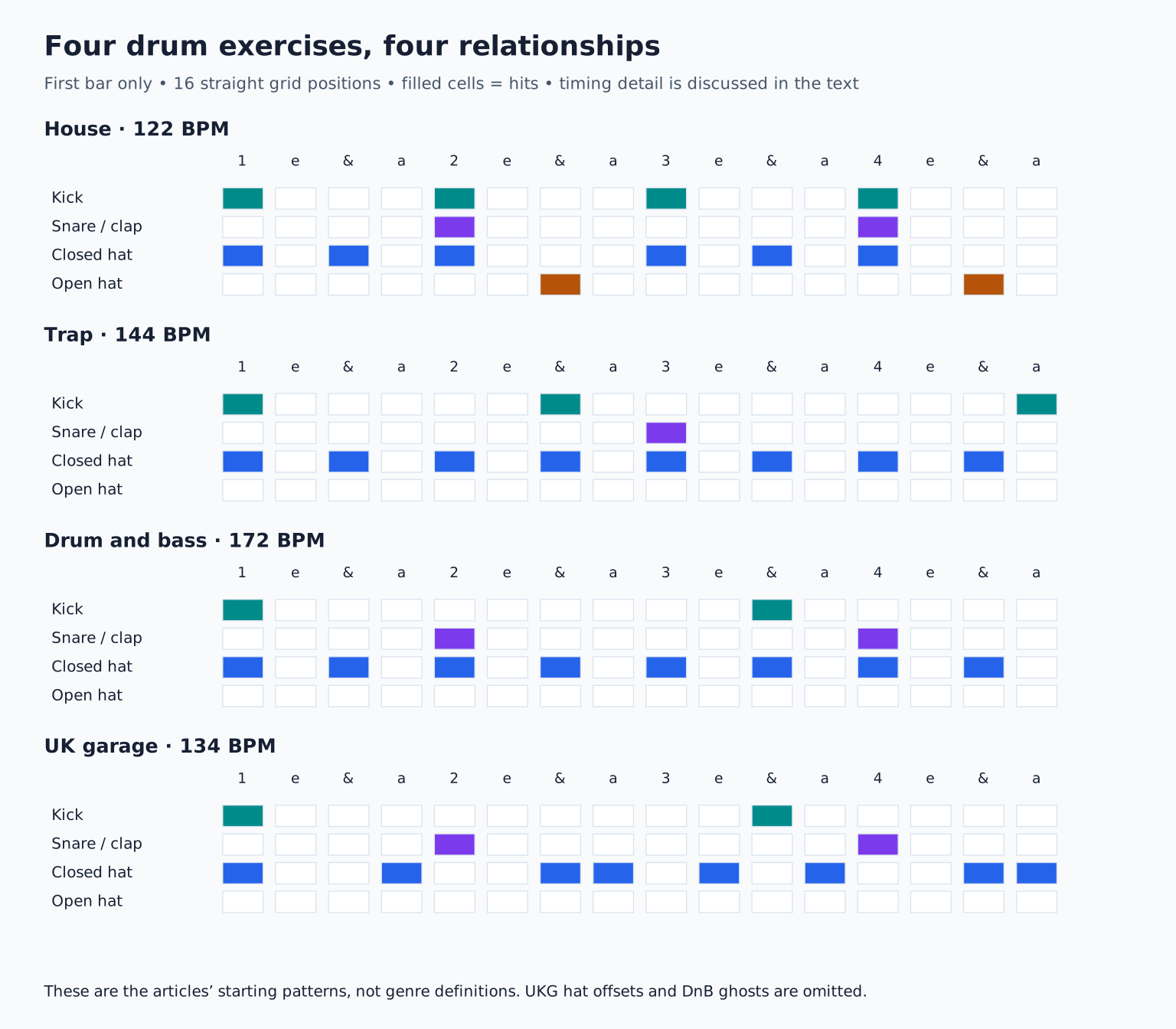
Choose a kick with a defined attack and manageable tail. Put it on beats 1, 2, 3, and 4. Add a clap on 2 and 4, a closed hat on each eighth note, and an open hat on the “and” between beats 2 to 3 and 4 to 1.
Remove the closed hats at the two positions occupied by open hats so a choke group does not cut the open sounds immediately. Keep the closed hats quieter on the numbered beats and stronger between them. Try velocities alternating around 50 and 75, adjusting to the sampler. These numbers are illustrative: velocity response depends on the instrument and sample layers.
Loop two bars. Remove the final closed hat in bar 2 so the pattern breathes before repeating. If the open hat rings too long, shorten its envelope or configure a choke relationship so the next closed hat stops it.
Before adding swing, listen to the straight pattern. Then delay selected alternate sixteenth subdivisions on a shaker or quiet hat layer. Keep kick and clap stable. A global timing change can move anchors you intended to preserve, and swing amounts are not standardized across DAWs.
TRY IT HERE
Find the pocket
Tap the grid, change the tempo and hear your pattern.
Ready when you are. Audio starts only when you press Play.
Keep experimenting in the beat maker LabGive the chords a playable shape
Use an eight bar progression, with each chord lasting two bars:
| Bars | Chord | Notes |
|---|---|---|
| 1 to 2 | C minor seventh | C, E flat, G, B flat |
| 3 to 4 | A flat major seventh | A flat, C, E flat, G |
| 5 to 6 | E flat major seventh | E flat, G, B flat, D |
| 7 to 8 | B flat dominant seventh | B flat, D, F, A flat |
A seventh chord adds a fourth chord tone above a basic three note triad. You do not need to understand every symbol before hearing the progression. Play the notes together, then move individual notes by octaves to keep the voices close.
Keep the chords in a middle register and leave the lowest region to the bass. For example, use E flat, G, B flat, C for C minor seventh rather than always stacking from the root. This is an inversion or reordered voicing; the chord identity remains recognizable.
Program short chord stabs on beat 1 and, beat 2 a, and beat 4. In the second bar of each chord, omit the middle stab. The gaps create a conversation with the drums rather than an unbroken block of harmony.
Write bass that participates in the rhythm
Use a short, rounded monophonic bass. Begin with the chord roots C, A flat, E flat, and B flat. Place a root on beat 1 for one quarter note, another on beat 2 and for an eighth, and the fifth on beat 3 and for an eighth.
On the second bar of each chord, add a short octave root on 4 and as a pickup. The fifths are G, E flat, B flat, and F respectively. Keep the pickup short enough that it does not overlap the next root unintentionally.
Now listen only to bass and drums. If every bass note coincides with a kick, try moving one bass hit into a gap. If the groove feels restless, remove the pickup. The point is not maximum syncopation; it is a clear relationship between repeated pulse and moving bass.
If the kick and bass blur, shorten the bass envelope before adding processing. Sidechain compression can create space, but it should support a working rhythm rather than compensate for every overlapping note.
Add a hook with room to answer
Use a pluck, short vocal you recorded, or simple lead. Over the first chord, play G on beat 1, B flat on 2 and, and C on beat 3, held for a beat. Leave the next bar empty. Over A flat, use E flat, G, A flat with the same rhythm.
For the second half, answer with G, F, E flat over E flat major, then F, D, B flat over B flat seventh. Keep the phrase in a comfortable upper register. The contour rises in the first half and falls in the second, giving the eight bars a recognizable shape.
Mute the chord stabs that clash most with the hook's attacks. Arrangement is often the easiest way to make the melody audible. If using a vocal sample, check its license and pitch rather than assuming a filename guarantees suitability.
Arrange for discovery and return
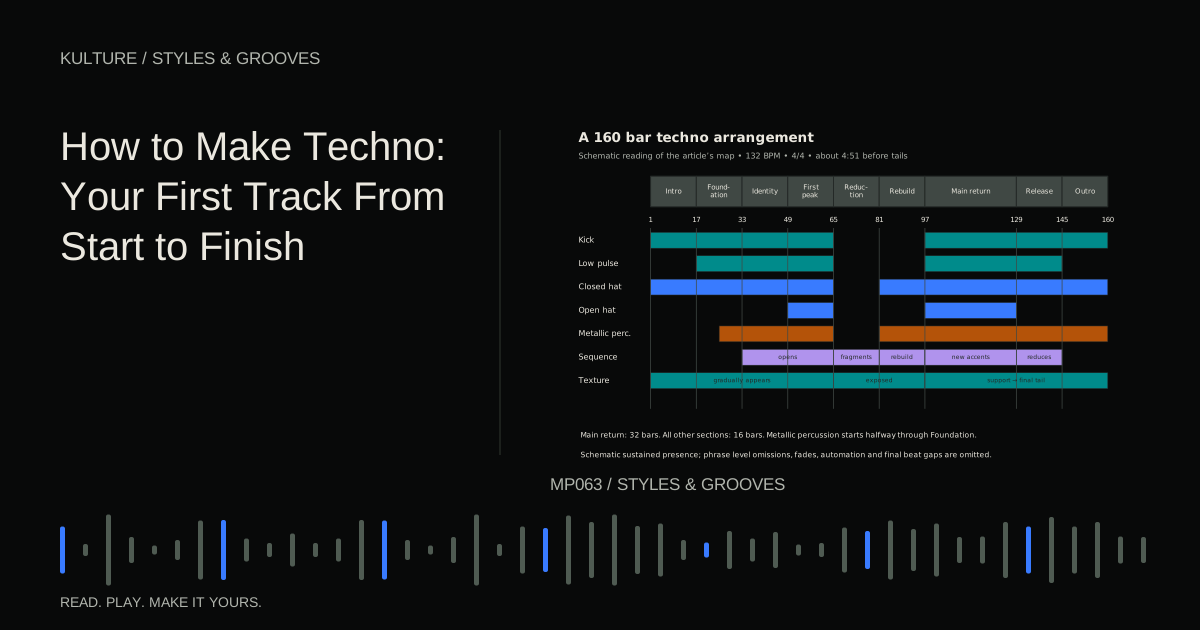
Try 128 bars, approximately 4 minutes 12 seconds at this tempo:
- Bars 1 to 16: drums, with chords gradually introduced.
- Bars 17 to 32: bass and complete chord rhythm.
- Bars 33 to 48: first hook presentation.
- Bars 49 to 64: remove kick and bass; sustain selected chord notes.
- Bars 65 to 80: rebuild percussion and tease only the hook's last note.
- Bars 81 to 112: full groove; add the hook's response more frequently in the second half.
- Bars 113 to 128: remove hook, then bass, leaving a clear exit.
Shorten this map for a compact listening version. If the eight bar harmony feels too slow, use one bar per chord, but check whether the bass has enough time to settle. Section length should follow musical interest rather than a prescribed duration.
Make movement feel performed
Automate a gentle increase in chord brightness toward the main return. Add a little more reverb during the breakdown and reduce the send when the kick returns. Keep the dry chord attack present enough that the rhythm does not disappear.
A one bar percussion fill can announce a major boundary. Use a low tom on beat 3 and two quieter hits on 4 and 4 and, replacing other hits rather than stacking everything. At another boundary, use silence instead. Varied transitions make repeated sections feel less mechanical.
Check the mix without losing the groove
Balance kick, bass, chords, hook, and hats in that order. If the hats dominate at quiet playback, lower them before dulling the entire mix. If chords seem muddy, inspect their register and note length before making deep equalization cuts.
Compare the full groove with the breakdown. Reverb that sounds beautiful alone may swamp the return. Check stereo and mono, especially if the chord instrument uses widening or chorus. Export the complete track and listen away from the arrangement screen.
For your exercise, create two bass versions with the same notes: one mostly on beats and one mostly between them. Choose by how the chord stabs and drums respond, not by which looks more complicated. Continue with house versus techno or arranging an eight bar loop.
TAKE IT INTO YOUR OWN MUSIC
Your next session.
Balance kick, bass, chords, hook, and hats in that order. If the hats dominate at quiet playback, lower them before dulling the entire mix. If chords seem muddy, inspect their register and note length before making deep equalization cuts.
Notes and progress stay in this browser.