A track at 130 beats per minute can be house, techno, garage, or something that crosses those boundaries. A distorted bass does not make every track drum and bass. Start by listening to relationships between parts, then use genre names as useful descriptions.
Five questions that reveal more than BPM
First, where is the main pulse? A kick on every quarter note creates a different foundation from a broken pattern with gaps. Second, where are the strongest backbeats, often carried by a snare or clap? Third, how are smaller subdivisions placed: straight, swung, or freely performed?
Fourth, what carries the identity: a vocal, a chord loop, a bass gesture, a percussion texture, or gradual sound transformation? Fifth, how does the piece develop over time? A verse, chorus song and a continuously evolving club track organize attention differently even when they use similar instruments.
Native Instruments' electronic music overview discusses production across several electronic styles. Treat any listed tempo range as a listening aid, not an eligibility test. Artists regularly work outside familiar ranges.
TRY IT HERE
Find the pocket
Tap the grid, change the tempo and hear your pattern.
Ready when you are. Audio starts only when you press Play.
Keep experimenting in the beat maker LabHouse and techno: related tools, different emphases
House often invites you to follow the conversation between a steady kick, bass groove, chords, and vocal or instrumental hooks. Disco, soul, and club traditions are important to understanding its musical vocabulary. Many house tracks use claps on beats 2 and 4, but that pattern alone does not identify the genre.
Techno often gives repeated patterns, synthetic timbre, and evolving rhythmic relationships a central role. A short sequence can become the main event through changes in accent, filtering, and interaction with percussion. There is melodic, soulful, sparse, abrasive, fast, and restrained techno; none of those adjectives defines the entire tradition.
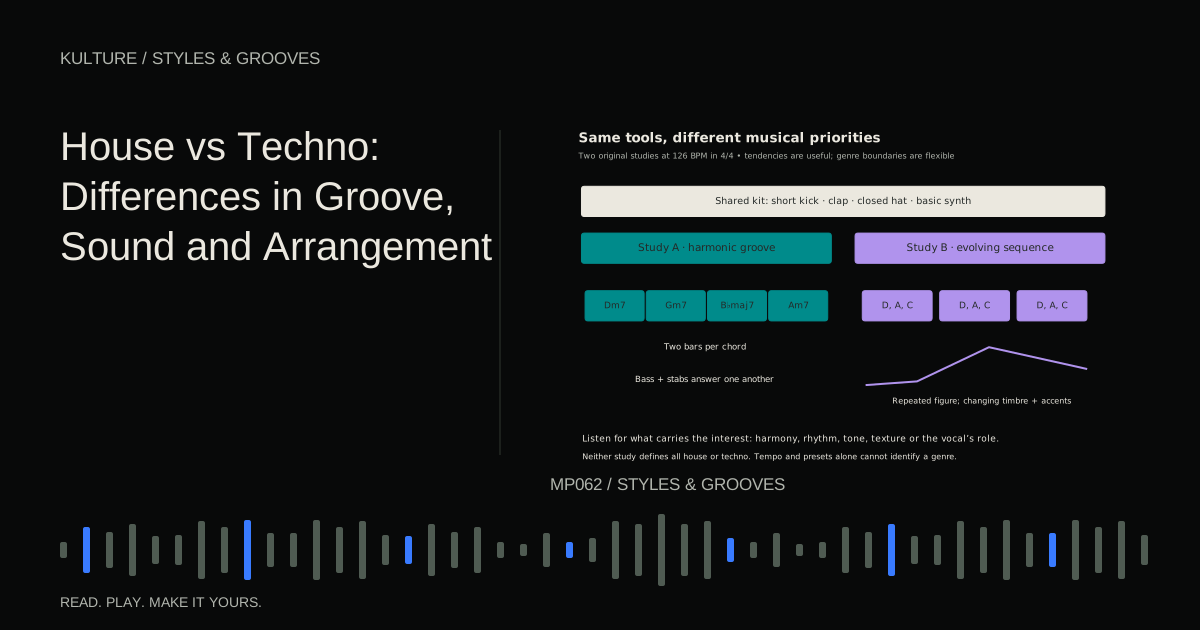
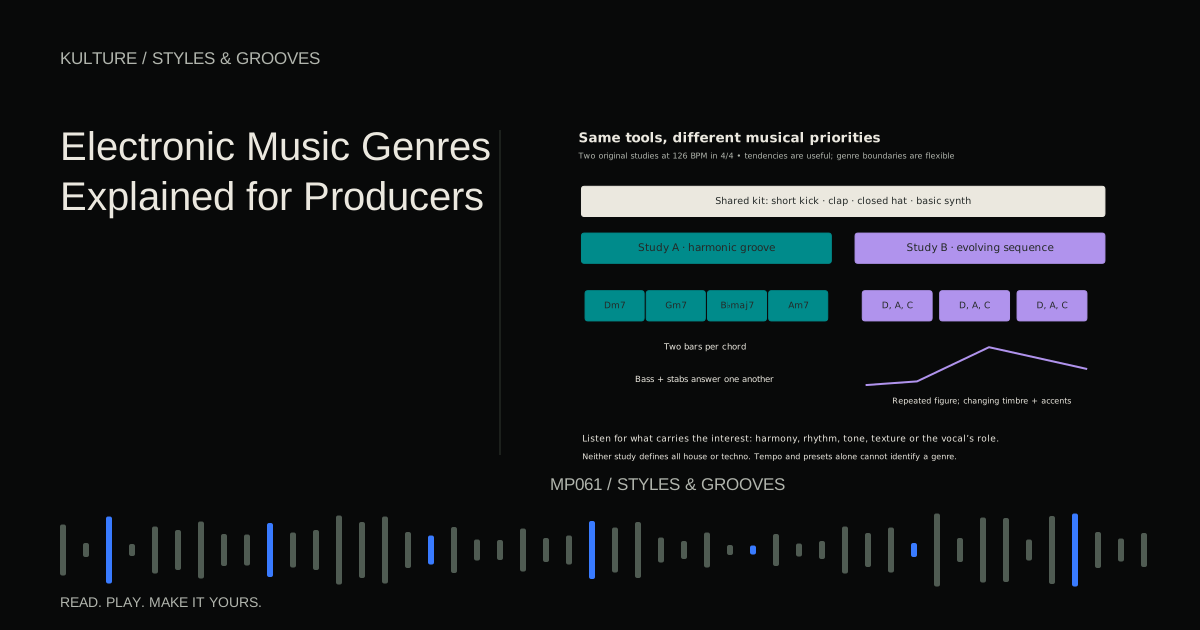
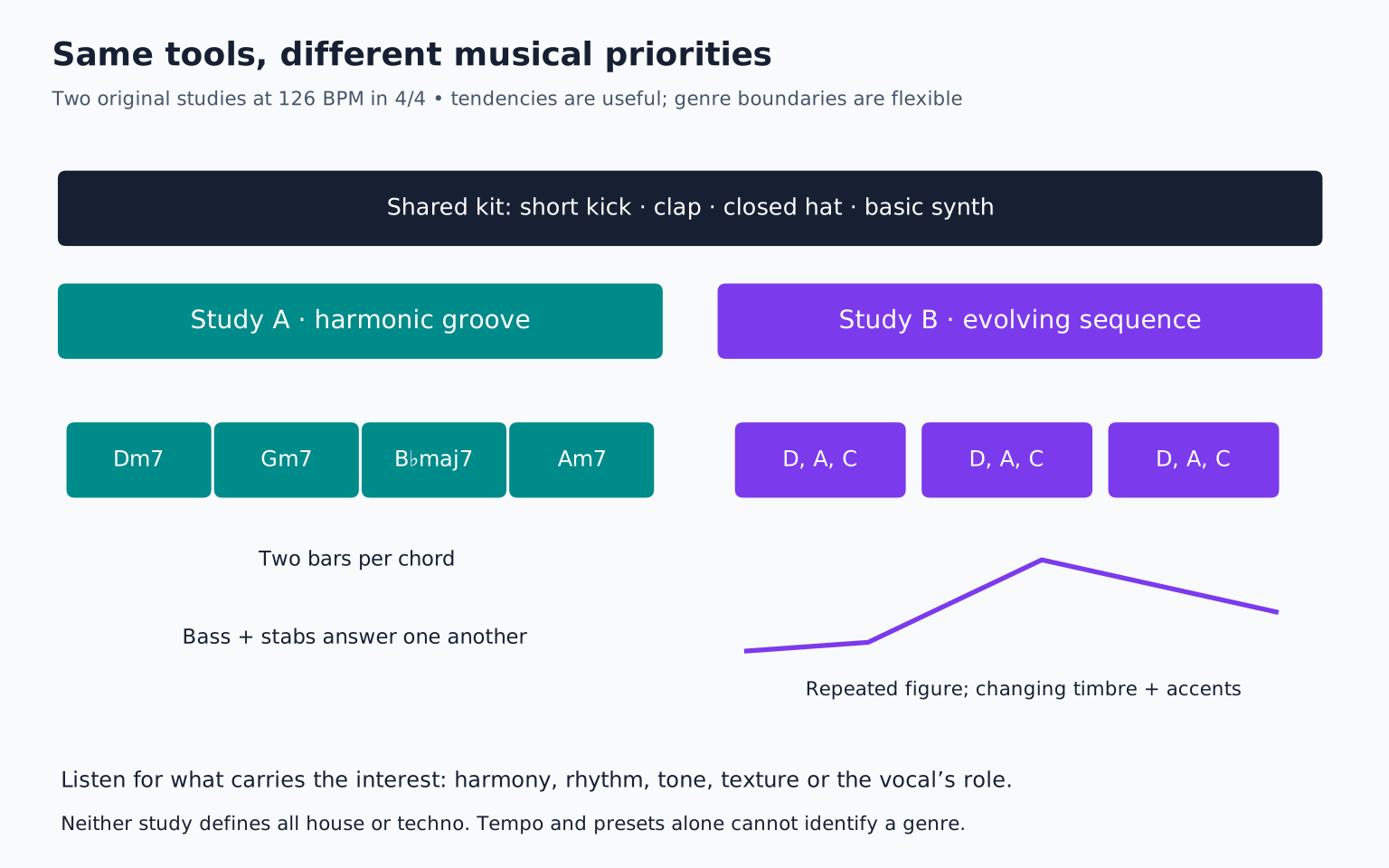
For a controlled comparison, use one four on the floor kick at 126 BPM. In version A, add a syncopated bass and changing seventh chords. In version B, hold one tonal center and develop a three note sequence through changing accents. These are teaching sketches of different priorities, not a claim that house cannot be minimal or techno cannot use chords. Continue with house versus techno.
Garage: hear the spaces
UK garage includes both four to the floor and broken, two step approaches. In two step, gaps in the kick pattern create room for shuffled percussion and bass. Vocal fragments may act like rhythmic instruments as well as carry words.
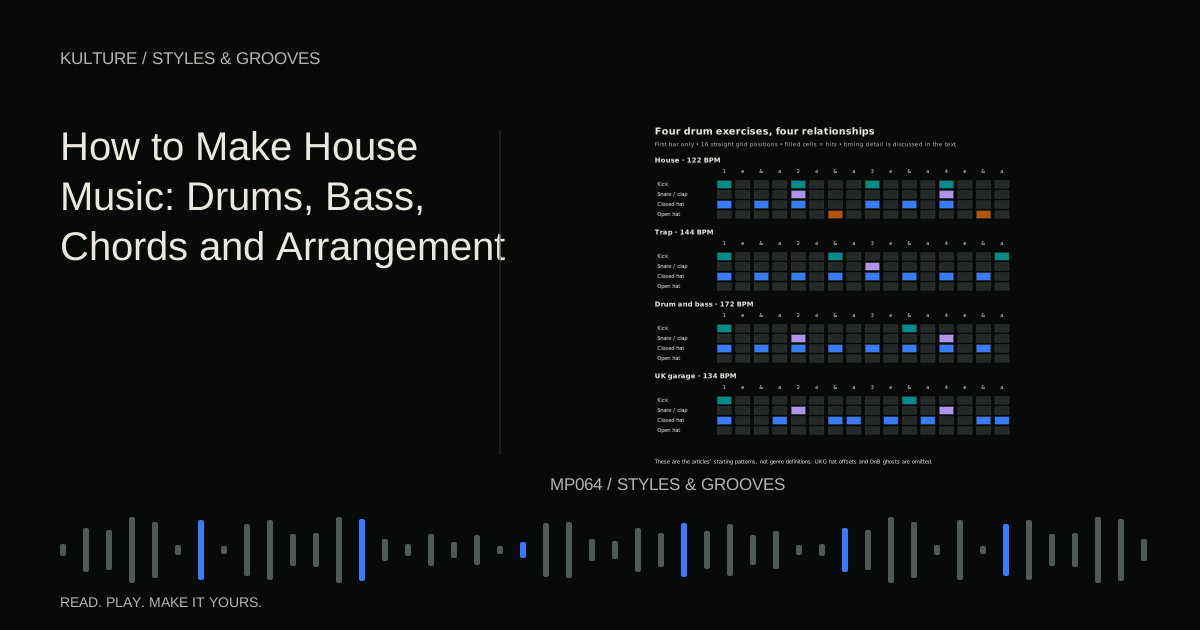
Try kicks on beat 1 and 3 and, snares on 2 and 4, and quiet hats on selected sixteenths. Delay some alternate sixteenth subdivisions slightly while keeping the main backbeats stable. Compare the result with the same hits placed evenly. Swing is a timing relationship, not simply playing triplets everywhere.
The Native Instruments UK garage guide provides a production oriented account of that rhythmic vocabulary. Our garage walkthrough develops an original example.
Drum and bass and jungle: speed with hierarchy
Both traditions can combine fast drum activity with slower feeling bass and harmonic movement. Jungle often puts chopped breakbeat performance and the character of recorded drums at the center. Drum and bass encompasses many approaches, including tightly programmed two step drums, rolling breaks, spacious liquid textures, and aggressive sound design.
At 172 BPM, place snares on beats 2 and 4 and kicks on 1 and 3 and. Now add quiet ghost notes between the snares. The snare anchors make the busy details readable. If every hit is equally loud, the rhythm loses hierarchy.
A breakbeat is a drum passage that can be sampled, sliced, and rearranged. Source rights still matter: an old or widely circulated break is not automatically cleared for release. You can record or program your own break for practice and control.
Hip hop, trap, and drill
Hip hop production covers a much wider world than any one drum pattern. Sampling, original composition, drum machine programming, and live performance can all contribute. A beat's relationship to a rapper's phrasing is often more important than the number of layers.
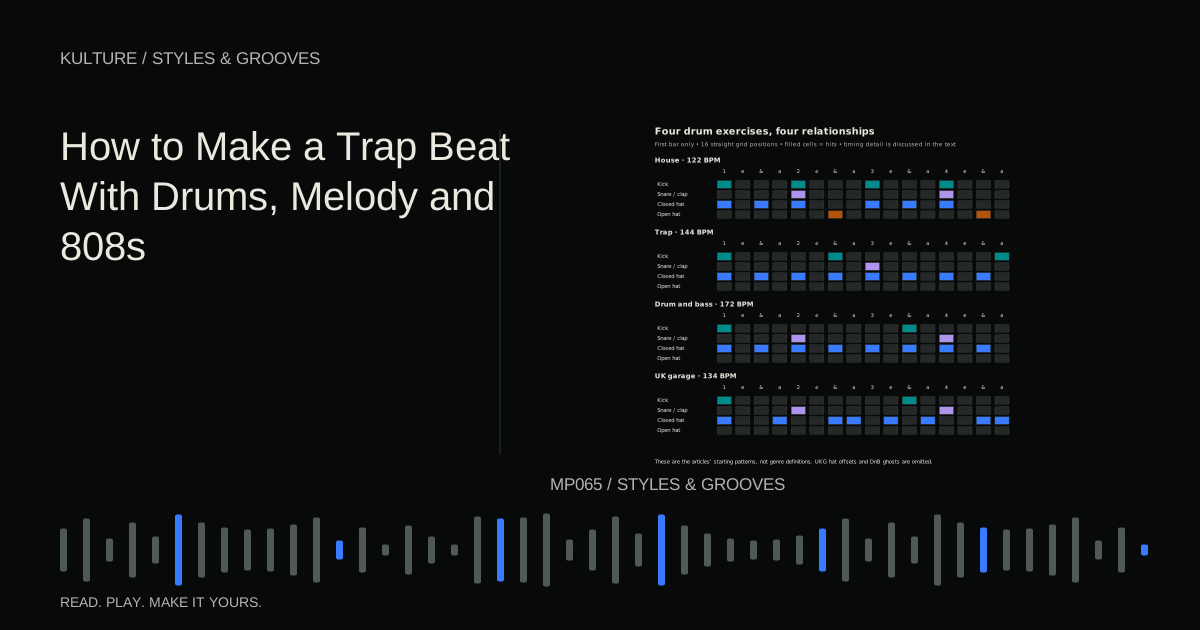
Trap commonly uses a half time backbeat, rapid hat details, and tuned sustained bass often called an 808. In modern production language, “808” may mean a pitched bass sound inspired by the Roland TR 808 bass drum, not the original machine itself.
UK drill often uses skippy percussion, displaced snare accents, and sliding bass. It shares tools with trap but can organize the rhythm differently. Neither style requires a particular lyrical subject in order to study its production techniques. Build distinct rhythmic examples before adding dramatic sound design.
R&B and pop: follow the vocal function
R&B production often gives considerable attention to vocal phrasing, harmonic color, and the pocket between performed or programmed parts. Extended chords are one option, not a substitute for expressive melody.
Pop is especially broad. A useful production question is how each section supports a memorable central idea. A chorus can become larger through melody and contrast without adding more instruments. Electronic pop may borrow almost any drum or sound design vocabulary while maintaining a clear vocal focus.
For both styles, try muting the instrumental fills while a guide vocal plays. If the song improves, the original arrangement may have been competing with its most important part.
Ambient and Afro house require different listening lenses
Ambient music can develop through texture, space, duration, and subtle transformation rather than a strongly marked beat. Slow change still needs intention: listen for evolving density, register, and harmonic tension.
Afro house is a diverse house tradition with major South African roots and international development. Layered percussion, interlocking rhythms, and spacious arrangements can be important, but adding a generic “African” sample to house is not an adequate understanding of the music. Study named artists and specific scenes; do not treat a continent as one rhythmic vocabulary.
Turn listening into production practice
Choose three tracks that listeners place in the same broad genre. For each, write the kick pattern, backbeat placement, bass role, harmonic pace, and section changes. Then list what differs. The differences are as educational as the similarities.
Create a one minute study using one observation from each track, with your own notes and sounds. Do not copy a recognizable hook or assume analytical study grants sampling permission. Finish with a sentence naming the musical behavior you practiced: “bass answers the vocal gaps,” for example. Then choose a detailed tutorial such as house production or ambient composition and build a complete original piece.
TAKE IT INTO YOUR OWN MUSIC
Your next session.
Choose three tracks that listeners place in the same broad genre. For each, write the kick pattern, backbeat placement, bass role, harmonic pace, and section changes. Then list what differs. The differences are as educational as the similarities.
Notes and progress stay in this browser.