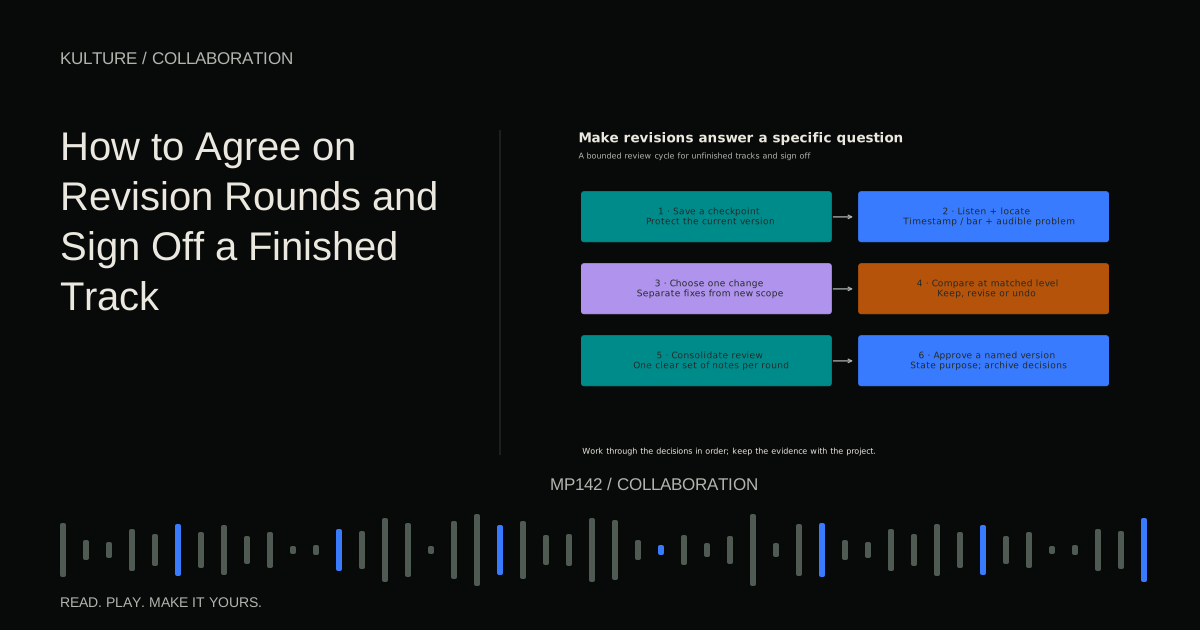
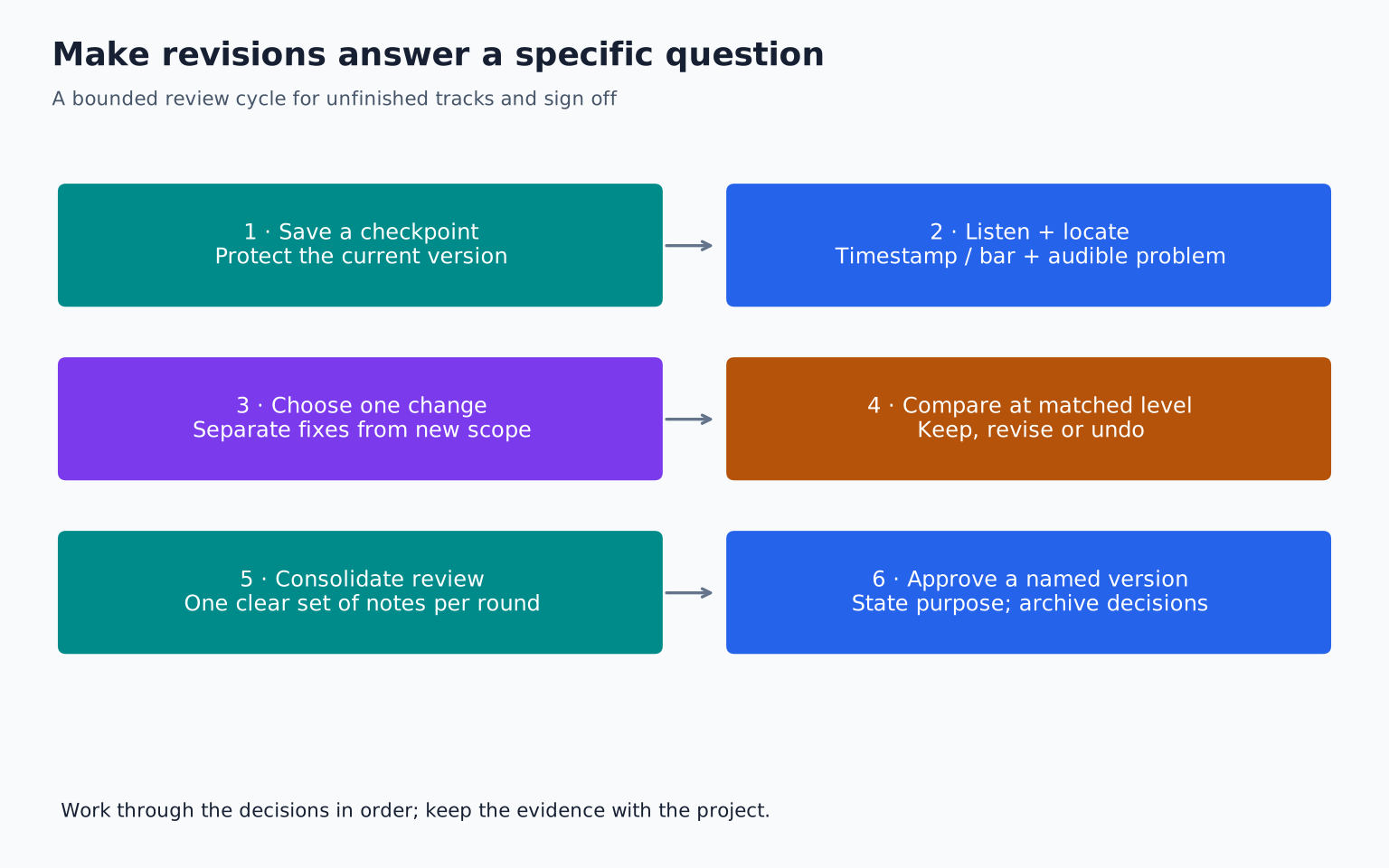
The goal is not to suppress creative feedback. It is to make feedback understandable and keep changes connected to the original scope.
Define a round as a complete set of notes
A revision round is commonly one consolidated set of feedback followed by an updated version. State that explicitly. Otherwise five separate messages over several days may be interpreted as one round by one person and five rounds by another.
Choose a feedback coordinator when several people are involved. The coordinator gathers opinions, resolves contradictions, and sends one clear list. Other collaborators still contribute; the engineer simply receives a workable decision rather than competing instructions.
Agree how long the recipient has to review and how quickly the creator can reasonably respond. Avoid assuming that a message sent late at night creates a next morning deadline.
TRY IT HERE
Make it your session
Turn the steps into a plan you can save.
Ready when you are. Audio starts only when you press Play.
Keep experimenting in the stem splitter LabSeparate errors, preferences, and changed scope
An error is a failure to deliver the agreed work, such as a missing backing vocal or an export with the wrong ending. A preference is a requested adjustment within the agreed direction, such as slightly less vocal reverb. Changed scope introduces new work, such as rewriting the chorus or replacing the singer after mixing is complete.
Discuss how each category is handled. A fair arrangement can treat corrections differently from creative revisions and charge or reschedule new scope separately. The exact terms belong in the agreement, not in assumptions discovered during a disagreement.
This article provides workflow guidance, not personal legal advice or a contract template. For Canadian projects involving rights or binding commitments, consult a qualified professional and review the Copyright Act's ownership framework where relevant.
Agree on the review stage
Feedback should match the stage of production. During arrangement review, discuss song structure, sounds, and performance needs. During mix review, focus on balance, tone, space, and dynamics. During mastering review, judge the finished stereo presentation and delivery quality.
You can still discover an arrangement problem late, but acknowledge that solving it may require reopening earlier work. Calling every change a “small tweak” does not make it small.
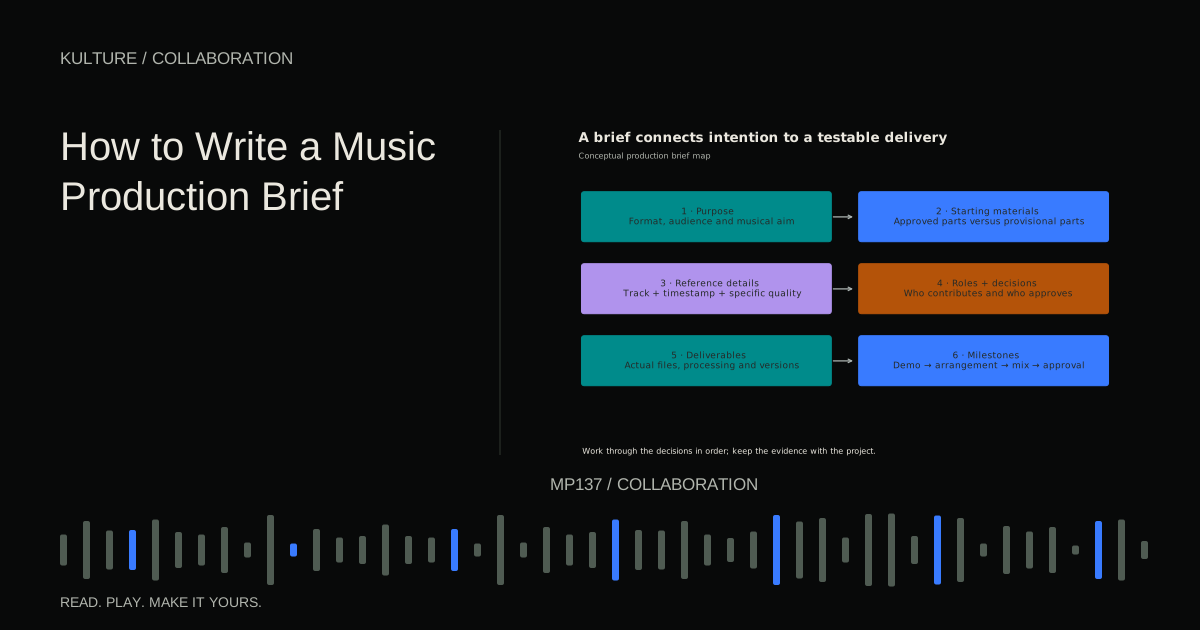
Use a production brief to record the stage boundaries and non negotiable decisions. Update it if the direction changes.
Give notes with location, observation, and goal
A useful note contains three parts:
- Where the issue occurs: timestamp or bar number.
- What you hear: a plain observation.
- What you want the listener to experience.
For example: “At 1:18, the backing vocals mask the lead's final words. Please keep the lead phrase clear while preserving the lift into the chorus.” This gives the engineer freedom to choose the best method.
A less useful note is “add 3 dB at 4 kHz” unless you have a specific technical reason and responsibility for that decision. Prescribing a control can solve the wrong problem or create another one.
Review on a stable playback setup
Listen at a comfortable, repeatable level on a familiar system. Compare with the previous version at similar loudness. A louder update can seem better even if it missed the requested change.
Avoid collecting contradictory notes from a phone speaker in a noisy street, unfamiliar headphones, and a car with extreme EQ without identifying the conditions. Multiple systems are useful when you look for persistent problems rather than treating every difference as a required correction.
The reference comparison guide explains level matching. Use it before requesting another round solely because the new version feels less exciting.
An example revision agreement in plain language
A project discussion might establish the following:
“The mix includes two consolidated creative revision rounds after the first mix. One person will gather the band's notes. Each round should identify the version reviewed and use timestamps. Missing agreed elements or export errors will be corrected separately. New recording, arrangement changes, and additional deliverable types will be discussed before work begins. Final approval will identify the exact file version.”
This is an example of topics to agree, not a legally complete agreement. Fees, deadlines, cancellation, rights, and other terms may need separate professional drafting.
The practical benefit is immediate: both sides know how to submit feedback and when a request changes the job.
Keep a version log
Use a simple record: version number, date, changes, reviewer, and status. For example, v03 may say “Reduced backing vocal level in chorus; shortened final delay; awaiting artist review.”
Do not overwrite v02 if it remains a useful reference. Equally, do not leave ten files called “final” in the delivery folder. Keep current review files separate from approved delivery files and old archives.
When a note is unclear, ask a focused question before making a speculative change. “Do you mean the lead vocal or the harmony at 2:04?” is more efficient than producing a whole new mix based on the wrong interpretation.
Define sign off precisely
Approval should identify the song, version, and scope. “Approved: Song_Mix_v05 for mastering” is different from “Approved for release, including the clean and instrumental masters.”
A mix approval does not necessarily approve artwork, metadata, ownership splits, or public release. Keep those decisions separate. If mastering follows, the mastering output needs its own check.
For final files, verify the format, duration, channels, and intended version. Apple's music delivery specification illustrates how technical delivery requirements exist alongside artistic approval. Follow the actual distributor's current requirements rather than assuming a generic “approved” message covers them.
Handle late changes calmly
If someone requests a new chorus after sign off, identify the consequence: reopening production, repeating mix work, updating alternate versions, and possibly delaying release. Offer a clear revised scope rather than treating the request as either automatically free or automatically impossible.
If a genuine technical error appears after approval, document it and correct the affected deliverables through the agreed process. Approval is not a reason to ignore a corrupted export.
Your exercise is to write a revision policy for one project using ordinary language, then draft an approval message naming a specific version and purpose. Continue with collaboration file delivery so the approved decision leads to an equally clear handoff.
TAKE IT INTO YOUR OWN MUSIC
Your next session.
A project discussion might establish the following:
Notes and progress stay in this browser.