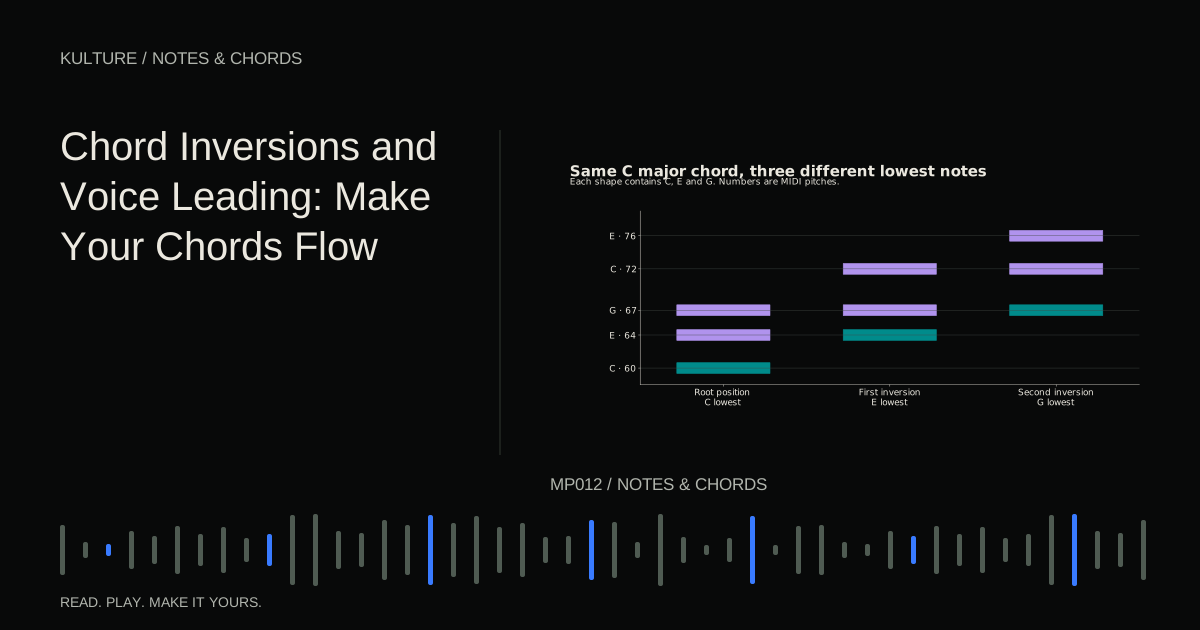
The useful question is not “Which inversion is correct?” It is “Where should each musical line go next?” A piano roll makes those lines visible, even if you do not play keyboard.
Inversion, voicing and root are different ideas
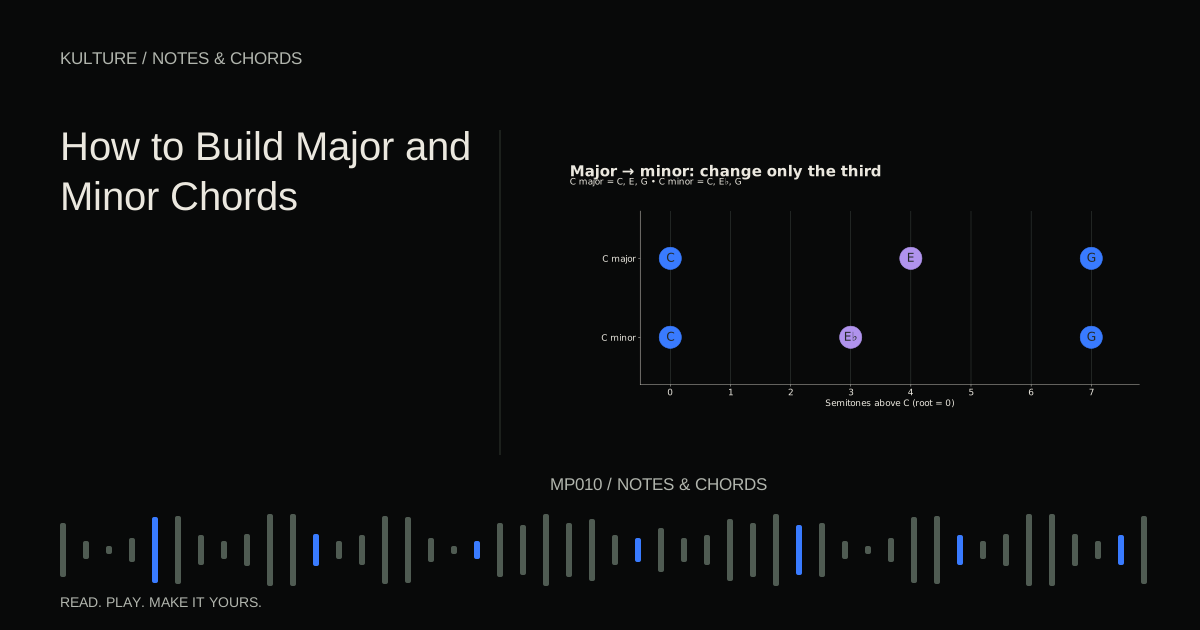
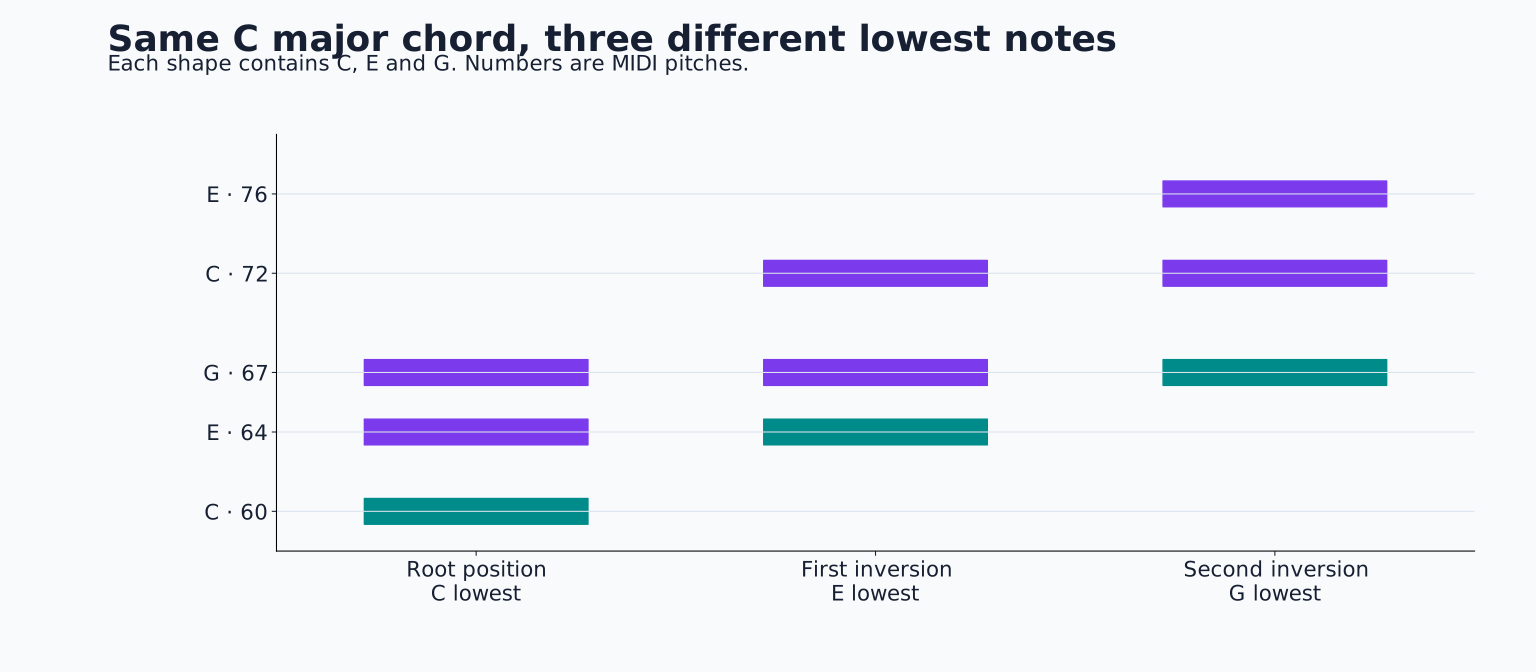
A C major triad contains C, E and G. In root position, C is the lowest chord tone. With E lowest, it is first inversion. With G lowest, it is second inversion. C remains the root in all three cases.
Voicing is the broader arrangement of chord notes: their order, octave, spacing and duplication. A chord can have several different voicings within the same inversion. C, G, E, spread across a wider range with C lowest, is still root position.
Ableton's inversion lesson demonstrates the lowest note distinction, while its voicing lesson explores spacing. The examples below apply these ideas to an original four chord production loop.
TRY IT HERE
Build it. Hear it.
Change one note and listen to the relationship.
Ready when you are. Audio starts only when you press Play.
Keep experimenting in the piano LabHear three versions of one chord
Load a piano and make three two beat chords. For unambiguous pitch references, use these MIDI note numbers:
| Version | MIDI notes | Lowest pitch |
|---|---|---|
| Root position | 60, 64, 67 | C |
| First inversion | 64, 67, 72 | E |
| Second inversion | 67, 72, 76 | G |
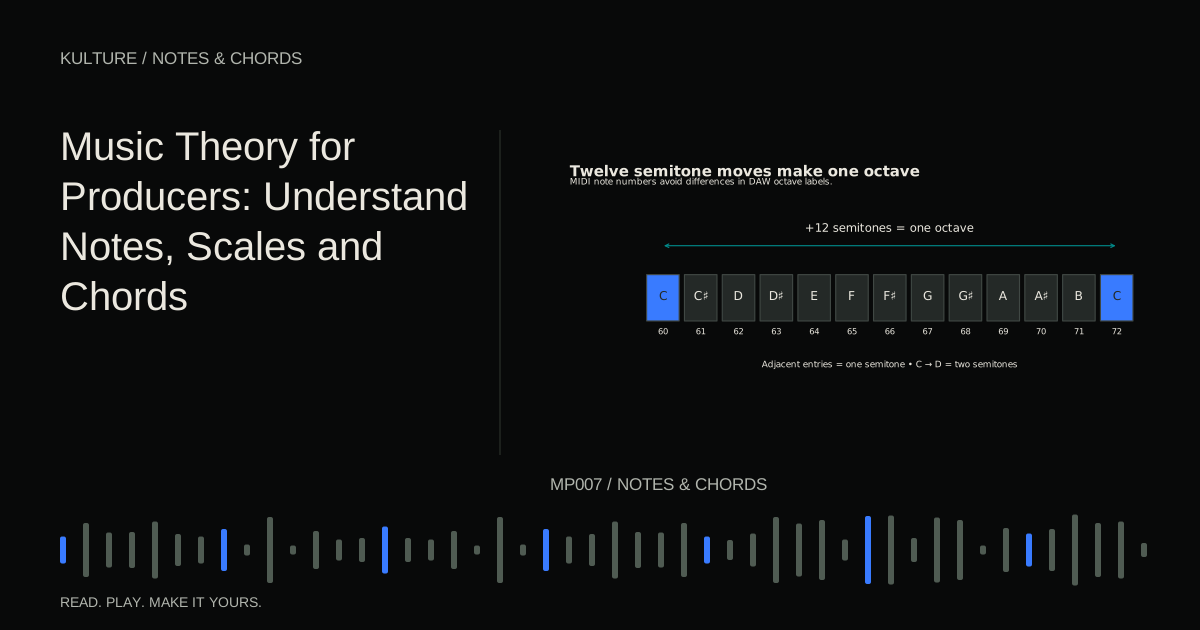
Octave labels vary by DAW, but note numbers do not change for this exercise. Play the three versions in sequence. They belong to the same chord family, yet the rising register and changing lowest note affect their weight and direction.
An inversion must preserve the chord's pitch classes. Moving the C in 60 to 64 to 67 up an octave gives 64 to 67 to 72, a first inversion C major triad. Lowering that C by only one semitone instead would give 59 to 64 to 67, replacing C with B and changing the harmony. Check that an intended octave move spans exactly twelve semitones.
Turn a progression into three lines
Use C, Am, F, G, one chord per bar. Start with these root position voicings:
- C: C, E, G
- Am: A, C, E
- F: F, A, C
- G: G, B, D
Depending on octave placement, the whole chord block may jump between bars. That can sound energetic, but it can also distract from a melody.
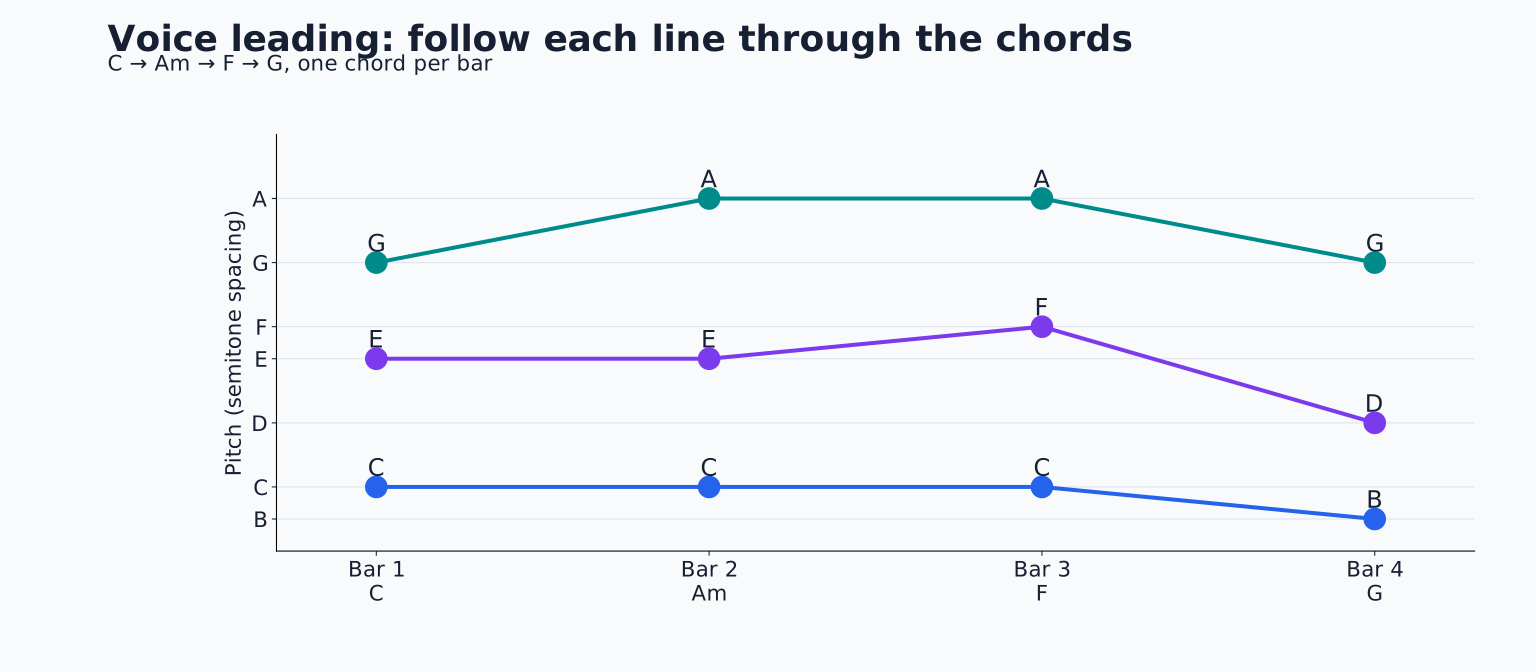
Instead, write three parts in roughly the same register:
| Chord | Low line | Middle line | High line |
|---|---|---|---|
| C | C | E | G |
| Am | C | E | A |
| F | C | F | A |
| G | B below C | D | G |
From C to Am, two notes stay while G rises to A. From Am to F, C and A stay while E rises to F. Into G, C falls to B, F falls to D and A falls to G. The progression is unchanged, but individual movements become easier to follow.
Keep all notes at the same velocity initially. You are judging pitch movement rather than performance differences. Then accent the top line slightly and listen to it as a simple melody.
The bass can change the inversion of the whole texture
If a keyboard plays E, G, C while a separate bass plays C below it, the total musical texture has C at the bottom. Calling the whole sonority “C first inversion” would be misleading, even though the keyboard part alone uses that shape.
This matters in production because bass and chord instruments usually occupy separate tracks. You can choose a compact upper voicing for smooth movement while the bass states the roots. Alternatively, use E in the bass under C major for the sound often written C/E.
A slash chord such as C/E means a C chord over an E bass. It does not mean C divided by E, and it does not necessarily mean two complete chords layered together. If the slash note is not a chord tone, the result has a different harmonic color that deserves deliberate listening.
For bass specific decisions, continue with How to Match a Bassline to Your Chords.
Choose smoothness or contrast
Minimal movement is a useful starting point, not a universal law. A chorus may benefit from moving the upper chord voicing higher. A dramatic bass leap can announce a new section. A repeated top note can create continuity while the harmony underneath changes.
Try keeping G as the top note over C and then placing A on top over Am and F. On the final G chord, choose either G for a return to the starting register or B above it for a rising ending. Both are valid G major chord tones; their melodic effects differ.
You can also allow contrary motion, where one voice rises while another falls. For example, let a bass move C down to A while an upper note moves G up to A. The parts separate and the texture opens. Listen for that sense of expansion rather than treating the piano roll as a geometric puzzle.
Space the low end carefully
Low notes have harmonics that can crowd one another. A thick pad playing a close position triad deep in the bass register may sound blurred even when the chord is correct. Move the third and fifth upward, leaving the root low, and compare.
Do this before reaching for equalization. You may discover that the mix problem was an orchestration problem: too many sustained notes competing in the same register. Conversely, spreading everything across several octaves can make a gentle part feel oversized.
Check the melody too. A top chord note that sits beside the lead can create an unintended second melody or a persistent clash. Move the chord voicing down, remove a doubled note or choose another inversion that leaves the lead space.
Editing traps to watch for
A scale locked editor can alter a dragged note in unexpected ways. Verify that octave moves are exactly twelve semitones. Accidentally overlapping notes on the same pitch can cause some instruments to retrigger or release unpredictably; remove duplicate events when necessary.
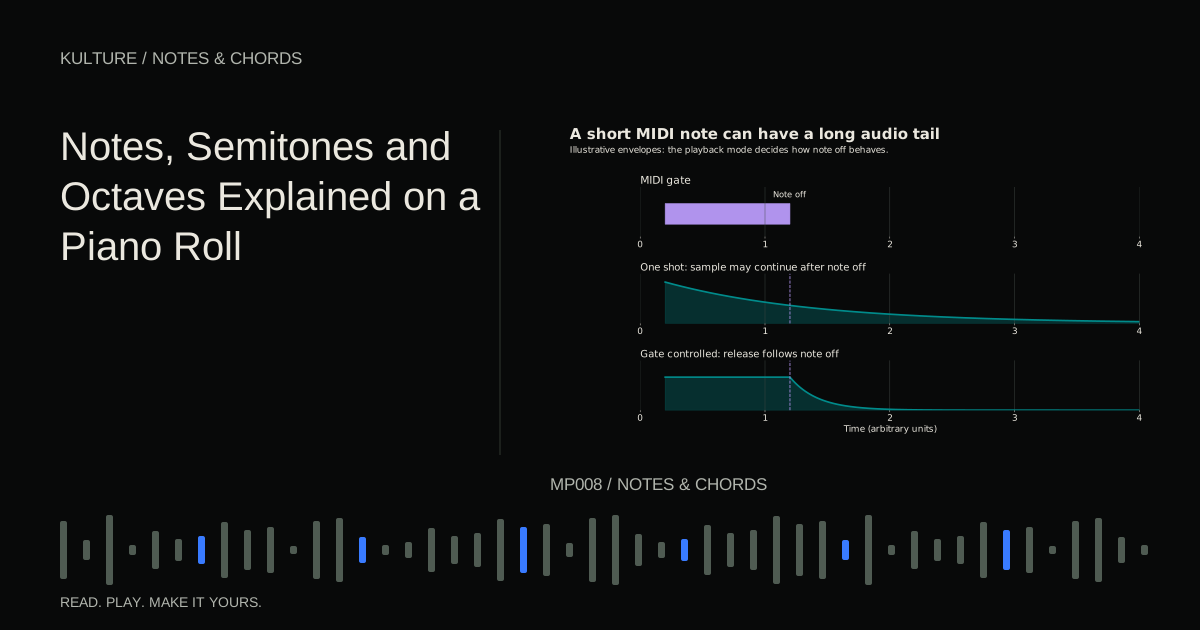
When shortening chords, listen to their release tails. Smooth pitch movement will still sound smeared if long reverb or sustain carries every old chord into the next. Temporarily bypass effects to separate voicing decisions from sound design decisions.
If a progression loses its identity after editing, check whether you removed an important third. Root and fifth alone can be useful, but they do not specify major or minor as clearly as a full triad.
A practical voice leading challenge
Write Dm, B flat, F, C as four root position triads. Duplicate the clip. In the duplicate, keep every upper note within a modest register and move each note to the nearest suitable chord tone. Add a separate root bass only after you like the upper part.
Compare the two versions blind. Choose the one that supports the song's energy; do not assume the smoother version must win. Then make a third version with a deliberately rising top line. For chord construction help, return to How to Build Major and Minor Chords.
TAKE IT INTO YOUR OWN MUSIC
Your next session.
Write Dm, B flat, F, C as four root position triads. Duplicate the clip. In the duplicate, keep every upper note within a modest register and move each note to the nearest suitable chord tone. Add a separate root bass only after you like the upper part.
Notes and progress stay in this browser.