You can change key smoothly through shared harmony, abruptly at a section boundary, or through a common sustained note. Choose the method for its musical effect and the performer's range, not because a key change automatically makes a final chorus better.
Distinguish modulation from transposition
Transposition moves musical material up or down by a consistent interval. If you move every note of a melody up two semitones, you have transposed it. A song may use that transposed material to establish a new key, but the act of moving notes and the listener's sense of a new tonal center are related, distinct ideas.
A brief D major chord inside C major might point toward G without making G the lasting home. If the music continues through a G centered progression and resolves there, the key change becomes clearer.
The University of Puget Sound's modulation chapter introduces these harmonic approaches. The examples below use Western major/minor tonal harmony and are not universal rules for every musical tradition.
TRY IT HERE
Write a small phrase
Choose notes on the grid. Leave a little space.
Ready when you are. Audio starts only when you press Play.
Keep experimenting in the piano LabMethod one: use a chord shared by both keys
Move from C major to G major. The C major scale is C, D, E, F, G, A, B. G major uses G, A, B, C, D, E, F sharp. Many chords belong to both keys, but the changed F sharp helps establish the new setting.
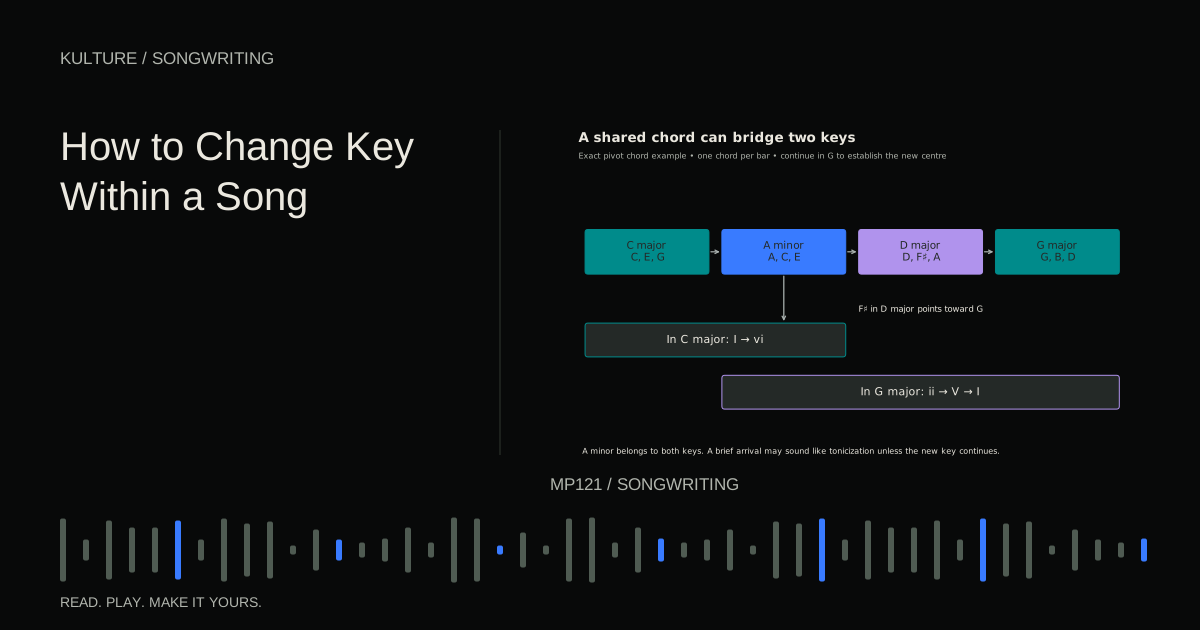
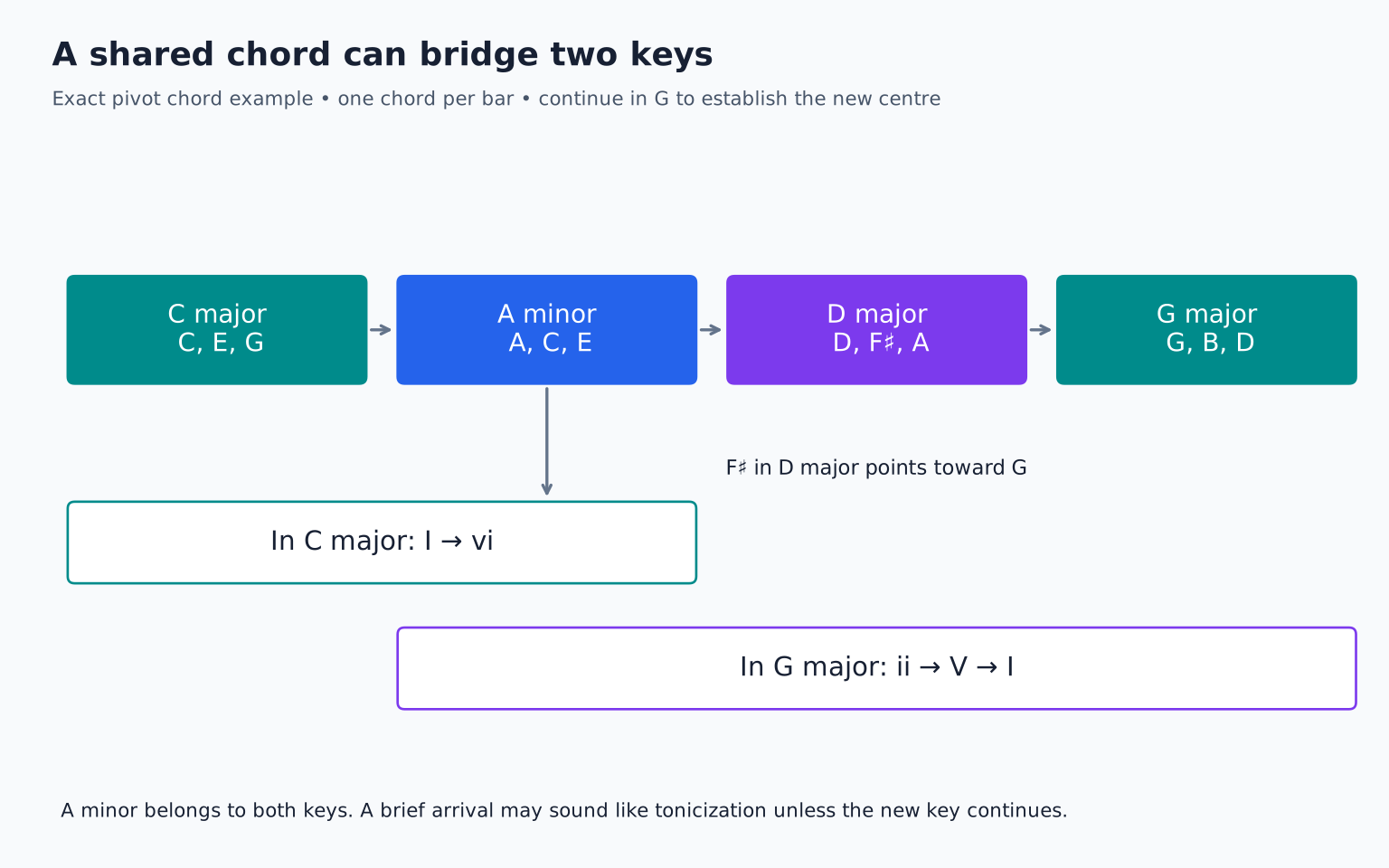
Play this progression, one chord per bar:
C major: A minor: D major: G major.
The notes are C, E, G, A, C, E, D, F sharp, A, and G, B, D. A minor can function in both keys: it is the sixth degree chord in C major and the second degree chord in G major. That shared role makes it a useful pivot.
The D major chord introduces F sharp and points strongly toward G. Continue with G, C, D, G for another four bars so the arrival is reinforced. If you immediately return to C as the main resting point, the listener may hear only a brief tonicization rather than a sustained modulation.
Make the melody confirm the change
Over the first C major bar, use E, G, C. Over A minor, use E, C, A. Over D major, use F sharp, A, F sharp. Resolve to G over the G major chord.
The F sharp to G motion helps the arrival feel intentional. Keep the melody in a singable register and use a clear phrase ending on G. Then write the next phrase using G major material rather than continuing to emphasize F natural accidentally.
Not every F natural after a modulation is an error; it may be an expressive borrowed color. But if your intention is a straightforward new key, start with consistent notes and add chromatic choices deliberately later.
Method two: make a direct section change
Suppose a chorus in C major uses C, G, Am, F. For a final chorus in D major, transpose the progression up two semitones: D, A, Bm, G.
Move the melody and bass up two semitones as well. A melody C, E, G, E becomes D, F sharp, A, F sharp. Check every pitched part, including backing vocals, sampled chords, tuned percussion with obvious pitch, and effect generated harmonies.
Place the change at a clear boundary after a brief rest or a transitional fill. The surprise can be the point, so a pivot chord is not required. However, listen to the old section's final chord against the new section's first chord and any overlapping reverb.
A direct upward change increases the singer's pitch demands. Test the new highest note before committing. If it becomes strained, lower the original key, choose a smaller or different modulation, or create contrast through arrangement instead.
Method three: use a common note as a bridge
A sustained note can connect two harmonic worlds even when the surrounding chords change. For example, E belongs to both C major and A major. Hold E in a vocal or pad while changing the harmony from C major to A major.
The C major chord contains C, E, G; A major contains A, C sharp, E. The held E remains stable while C changes to C sharp and G gives way to A. Continue with D, E, A in the new key to make A feel established.
This can sound more striking than the shared chord example because several notes change around the common tone. Use a sparse texture during the transition so the listener can hear the connection. If every old chord tail continues, the intended transformation may become an accidental cluster.
Manage bass, samples, and effects
The bass strongly influences tonal center. Make its new roots clear at the arrival rather than leaving a long old key note underneath by accident. Check release tails and overlapping MIDI notes, not only note starts.
A melodic audio loop may need pitch shifting to fit the new key. Listen for artifacts and for chords inside the sample that do not transpose cleanly into the intended harmony. A loop labelled with a key is only a starting clue; use your ears.
Delay repeats and reverb tails can carry old key notes across the boundary. That overlap may create a beautiful transition, or it may clash. Shorten the send, automate the effect, or leave a gap if the harmonic change needs a clean entrance.
Do not transpose unpitched drums automatically with the song. A snare does not need to move two semitones because the chorus did. Evaluate sounds with obvious sustained pitch individually.
Diagnose a key change that feels unconvincing
If the new key never feels established, strengthen its bass root, phrase endings, and characteristic chord progression. If the change feels abrupt in an unwanted way, add a shared chord or common note, or give the old section a clearer ending.
If the chorus becomes more exciting only because it is louder, compare at similar levels and judge the harmonic effect separately. If the change distracts from the lyric, the song may need a simpler final return.
A modulation is not required to avoid repetition. New melody phrasing, a countermelody, reduced texture, or a different bass rhythm can create development while staying in one key.
Practice three arrivals
Write an eight bar C major idea. Make one version that moves smoothly to G through A minor and D major, one that jumps directly to D at a section boundary, and one that holds E into A major. Continue at least four bars in each destination so the new center has time to register.
Record or render all three and describe the emotional effect without relying only on theory labels. Then choose whether any version serves your actual song. Review chord progressions if the harmony is unfamiliar, and chorus contrast for alternatives to changing key.
TAKE IT INTO YOUR OWN MUSIC
Your next session.
Write an eight bar C major idea. Make one version that moves smoothly to G through A minor and D major, one that jumps directly to D at a section boundary, and one that holds E into A major. Continue at least four bars in each destination so the new center has time to register.
Notes and progress stay in this browser.