These terms describe different things. A track at 120 BPM does not contain 120 bars per minute, and sixteen bars do not have a fixed duration until you know the tempo and meter.
Feel the beat before measuring it
Tap at a steady pace while counting “1, 2, 3, 4.” Those taps are your reference beats. If you make 120 evenly spaced taps in one minute, the tempo is 120 beats per minute.
At 60 BPM, each beat lasts one second. At 120 BPM, it lasts half a second. At 100 BPM, it lasts 0.6 seconds. The calculation is 60 divided by BPM, giving seconds per beat when BPM refers to that beat unit.
Ableton's beat and tempo lesson offers an interactive pulse comparison. When listening to music, you may naturally tap at half or twice the tempo shown in a DAW. That does not necessarily mean either interpretation is useless; different rhythmic layers suggest different pulses.
TRY IT HERE
Find the pocket
Tap the grid, change the tempo and hear your pattern.
Ready when you are. Audio starts only when you press Play.
Keep experimenting in the beat maker LabWhat a time signature contributes
In 4/4, the top number indicates four quarter note beats per bar, and the bottom number identifies the quarter note unit. Count “1, 2, 3, 4” repeatedly, giving the first count a little emphasis.
In 3/4, there are three quarter note beats per bar. In 6/8, there are six eighth note units, commonly felt as two larger beats, each divided into three. This is why “the top number always tells you how many main beats you feel” is an oversimplification.
For the exercises here, use 4/4 with quarter note BPM. That keeps the arithmetic and grid positions clear. If working in another meter, check what your metronome and tempo display treat as the beat unit.
Bars give repetition a shape
A bar, also called a measure, groups time according to the meter. In 4/4, the fifth quarter note count begins the next bar. A four bar phrase therefore contains sixteen quarter note beats.
Ableton's bars lesson demonstrates how patterns extend across these groups. A bar line is an organizational boundary, not a requirement to trigger a sound. A bass note can begin before it and continue after it, or the downbeat can deliberately be silent.
Many DAWs display musical positions as bar, beat and subdivision. The exact punctuation and indexing differ. A position beginning “2.1” often means bar 2, beat 1, but verify the application's convention rather than treating every timestamp as identical.
Subdivide the beat
In a straight 4/4 grid, a quarter note beat can divide into two eighth notes or four sixteenth notes. Count eighth notes as “1 and 2 and 3 and 4 and.” Count sixteenths as “1 e and a 2 e and a 3 e and a 4 e and a.”
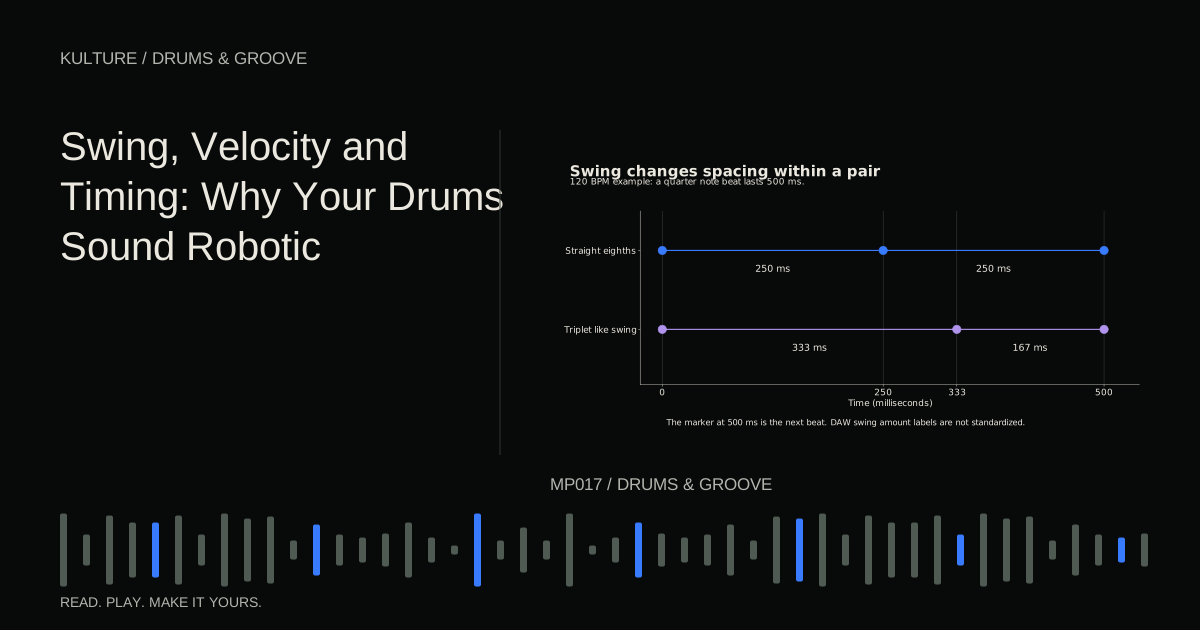
At 120 BPM, a quarter note lasts 500 milliseconds, an eighth note 250 milliseconds and a sixteenth 125 milliseconds. These values change with tempo. They are useful for understanding delays, note lengths and small rhythmic offsets, not mandatory effect settings.
An eighth note triplet divides one quarter note beat into three equal parts. It is different from an ordinary eighth note. Three eighth note triplets fit where two straight eighth notes would fit. Swing can approach a triplet like feel, but a swing control and a triplet grid are not interchangeable concepts.
Translate a sixteen step sequencer
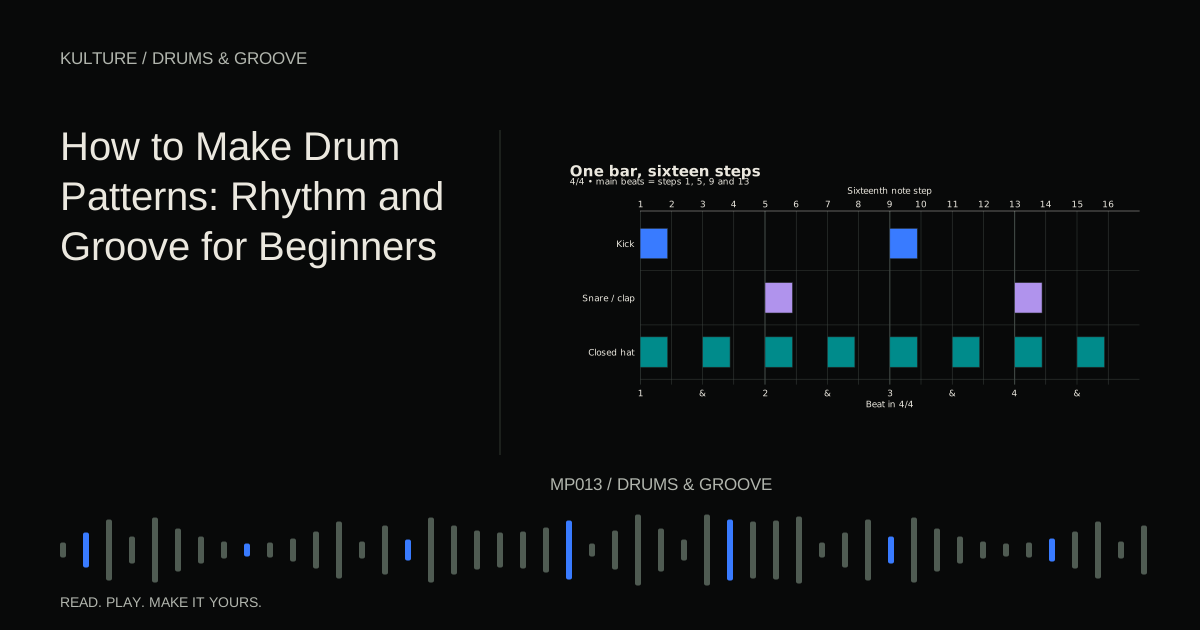
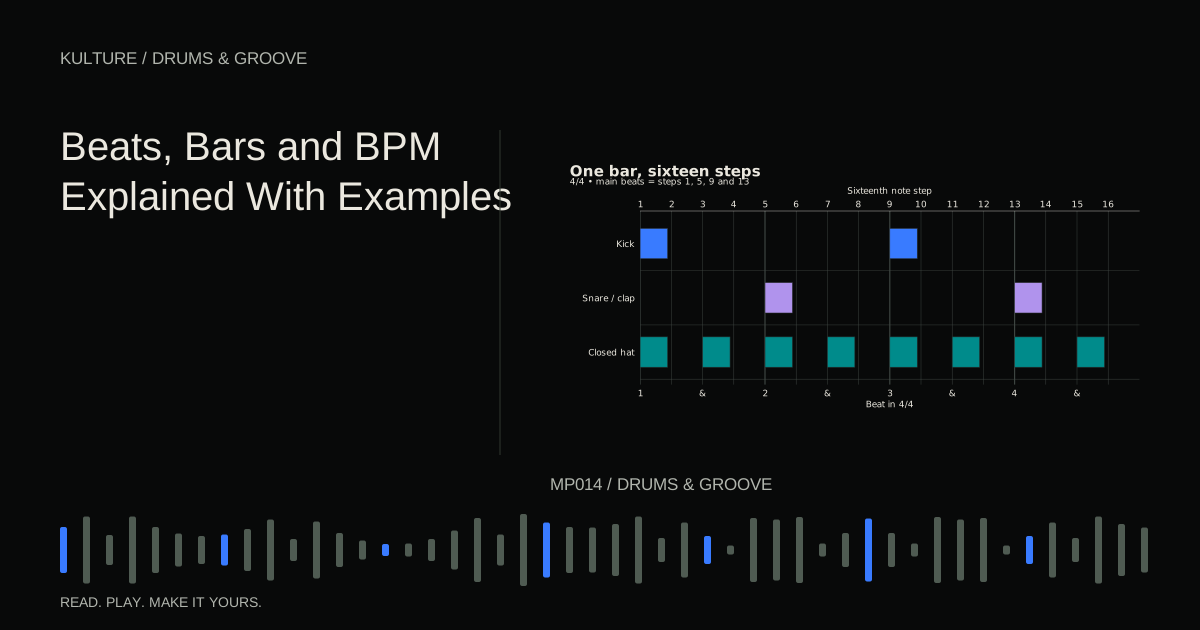
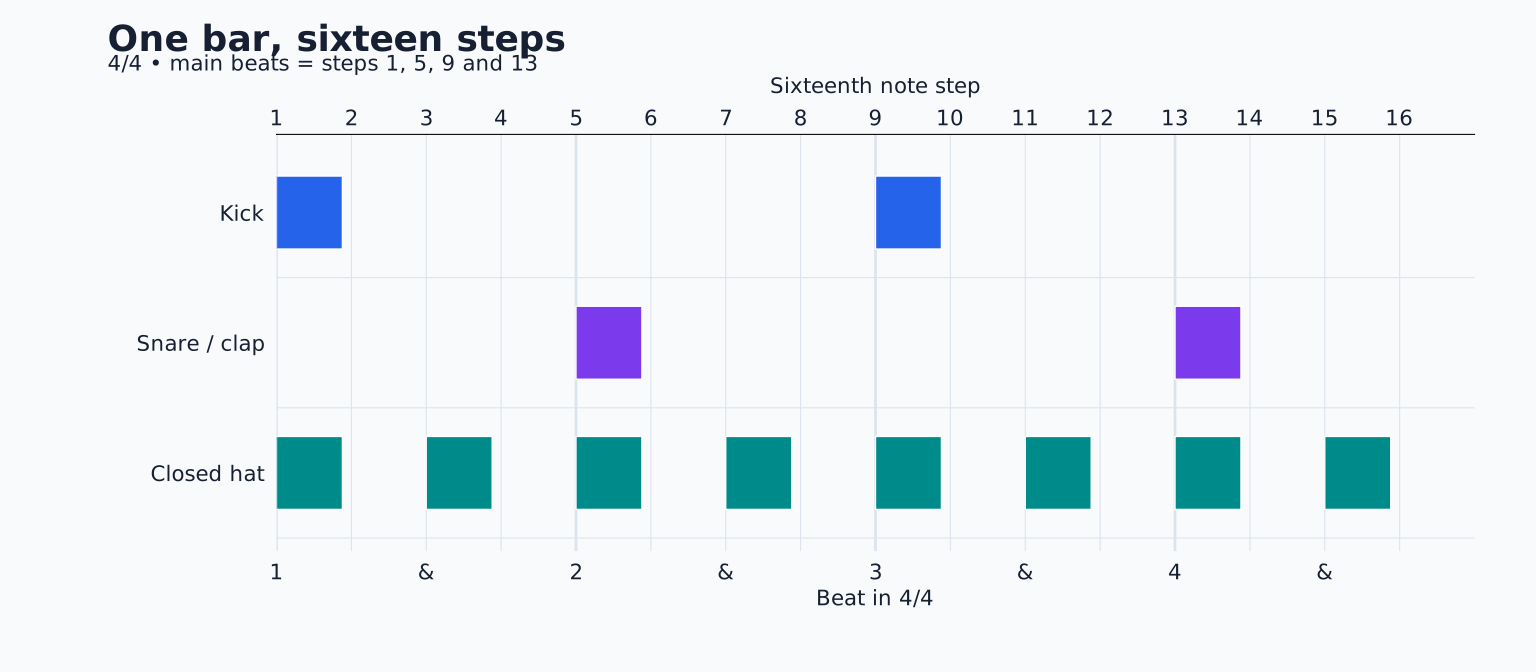
If one bar of 4/4 contains sixteen equal sixteenth note steps, the locations are:
| Main beat | Step | Halfway through beat |
|---|---|---|
| 1 | 1 | Step 3 |
| 2 | 5 | Step 7 |
| 3 | 9 | Step 11 |
| 4 | 13 | Step 15 |
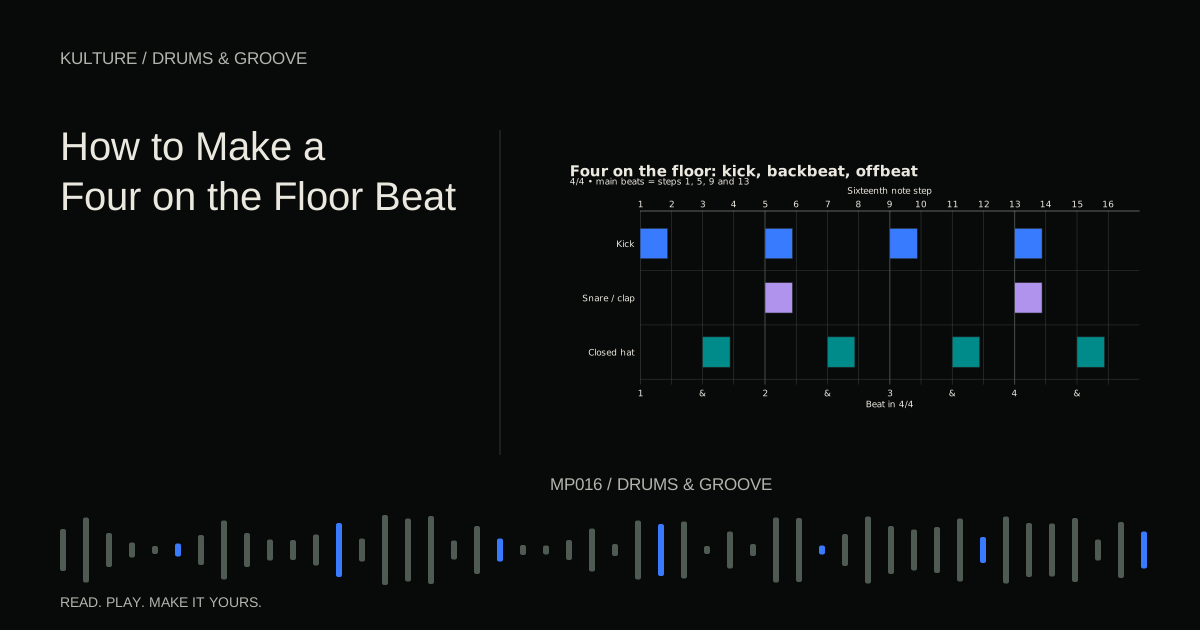
Place kicks on steps 1, 5, 9 and 13. You now hear four quarter note kicks. Put hats on steps 3, 7, 11 and 15. They sit on the offbeats between the kicks.
If you change the sequencer to thirty two steps per bar, those numbers no longer represent the same locations. Always identify the grid division before copying a numbered pattern from a tutorial.
For a complete beat using this mapping, see How to Make a Four on the Floor Beat.
Calculate section duration
In 4/4 with quarter note BPM, one bar lasts 4 × 60 ÷ BPM seconds. At 120 BPM, that is two seconds. Eight bars last sixteen seconds, and sixteen bars last thirty two seconds.
At 90 BPM, one bar lasts about 2.667 seconds. Eight bars last about 21.333 seconds. The same eight bar arrangement occupies more clock time at the slower tempo.
This is useful when planning a video cue or a timed introduction. However, a song can contain tempo changes, pickup notes or partial bars. Use the actual timeline when a delivery has an exact duration requirement.
A practical exercise is to build sixteen bars at 120 BPM, then change the project to 100 BPM. MIDI events retain their musical positions while their clock times change. Audio may or may not follow correctly depending on the DAW's time stretch and tempo follow settings.
Half time and double time are about feel too
A drum pattern can feel slower without changing the project BPM. At 140 BPM, placing a prominent snare on beat 3 creates a familiar half time framework. A listener may experience the groove as related to 70 BPM.
Conversely, adding fast hats does not necessarily double the tempo. The main beat can remain unchanged while the subdivisions become busier. This distinction matters when comparing genre tempo ranges or recreating a rhythm by ear.
Try one loop at 120 BPM with snare hits on beats 2 and 4. In a copy, place the main snare only on beat 3. Leave the tempo unchanged. Listen to how the large scale motion changes even though the clock and grid do not.
Avoid three counting traps
First, a “beat” can mean the pulse, a complete drum pattern or an instrumental production in casual conversation. Ask which meaning matters when collaborating. “Send me the beat” usually does not mean a single quarter note click.
Second, a pickup starts before the main phrase's first strong beat. Do not force it into beat 1 just because it is the first audible note. Count into the phrase and identify where its main arrival occurs.
Third, silence does not stop musical time. Keep counting through a break. A fill that ends with a rest can make the following downbeat stronger precisely because the listener maintains the pulse internally.
Practice without watching the grid
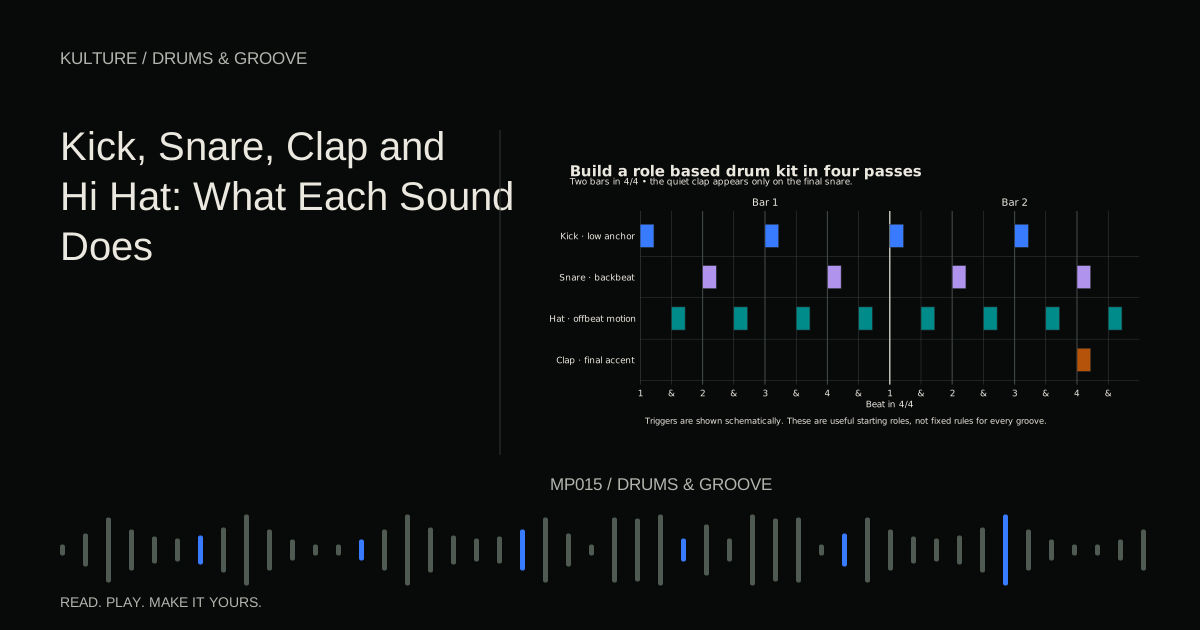
Make four bars at 100 BPM. Put a kick on every quarter note beat and a snare on beats 2 and 4. Add eighth note hats, then mute the kick for bar 4. Count through the gap and confirm that you land with bar 1 when the loop repeats.
Next change only the hat division from eighths to sixteenths. The tempo is unchanged, but the surface activity doubles. Continue with How to Make Drum Patterns to turn this counting framework into a groove.
TAKE IT INTO YOUR OWN MUSIC
Your next session.
Make four bars at 100 BPM. Put a kick on every quarter note beat and a snare on beats 2 and 4. Add eighth note hats, then mute the kick for bar 4. Count through the gap and confirm that you land with bar 1 when the loop repeats.
Notes and progress stay in this browser.