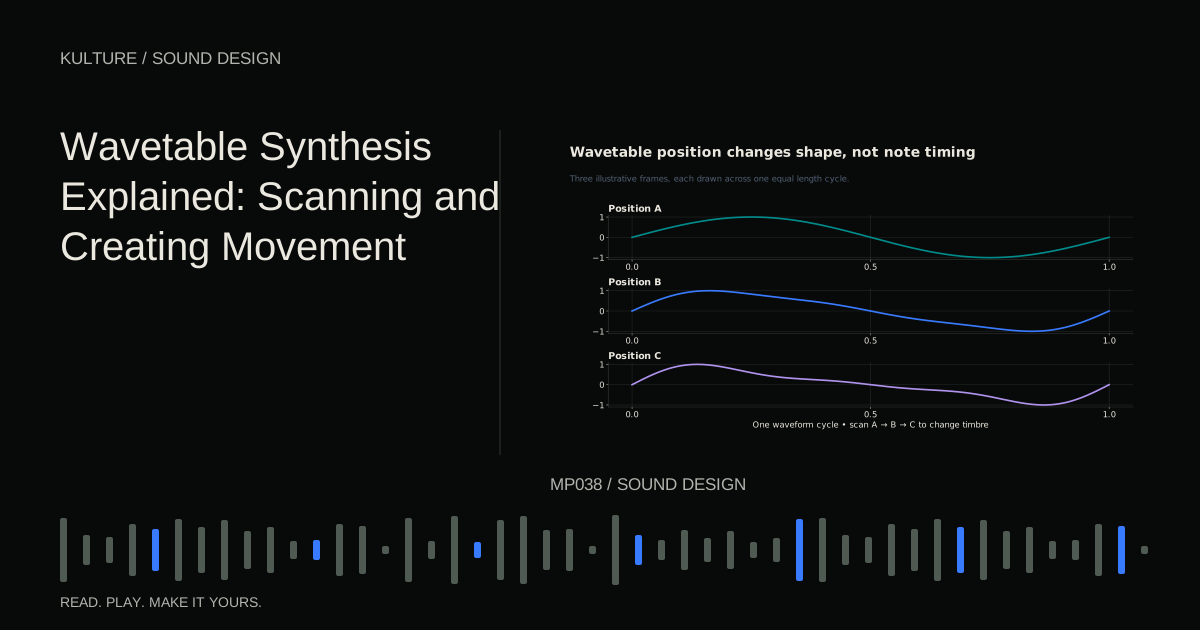
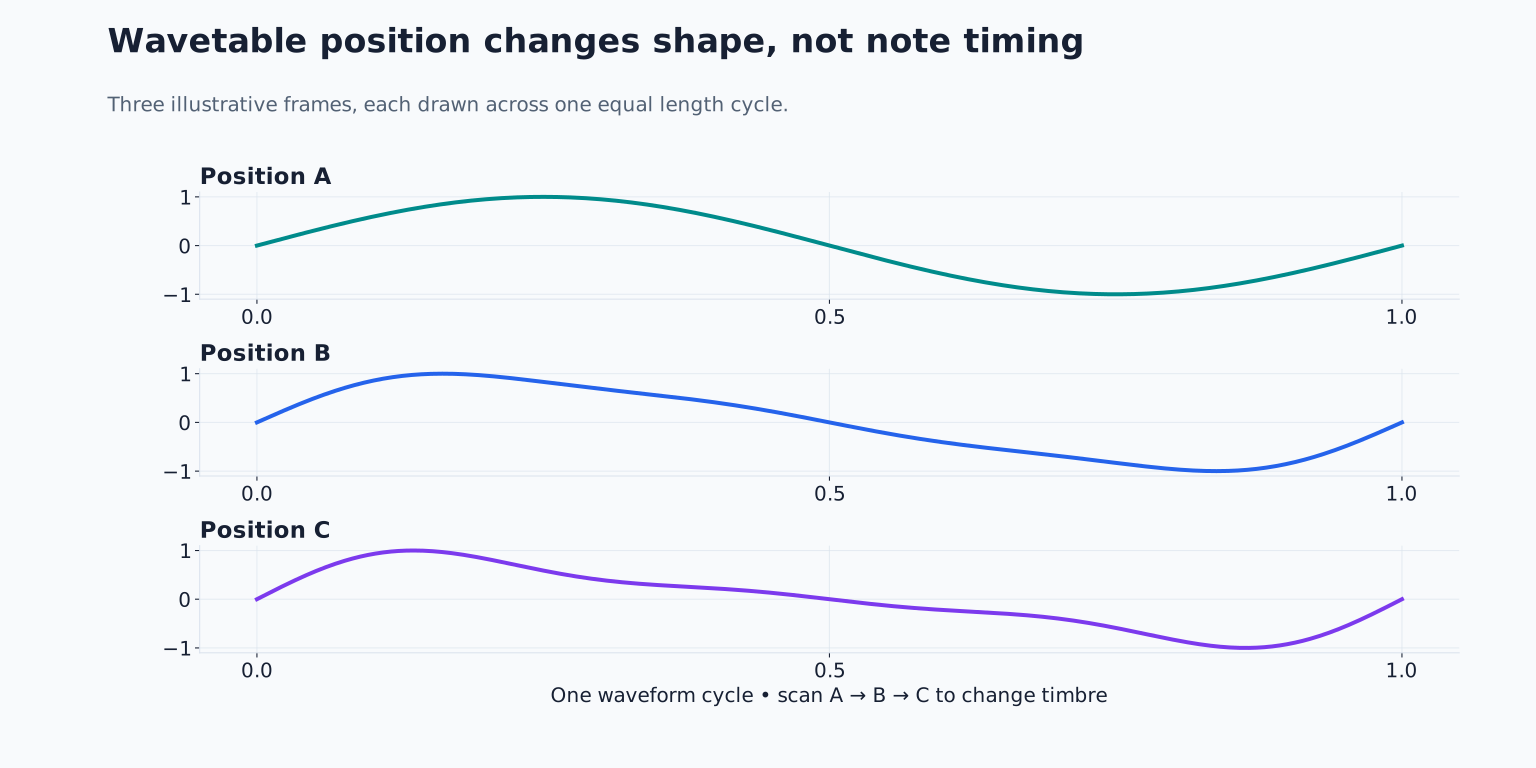
Think of a table as a collection of related waveform shapes, not a row of complete recorded notes. The exact content matters enormously: scanning a smooth collection may create a gentle transformation, while another table produces abrupt or metallic changes. The Massive X oscillator documentation illustrates the distinction between waveform playback and movement through a table.
Separate pitch from position
Open a wavetable synth and initialize it. Use one oscillator, disable unison and effects, and keep the filter fairly open. Select a simple table if the instrument offers one. Hold one note and move the wavetable position control slowly.
The note should keep broadly the same musical identity while its tone changes. Some waveforms emphasize different harmonics so strongly that the perceived pitch seems to shift; this does not necessarily mean the keyboard tuning changed. Return to a simpler position and compare.
Now leave position fixed and play notes an octave apart. This changes playback frequency while leaving the chosen shape unchanged. Understanding these two independent actions prevents a common mistake: treating wavetable position as a pitch control.
Different instruments may interpolate between frames, meaning they blend neighbouring shapes, or provide modes that alter the scanning behaviour. Do not assume the centre of every table is the neutral or best sounding position. Explore the actual table you selected.
TRY IT HERE
Move between wave shapes
Morph from a sine toward a brighter harmonic wave.
Ready when you are. Audio starts only when you press Play.
Keep experimenting in the synth LabMake a controlled moving pluck
Create a two bar pattern at 110 BPM. Put eighth notes on beats one, two and, three and four and of each bar. Use C, G, E flat and B flat for the first bar, then C, D, E flat and G for the second. Choose a middle register so both the attack and body are audible.
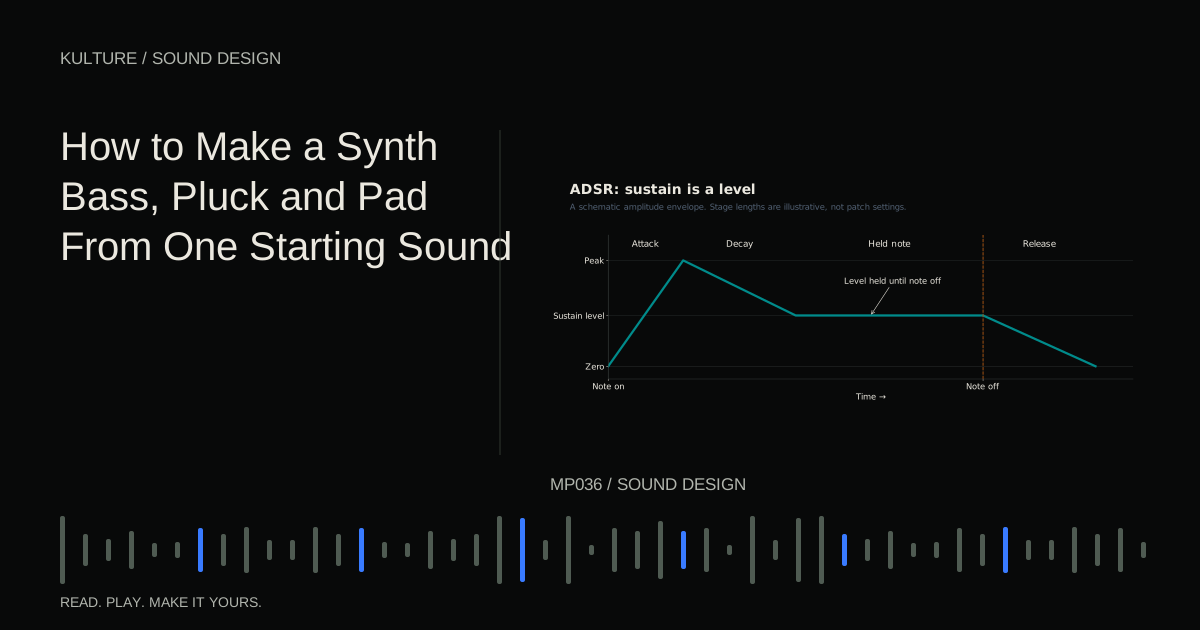
Set amplitude attack near 5 milliseconds, decay around 350 milliseconds, sustain low and release around 100 milliseconds. These are example values, and the envelope shape in your instrument will affect the result.
Choose a wavetable position that sounds relatively rounded. Route an envelope to position with a positive amount so the beginning visits a brighter part of the table and returns toward the starting point. Try a position envelope decay near 180 milliseconds. The intended sound begins with complexity and settles before the volume tail finishes.
If the movement goes through an unpleasant region, reduce the modulation range rather than replacing the entire instrument. Move the base position too. The useful journey might occupy only a small part of the table.
Save a version with no position modulation. Toggle between the two at comparable loudness. A moving display is not enough: you should be able to explain whether the modulation adds attack, changes the vowel like quality or creates distracting instability.
Turn movement into a pad
Duplicate the patch and replace the short notes with a sustained chord: C, E flat and G for two bars. Extend amplitude attack to about one second and release to roughly two seconds. Lower the output before playing multiple notes because a chord contains more simultaneous voices.
Remove the fast position envelope and add a slow triangle shaped LFO. Choose a cycle around four bars if tempo synchronization is available. Limit its range to the part of the table that suited the pluck. This should produce a gradual change across the chord, rather than a separate sweep every time a note starts.
Compare note retriggered and free running LFO behaviour if your synth provides both. Retriggering can synchronize every chord’s movement; a free running cycle may continue through note changes. Neither is automatically more musical. The first is repeatable, while the second can create variation.
Add a subtle filter movement only after you like the oscillator movement. A closing filter can conceal much of the table’s high frequency change, making it seem as though the position modulation has stopped working. Temporarily reopen the filter to diagnose that situation.
Do not confuse scanning with every other oscillator control
Many wavetable synths include warping, bending, synchronization, phase modulation or spectral transformations. These can change the selected waveform without being the same as moving to another position in the table.
Learn them one at a time. Save the basic patch, freeze the position, and move one extra control while sustaining a note. Write a plain language observation: more nasal, more buzzy, less stable in pitch, sharper attack. You do not need a technical description before deciding whether a change helps the arrangement.
Stacking maximum warp, wide unison and rapid scanning can obscure the part’s original purpose. If the sound needs to support a vocal, an exciting solo texture may be the wrong result. Check the phrase with other instruments before committing to additional complexity.
Control width and low frequency consistency
Unison duplicates voices, often with small pitch or stereo differences. It can turn a narrow patch into a broad one, but the result may change across notes and mono playback. Keep a bass patch’s low frequency foundation stable before adding a separate wide layer.
A wavetable with dramatically different levels at different positions can create apparent pumping as you scan. Lower the modulation range, select more consistent regions, or use level automation if the movement is intentional. Compression is an option, but it should not be the first response to a routing mistake.
For harshness, reduce the oscillator’s extra processing before applying a large high frequency cut. For a sound that feels too static, verify that the modulation source is actually assigned and moving over a meaningful range. A very slow cycle needs time to reveal itself.
A useful practice constraint
Make three patches from one table: a bass with fixed position, a pluck with envelope driven position and a pad with LFO driven position. Keep a short written note of the chosen region and why you avoided the rest. You will learn more from this limited comparison than from rapidly auditioning hundreds of tables.
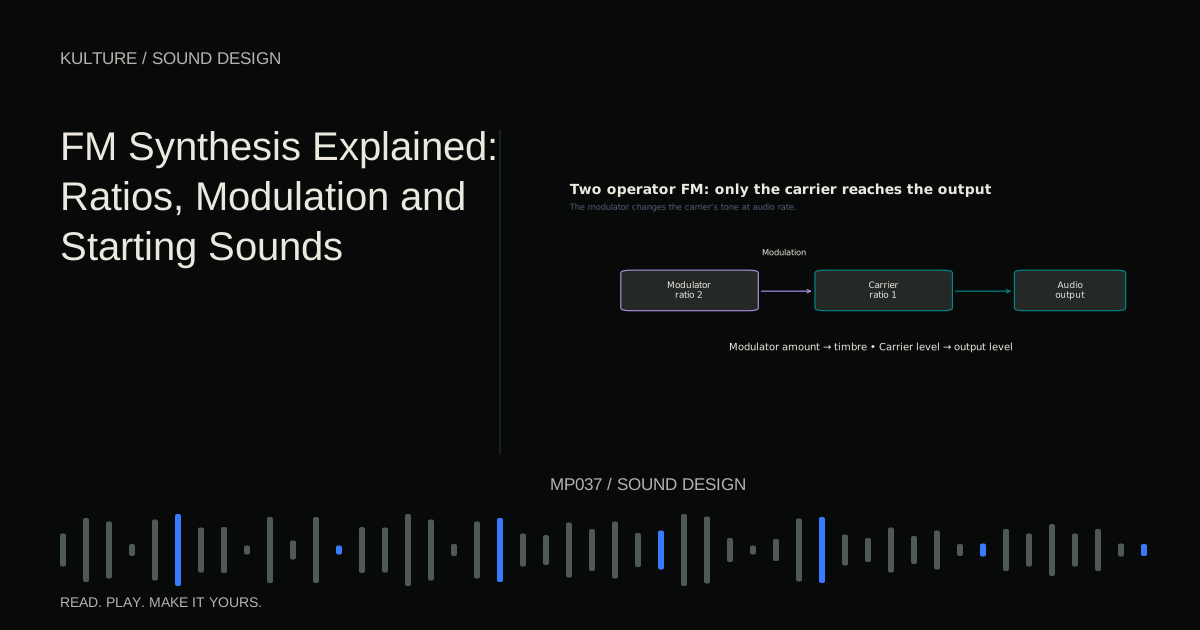
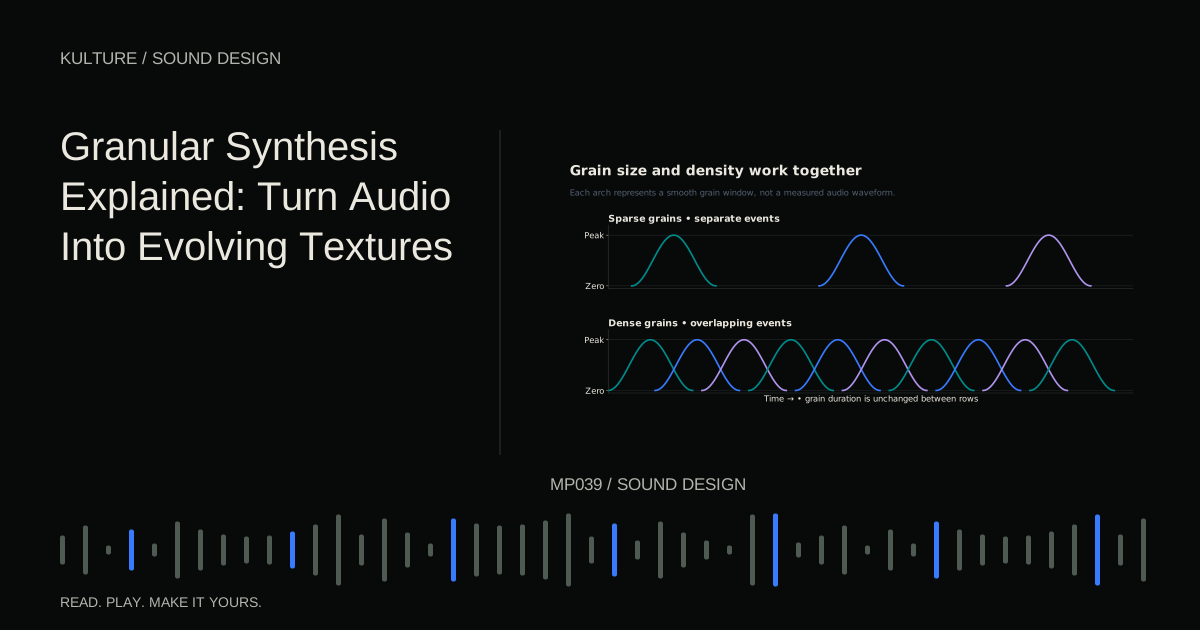
Next compare the sound generation approach with FM synthesis. For movement built from an actual recording rather than a repeating waveform, continue to granular synthesis.
TAKE IT INTO YOUR OWN MUSIC
Your next session.
Make three patches from one table: a bass with fixed position, a pluck with envelope driven position and a pad with LFO driven position. Keep a short written note of the chosen region and why you avoided the rest. You will learn more from this limited comparison than from rapidly auditioning hundreds of tables.
Notes and progress stay in this browser.