This guide is Canada focused educational information, not personal legal advice. Copyright, contracts, collective administration, and platform policies can interact. For a disputed contribution, unclear sample, significant agreement, or international release complication, consult a qualified music lawyer or the relevant rights organization.
Separate the song from the recording
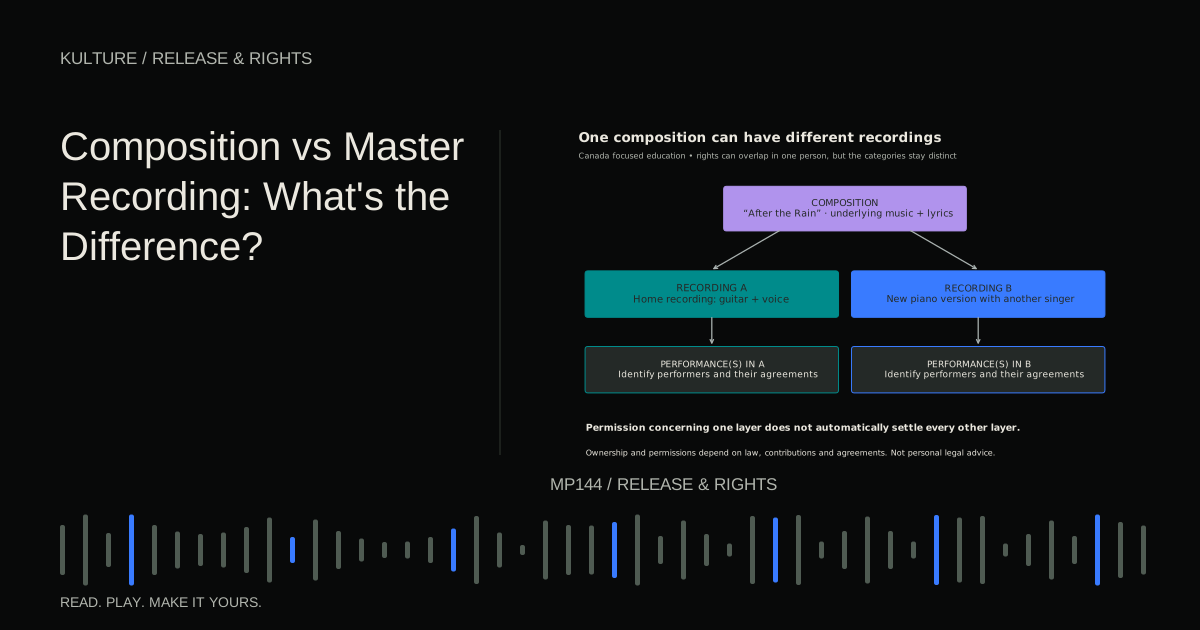
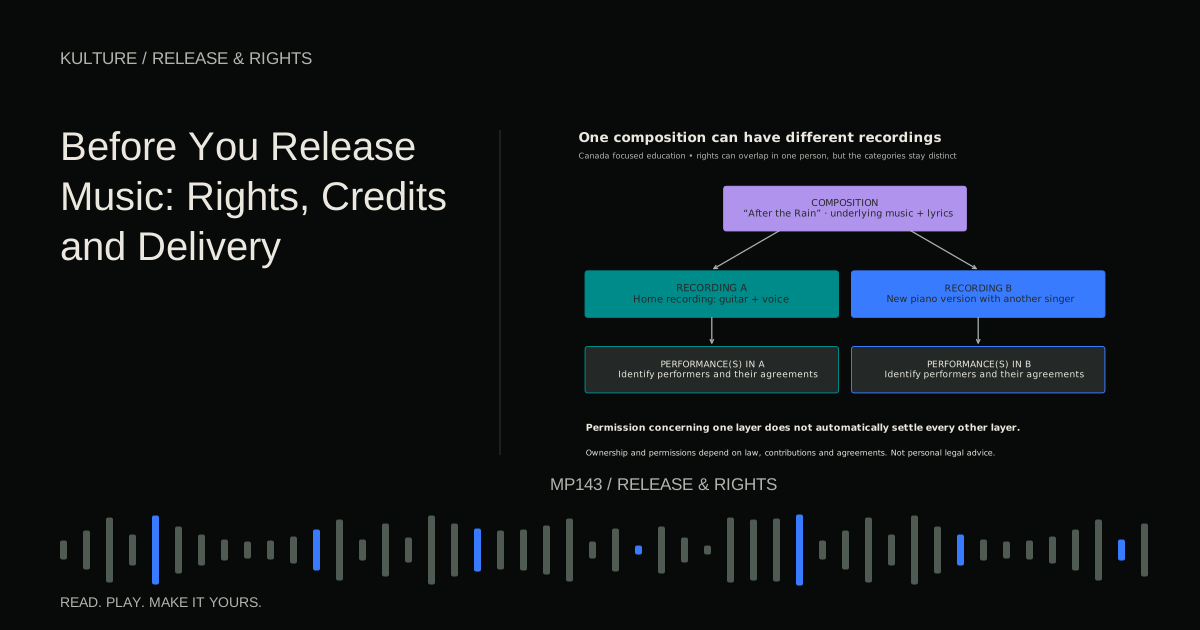
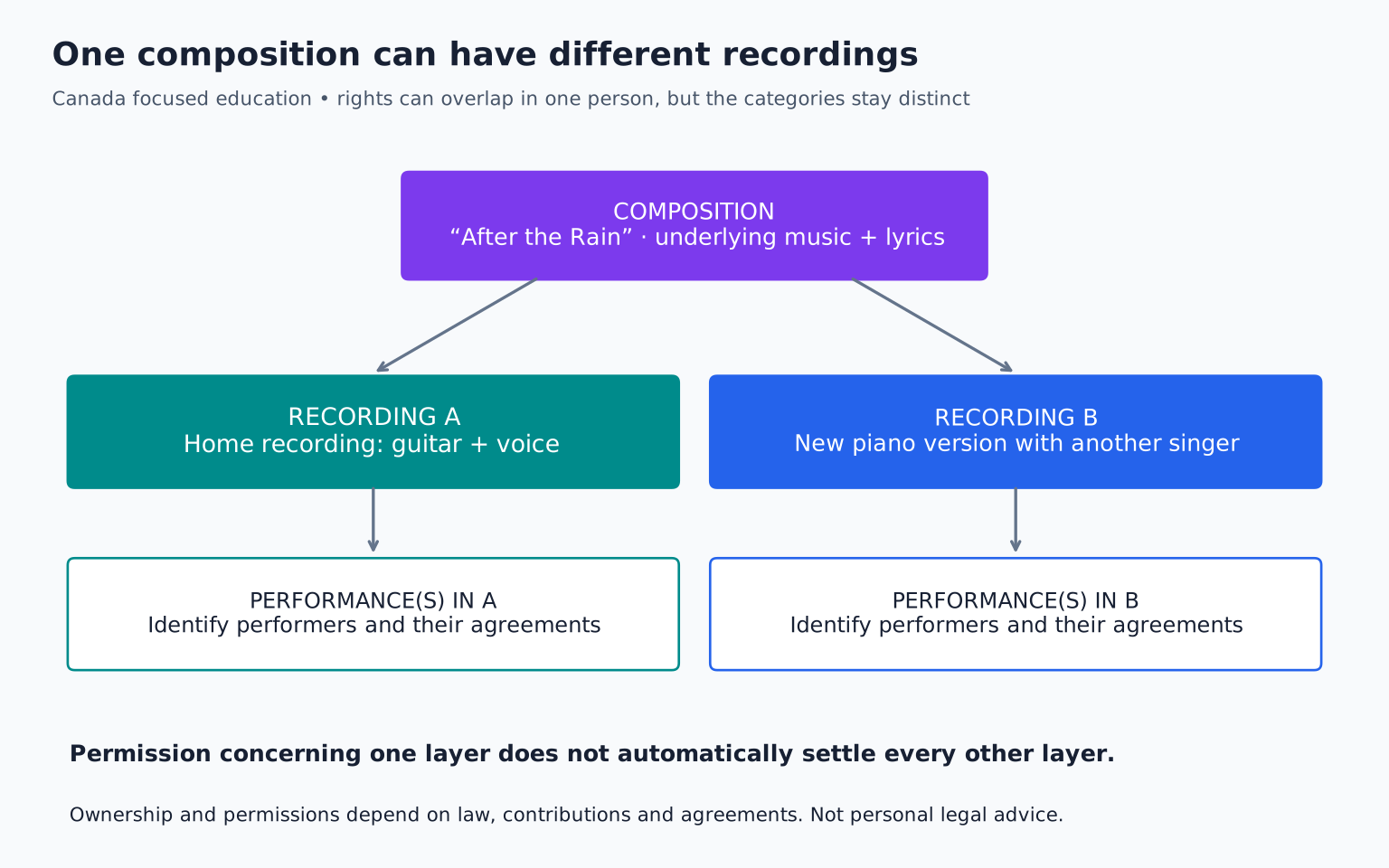
The composition is the musical work, including music and lyrics where applicable. The master recording is a particular recorded performance of that work. A song can have many recordings, and the people controlling the composition may differ from those controlling a recording.
Canada's Copyright Act addresses rights in works, performers' rights, and sound recording makers' rights separately. That structure is a warning against treating “I own the song” as a complete rights explanation.
Start a release record with separate headings for composition, recording, and performances. If the same person controls all of them, document that. If different people are involved, identify their roles and the agreements supporting the release.
TRY IT HERE
Make it your session
Turn the steps into a plan you can save.
Ready when you are. Audio starts only when you press Play.
Keep experimenting in the stem splitter LabMap every outside contribution
List samples, loops, licensed beats, guest performances, co written lyrics, artwork, photographs, and any other third party material. For each, record its source, who supplied it, and the permission or licence relied on.
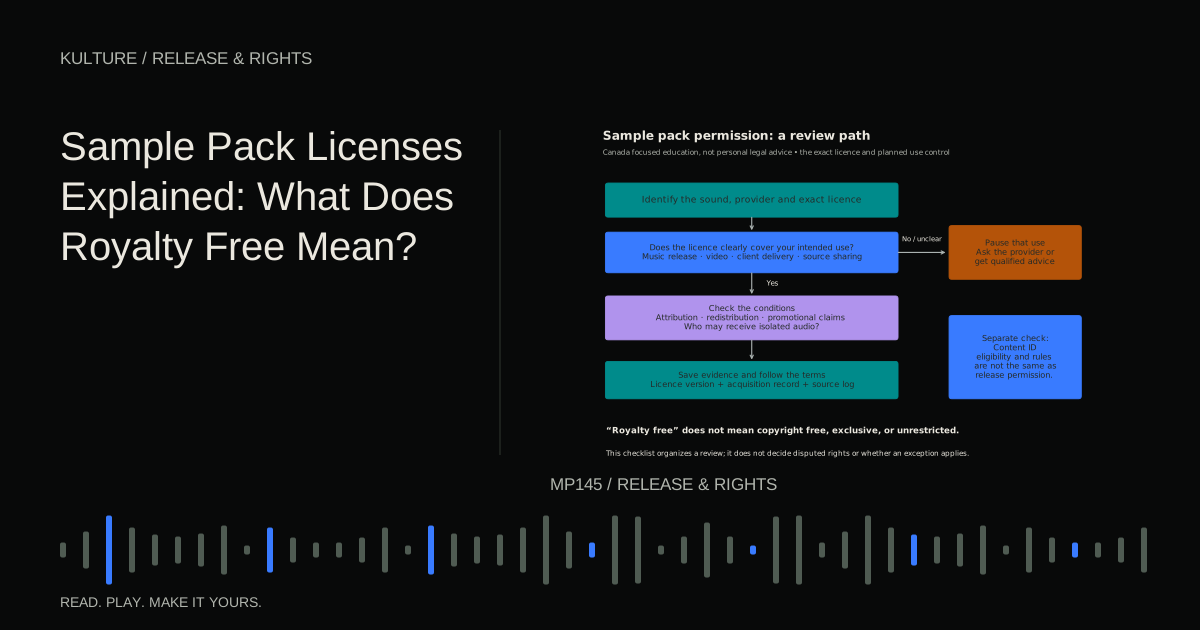
A producer saying “it is from a pack” is a starting point, not the complete record. Which pack? Which provider? Which licence? Was it downloaded under the account and conditions that grant the relevant use? Are there restrictions on redistribution, promotional claims, or automated rights enforcement?
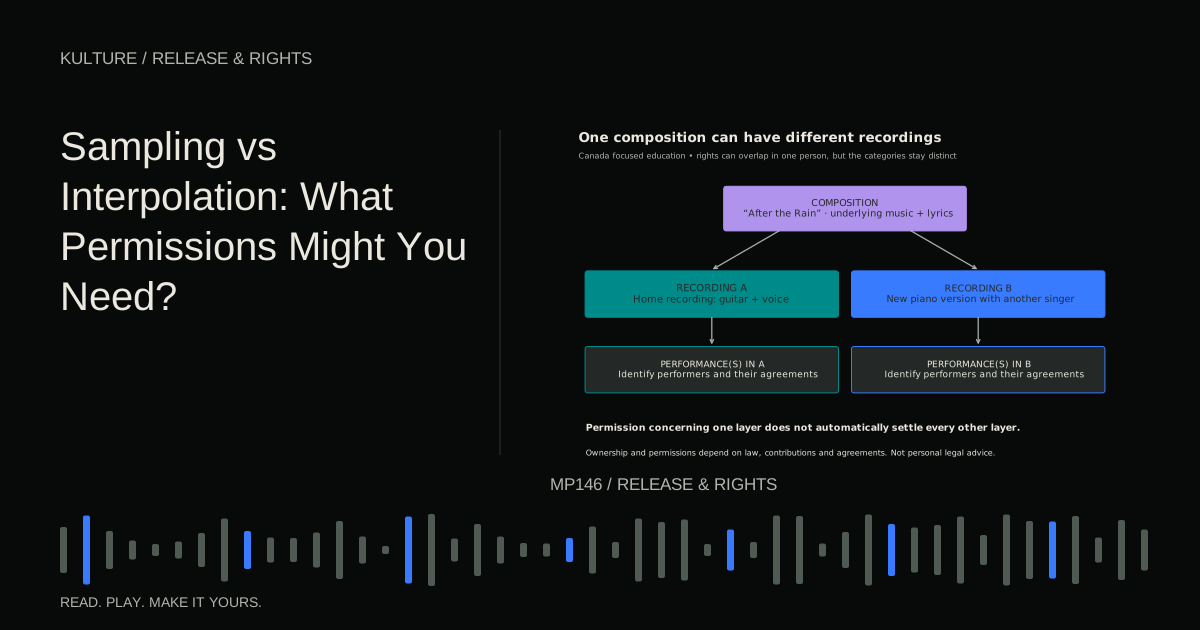
The sample pack licence guide explains why royalty free does not mean unrestricted. For borrowed material from an existing song, use sampling versus interpolation before assuming a short excerpt is safe.
Resolve credits and splits while everyone is reachable
Credits identify contributions, such as writer, producer, vocalist, mixer, or mastering engineer. Splits describe agreed shares of a particular right or revenue stream. A production credit does not by itself specify a composition share, master ownership, or payment entitlement.
Record what the percentages refer to. “Fifty fifty” is incomplete unless you know whether it concerns composition ownership, recording income, net profits after expenses, or something else. Different systems also use different share representations, so translate the agreement into each registration system carefully.
Confirm spelling, professional names, legal names where required, and contributor identifiers when relevant. Keep private administrative details out of public credits unless they are needed and authorized.
If there is a disagreement, pause the affected release step. A distributor's form is not the place to resolve a disputed ownership claim by entering whichever percentage seems easiest.
Do not confuse registration with permission
Copyright protection and registration are different concepts. The Canadian Intellectual Property Office's copyright overview explains automatic protection and the evidentiary role of registration. Registration does not clear third party material or settle every ownership dispute.
Likewise, registering a work with a collection organization is an administrative step for represented rights. It is not a universal licence to release every recording containing that work. Know which rights and uses the organization handles and what your agreement with it covers.
SOCAN's creator information and Re:Sound's artist information are useful starting points for different parts of the Canadian rights landscape. Eligibility, repertoire, mandates, usage, and reporting affect collection; no organization should be described as automatically collecting every possible royalty for every artist.
Check the release agreement itself
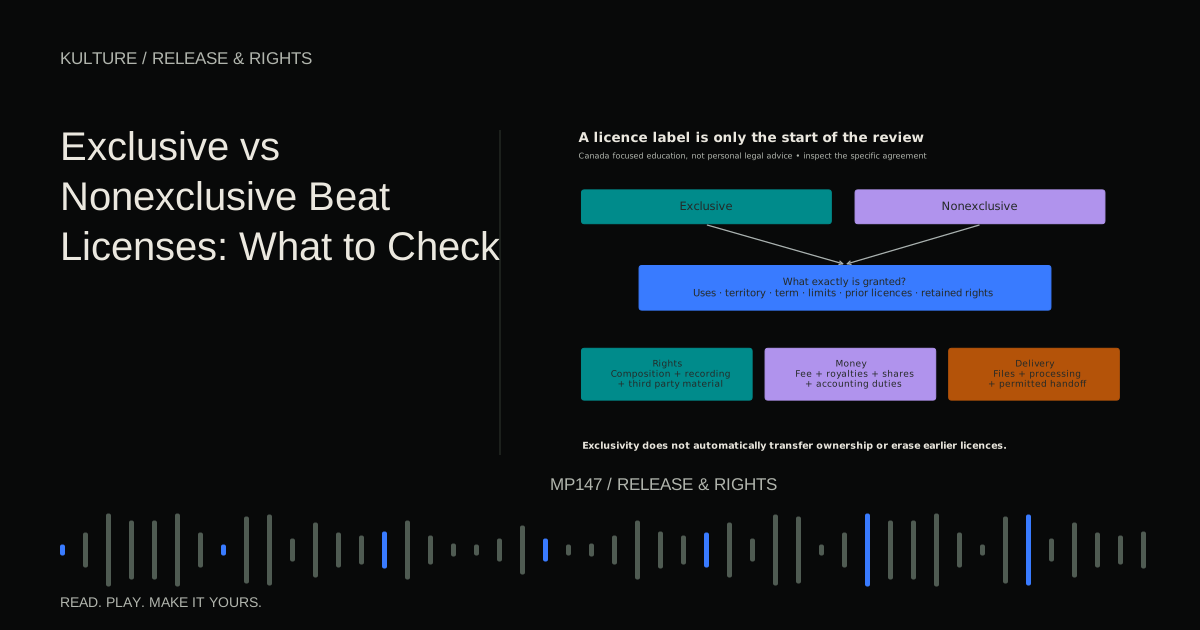
A distributor, label, beat seller, library, or collaborator may ask for warranties about your rights. Read what you are promising. If the form asks whether you have exclusive rights to every source sound, a nonexclusive loop licence may matter even when commercial use is permitted.
Review territory, term, fees, revenue deductions, withdrawal procedures, account responsibilities, and any optional services. Content identification services can carry requirements different from ordinary distribution.
YouTube's Content ID eligibility guidance illustrates why permission to use material and eligibility to claim it automatically are separate questions. Do not enroll material in an enforcement system simply because an upload form offers a checkbox.
Lock the audio before entering metadata
Identify the approved main master and every alternate version. Check starts, endings, channels, clicks, and the intended explicit or clean content. Make sure the final file is the mastered version if mastering was commissioned.
Use filenames that distinguish title, version, and approval status. Keep old drafts outside the final delivery folder. If a last minute mix change arrives, repeat the relevant audio checks and update the release record rather than silently replacing a file.
The technical requirements come from the actual distributor or destination. Do not assume every service wants the same sample rate, bit depth, or loudness. Keep a high quality source master so new formats can be created without repeated lossy conversion.
Build one authoritative metadata sheet
Record the release title, track titles, artist roles, contributor credits, language, explicit status, release date, track order, and copyright information as applicable. Include identifiers and the exact audio filename for each track.
An ISRC identifies a recording. It is not proof of copyright ownership. IFPI's ISRC FAQ explains the distinction between recording identifiers and musical work identifiers. Use the same identifier appropriately for the same recording, and follow the rules for materially different versions.
Check existing artist profile links when submitting music. A common artist name can be mapped to the wrong profile if identity information is incomplete. Do not invent identifiers or assume a profile with a matching name is yours.
Treat artwork as another rights bearing asset
Confirm who created the image, what licence permits release use, and whether any recognizable people, logos, or other protected elements raise additional issues. Paying for a design does not make every underlying image available for every use.
Check the distributor's current size, format, and content requirements. Apple's style guide is one official example of artwork and metadata rules; your distributor may impose additional requirements.
Keep the approved artwork file and its permission record with the release package. Do not use a low resolution preview merely because it looks acceptable as a small thumbnail.
Work through a simple release example
Suppose two writers create an original song, a producer supplies a beat containing a licensed loop, and a guest singer records a harmony. Before scheduling release, document the composition agreement, recording arrangement, guest performance permission and credit, and the loop licence. Confirm any beat licence conditions and whether content identification enrollment is permitted.
Then approve the master, collect credits, assign or confirm recording identifiers, prepare artwork, and submit the package. If the loop's origin cannot be verified, resolve or replace it before relying on a rights warranty.
Your exercise is to make a one page release record with columns for asset, contributor, permission, evidence, and status. Any blank permission field becomes an action item before distribution. Continue with the first release checklist for the operational delivery steps.
TAKE IT INTO YOUR OWN MUSIC
Your next session.
Suppose two writers create an original song, a producer supplies a beat containing a licensed loop, and a guest singer records a harmony. Before scheduling release, document the composition agreement, recording arrangement, guest performance permission and credit, and the loop licence. Confirm any beat licence conditions and whether content identification enrollment is permitted.
Notes and progress stay in this browser.