This is Canada focused educational information, not personal legal advice. The exact rights and ownership of a project depend on the law, the contributions, and the agreements involved.
Start with an ordinary example
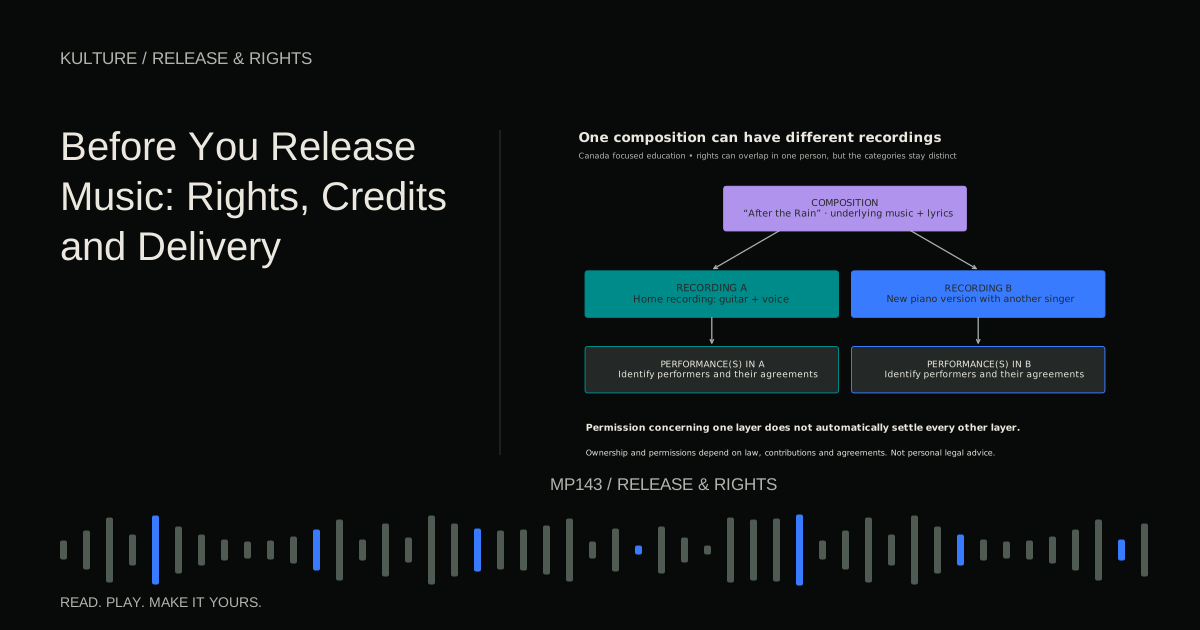
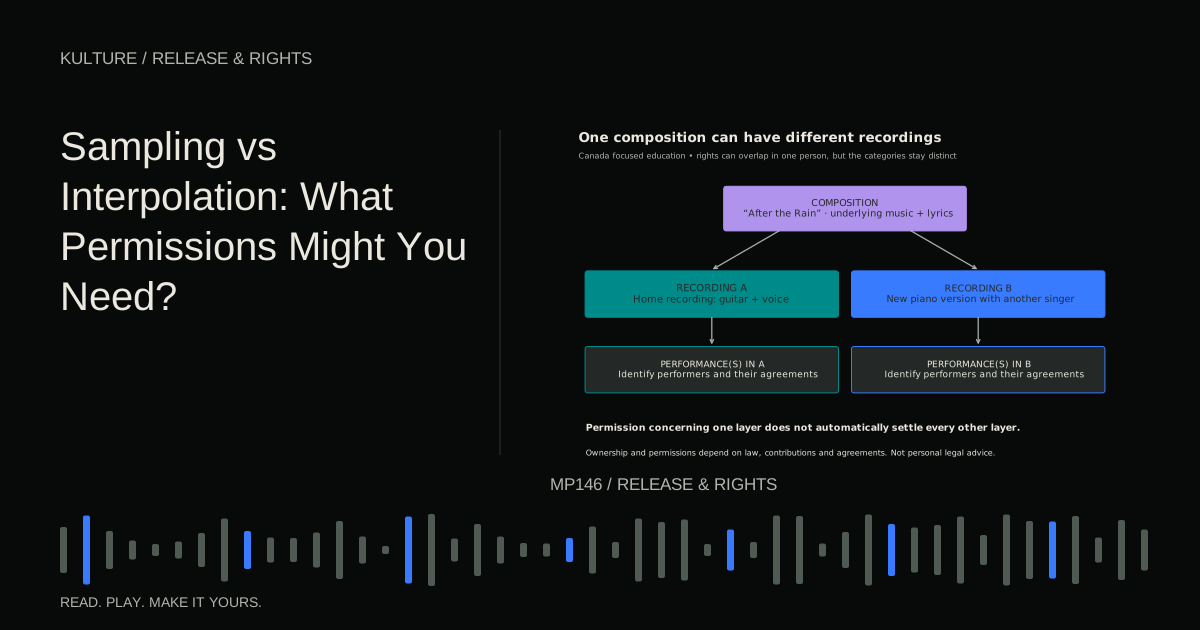
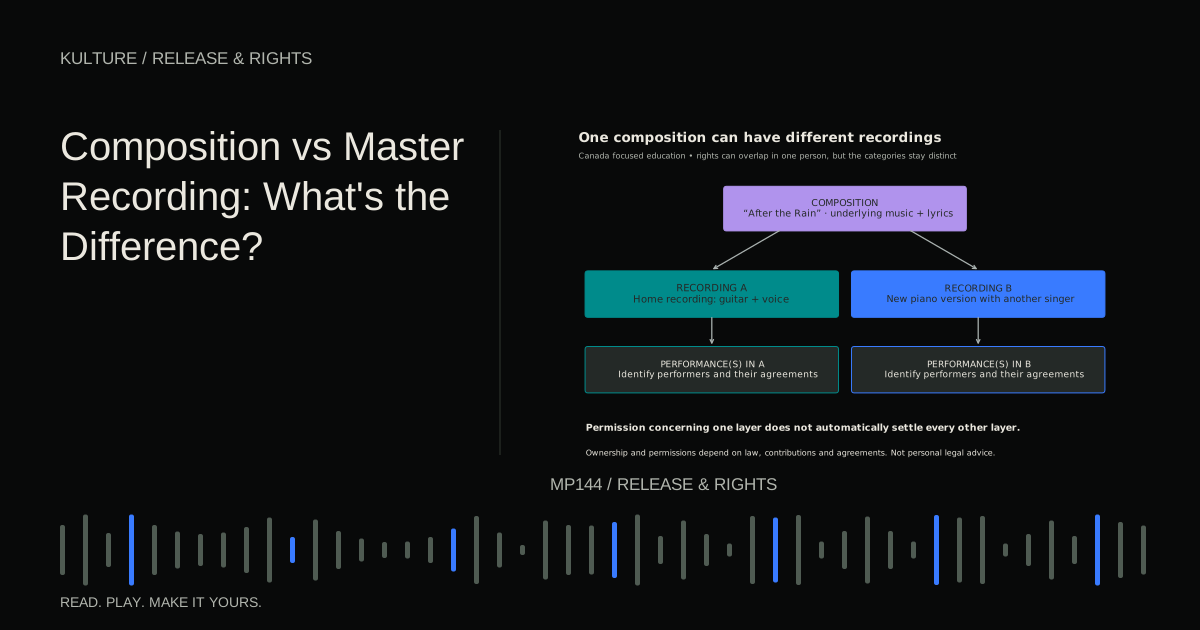
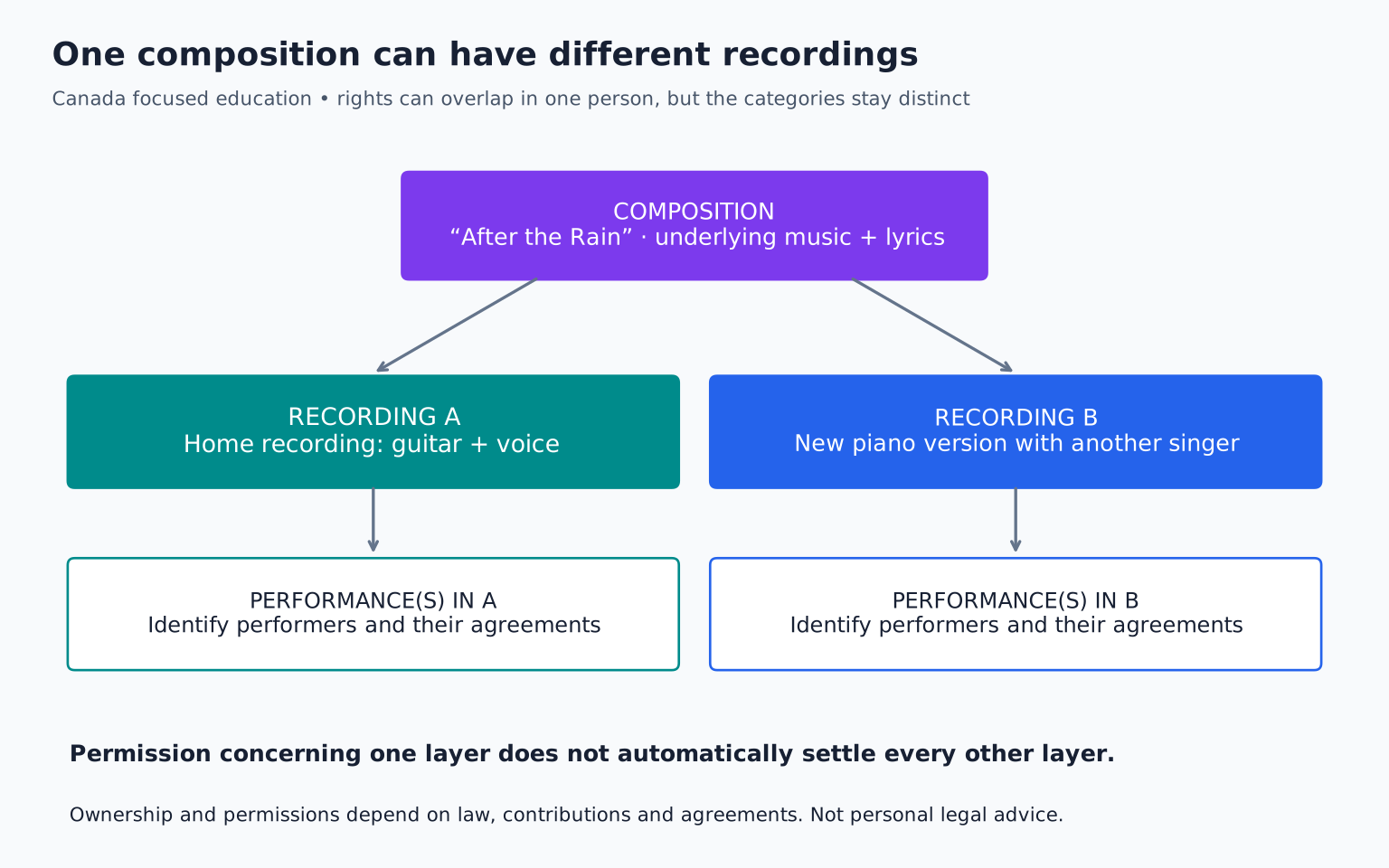
Imagine you write a melody and lyrics called “After the Rain.” You record it at home with guitar and voice. Later, another singer records a piano version.
The two recordings can embody the same composition, but they are different recorded performances. Your home recording and the singer's piano recording are not the same master. Permission to use one recording does not automatically provide every permission concerning the composition, and permission concerning the composition does not automatically authorize copying a particular recording.
This distinction also explains why rerecording a song does not make the underlying song disappear as a rights issue. You may create new recorded audio while still using another person's protected musical work.
TRY IT HERE
Make it your session
Turn the steps into a plan you can save.
Ready when you are. Audio starts only when you press Play.
Keep experimenting in the stem splitter LabWhat the composition includes
A composition can include music and lyrics where present. The legal analysis of what is protected and who contributed authorship can be fact specific. Do not assume that every production suggestion creates a writing share, or that only the person singing contributed to the composition.
Canada's Copyright Act, section 3, sets out rights in works, including reproduction and public performance in the statutory framework. That is different from merely owning a copy of a file or a notebook containing the song.
For practical recordkeeping, identify the writers, their agreed composition shares, and any publisher or administrator involved. Keep the agreement separate from the audio production credits so the two records do not become confused.
What the recording includes
A master is a specific recorded result: the chosen performances, sounds, edits, and mix embodied in the recording. The term is used informally in several ways, so specify which recording and version you mean.
Canada's section 18 addresses sound recording makers' rights. Determining the maker and ownership is not always as simple as asking who pressed Record, paid the invoice, or owns the studio computer.
Write down the recording arrangement: who controls release, who can license the master, how revenue is handled, and what approvals are required. A producer's fee, an artist's ownership, and a label's licence can coexist in different combinations.
Performers are another part of the picture
The singer, drummer, or instrumentalist may have rights in their performance distinct from composition and recording ownership. Section 15 of the Canadian Copyright Act addresses performers' rights, subject to its conditions.
This is why a release package should include appropriate performer permissions and agreements rather than assuming that a session payment settles every possible use. The agreement may need to address recording, release, editing, credit, and other uses relevant to the project.
A performer can also be a writer or recording owner, but those roles should be identified separately. One person's multiple roles do not collapse the legal distinctions.
Credit is not the same as ownership
A public credit says what someone did. A rights agreement says what they own or may do. “Produced by” does not automatically define a percentage of the composition or the master. “Mixed by” does not automatically mean the mixer owns the recording.
Likewise, a person may hold rights without appearing as a featured artist. Public presentation and legal administration serve different purposes.
Use credits, ownership, and splits to plan the conversation. Ask what each percentage refers to, who can approve uses, and whether payment is a fee, royalty, or both.
A licence is not necessarily a transfer of ownership
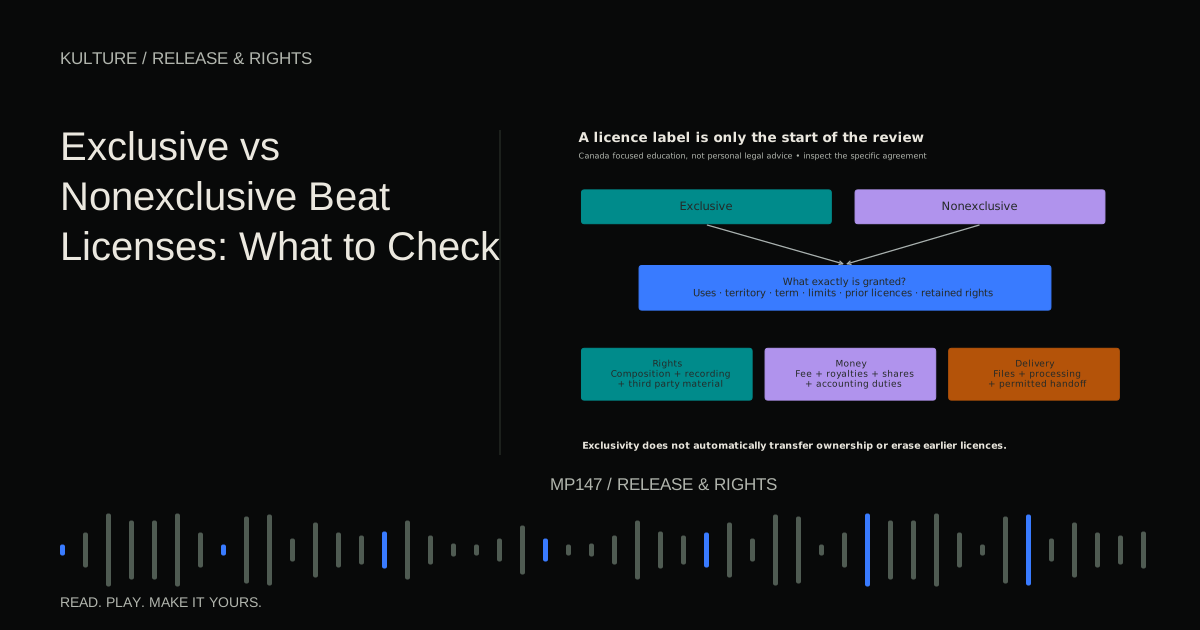
A licence gives permission within defined terms. An assignment transfers ownership of rights within its scope. An exclusive licence can reserve certain permitted uses to one licensee while ownership remains elsewhere.
For Canadian works, section 13 includes ownership and written assignment provisions. Do not substitute a casual message saying “you bought the beat” for a clear understanding of the actual agreement.
Check territory, duration, permitted uses, exclusivity, sublicensing, and retained rights. A licence for releasing a song may not include every advertising, film, game, or sample library use someone later proposes.
Why sampling can involve more than one layer
If you copy audio from an existing recording, you are using recorded material that may also embody a protected composition and performance. If you rerecord a recognizable musical passage instead, you may avoid copying the original audio while still raising composition questions.
The exact permissions depend on the material, use, jurisdiction, licences, and any applicable exception. There is no dependable universal “a few seconds is free” rule. See sampling versus interpolation for a cautious workflow.
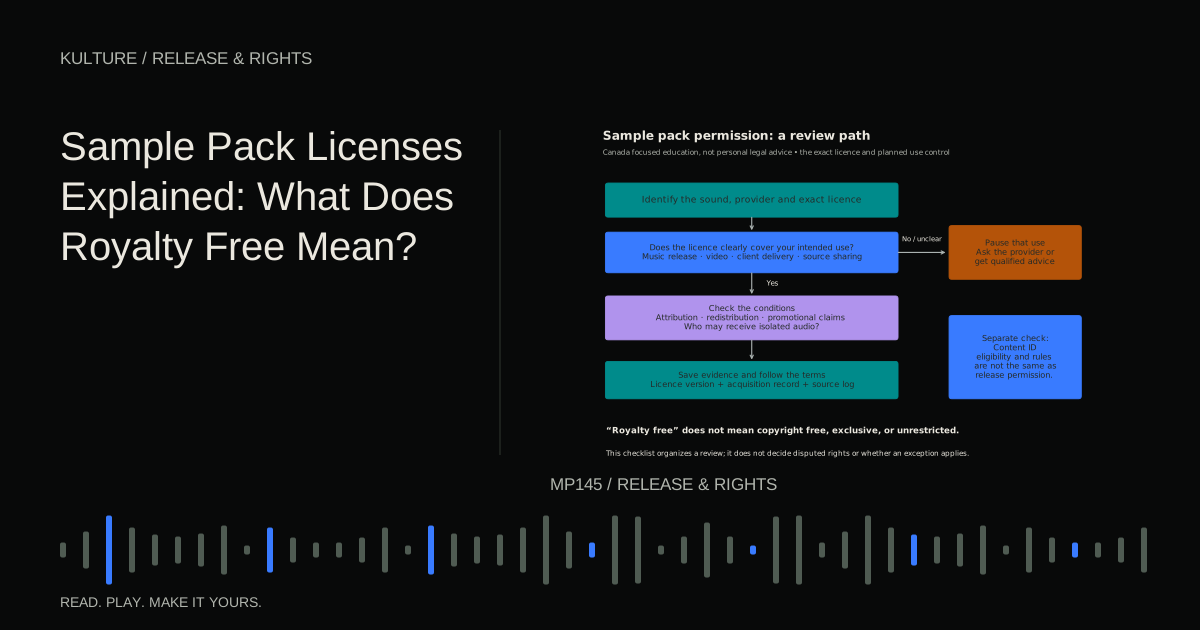
A sample pack licence may already authorize certain uses, but its scope still matters. Do not assume that a commercial recording and a licensed production loop have the same permission pathway.
Keep identifiers in their proper role
An ISRC identifies a recording; an ISWC identifies a musical work. Neither is a substitute for the agreement establishing rights. IFPI's FAQ explains the recording code system and its relationship to works.
A song can have several ISRCs associated with different recordings. Releasing the same recording on another platform does not automatically create a new recording. Conversely, a materially different version may need its own identifier under the relevant rules.
Store identifiers alongside titles, version labels, contributors, and audio filenames. This reduces mistakes when a single composition has an original recording, acoustic version, live version, and remix.
Map one project on paper
Draw three boxes: composition, recording, and performances. Under each, list the people involved and the evidence supporting the intended release. Then add separate notes for artwork and any third party material.
For an original solo project, the map may be simple. For a collaboration using a licensed beat and guest vocalist, it may reveal unanswered questions. Resolve those questions before promising a distributor or client that you control everything.
Your next step is to complete that map for one track and read the release rights overview. The useful outcome is not memorizing legal labels; it is knowing which person or agreement you need to consult before using the music.
TAKE IT INTO YOUR OWN MUSIC
Your next session.
Imagine you write a melody and lyrics called “After the Rain.” You record it at home with guitar and voice. Later, another singer records a piano version.
Notes and progress stay in this browser.