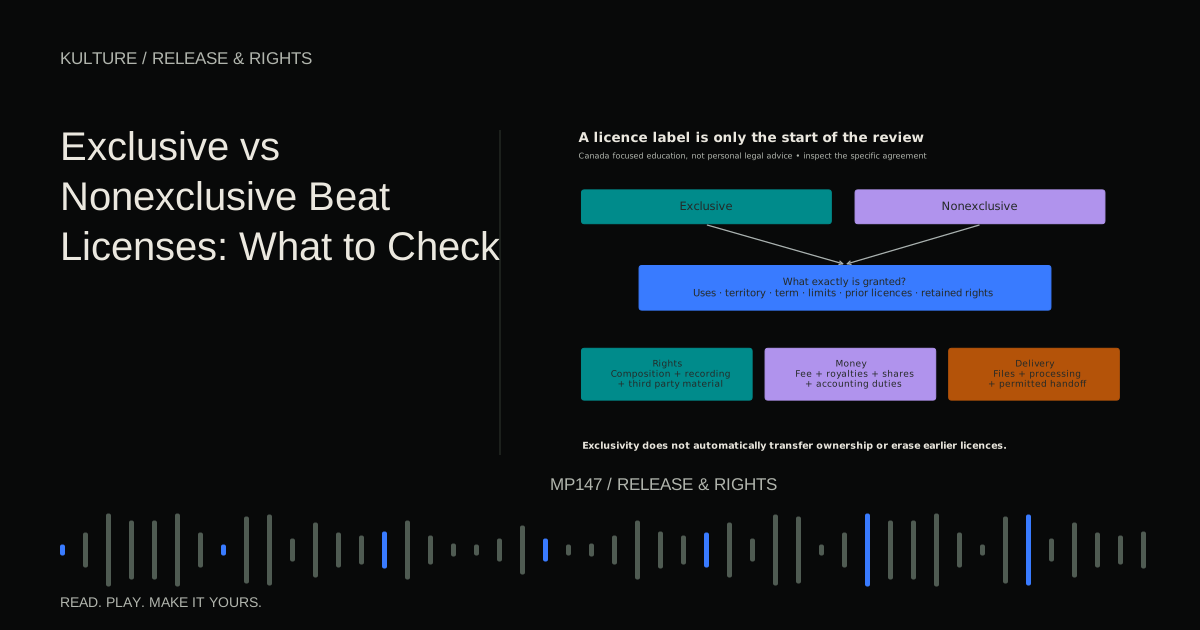
Read the actual agreement before paying. This is Canada focused educational information, not personal legal advice. Online marketplaces may use contracts governed by another jurisdiction, so confirm the agreement's governing law and obtain qualified advice for significant commitments.
Start with the rights being licensed
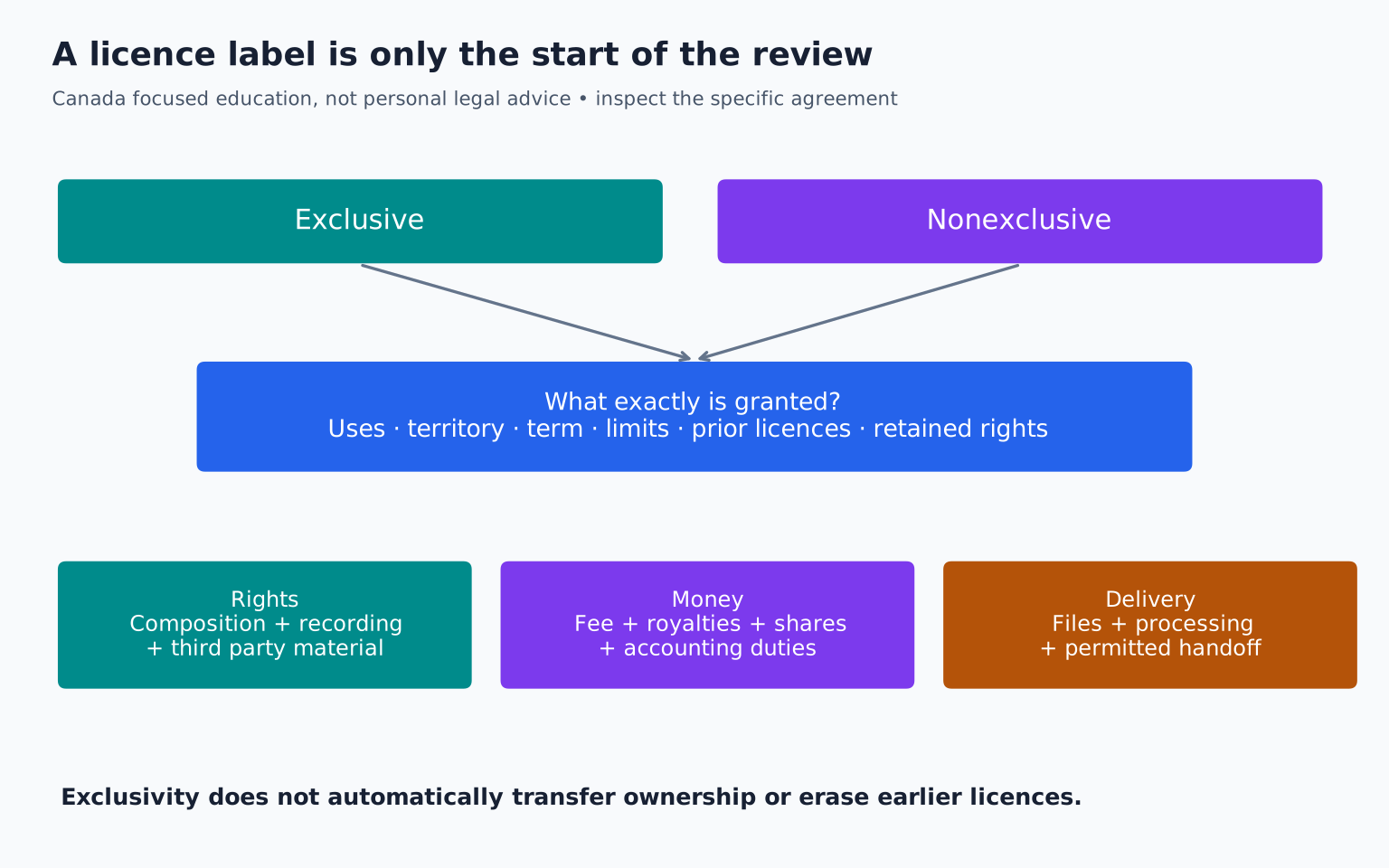
A beat can contain a musical composition, a recording, performances, and licensed third party material. The agreement should identify what the seller controls and what you are allowed to do with it.
Ask whether you may record vocals over the beat, distribute the resulting song, perform it live, make videos, license it for screen use, create remixes, or deliver stems to others. Do not assume that permission for one use includes all the others.
Canada's Copyright Act, section 13 distinguishes ownership, assignments, and licences within its framework. A licence can grant meaningful rights without transferring the copyright itself.
TRY IT HERE
Make it your session
Turn the steps into a plan you can save.
Ready when you are. Audio starts only when you press Play.
Keep experimenting in the stem splitter LabDo not confuse exclusivity with ownership
An exclusive licence may stop the producer from granting competing permissions within a defined scope, but it may leave ownership with the producer. An assignment is a different transaction. Read the wording rather than treating “exclusive” as shorthand for “I own everything.”
Ask what happens to licences granted before your purchase. Earlier nonexclusive users may retain rights under their agreements. Do not assume an exclusive purchase automatically removes their songs from stores or cancels their permissions.
Also ask whether the producer retains rights to perform, display, promote, or otherwise use the beat. Exclusivity can be limited by territory, duration, type of use, or other terms.
Check usage limits and what happens when you exceed them
Nonexclusive licences may contain limits involving streams, sales, videos, performances, or distribution. The exact limits are contract specific. Some licences may require an upgrade or further negotiation when a threshold is reached.
BeatStars' explanation of available licences emphasizes that producer defined terms vary. This is a marketplace example, not a statement of Canadian law or a universal beat licensing model.
Write the relevant limits into your release record and identify who will monitor them. A licence is not useful if nobody remembers the condition until the track exceeds it.
Separate the purchase price from ongoing obligations
A one time fee does not necessarily mean there are no royalties, publishing shares, credits, or reporting duties. Read the sections concerning the new song, composition shares, master income, and any producer participation.
Ask what each percentage means. “Producer gets 50%” is incomplete without the right or revenue base, deductions, accounting method, and payment timing. A composition share and a share of net master receipts are different arrangements.
Do not invent a standard split. The appropriate agreement depends on the parties and contributions, and the contract may use terminology that needs professional interpretation.
The credits and splits guide provides questions to discuss before release.
Verify the seller's authority and source material
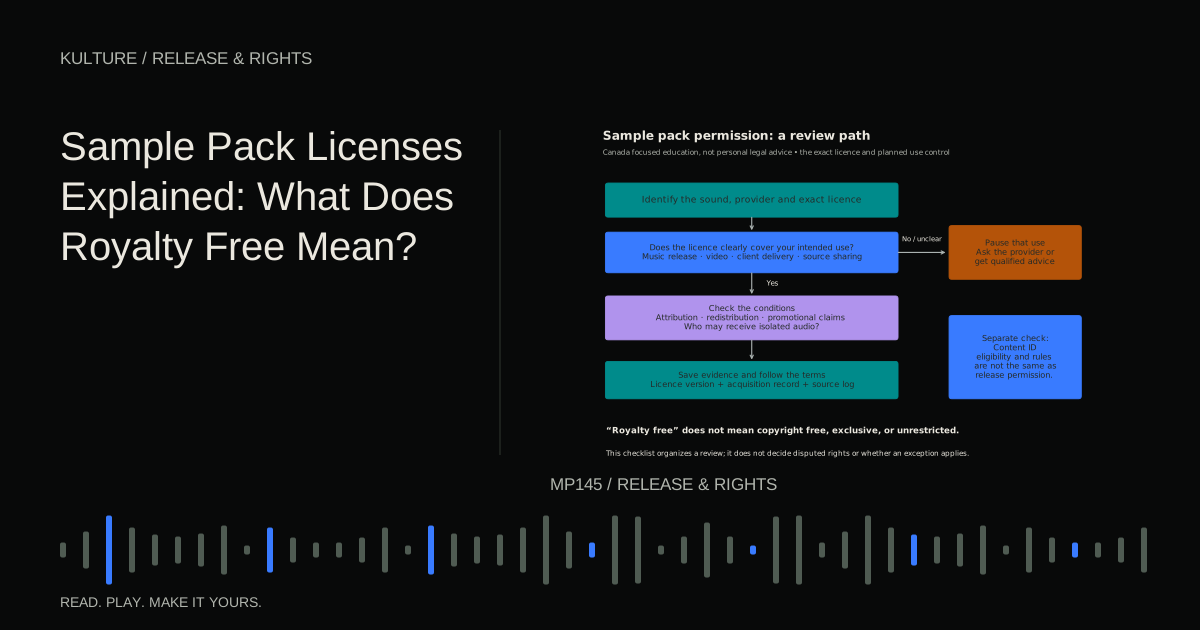
Ask whether the beat contains samples, loops, collaborators, or other third party material. Request a clear explanation of what is already licensed and what you must clear separately.
A seller may be able to license their own contribution without controlling every underlying element. A warranty in the contract matters, but it does not make an unidentified source magically cleared. Keep supporting documentation where available.
If a recognizable commercial sample is central to the beat, investigate it before building a release around the purchase. Use sampling versus interpolation for the relevant distinctions.
Review Content ID and distribution restrictions
Some agreements restrict automated content identification registration because multiple artists may lawfully use the same beat. Platforms also have independent eligibility rules.
YouTube's Content ID requirements explain the need for appropriate exclusive rights in reference material. Permission to distribute your song is not automatically permission to generate claims against every matching use of a shared beat.
Check the beat contract and your distributor's optional services. Do not enroll by default, and do not assume ordinary streaming monetization is identical to Content ID enrollment.
Inspect the files included in the licence
A low priced licence may provide only a compressed stereo file, while another option may include a high quality WAV or individual tracks. These are delivery differences, not proof of ownership differences unless the agreement says so.
If you need detailed mixing, ask for the actual contents of the “stems” package. Are drums separated? Are effects printed? Is the beat already heavily limited? Can the producer supply a clean version suitable for mixing vocals?
Use stems versus multitracks to clarify the request. A licence that permits your use may still be a poor practical fit if the supplied audio cannot support the intended production.
A comparison example
Suppose Licence A is nonexclusive, permits a defined level of distribution, includes a stereo WAV, and specifies a composition split. Licence B is described as exclusive, includes multitracks, and reserves some producer rights while preserving earlier licences.
Do not choose B solely because “exclusive” sounds safer. Compare the actual permitted uses, term, prior user position, financial obligations, source material assurances, and files. If your planned release includes a music video and paid advertising, check those uses explicitly in both agreements.
The better choice is the one whose terms support the project at an acceptable cost and risk, not automatically the one with the strongest marketing label.
Save the agreement you actually accepted
Keep the exact contract, receipt, beat title, seller identity, purchase date, and delivered files. A marketplace's current generic page may change and may not show the terms of your transaction.
Before signing, resolve unclear language about termination, refunds, upgrades, credit, ownership, and dispute resolution. BeatStars' contract FAQ illustrates that transaction specific information can be incorporated into licences; inspect the actual document.
Your exercise is to compare two licences using a checklist of uses, limits, rights, money, source material, files, and termination. Highlight every unanswered question and obtain clarification before purchase. A carefully reviewed modest licence is more useful than an expensive label you do not understand.
TAKE IT INTO YOUR OWN MUSIC
Your next session.
Suppose Licence A is nonexclusive, permits a defined level of distribution, includes a stereo WAV, and specifies a composition split. Licence B is described as exclusive, includes multitracks, and reserves some producer rights while preserving earlier licences.
Notes and progress stay in this browser.