This article is Canada focused educational information, not legal advice. Provider examples illustrate their own terms as checked in October 2026; they are not rules for every sample library or every jurisdiction.
Separate buying a file from owning its rights
A sample pack gives you access to audio and, usually, a licence explaining how it can be used. That licence may allow incorporation into new music while restricting redistribution of the original samples.
Canada's government copyright overview distinguishes ownership of a copy from copyright ownership. Downloading or paying for a sound does not by itself answer who controls the underlying rights.
Read the licence attached to the exact product. A provider may offer different terms for ordinary samples, artist collaborations, promotional downloads, MIDI, presets, or other content. A label on a marketplace page is not a substitute for the operative agreement.
TRY IT HERE
Make it your session
Turn the steps into a plan you can save.
Ready when you are. Audio starts only when you press Play.
Keep experimenting in the stem splitter LabAsk six questions before using the pack
- Who is licensed: you, your company, or anyone with access to the files?
- Which uses are permitted: commercial music, video, games, live performance, or other work?
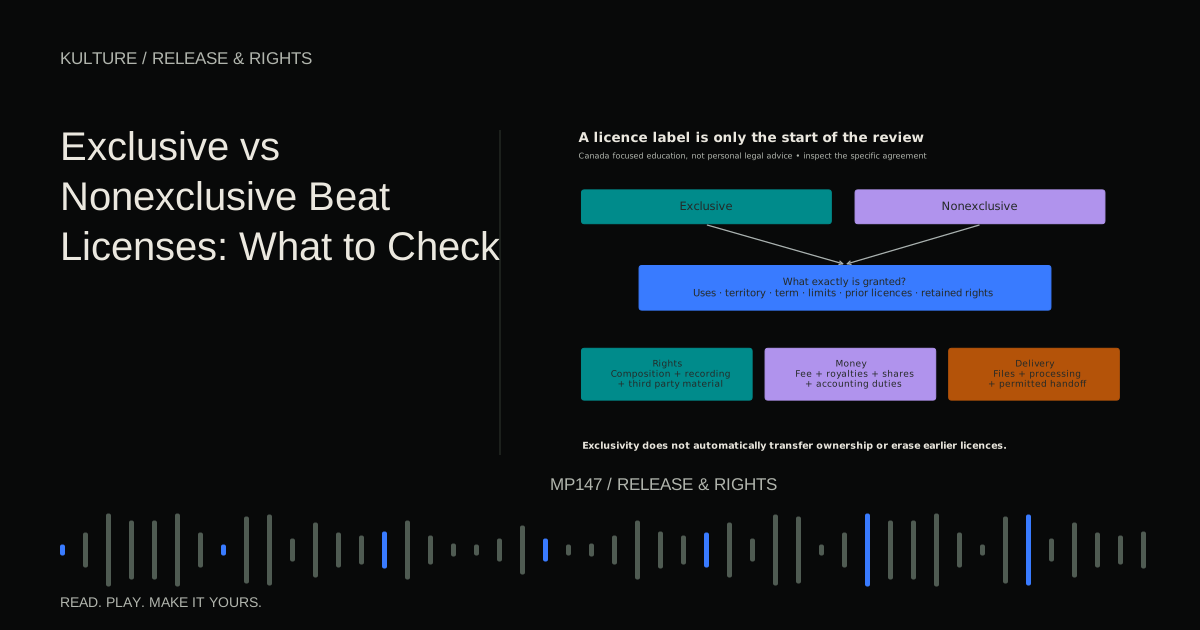
- Is the licence exclusive or nonexclusive?
- Can source files be shared with collaborators, clients, or engineers, and under what conditions?
- What redistribution, attribution, promotional, or content identification restrictions apply?
- What evidence can you retain to show the licence and acquisition date?
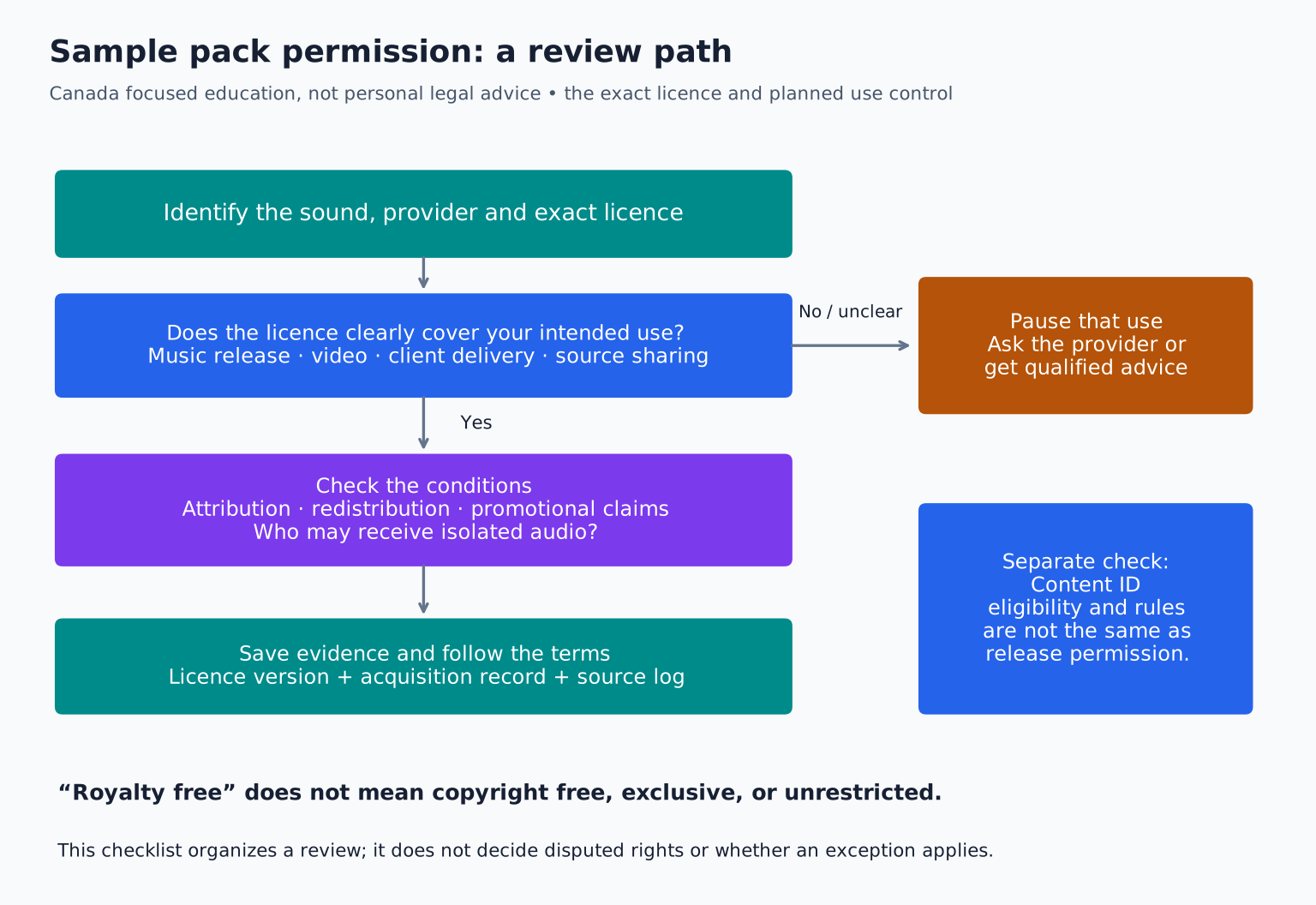
These questions turn “royalty free” into a practical decision. If the intended use falls outside the clear terms, ask the provider or obtain qualified advice rather than relying on a forum summary.
Understand nonexclusive use
A nonexclusive licence means other people may also receive permission to use the same material. You might hear the same loop in another artist's release without either artist having copied the other's new work.
As a provider specific example, Splice's licensing FAQ describes its sounds as nonexclusive and royalty free, permits covered commercial uses subject to its terms, and restricts redistribution as samples or loops. It also discusses certified licence evidence and name or likeness restrictions.
Those statements describe Splice's documented model. Do not apply them automatically to another seller, a free download, or a sample someone sent through a group chat. Check the actual licence that applies to your acquisition.
Nonexclusive source material can coexist with original contributions in your track. The important distinction is between your new work and the shared source sound; do not claim exclusive ownership over the latter merely because you used it first.
Music release and sample redistribution are different uses
Consider two projects. In one, you incorporate a percussion loop into an original song with bass, vocals, and other parts. In the other, you upload the same loop as part of a new downloadable drum pack.
A licence may allow the first and prohibit the second. Editing, pitching, or layering the loop does not automatically remove redistribution restrictions. The terms may also address whether collaborators can access isolated source files.
If you deliver stems containing licensed material to a client, check whether the proposed handoff is permitted and whether the client needs documentation or their own licence. Do not assume a music production licence authorizes unrestricted resale of every isolated component.
Do not promise Content ID eligibility
Permission to release music is different from permission or eligibility to register it in an automated rights enforcement system. Such systems can generate claims against other people using matching audio.
YouTube's Content ID eligibility rules require appropriate exclusive rights in reference material and identify nonexclusively licensed third party content as a concern. A distributor may impose its own enrollment conditions as well.
Read those conditions before checking an optional monetization or content identification box. Do not make a blanket promise that every song containing a royalty free loop is eligible, or that every such song is categorically barred from all monetization. The service, reference content, and applicable policy matter.
Keep a source log while producing
Create a simple record with the sample filename, provider, pack, acquisition date, account or receipt reference, licence document, and where it appears in the song. Keep this record with the private project archive.
For example: “PercLoop_104.wav, provider and pack name, downloaded 19 October 2026, used in choruses, licence PDF saved.” If a file is renamed in the DAW, preserve the original name in the log so you can trace it later.
Do not wait until a distributor asks for evidence. A project containing dozens of renamed samples is much harder to audit after months of editing.
Handle claims without making assumptions
An automated match does not by itself prove infringement, and a licence does not guarantee that no automated match will occur. Review the claim, identify the matching material, and gather the relevant evidence.
Use the platform's proper dispute process only when you have a truthful basis. Do not claim ownership of the original sample if your basis is a nonexclusive licence. Explain the permission accurately and keep copies of communications.
If the dispute concerns material outside the licence or involves significant consequences, seek qualified advice. Avoid public accusations against another artist merely because the same loop appears in both tracks.
Check promotional and credit language
A vocal sample by a recognizable performer does not necessarily let you advertise the release as a feature by that performer. Names, likenesses, and promotional claims can have separate restrictions.
Likewise, credit requirements vary. Some licences require attribution; others do not, or restrict certain forms of artist association. Follow the actual terms and obtain permission where necessary. Do not invent a featured artist relationship from a sample pack download.
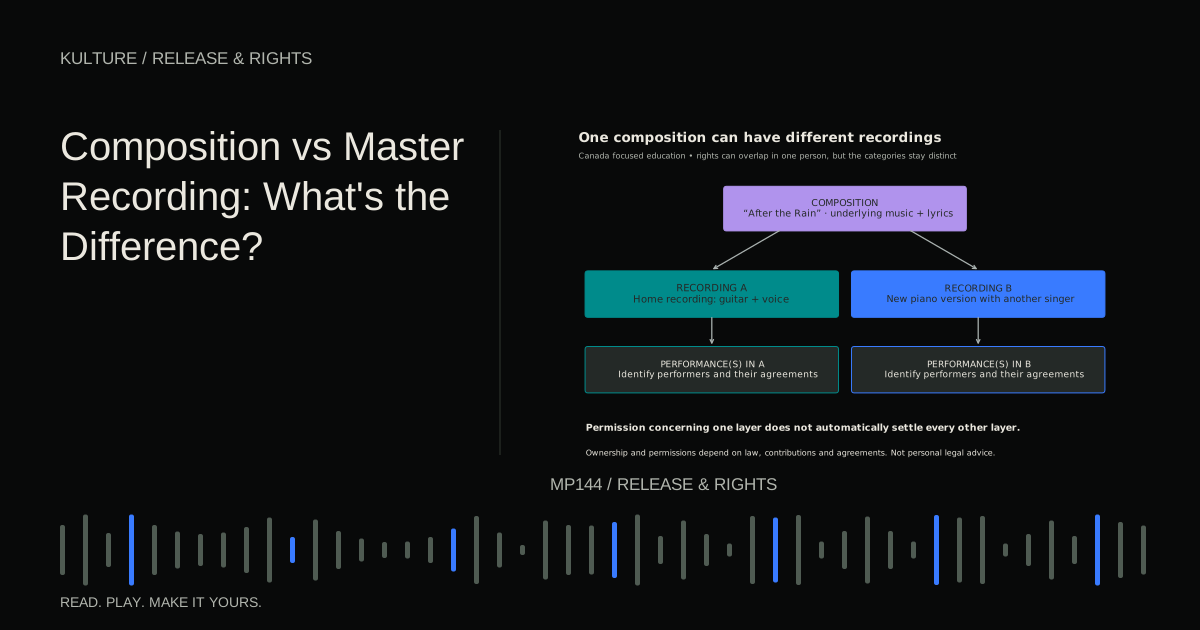
The composition versus master guide explains why source audio and the new recording should be considered separately.
A practical licence review exercise
Choose one sample you have actually used. Locate its original source and licence. Write a three line summary: permitted use, important restriction, and evidence saved. Then check the planned release and any stem delivery against those lines.
If the licence is missing or ambiguous, mark the sample unresolved. Replacing it may be simpler than releasing under uncertainty, but do not assume replacement is required before investigating the source. Continue with the release checklist once every outside asset has a documented status.
TAKE IT INTO YOUR OWN MUSIC
Your next session.
Choose one sample you have actually used. Locate its original source and licence. Write a three line summary: permitted use, important restriction, and evidence saved. Then check the planned release and any stem delivery against those lines.
Notes and progress stay in this browser.