FabFilter’s delay control reference documents time, feedback, stereo width and dry/wet controls in a practical processor.
Start with one repeat. It is much easier to hear the timing relationship before feedback, modulation and stereo movement fill the space.
Calculate the rhythm you want
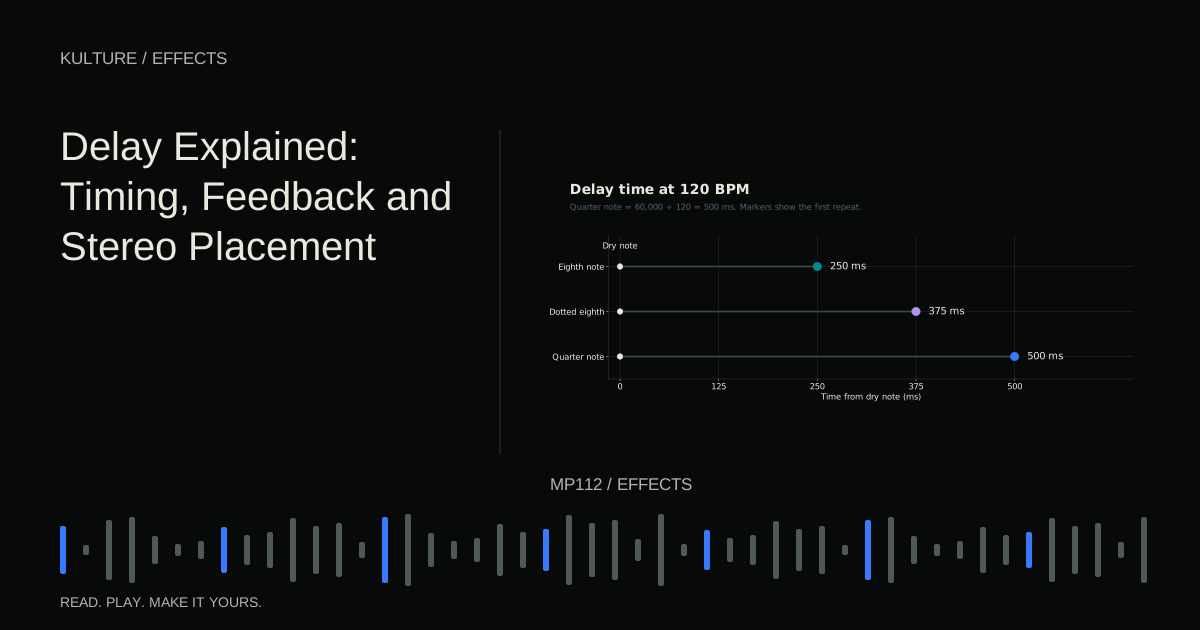
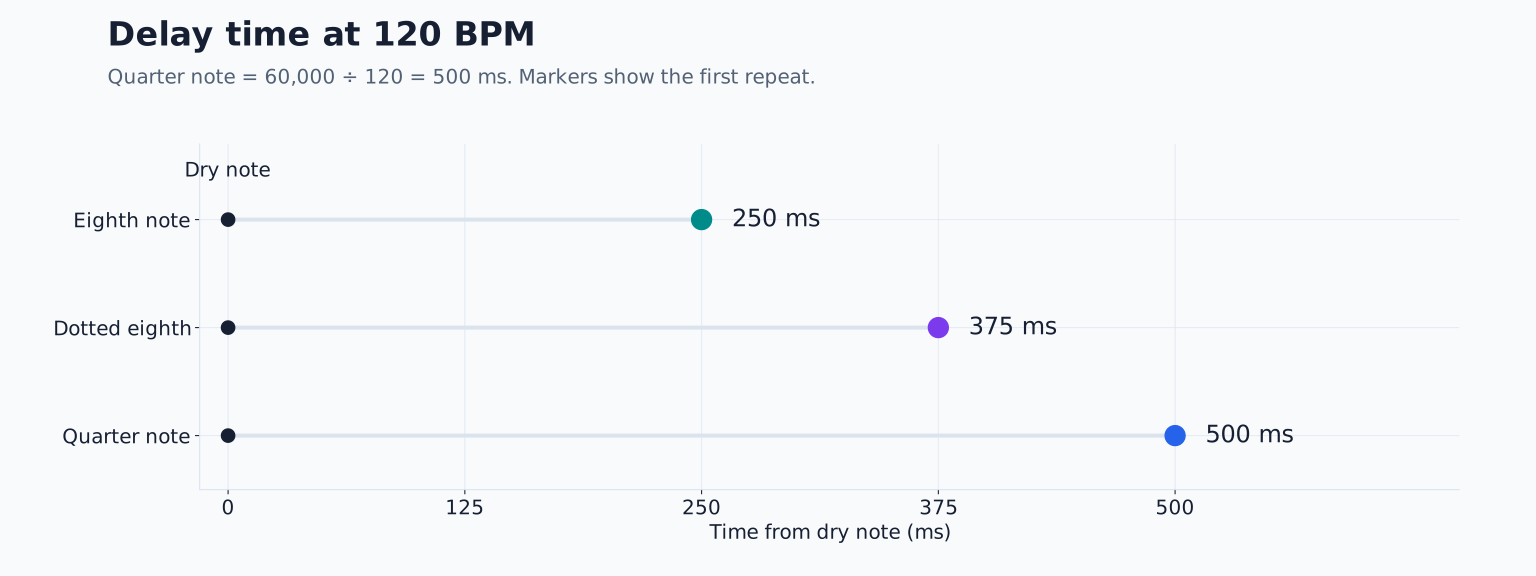
A quarter note duration in milliseconds is 60,000 divided by BPM. At 120 BPM, that is 500 milliseconds. An eighth note is 250 milliseconds, a sixteenth is 125 milliseconds and a dotted eighth is 375 milliseconds.
A dotted note lasts one and a half times its undotted value. An eighth note triplet lasts two thirds of a regular eighth note, so at 120 BPM it is about 166.7 milliseconds. These are different rhythmic relationships, not interchangeable forms of “swing.”
Many delays synchronize directly to note values, so you do not need to calculate every setting. The calculation is still useful when a plugin uses milliseconds or you want to understand why a repeat lands where it does.
TRY IT HERE
Hear the repeats
Change the delay time and feedback on a short phrase.
Ready when you are. Audio starts only when you press Play.
Keep experimenting in the synth LabHear one repeat against a beat
Create a 120 BPM project. Put a short pluck on beat one of a two bar loop, using a comfortable middle register C. Add a delay with feedback at zero and an eighth note time. Keep the wet level low initially, then raise it enough to hear the repeat.
You should hear the original on beat one and the repeat on the following eighth note position. Change time to a quarter note and hear the repeat land on beat two. Then try a dotted eighth and count its placement between those positions.
Some delays interpret zero feedback or routing modes differently, so verify that you actually hear a single repeat. If several echoes remain, another delay, reverb or internal multi tap mode may be active.
Feedback creates a series, not just a longer first echo
Increase feedback gradually. Each repeat now feeds later repetitions, usually becoming quieter as it continues. In an ideal simple delay, the feedback gain determines the level ratio between repeats, but real models may add filtering, distortion or other behaviour.
Listen to how many repeats remain musically useful. A phrase ending might welcome several; a busy melody may need only one or two. High feedback can create buildup, and some processors can self oscillate. Keep output controlled and avoid extreme settings while learning.
Manufacturer documentation is important when a delay combines unusual feedback paths or modes. Valhalla’s Supermassive documentation illustrates how delay based designs can extend into dense, reverberant textures rather than simple echoes.
Fit delay to a phrase instead of a solo note
Program C on beat one, E flat on beat two and, G on beat three and B flat on beat four and. Repeat the rhythm in bar two with G, F, E flat and C. Keep these pluck notes short, and add an empty third bar before the phrase repeats so its final echoes have a gap to answer in. Begin with an eighth note delay and restrained feedback.
Listen for collisions between repeats and new notes. If the phrase becomes confusing, reduce feedback, lower the wet level or choose a different interval. A tempo synchronized setting is not automatically rhythmically useful.
Now automate the send so only the final C reaches the delay. The repeat can answer the phrase during the gap. This selective approach often creates more apparent space with less clutter than continuous delay on every note.
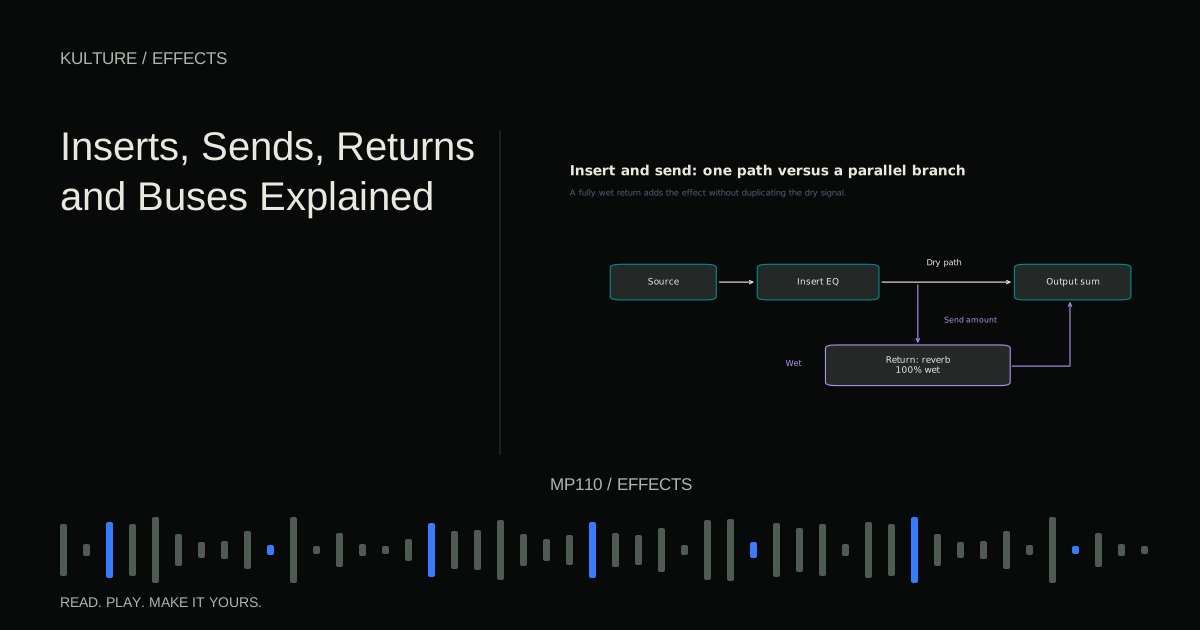
Use a return for this test, with the delay fully wet and the original track providing the dry sound. If routing is unfamiliar, read inserts, sends, returns and buses.
Give the repeats their own tone
A perfectly bright copy can compete with the source. Filtering the delay return can make the repeats easier to distinguish and place them behind the original. Try reducing unnecessary low energy and gently darkening the high end.
Some delays place filters inside the feedback loop, so later repetitions become progressively more altered. Others filter only the output, giving every repeat a similar tonal treatment. Both are useful, but they produce different development over time.
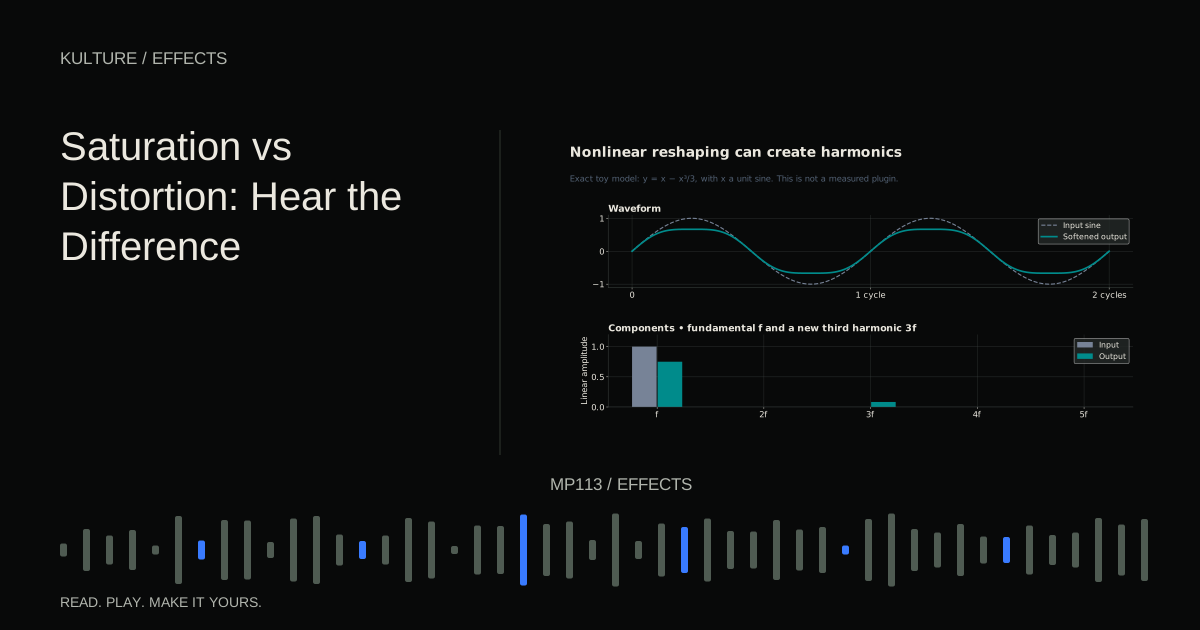
Add distortion or saturation to the wet path if you want the echo to become a contrasting texture. Keep the dry source clear while auditioning. If the repeats become harsher with each cycle, inspect feedback path processing and lower the amount.
Stereo placement changes the conversation
A mono delay can keep the echo near the source. A panned return can place the answer elsewhere. A ping pong mode commonly alternates repeats across channels, although the exact routing differs by processor.
Try the same phrase with a centred echo, a slightly panned echo and alternating left right repeats. Listen to whether the movement supports the rhythm or distracts from the lead. Wider is not automatically better.
Check the result in mono, especially with very short delay differences used for widening. Closely related delayed copies can comb filter when combined. Longer, clearly separate echoes behave more like rhythmic events, but still affect balance when left right separation disappears.
See mono troubleshooting if the source becomes hollow or weak rather than merely narrower.
Changing delay time can change pitch
Some delay designs pitch bend while the delay time moves, resembling changes in tape speed. Others crossfade or jump between times to reduce that effect. If you automate time, audition the actual transition rather than assuming it will be smooth or pitch stable.
For a controlled experiment, sustain a note, add a few audible repeats and move delay time slowly. Keep the level low and feedback restrained. Notice whether you hear a glide, a transition between taps or a discontinuity.
Use that behaviour creatively only after you know which one your processor produces. Automating the wet level or send may be a cleaner way to introduce an echo without changing its timing mid phrase.
Troubleshoot an overcrowded delay
If repeats obscure the next chord, shorten the feedback tail or reduce the send before that change. If they obscure the lead’s articulation, lower wet level or alter their tone. If the groove feels late, compare a shorter interval or fewer repeats rather than moving the original notes.
For practice, make three versions of one phrase: a single rhythmic answer, a filtered multi repeat tail and a stereo call and response. Keep the source identical and choose the version that best fits the arrangement. Then compare delay with reverb and try changing their order in a saved experiment.
TAKE IT INTO YOUR OWN MUSIC
Your next session.
If repeats obscure the next chord, shorten the feedback tail or reduce the send before that change. If they obscure the lead’s articulation, lower wet level or alter their tone. If the groove feels late, compare a shorter interval or fewer repeats rather than moving the original notes.
Notes and progress stay in this browser.