Your goal is not an identical stereo and mono experience. It is to preserve the song’s important information when left and right are summed. The melody, vocal and rhythmic foundation should still make sense even if the atmosphere becomes narrower.
Use an actual mono sum
Use a mono sum control in your DAW, monitor controller or a suitable utility plugin. Listening to only the left speaker is not the same test: that checks one channel rather than the combination of both.
Also note that mono sum tools may apply different gain compensation. A level change alone does not prove cancellation. Compare the relative balance and tone of the important parts, not only overall loudness.
iZotope’s mono and stereo explanation provides context for checking a stereo production in mono. Make the check at the end of the monitoring path so you hear the complete mix, including stereo effects.
TRY IT HERE
Check the centre
Hear what happens when opposite polarity signals are summed.
Ready when you are. Audio starts only when you press Play.
Keep experimenting in the synth LabUnderstand what combining channels does
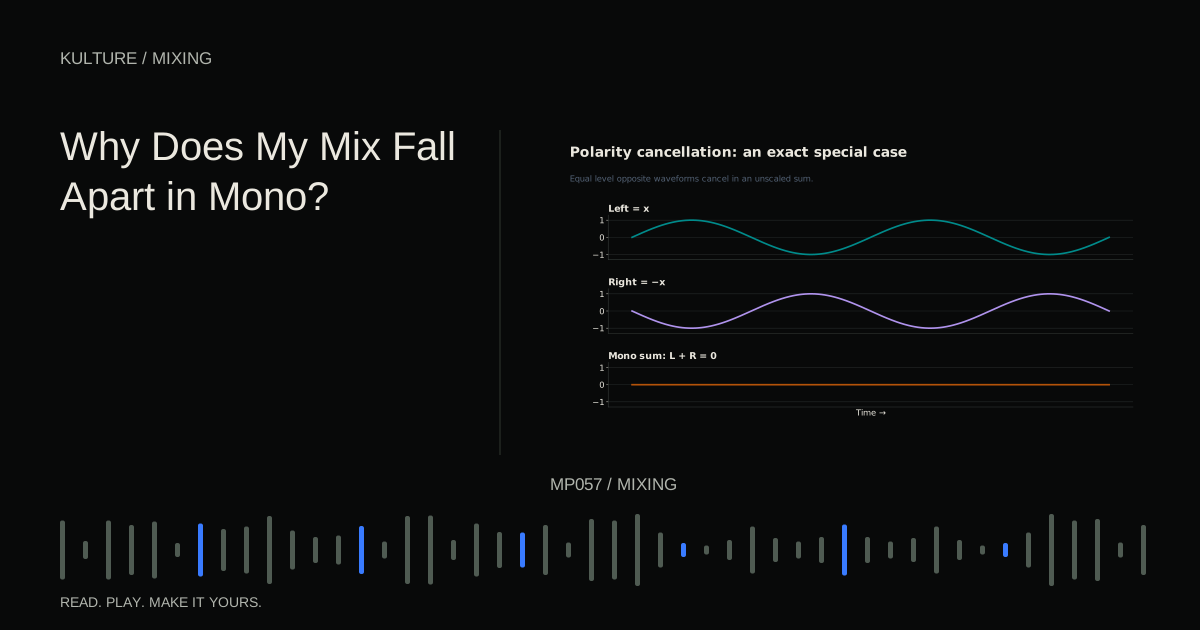
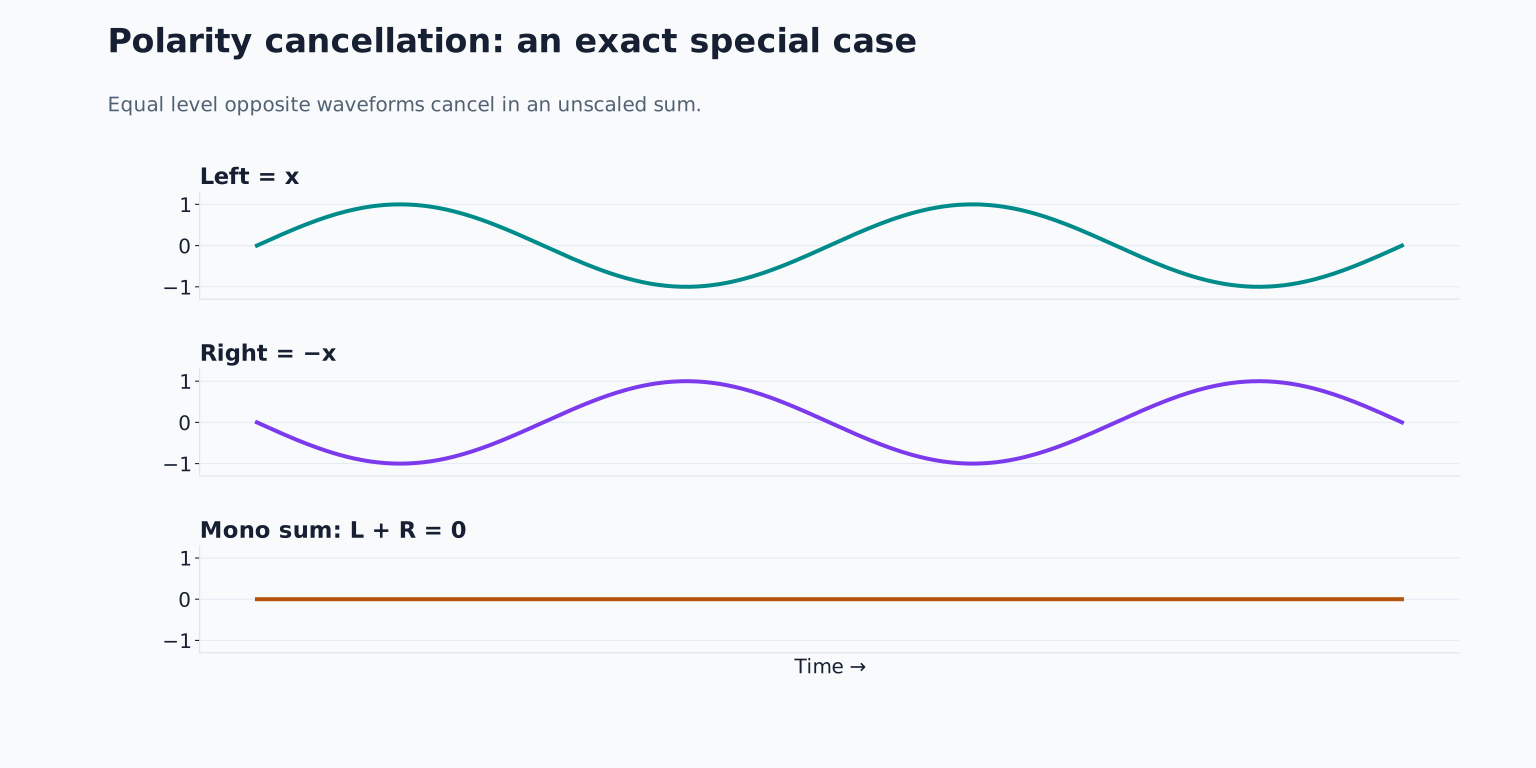
When two copies of the same waveform align and have the same polarity, they reinforce. If one is an exact polarity inverted copy of the other at the same level, they cancel when summed. Polarity inversion flips positive and negative values; it is not a universal correction for every phase problem.
A time delay produces a more complicated relationship. Some frequencies reinforce while others cancel, creating a comb filter pattern of peaks and notches. The result can sound hollow or phasey rather than completely silent.
Different sounds do not automatically cancel simply because one is panned left and another right. The strongest predictable cancellation occurs with related signals whose timing and polarity create opposing components. This distinction matters when deciding whether to change the arrangement or the stereo processing.
Reproduce the problem with a short delay
Use a mono pluck playing C, E flat, G and B flat as quarter notes at 100 BPM. Duplicate it exactly. Pan one copy left and one right. With no timing difference, you have two matching channels rather than a richly independent stereo performance.
Delay one copy by about 10 milliseconds as an experiment. In stereo, the result may feel wider or shifted. Sum it to mono and listen for a change in tone. Adjust the delay slightly and hear how the coloration changes.
This is a learning test, not a recommended widening preset. iZotope’s Haas effect discussion explains why short interchannel delays can create mono comb filtering.
Remove the delay and compare again. You now know what one common failure sounds like, which is more useful than reacting to a meter without an audible reference.
Find the track that changes
If the full mix falls apart, keep the mono sum active and mute likely stereo processors one at a time. Start with widening, chorus, unison, stereo delays and artificial double tracking effects. Listen for the main part’s body returning.
Then inspect stereo samples and multi microphone recordings. The issue may already exist in the source rather than being introduced by a plugin. Soloing the source briefly can help locate it, but make the final judgment in the mix.
If the sound remains present but becomes buried, masking may be the main issue. Panned instruments that were separated in stereo now compete in the same spatial position. Adjust their levels, registers or rhythm before treating the situation as a polarity fault.
Preserve a dependable identity layer
For an important lead or bass, keep a clear core that survives mono, then use a separate support layer or effect for width. This does not require every low frequency in every genre to be mono, but it gives you a stable foundation while learning.
Reduce the wet amount or stereo spread of the problematic effect and compare. You may keep most of the attractive stereo impression with less destructive interaction. If the effect has independent dry and wet paths, make sure the dry core is not accidentally removed.
Another option is a genuinely different supporting performance or complementary patch rather than a delayed identical copy. Different parts can still mask each other, but they do not create the same fixed comb filter relationship as two tightly related copies.
Learn more in layering synth sounds, where each layer has a defined musical job.
Use meters as clues
A correlation meter indicates aspects of the relationship between left and right. Strongly negative readings can flag material that deserves a mono check, while a brief dip is not a complete diagnosis. Different meter designs and source material require interpretation.
A stereo scope or vectorscope can help show the image’s distribution, but it cannot decide whether the lead remains intelligible. Listen to the actual mono sum. A mix can show a reassuring average reading while one important effect disappears during a key moment.
Do not force the meter toward maximum positive correlation simply to obtain a tidy display. That can collapse useful stereo differences. The objective is a reliable musical result, not a particular animated shape.
Be careful with phase fixes
Try polarity inversion on related layers as a controlled comparison, then listen across the whole phrase. A change that improves one bass note may weaken another because pitch and timing vary.
For multi microphone recordings, time alignment can change both tone and the sense of space. Preserve an original version before moving clips. An automatic alignment result is still something to audition, not a guarantee of the most natural sound.
Mid side processing can adjust existing differences between channels, but it does not magically restore information that cancels in the mono sum. Boosting sides may make the stereo version wider while increasing the difference between stereo and mono perception. See mid side processing for the underlying relationship.
For practice, identify one wide part in your song and save three versions: original, reduced effect and a stable core with a quieter wide layer. Compare in stereo and mono at similar levels. Keep the version whose musical role survives both, even if it is slightly less spectacular in isolation.
TAKE IT INTO YOUR OWN MUSIC
Your next session.
Try polarity inversion on related layers as a controlled comparison, then listen across the whole phrase. A change that improves one bass note may weaken another because pitch and timing vary.
Notes and progress stay in this browser.