When receiving feedback, separate evidence from preference and proposed solutions. A listener may correctly notice a problem while suggesting a fix that does not suit the song. Your job is to understand the observation, test an appropriate response, and preserve the track's direction.
Ask at the right stage
A rough songwriting demo needs feedback on melody, lyric, and structure. A nearly complete mix may need feedback on balance, clarity, and translation. Asking for detailed tonal criticism before the arrangement exists can send you into unnecessary polishing.
Tell the listener what is finished and what remains provisional. For example: “The vocal is a guide and the drum sounds are temporary. I want to know whether the second chorus feels like a payoff.” That context prevents a helpful person from spending all their attention on an issue you already plan to replace.
Do not use the word “rough” to dismiss every criticism, however. If the guide vocal reveals that a lyric cannot be phrased naturally, that may be exactly the problem to solve now.
TRY IT HERE
Make it your session
Turn the steps into a plan you can save.
Ready when you are. Audio starts only when you press Play.
Keep experimenting in the beat maker LabProvide a bounded listening request
Send a clearly named version and ask one or two questions. Include timestamps if a specific passage matters, but also request a full listen when evaluating structure. A section can feel effective in isolation and unnecessary in the complete song.
A useful request might be: “Please listen once through. Does the return at 1:36 feel stronger than the first section? Is there any moment where your attention drops?” This invites observations about the actual goal.
Avoid requesting praise disguised as feedback or asking ten people to redesign the track independently. A small group with different but relevant listening perspectives is often easier to interpret than a flood of unstructured reactions.
Give observations before prescriptions
When reviewing someone else's work, start with what you hear. “The low end becomes much denser when the bass enters” is an observation. “Cut 200 Hz by 6 dB” is a prescription that may or may not address the cause.
A constructive note can have three parts:
- Location: “At the chorus entrance, around 0:58.”
- Experience: “The title lyric becomes harder to understand.”
- Possible reason or test: “The bright chord attacks may be competing; try muting them under the first line.”
Make uncertainty explicit when needed. You can say that a possible cause is an inference. Do not claim to know the creator's plugin settings or recording problems from a mix alone.
Also name what should be preserved. “The bass and kick relationship in the verse is compelling” tells the producer not to destroy a working feature while revising another area. This is useful specificity, not obligatory compliment padding.
Listen according to the musical goal
A sparse ambient piece should not be judged as though it were a high impact dance drop. A deliberately intimate vocal may not benefit from a huge stereo effect. Ask what the creator intends before recommending a different aesthetic.
Berklee's critical listening guidance encourages attention to musical features such as motifs, contrast, and lyric perspective. Those observations help feedback remain grounded in the song rather than only personal taste.
You can still disagree with the intended result. Say, “I prefer a shorter intro, but the current one does establish the atmosphere,” rather than presenting your preference as a technical law.
Sort incoming notes into decisions
Create a short list with columns or headings for observation, priority, proposed test, and result. Group repeated comments that describe the same issue, even if listeners use different words.
For example, “the chorus is small,” “the return is flat,” and “I expected more at 1:36” may all point to insufficient contrast. They do not necessarily mean the chorus needs more tracks. The verse may already contain the strongest elements.
Classify notes as technical faults, musical communication issues, or aesthetic preferences. Repair clear faults. Investigate communication issues. Evaluate preferences against your own goal. A single trusted observation can be important, but a vote is not a substitute for artistic judgment.
Run a controlled revision
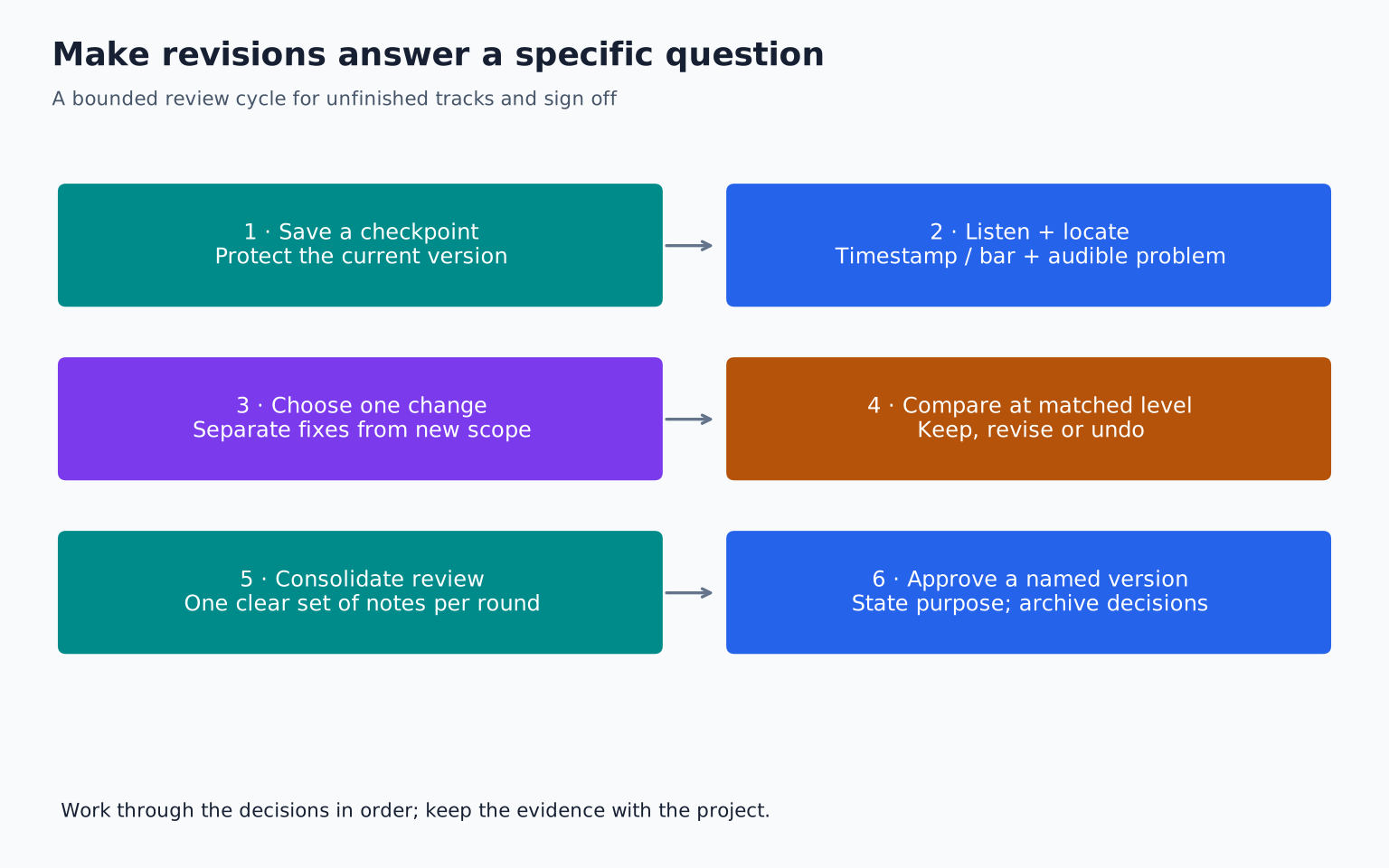
Suppose two listeners say the chorus lacks impact. Save the current version. In a copy, remove the upper harmony from the preceding verse and reserve it for the chorus. Keep the chorus level unchanged.
Export the transition with several bars of lead in. Compare old and new at similar loudness. If the chorus now feels more distinct, the issue was partly arrangement. If not, test a different hypothesis, such as a higher melodic arrival or a simpler bass rhythm.
Do not respond by changing every drum, synth, and effect. That creates a new track without telling you which feedback was useful. Controlled revisions turn comments into learning.
Handle conflicting feedback
One listener may want more bass while another finds the bass excessive. Ask what systems they used and which moments they mean. They may be reacting to different playback conditions, different frequency regions, or different aesthetic expectations.
Check on familiar systems and compare at sensible levels. If the problem only appears on one unusual setup, do not automatically reshape the whole mix around it. If the same note disappears across several systems, investigate its register, harmonics, or interaction with other parts.
When the disagreement is artistic, choose the direction that supports the song. You can thank a listener for a useful perspective without adopting every suggestion.
Close the feedback loop
After revising, send the new version only if another listen would answer a specific remaining question. Explain the relevant change briefly: “I shortened the breakdown and reserved the harmony for the return.” Do not make the listener compare a dozen unlabeled files.
Set a finish line. Once the intended issues are resolved and a full listen reveals no high priority problem, complete the version. Reopening feedback indefinitely can prevent the track from ever finding an audience.
For practice, exchange a one minute draft with another producer. Each person gives three timestamped observations and one feature to preserve, without naming plugins. Make one revision and explain whether it improved the intended effect. Continue with reference track analysis for independent comparison and finishing a track for deciding when feedback has done its job.
TAKE IT INTO YOUR OWN MUSIC
Your next session.
After revising, send the new version only if another listen would answer a specific remaining question. Explain the relevant change briefly: “I shortened the breakdown and reserved the harmony for the return.” Do not make the listener compare a dozen unlabeled files.
Notes and progress stay in this browser.