The most useful reference note describes a relationship: “The bass stops before the snare,” “the second chorus adds an upper harmony,” or “the vocal is more direct than the pad.” A vague goal such as “make mine sound exactly like this” is much harder to apply productively.
Choose a reference for the question
One track may be useful for arrangement, another for drum balance, and another for vocal space. They do not all need to resemble your song in every respect. However, a reference with a radically different instrumentation or register may be misleading for tonal balance.
Choose a small set, perhaps two or three, and write each one's purpose. Avoid switching to a new favorite every time you feel uncertain. Constantly changing the target can make a coherent project drift in several directions.
Use legally obtained access to the music. Listening and analysis do not automatically grant permission to sample, reproduce, or distribute parts of the recording. If you want to use actual audio from it, investigate rights separately.
TRY IT HERE
Make it your session
Turn the steps into a plan you can save.
Ready when you are. Audio starts only when you press Play.
Keep experimenting in the beat maker LabSeparate arrangement analysis from mix comparison
Arrangement analysis asks when parts enter, how long sections last, and what changes at boundaries. You can do this by listening and taking notes. Mix comparison asks about relative levels, frequency balance, dynamics, and space. That requires careful attention to playback loudness and signal routing.
Do not conclude that your chorus needs more instruments simply because a louder mastered reference feels more exciting. First determine whether the difference is musical or just level.
iZotope's reference track guidance emphasizes level matching for useful comparisons. Lower a loud reference toward your mix's perceived loudness rather than driving your unfinished mix harder just to match its meter.
Map a structure without borrowing the song
Listen once from beginning to end. Mark audible changes: drums enter, bass leaves, singer changes melody, hook returns. On a second pass, count bars and assign section roles.
Imagine a reference has a sixteen bar introduction, a sixteen bar groove, an eight bar breakdown, and a thirty two bar return. The transferable observation might be “the main hook is withheld until the groove is established,” not “copy every entrance at the same second.”
Apply that principle to your own material. If your hook is a vocal sentence that needs immediate context, an eight bar introduction may be better. If your percussion develops slowly, the longer introduction may make sense. A reference is evidence of one successful solution, not a command.
Translate sound observations into actions
Suppose the reference bass feels clear but yours feels cloudy. Ask narrower questions:
- Does the reference bass have shorter notes?
- Is its register higher?
- Does the kick leave more space after its attack?
- Are fewer other instruments active in the low range?
- Does the bass have more audible harmonics above its fundamental?
Test the most plausible explanation first. Shorten your bass release and compare. If that improves clarity, you learned something useful. If not, restore the original and test another cause. Do not immediately add a large equalization boost because a spectral display looks different.
For a vocal space comparison, listen to the dry impression, reverb tail, and delay timing separately. A vocal can sound wide because of backing parts rather than a wide lead. Copying one widening plugin may miss the actual arrangement reason.
Set up fair playback
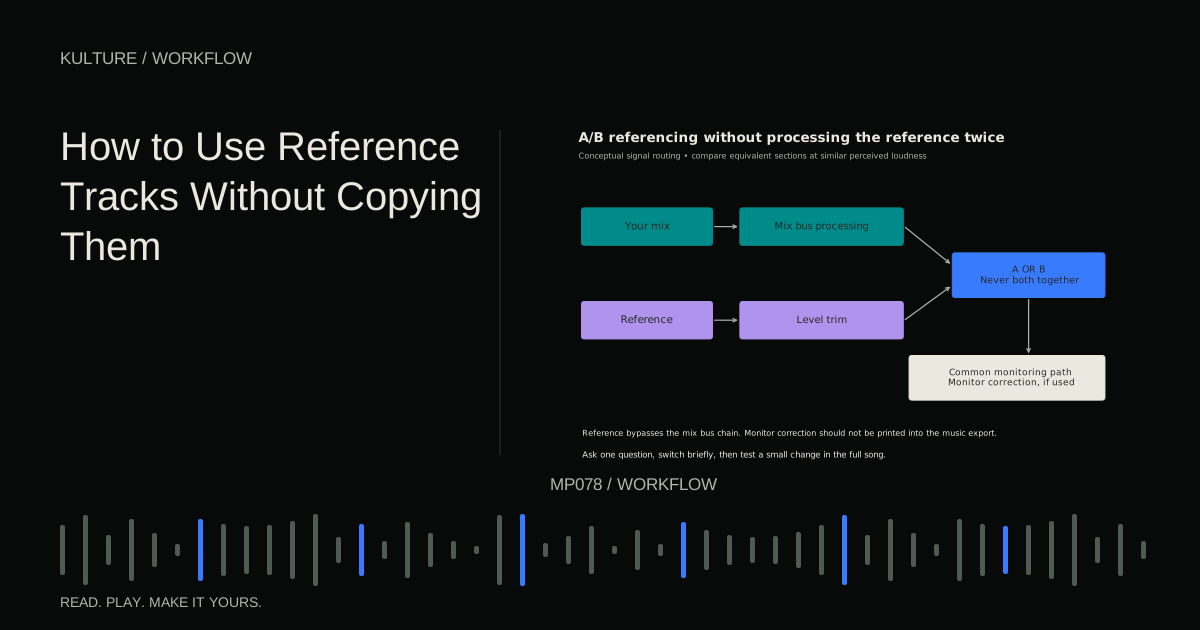
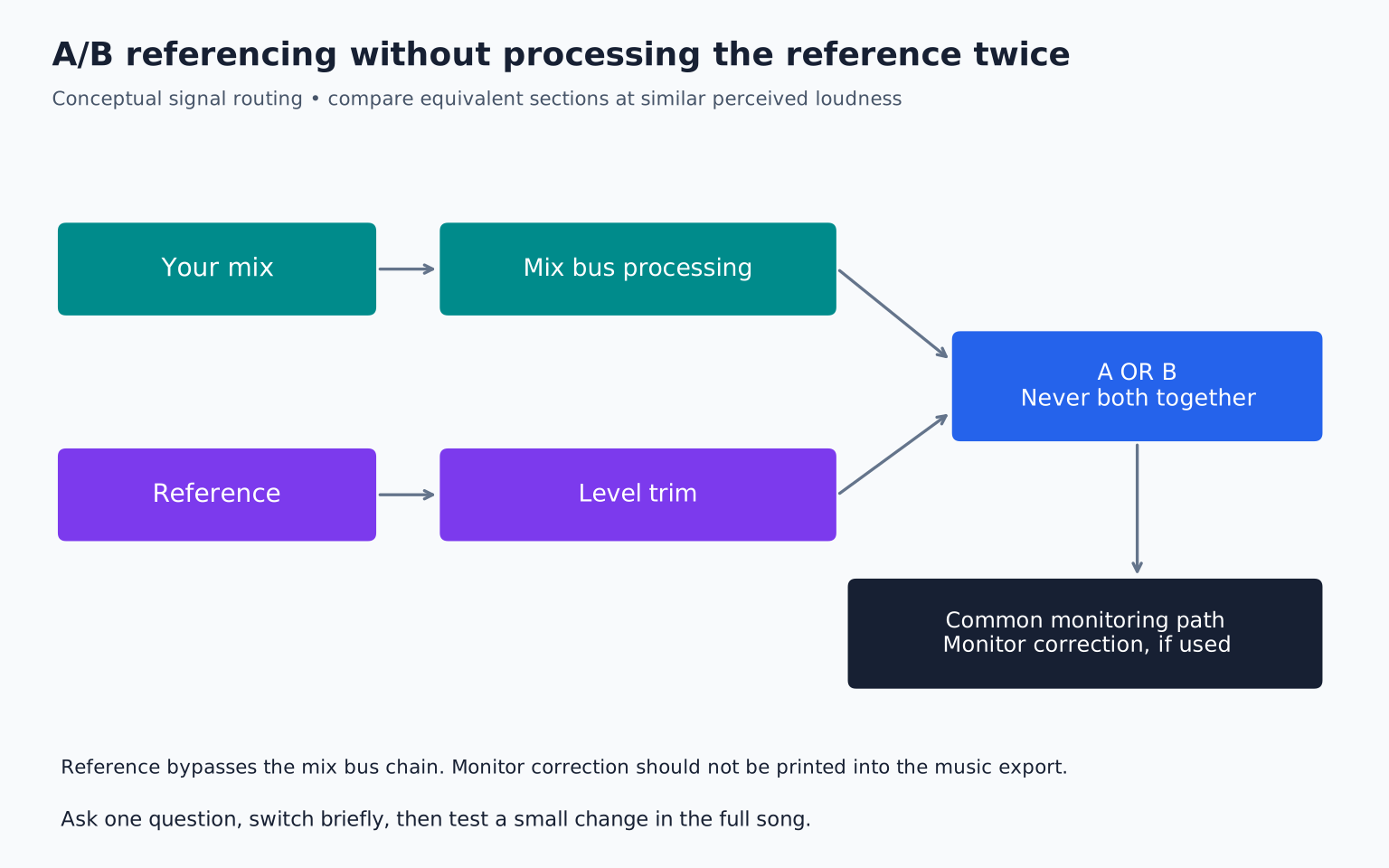
If importing a reference into your DAW, route it so your mix processing does not unintentionally process it again. Exact routing depends on the application. Verify the path with meters and listening rather than assuming a reference track automatically bypasses the master chain.
Mute the reference during exports unless you are intentionally making a private analysis file and have the necessary rights for its use. Keep it clearly labelled to avoid accidental inclusion in your own delivery.
Compare equivalent sections: a full chorus against a full chorus, or a sparse verse against a sparse verse. Match perceived loudness as closely as practical and switch in short intervals. Long delays between comparisons make small judgments less reliable.
Do not chase exact matching of every frequency. Different keys, instruments, and performances create legitimate differences. A spectrum is a description of the sound, not a universal quality target.
Use multiple references to find principles
If three tracks in your intended style all preserve a clear kick attack despite different bass sounds, that suggests a useful relationship to study. If only one uses a dramatic high frequency sweep, the sweep may be that track's individual signature rather than a genre requirement.
Write similarities and differences. This prevents overfitting your work to one production. It also helps you notice what you actually like: perhaps you thought you wanted a particular synth but really wanted the way it leaves gaps for a vocal.
Berklee's critical listening article encourages attention to musical features such as motifs and section contrast. Apply that attention to your own song before reaching for technical fixes.
Keep an originality boundary
Learning a general technique, such as call and response or a sparse introduction, is different from reproducing a distinctive melody, lyric, or recorded performance. If your result feels recognizably like one reference, change the core musical material rather than merely swapping sounds.
For a practical exercise, borrow only an abstract constraint: “four bar melody with a rest in the second bar.” Write your own pitches, rhythm, harmony, and phrase shape within that constraint. Then close the reference and develop the idea independently.
Avoid using “inspired by” as a substitute for permission when actual protected material is involved. This article is about analysis and production practice, not a legal clearance assessment.
Turn comparison into a finite revision
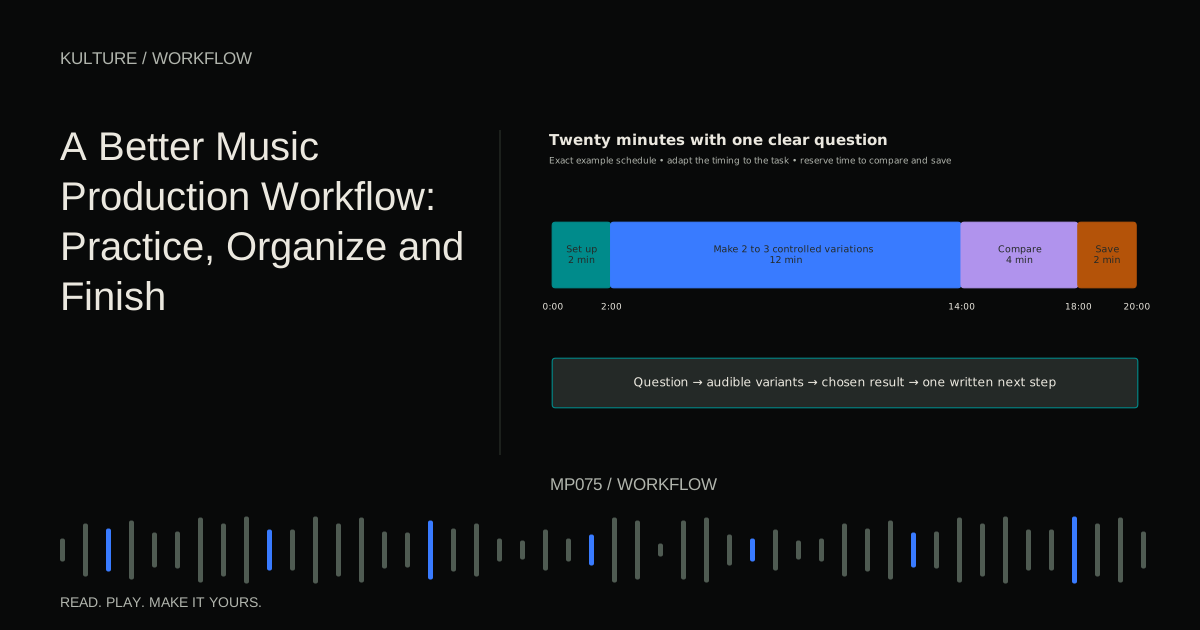
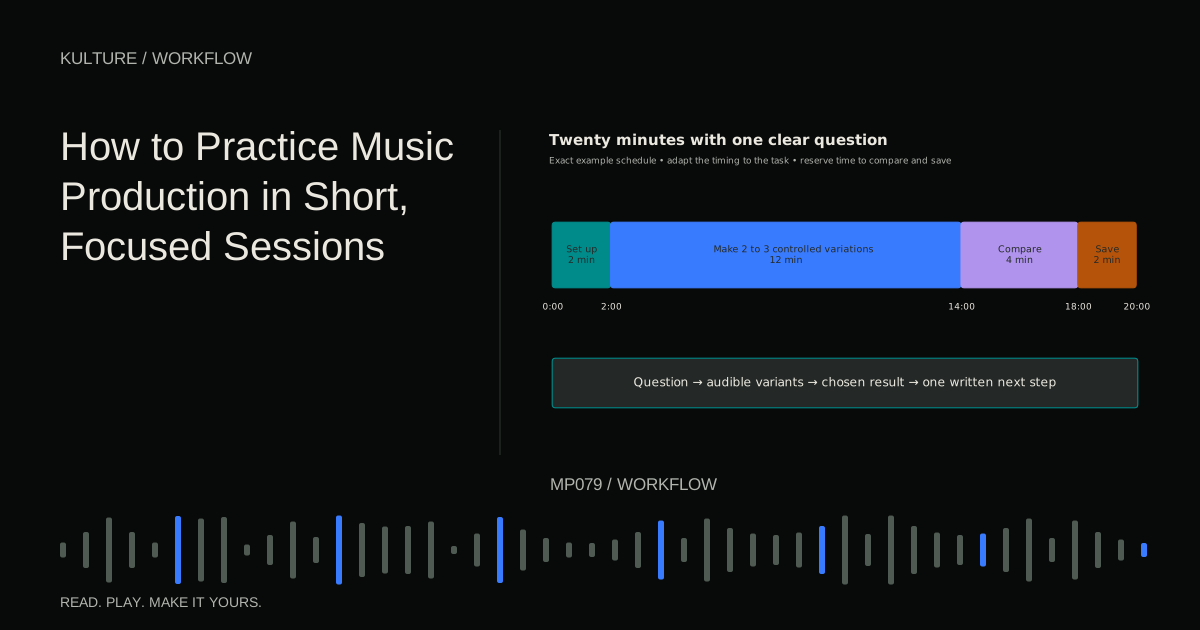
After a reference session, choose one action: shorten the breakdown, reduce the pad under the vocal, or clarify the bass attacks. Save a version, make that change, and compare with your previous mix as well as the reference.
If the change moves your song away from its intended emotion, undo it even if it resembles the reference more closely. The final judge is whether your production communicates its own idea.
Your exercise is to analyze two tracks for the same question and produce three factual observations from each. Apply only one shared principle to your project. Continue with level matched mix comparison for technical listening and finishing decisions when references begin reopening settled choices.
TAKE IT INTO YOUR OWN MUSIC
Your next session.
After a reference session, choose one action: shorten the breakdown, reduce the pad under the vocal, or clarify the bass attacks. Save a version, make that change, and compare with your previous mix as well as the reference.
Notes and progress stay in this browser.