A strong starting arrangement is a clear lead vocal, two chorus doubles, one harmony on an important phrase, and a few ad libs in genuine gaps. This gives the song contrast without requiring every line to be sung five times.
A double is another performance
Double tracking means recording the same part again, aiming for similar pitch and phrasing. The small differences between performances create thickness and movement. Duplicating one audio file onto another track does not create those differences; it normally just increases level if the copies remain identical and aligned.
iZotope's double tracking explanation distinguishes recorded doubles from artificial alternatives. Artificial doubling can be a valid effect, but it is a different tool with different phase and timing behaviour.
Record doubles after the lead melody and lyric are settled. If the lead changes later, a supporting take may reinforce the old timing or words and become distracting.
TRY IT HERE
Make it your session
Turn the steps into a plan you can save.
Ready when you are. Audio starts only when you press Play.
Keep experimenting in the sample pads LabMatch the parts that listeners notice
Ask the singer to follow the lead's entrances, vowel lengths, consonant placement, and endings. Exact microscopic matching is not the goal, but obvious discrepancies can make words blurry.
Play the lead in the headphones at a useful level alongside the backing. Some singers match better with a little less lead once they know the part; others need it clearly audible. Avoid a cue mix so loud that they cannot judge their own performance.
For an eight bar chorus, record one full double and listen before recording another. If the words consistently end late, address that performance issue first. Repeating the same mismatch across four tracks makes editing harder.
Build width with arrangement, not only panning
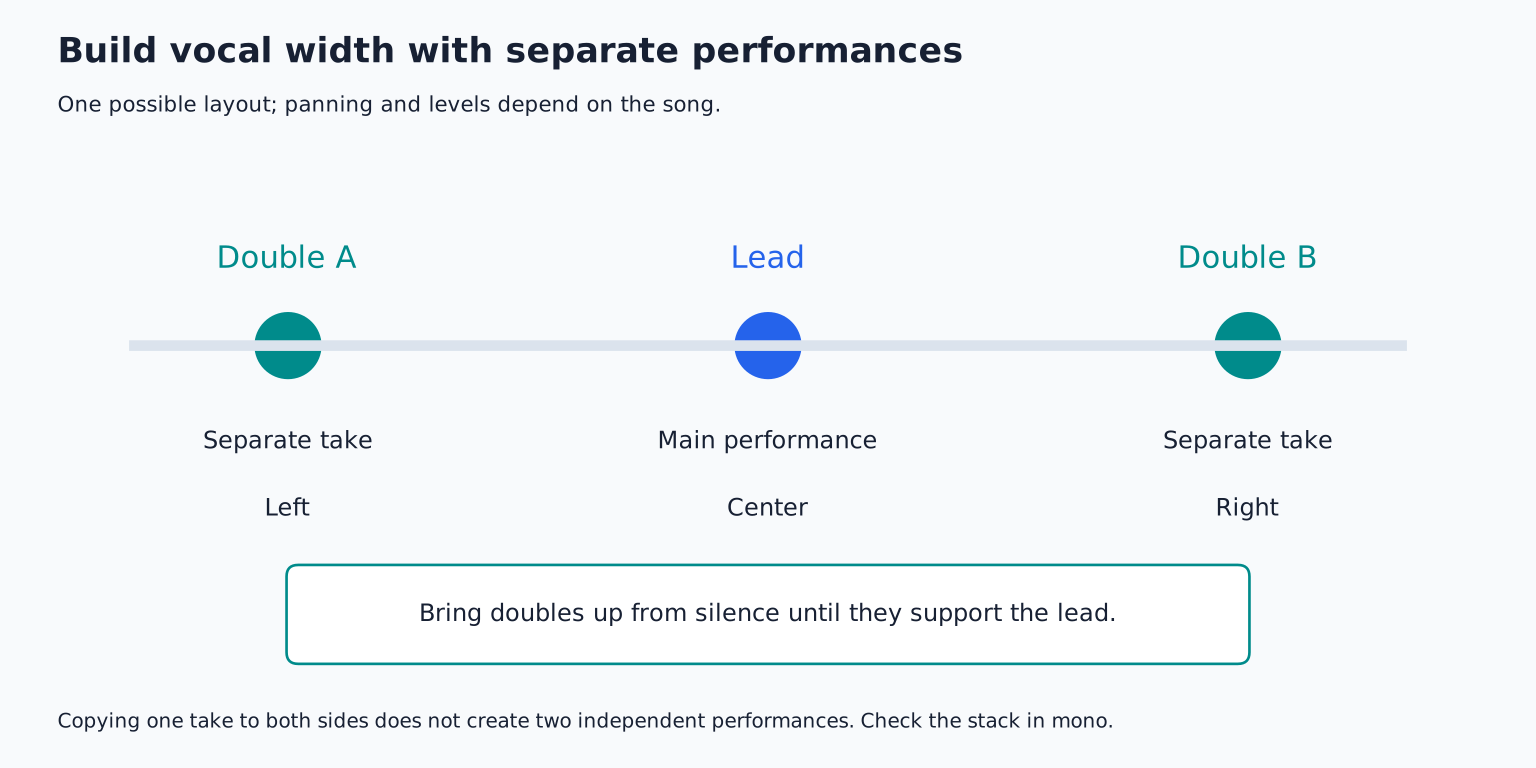
Two separate doubles can be panned left and right, while the main lead remains centred. Bring the doubles up from silence until the chorus gains support without losing the lead's focus. Hard panning is an option, not a requirement; narrower placement may suit a more intimate song.
Keep the verse simpler if you want the chorus to feel larger. Muting doubles in the verse can create more contrast than making the chorus louder. You can also double only a key phrase instead of an entire section.
Check the mix in mono. The vocal should still have a stable lead and intelligible words when stereo width is reduced. If an artificial widening effect causes cancellation, reduce it or choose a different approach rather than assuming every listener will hear the ideal stereo image.
Write harmonies against the chords
A harmony is a distinct melodic line that works with the lead and accompaniment. Moving every lead note up three or four semitones may create some useful intervals, but it does not automatically produce a correct harmony across a chord progression.
Try a simple example. Over a C major chord containing C, E, and G, let the lead hold E and the harmony hold G. Over an F major chord containing F, A, and C, let the lead hold F and the harmony move to A. Both are upward supporting relationships, but the exact notes follow the chords.
Then consider the line between those notes. Can the harmony move smoothly from G to A? Does its range suit the singer? Does it collide with another instrument? A singable harmony is easier to perform convincingly than a series of theoretical vertical intervals.
For a refresher, read how to make a melody fit your chords. iZotope's harmony tutorial also distinguishes harmony parts from same note doubles.
Rehearse each harmony as its own melody
Play the harmony on a simple instrument and sing it alone first. Then add the lead, and finally the full backing. This makes it easier to keep the intended note rather than being pulled back to the main melody.
Record the harmony on a separate track with a clear name, such as “Chorus High Harmony.” If you double it, make that an intentional next step. Do not label everything “Backing 1” and rely on memory once the session grows.
A harmony can appear only on the second half of a line or the final word. Sparse placement often makes its arrival more expressive. Leave room for the lead to tell the story before adding another voice.
Give ad libs a conversational role
Ad libs can echo a word, answer a phrase, introduce a contrasting rhythm, or add a spontaneous reaction. Record a few freer passes while the lead plays, then select moments that contribute something specific.
For example, if the lead ends on beat 2 and the next line begins in the next bar, there may be space for a short response on beats 3 to 4. If the lead already fills that gap with a sustained note, an ad lib may need to wait or use a contrasting register.
Keep the best few rather than filling every empty moment. Silence lets the listener absorb the main lyric. An ad lib should feel like a response, not a second lead arguing for attention.
Edit the stack around the lead
Use the chosen lead as the timing reference, but do not quantize every supporting waveform to it automatically. Tighten distracting word starts and endings. Preserve enough difference for the parts to sound like separate performances.
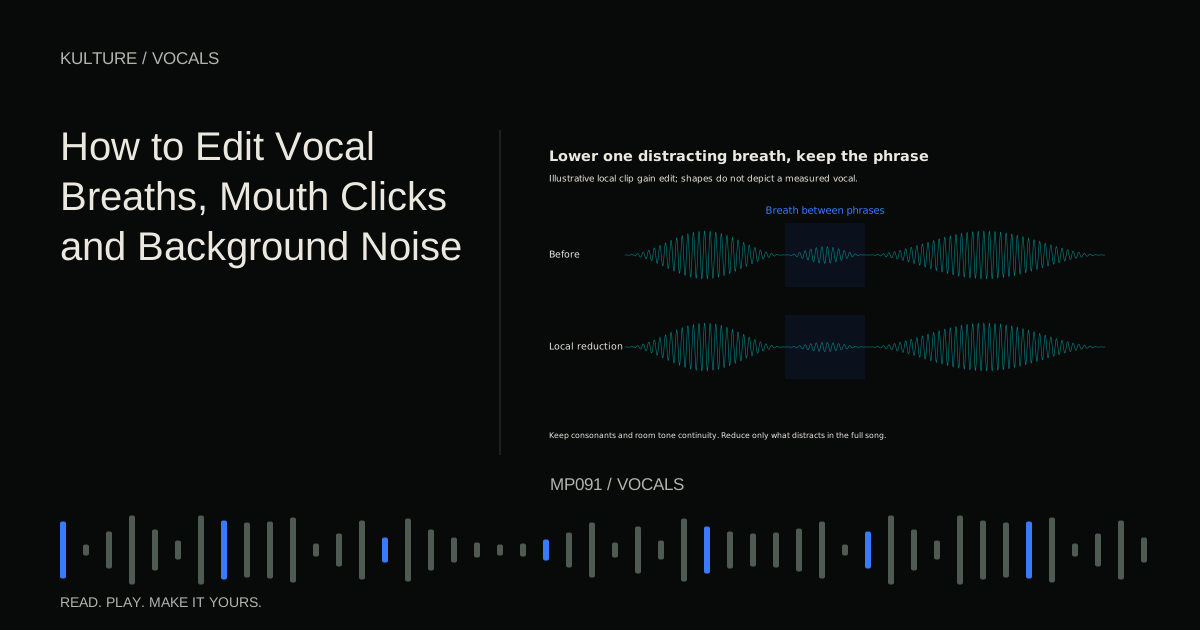
Reduce redundant breaths and sibilants where several tracks pile up. You might keep the lead breath and lower the corresponding breaths in doubles. If every s lands slightly differently, edit or de ess the support parts rather than making the lead unnaturally dull.
Use fades and crossfades at edits and check transitions with the full stack. A tiny edit that sounds fine in solo may create an obvious consonant flam when combined with the lead.
Mix support parts as support
Begin with level and panning. If doubles obscure the lyric, lower them before applying elaborate EQ. If harmonies compete in the lead's register, reconsider the notes or where they enter.
Supporting voices may benefit from different ambience or a less forward tonal balance, but there is no mandatory “backing vocal EQ.” Listen for their role. A featured harmony may deserve clarity; a texture double may sit farther back.
Route related tracks to a group if your DAW supports it, so you can adjust the stack together. Keep individual control for breaths, harsh words, and uneven entries.
For practice, produce one eight bar chorus with a lead, two doubles, a two note harmony phrase, and two short ad libs. Make a second version with half the support parts muted. Compare which moments genuinely improve. Continue with the vocal chain lesson only after the arrangement works with simple level balance.
TAKE IT INTO YOUR OWN MUSIC
Your next session.
Begin with level and panning. If doubles obscure the lyric, lower them before applying elaborate EQ. If harmonies compete in the lead's register, reconsider the notes or where they enter.
Notes and progress stay in this browser.