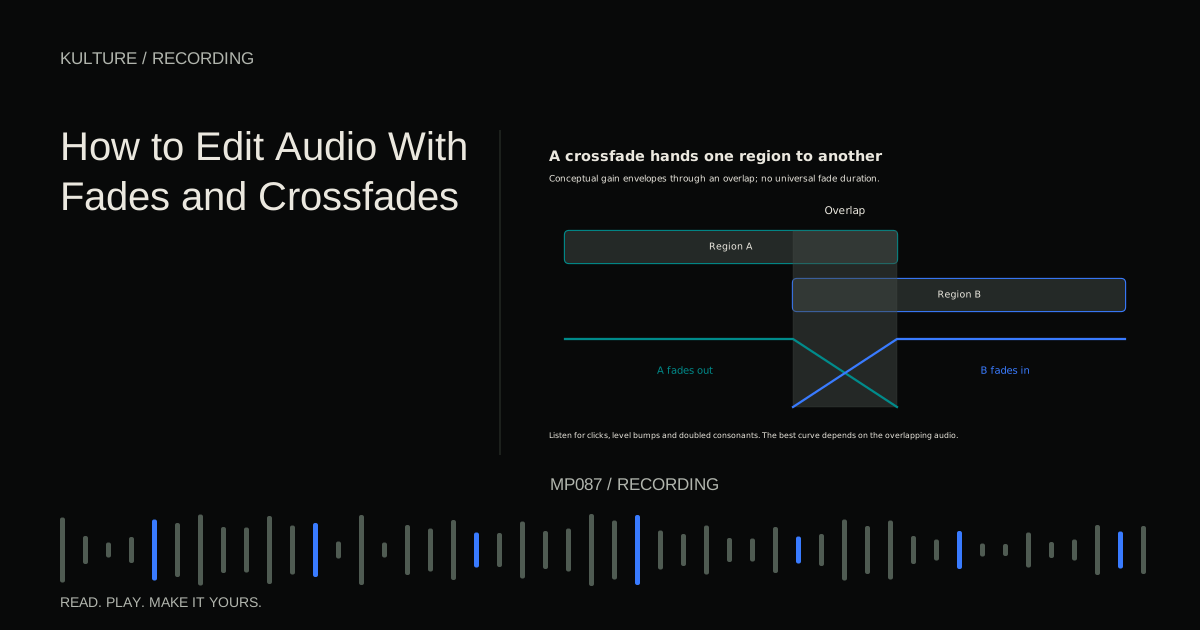
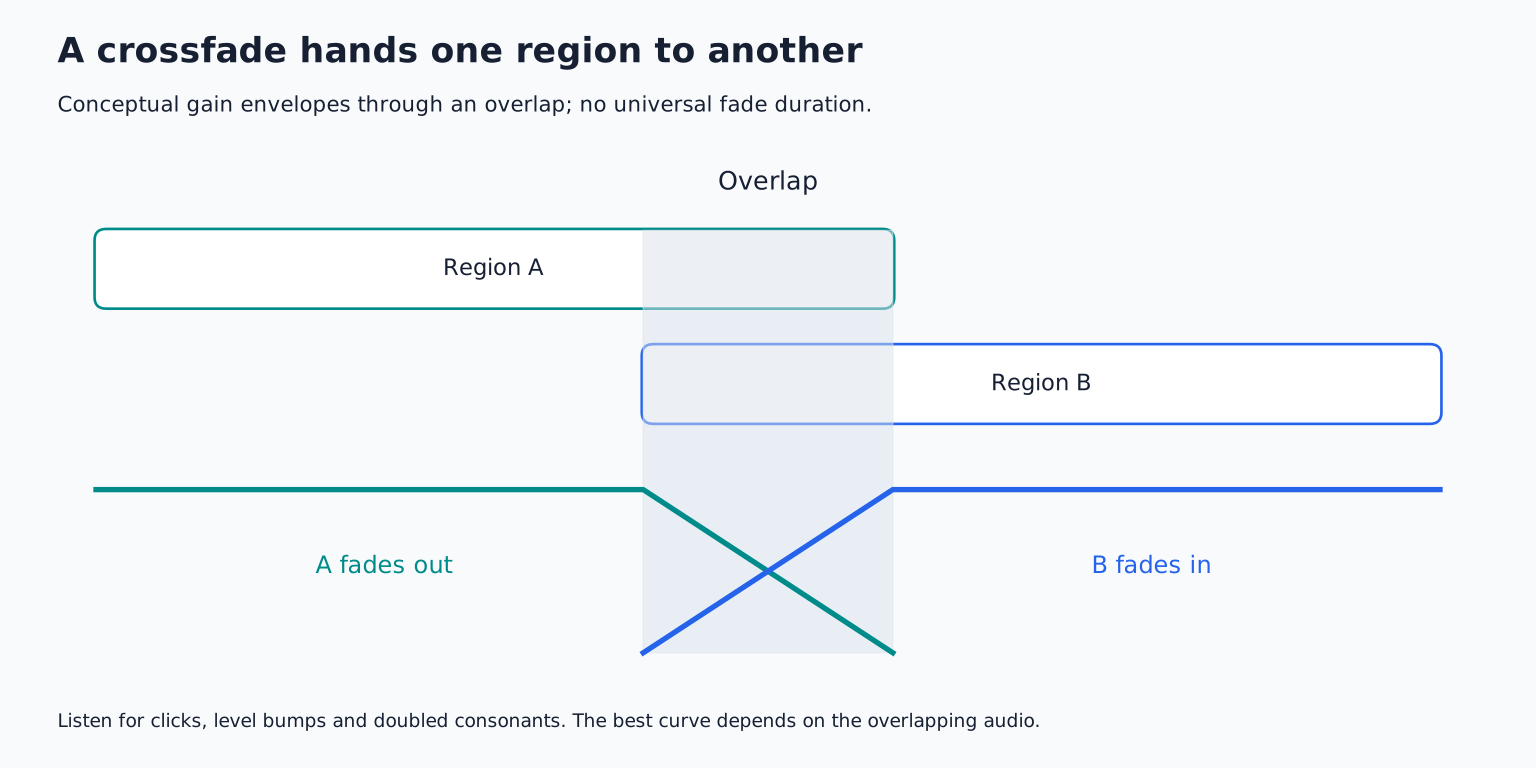
A fade in raises the beginning of a region from silence or a lower level. A fade out lowers its end. A crossfade overlaps two regions while one fades out and the other fades in. The right duration depends on what the sound is doing: a drum attack, a spoken breath, and a sustained guitar chord need different treatment.
Why an edit can click
Audio is a changing waveform. If playback jumps abruptly from one value to a very different value, that discontinuity can sound like a click. Cutting a bass note halfway through a wave cycle is a common example.
A zero crossing is a point where the waveform passes through zero amplitude. Editing near one can reduce a discontinuity, but it is not a complete solution. The waveforms on either side may have different slopes or different ongoing sound. Stereo channels may not cross zero at the same moment. A short fade gives you additional control.
Clicks can also come from damaged recordings, buffer problems, or mouth noises. Adding a fade to every clip edge will not repair a crackle located in the middle of a word. Identify the noise before choosing the tool.
TRY IT HERE
Rebuild the phrase
Reorder four slices of an original melody and play them back.
Ready when you are. Audio starts only when you press Play.
Keep experimenting in the sample pads LabWork nondestructively
Keep the original recording and make edits in the DAW timeline. Most modern DAWs let you trim a region without deleting the underlying source, but confirm how your software handles consolidation, destructive editing, and file cleanup.
Zoom in enough to place the boundary accurately, then zoom back out to hear it musically. The waveform can show where an attack starts; it cannot decide whether the resulting rhythm feels right.
Ableton's Arrangement View manual documents audio clip fades and crossfades as an example of a DAW's implementation. Other programs use different handles or tools. Learn the operation in your software, then apply the listening principles here rather than copying an arbitrary fade length.
Remove an edge click without weakening the attack
Take a recorded handclap or guitar pluck. Trim obvious silence before the sound, but leave enough space to preserve its onset. Add a very short fade in, perhaps around 2 milliseconds as an initial test. Listen to the sound against the original at similar loudness.
If the click disappears and the attack remains intact, the fade is doing its job. If the clap becomes soft or the pick loses definition, shorten the fade or move its start earlier. A 20 millisecond fade may be subtle on a pad but remove a large part of a percussion transient, meaning its brief initial attack.
At the end, add a fade out that follows the intended decay. Do not cut a ringing instrument merely because the next grid line looks tidy. Natural tails often extend across musical boundaries.
Build a clean vocal splice
Suppose one vocal take has the best first sentence and another has the best second sentence. Place the splice in the pause between them. Keep the breath that introduces the second sentence with that sentence where possible.
Overlap the region edges slightly and create a crossfade. Begin with a short transition, then listen through several seconds before and after it. If the room tone jumps, lengthen or reposition the fade in the gap. If the singer seems to inhale twice, remove the unwanted breath rather than blending both louder.
When there is no gap, choose a boundary within a stable portion of the sound and compare the takes' pitch and vowel colour. A crossfade between two different sung pitches can momentarily create a chorus like effect. Moving the boundary may work better than making the fade longer.
Fade shape affects perceived level
A linear fade changes amplitude at a constant rate. Other curves change more quickly near one end and more slowly near the other. An equal power crossfade is designed to maintain perceived energy more consistently for suitable uncorrelated material, but it is not universally transparent.
If two overlapping regions contain very similar, aligned audio, adding them can create a level rise. If their waveforms oppose each other, the overlap can lose body. Changing the crossfade curve may help the level contour, but it does not erase an underlying timing or phase mismatch.
Listen for three separate things: a click at the boundary, a level bump or dip through the overlap, and a tonal change. Fixing one does not guarantee the other two are solved.
Editing loops without a seam
A loop repeats from its end back to its beginning. To sound continuous, both the musical timing and the audio boundary need attention. A perfectly click free loop can still have the wrong number of beats.
For a one bar percussion loop, first confirm the downbeat and exact bar length at the chosen tempo. Preserve the first attack. If a cymbal tail crosses the loop boundary, decide whether you want that tail to continue underneath the next repetition. Some samplers support dedicated loop crossfades; in a timeline you may need overlapping copies or a printed loop with a wrapped tail.
For a sustained texture, find a stable middle region rather than looping its initial attack. Try a longer crossfade across the loop seam and listen for a repeating swell. A seam can be technically smooth yet obviously periodic.
Building a sampled instrument explains how loop boundaries interact with note release and sustained playback.
Keep related microphones together
When editing a multi mic drum or guitar recording, apply corresponding cuts and timing moves across the related tracks. Their relative timing contributes to the combined tone. Moving one region independently can change cancellation and make an edit sound thinner even if each microphone sounds fine alone.
Crossfades should be checked with all relevant microphones playing. A long cymbal decay may reveal a cut that is invisible on the close snare track. A stereo recording also needs linked channel edits so the left and right image does not jump.
Polarity reversal is not a substitute for careful editing. It flips a signal's sign; it does not align all frequencies or repair a splice between unrelated performances.
Troubleshoot by listening to the kind of failure
A tiny tick suggests a discontinuity or a transient damaged at the boundary. Move the cut, add a shorter fade, or restore the original onset. A soft attack suggests the fade in is too long or starts too late. A brief doubled consonant means the overlap contains two distinct performances of the consonant.
A hollow sustained note may indicate two similar sounds interfering during the overlap. Try a different boundary or a shorter transition. An obvious silence between phrases may mean you removed all room tone. Restore some natural background rather than forcing every gap to absolute digital silence.
For an exercise, make three edits: a trimmed drum hit, a vocal take replacement, and a looping sustained sound. Save an unfaded version of each, then create the shortest fade that solves the audible problem. Compare in context. Continue with comping complete performances, where good boundaries serve a larger musical decision.
TAKE IT INTO YOUR OWN MUSIC
Your next session.
A tiny tick suggests a discontinuity or a transient damaged at the boundary. Move the cut, add a shorter fade, or restore the original onset. A soft attack suggests the fade in is too long or starts too late. A brief doubled consonant means the overlap contains two distinct performances of the consonant.
Notes and progress stay in this browser.