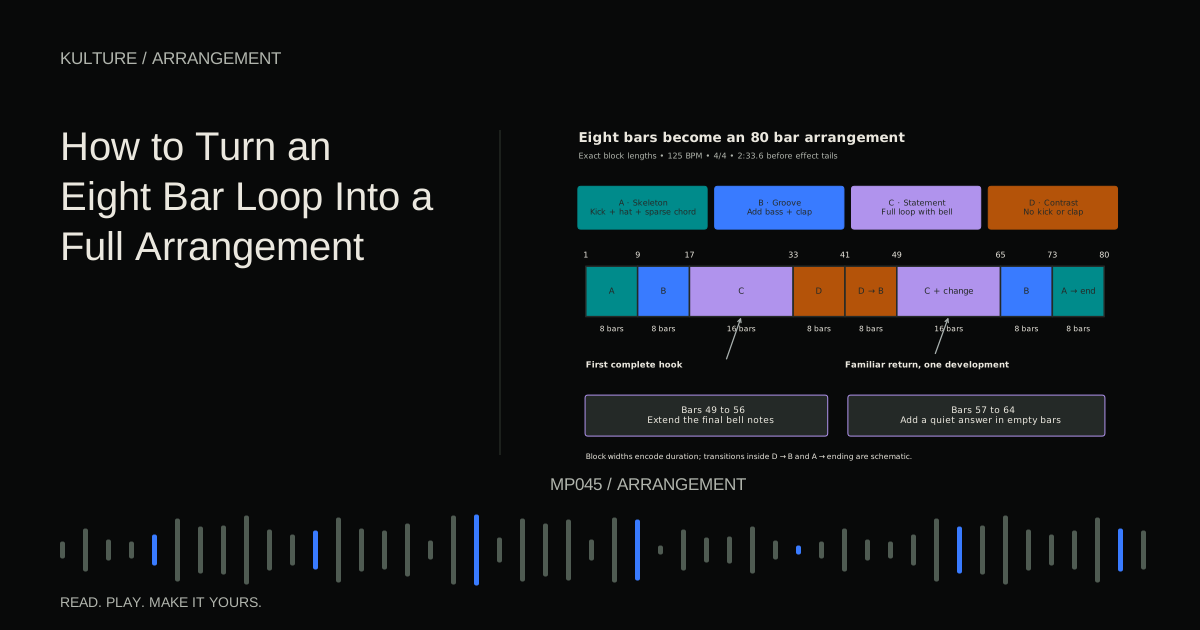
This lesson uses a specific 80 bar plan at 125 beats per minute in 4/4. That produces 2 minutes 33.6 seconds before effect tails. It is deliberately compact so you can finish the experiment in one session. For the broader process through export, see how to turn a loop into a finished track.
Audit what is inside the loop
Name every part by function rather than preset name. A typical sketch might contain pulse, low foundation, chord support, main hook, upper percussion, and atmosphere. If three tracks all provide the hook, choose which leads and which answers.
Our example contains a kick, clap, closed hat, bass, short chord stab, and a bell motif. Set the harmony to D minor for four bars and B flat major for four bars. The chord notes are D, F, A and B flat, D, F. Let the bass emphasize D in the first half and B flat in the second.
Use this bell phrase in bar 1: A on beat 1, F on beat 2 and, E on beat 3, D on beat 4. Leave bar 2 empty. Repeat in bar 3; in bar 4, hold F through the second half. Across the B flat chord, use F, D, C, D with the same rhythm. These are original practice notes, not a requirement for the style.
Before arranging, confirm the loop boundary. A note extending past bar 8 may overlap its repeated copy. That overlap can sound beautiful, but it should be intentional. Listen to two complete cycles, especially the transition from B flat back to D.
TRY IT HERE
Sketch the arrangement
Switch parts on and off across eight sections.
Ready when you are. Audio starts only when you press Play.
Keep experimenting in the beat maker LabCreate four versions, not forty new sounds
Keep an untouched copy of the full loop. Then create these variants:
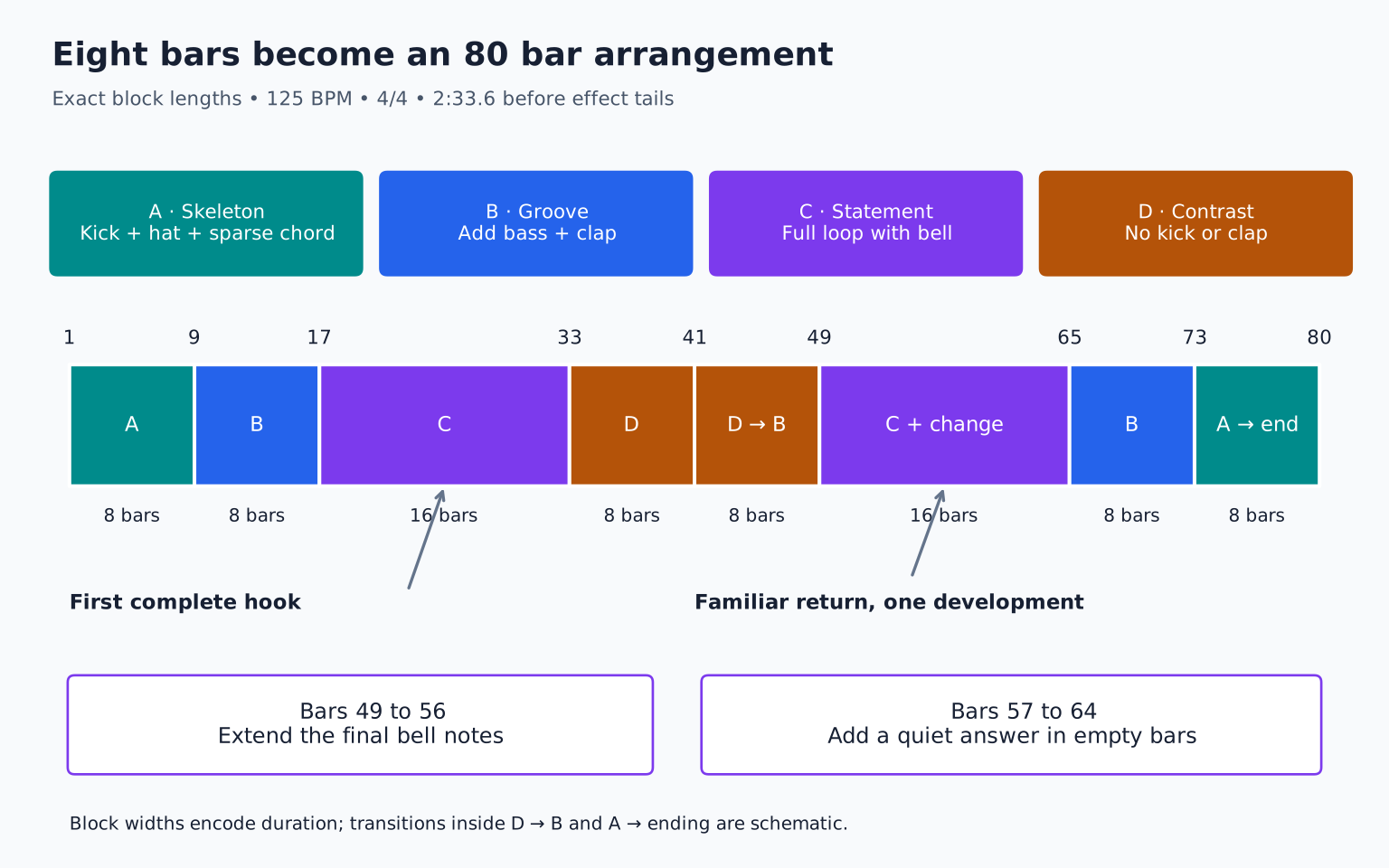
A: Skeleton. Kick, closed hat, and one chord stab every two bars. No bass or bell. This establishes time without revealing the entire idea.
B: Groove. Add bass and clap, but keep the bell absent. Shorten the chord stabs so the bass rhythm becomes obvious.
C: Statement. Use the full loop. This is the first complete presentation of the musical promise.
D: Contrast. Remove kick and clap. Sustain the chord notes quietly, and let only the final note of each bell phrase remain. This preserves identity while changing motion.
These are arrangement decisions, not necessarily separate files. In a timeline based DAW, duplicate the clips and edit copies. In a pattern based DAW, create distinct patterns where needed. Check whether editing a repeated clip changes every linked instance before making variations.
Ableton's manual explains its linear Arrangement View. Other DAWs use different names, but the underlying task is the same: position audio and MIDI material along time.
Lay out the entire 80 bars
Place markers before moving clips:
| Bars | Material | Listener's experience |
|---|---|---|
| 1 to 8 | A | Learn the pulse and chord color |
| 9 to 16 | B | Discover the bass relationship |
| 17 to 32 | C | Hear the complete hook twice |
| 33 to 40 | D | Hear familiar material with room around it |
| 41 to 48 | D becoming B | Anticipate the full groove |
| 49 to 64 | C with one change | Recognize the return and its development |
| 65 to 72 | B | Release the hook while the groove continues |
| 73 to 80 | A becoming an ending | Reduce movement and close |
Do not spend half an hour making a sweep at bar 48. Place the blocks first and play the whole timeline. If the contrast feels too short or the second statement too long, alter the block lengths now.
Make the second statement earn its place
A repeated statement can reward familiarity without being identical. In bars 49 to 56, keep the bell's original notes but extend the final note of each phrase. In bars 57 to 64, add a quieter answering phrase only in the empty bars: D on beat 3, F on 3 and, A on beat 4.
Do not also add three percussion loops, a new bass, and a new chord progression. One legible change often creates more development than several indistinct ones. The listener should recognize what returned and notice what grew.
If the new answer competes with the bell, move it to a lower register or remove its first note. If it still distracts, save it for another track. An unused idea is not a failed idea.
Design each boundary differently
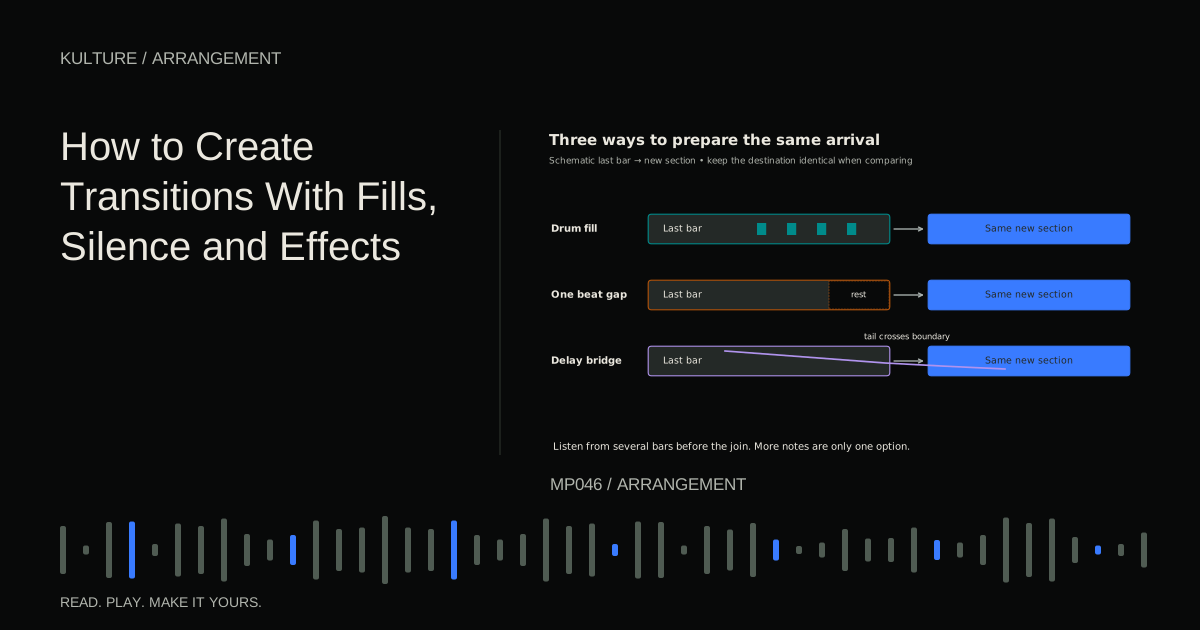
At bar 9, let bass enter cleanly without a fill. At bar 17, introduce the bell one eighth note before the boundary as a pickup, if the phrase still feels natural. At bar 33, stop the drums but allow the final chord's reverb to continue.
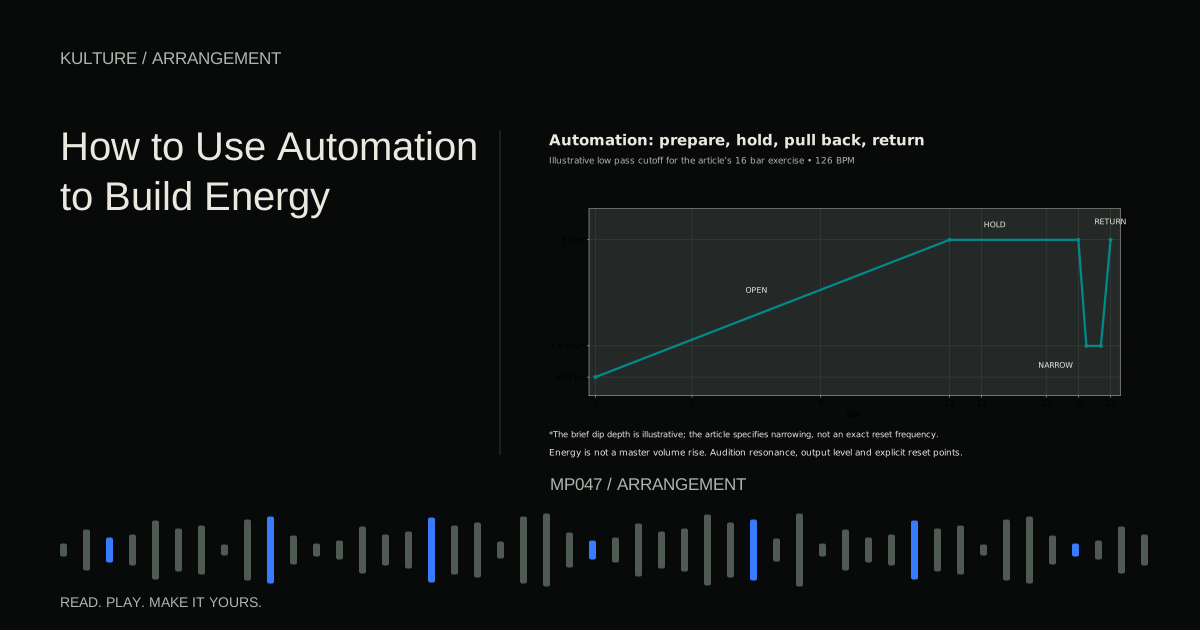
Across bars 45 to 48, increase the hat density gradually while withholding bass. Remove the final half beat before bar 49. At bar 73, remove the clap and let the remaining percussion thin out.
For the ending, do not accidentally cut the arrangement in the middle of a sustained chord. Stop new drum hits before the final D minor chord, hold it, then allow its tail to decay. An abrupt ending is valid too, but audition it as a compositional choice.
Use three listening passes
On the first pass, judge only pacing. Put a marker where attention drops; do not stop playback. On the second, judge whether the important element is obvious in each section. On the third, listen for technical seams: clicks, clipped tails, doubled bass notes, and automation jumping to an unexpected value.
The passes answer different questions. A beautiful reverb does not repair a missing musical destination. A strong structure does not excuse an accidental click at every edit. Separate the decisions so neither gets lost.
Common problems and practical repairs
The intro sounds like the chorus with tracks muted. Give it different phrasing. Use a fragment of the hook rather than the complete phrase played quietly.
The breakdown empties out too much. Keep one timekeeping or identity element, perhaps the delayed last note of the bell. Quiet does not have to mean directionless.
The return is disappointing. Check that the preceding section has not already restored everything. Withhold the low foundation or strongest hook until the arrival.
The track feels assembled from rectangles. Add pickups, held notes, and effect tails that cross selected boundaries. Not every sound needs to begin and end on a section line.
Finish the experiment
Export the arrangement and listen without viewing it. Write one change that improved the original loop and one moment that still needs work. Save this version before revising. Then repeat with a different loop and a shorter contrast section. The skill is not memorizing this 80 bar map; it is learning to assign a job to each repetition. Next, refine the joins with fills, silence, and effects.
TAKE IT INTO YOUR OWN MUSIC
Your next session.
The intro sounds like the chorus with tracks muted. Give it different phrasing. Use a fragment of the hook rather than the complete phrase played quietly.
Notes and progress stay in this browser.