A section's identity comes from what listeners hear. Eight bars labelled “chorus” are not a convincing chorus if they feel identical to the verse. Conversely, a chorus can work beautifully without being the loudest or busiest section.
Form and arrangement are related, but different
Form is the large scale pattern: verse, chorus, verse, chorus, for instance. Arrangement is how the music is distributed among instruments and across time. The same form could be arranged for one guitar or a hundred electronic tracks.
Ableton's interactive song structure lesson introduces the idea of combining smaller musical blocks into a larger form. Use labels to hear those relationships, rather than trying to prove that every piece fits one diagram.
In 4/4, a bar contains four quarter note beats. Eight bars at 100 beats per minute last 19.2 seconds. Eight bars at 150 BPM last 12.8 seconds. Section length in bars therefore does not tell the whole story about pacing.
TRY IT HERE
Sketch the arrangement
Switch parts on and off across eight sections.
Ready when you are. Audio starts only when you press Play.
Keep experimenting in the beat maker LabWhat each section does
Intro: establish a reason to listen
An intro can present the hook immediately, reveal a distinctive sound, or provide a rhythmic runway. A club oriented introduction may leave room for a DJ to blend another track; a vocal song may begin with the singer before any drums.
Try four bars of a guitar figure, then let the verse begin. If the figure does not become more meaningful through repetition, extending it to sixteen bars probably will not help. Ask what the listener learns during the extra time.
Verse: develop information
Verses often retain a similar melody while changing lyrics. Their job is commonly to add scenes, details, or perspective. A producer can support that job by leaving space around consonants and changing a small instrumental response between vocal lines.
In an instrumental piece, an A section may serve a comparable role without being a literal verse. Calling it “groove A” is often clearer than forcing vocal terminology onto it.
Pre chorus: make the destination feel necessary
A pre chorus connects the verse to the chorus. It might rise melodically, accelerate chord changes, repeat an unsettled lyric, or remove instruments. It is optional. If the verse already creates an effective lead in, a pre chorus can be redundant.
A simple example in C major is a verse over C, Am, F, G, followed by two bars of Dm and two bars of G before returning to C. The G chord creates an expectation of C in this tonal context. The expectation is more important than the theoretical label.
Chorus: return to the main statement
The chorus commonly repeats the song's title or central idea. It gains identity through recurrence. Longer melody notes, a clearer rhythmic pattern, a higher register, or an exposed solo voice can all distinguish it.
For a practical comparison, make a verse melody mostly from E4 and G4 in eighth notes. In the chorus, start on A4 and hold it for two beats before moving G4, E4. The lift comes from contour and duration, even if the drum loop stays unchanged. Adjust those example octaves for the singer.
Post chorus: extend the payoff
A post chorus follows the chorus with another memorable gesture, often a vocal phrase or instrumental hook. It should extend the reward rather than postpone the next useful section. If the chorus already resolves perfectly, a post chorus may weaken the pacing.
Bridge: change perspective
A bridge usually brings material that contrasts with the recurring verse and chorus. It can change harmony, lyric perspective, texture, or rhythmic feel. A bridge need not change key.
For example, after two choruses in C major, hold an A minor chord under a quieter vocal passage. Restore the chorus harmony afterward. The contrast comes from focus and harmonic pacing, not from an obligatory modulation.
Breakdown, build, and drop
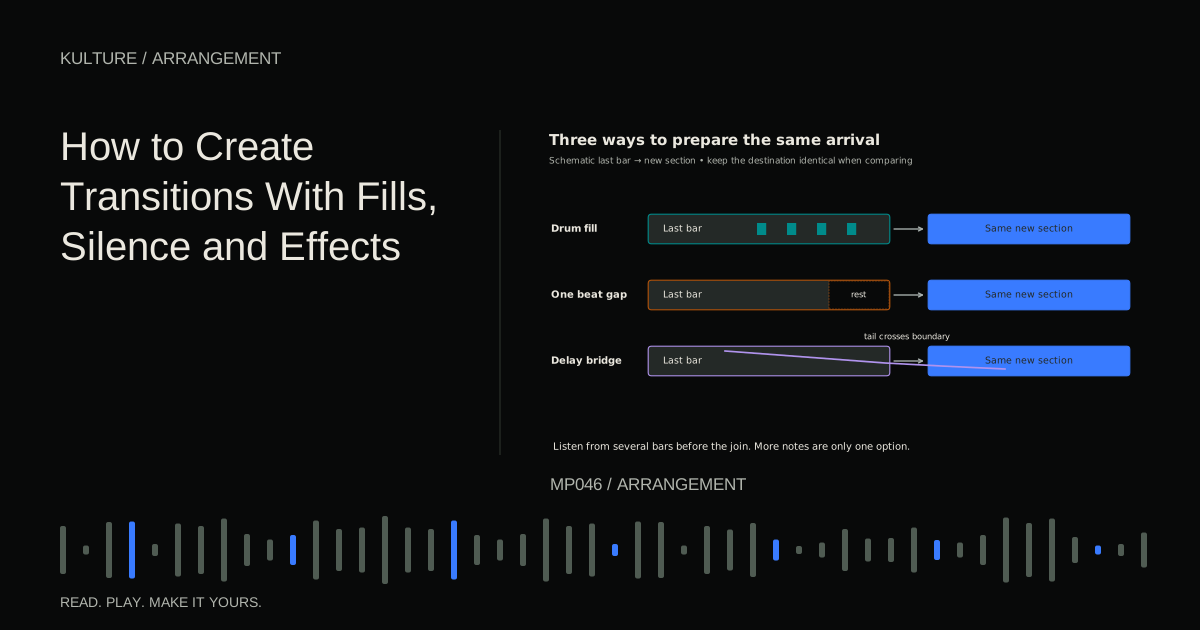
A breakdown removes or reduces parts that carry the groove. A build increases expectation. A drop is an arrival, often marked by the return of drums and bass. These functions can overlap with vocal sections: a chorus may occur over a drop, and a breakdown may contain a verse.
Not all dance music uses a long breakdown or dramatic riser. Some tracks develop through continuous, small changes. The word “drop” should not make you add a festival style gesture to a restrained groove that does not need it.
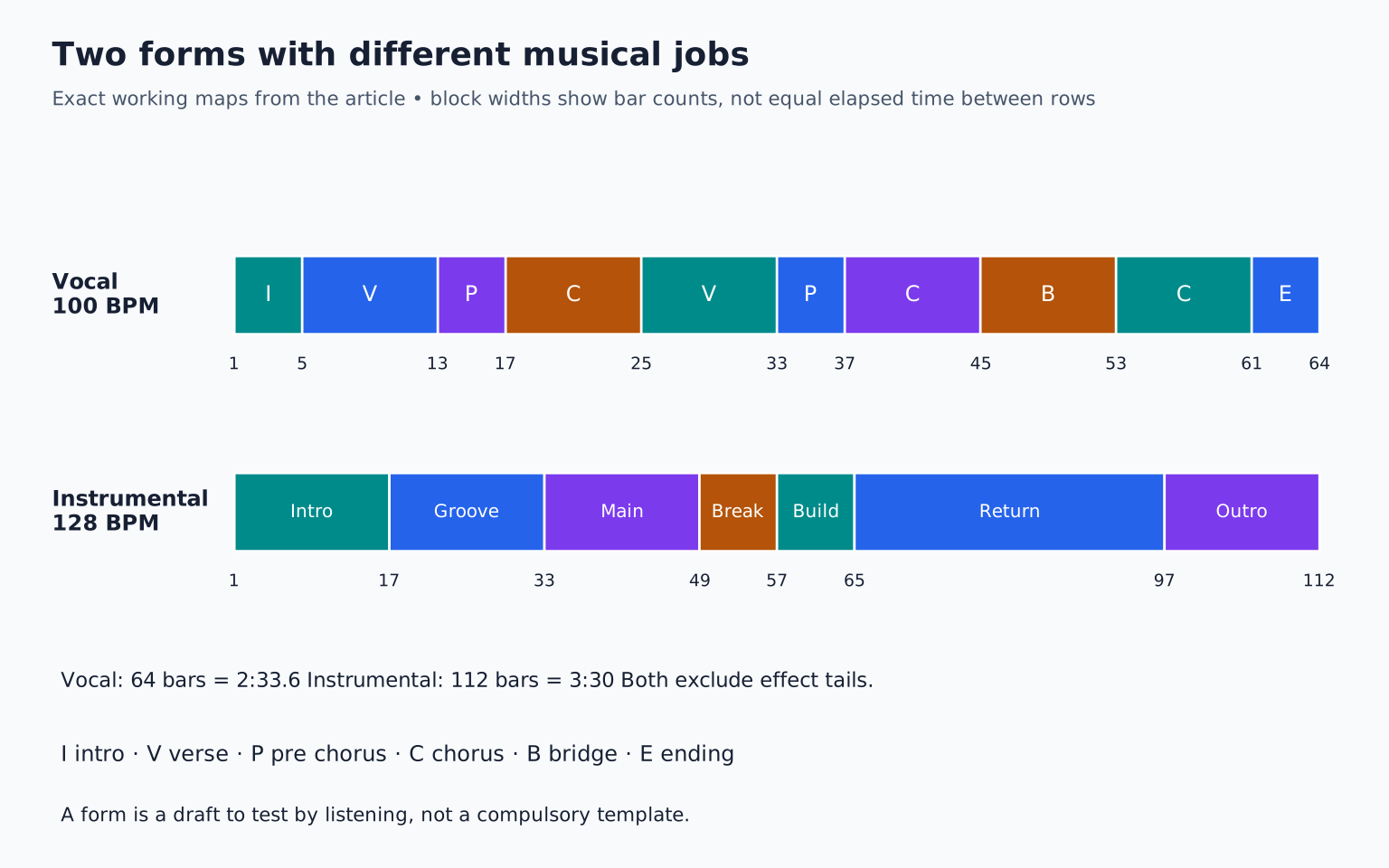
Two working maps
Here are two original forms to program, using your own material.
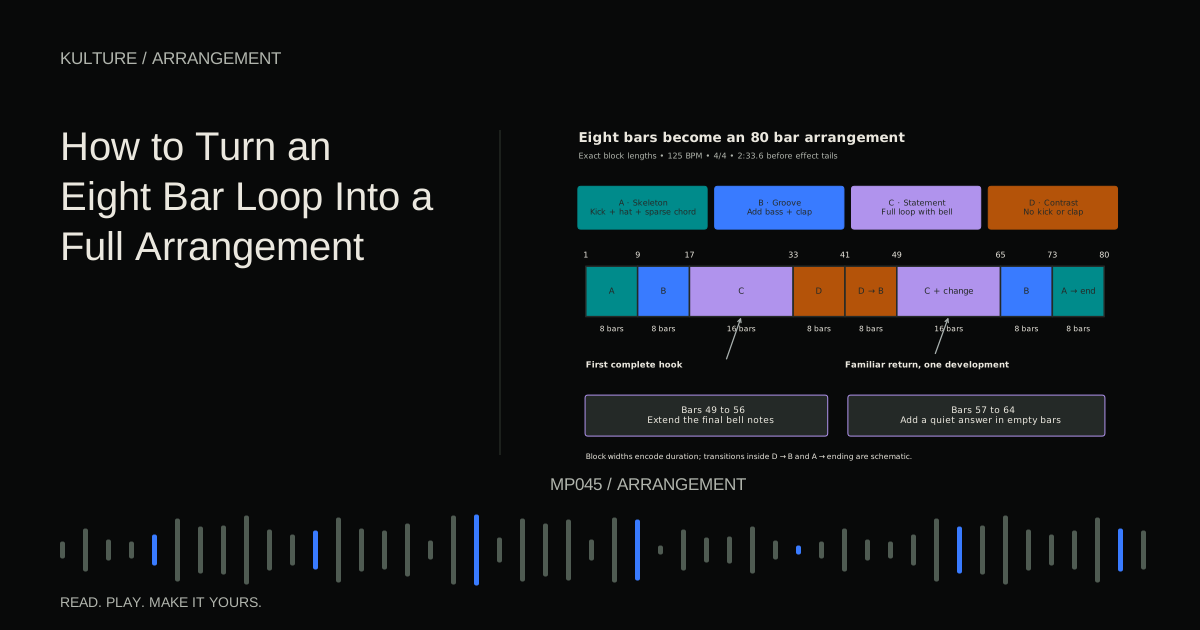
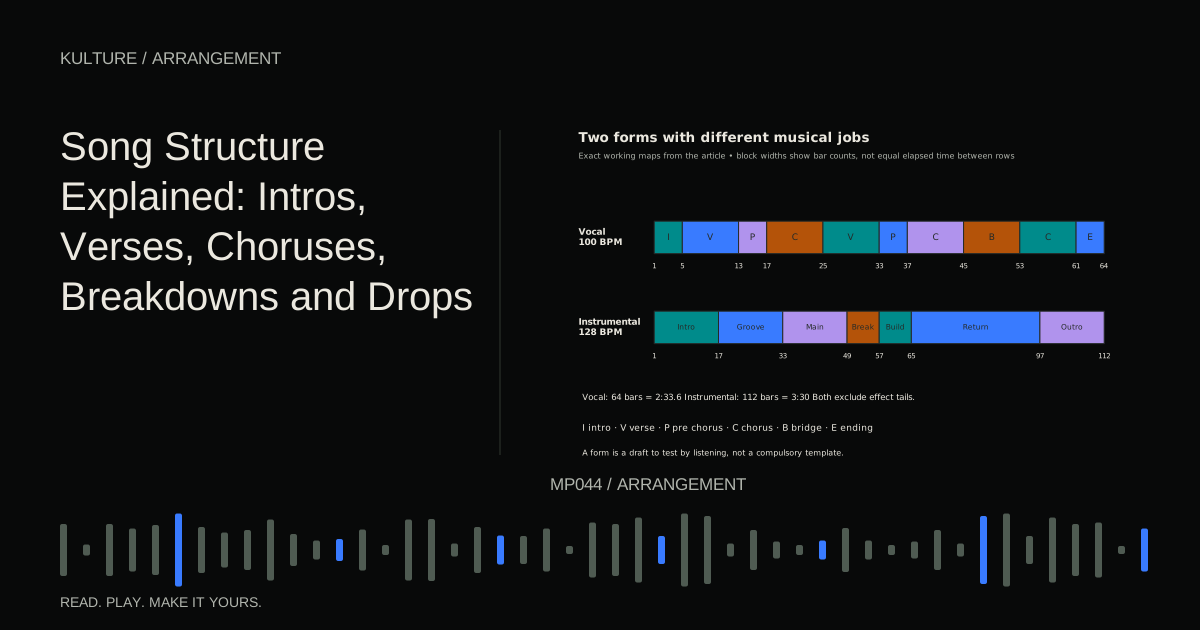
Vocal map at 100 BPM: intro 4 bars; verse 8; pre chorus 4; chorus 8; verse 8; pre chorus 4; chorus 8; bridge 8; final chorus 8; ending 4. This totals 64 bars, or 2 minutes 33.6 seconds before tails.
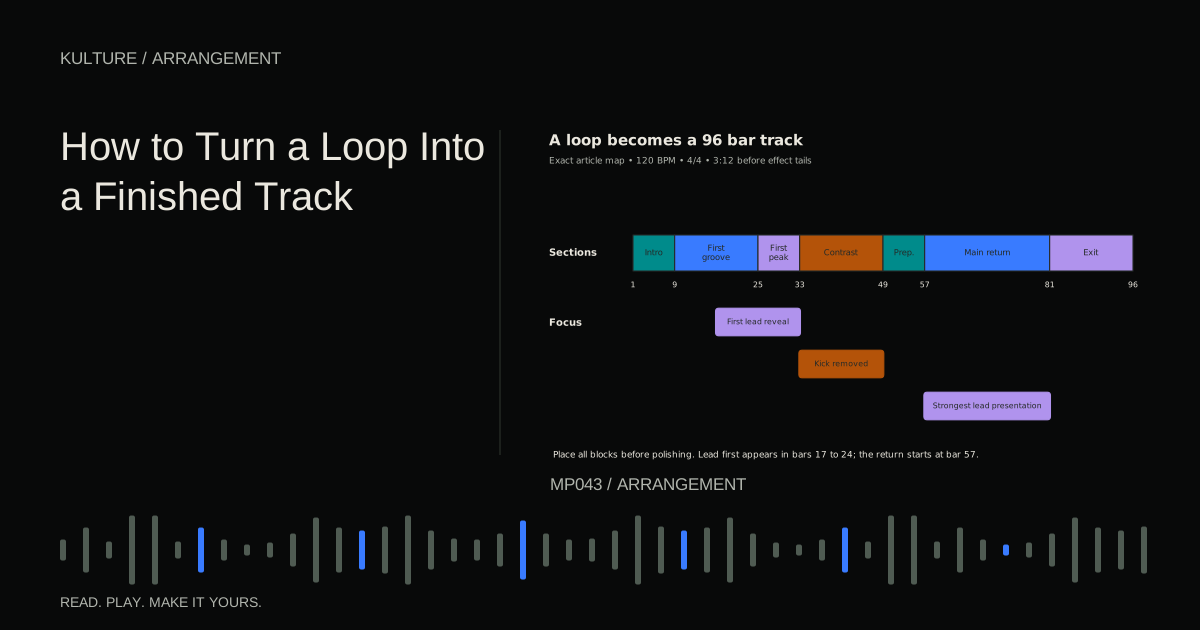
Instrumental map at 128 BPM: intro 16; groove 16; main statement 16; breakdown 8; build 8; return 32; outro 16. This totals 112 bars, or 3 minutes 30 seconds.
Neither is a universal target. The instrumental version allows a long return to develop through percussion and sound changes. The vocal version revisits its central statement more frequently. If your material wants a different balance, change the map.
How to analyze a reference without guessing
Listen once without stopping. Write the points where the musical function changes. On a second pass, count bars and name the changes: “vocal enters,” “bass leaves,” “new lyric with same tune,” “hook returns.” Only then assign section names.
An eight bar phrase is not necessarily a whole section. A verse may contain two eight bar phrases, while a chorus may include a two bar extension. If counting becomes confusing, follow recurring downbeats and vocal phrases rather than treating the waveform's visual shape as proof.
Record arrangement facts rather than copying distinctive melodies. Using reference tracks without copying them explains how to turn analysis into your own production decisions.
Diagnose a form that feels flat
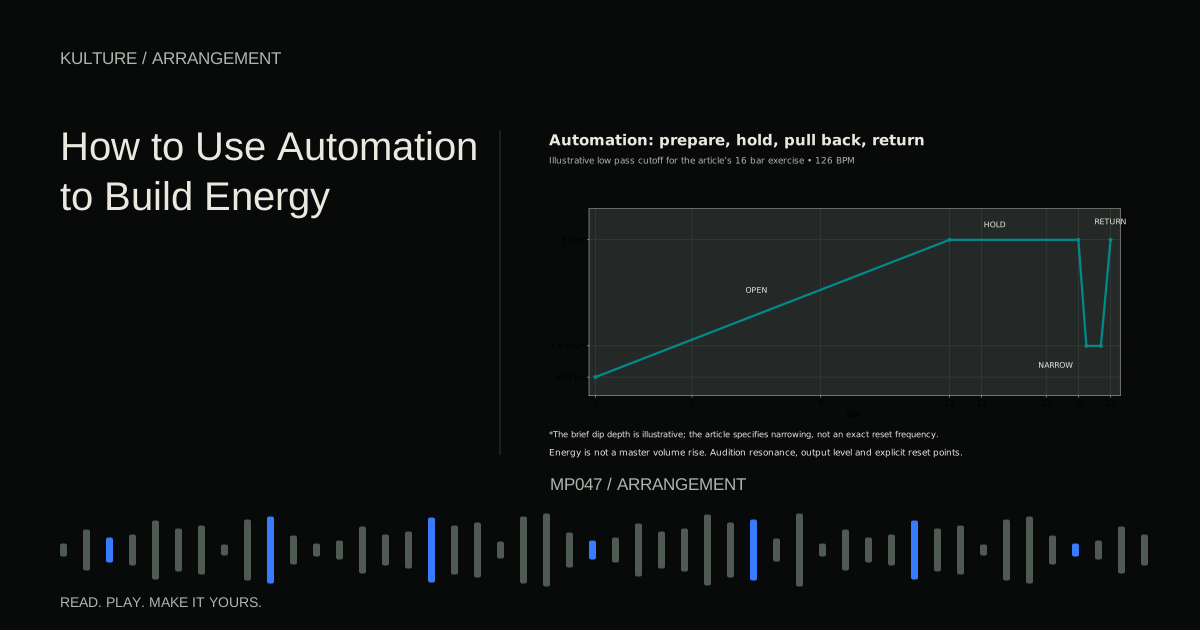
If the chorus feels weak, first compare what changes at its entrance. Raising the master volume does not create a stronger musical idea. Try moving the melody higher, simplifying the bass rhythm, or removing an overactive instrumental part.
If the song feels repetitive, determine whether the repetition lacks development or simply lasts too long. If it feels incoherent, restore a recurring motif across sections. A track can have too much novelty just as easily as too little.
Practice
Arrange the same eight bar idea into both maps above. Replace vocal roles with a lead instrument if necessary. Write one sentence describing the job of every section. Any section that has no clear job is a candidate for shortening, combining, or removing. Then build stronger contrasts with the chorus and verse lesson.
TAKE IT INTO YOUR OWN MUSIC
Your next session.
Arrange the same eight bar idea into both maps above. Replace vocal roles with a lead instrument if necessary. Write one sentence describing the job of every section. Any section that has no clear job is a candidate for shortening, combining, or removing. Then build stronger contrasts with the chorus and verse lesson.
Notes and progress stay in this browser.