Choose a skill small enough to isolate: bass note length, chord inversions, hat accents, vocal editing, or one transition. “Learn mixing” is too large. “Compare three ways to make this snare clearer without raising its level” is a workable exercise.
Practice is different from browsing
Watching a tutorial can explain a technique, but the learning becomes practical when you apply it, listen, and make a decision. Browsing presets may reveal a useful sound, but it does not automatically train a chosen skill.
Before starting, write a question and a deliverable. For example: “How do bass rests change the groove? Save three two bar patterns and choose one.” The deliverable can be a short export, a saved preset, or a written observation supported by a project.
Berklee's practice planning lesson emphasizes goal oriented sessions. Production benefits from the same principle: focused work with a clear purpose is easier to evaluate than time spent opening unrelated tools.
TRY IT HERE
Make it your session
Turn the steps into a plan you can save.
Ready when you are. Audio starts only when you press Play.
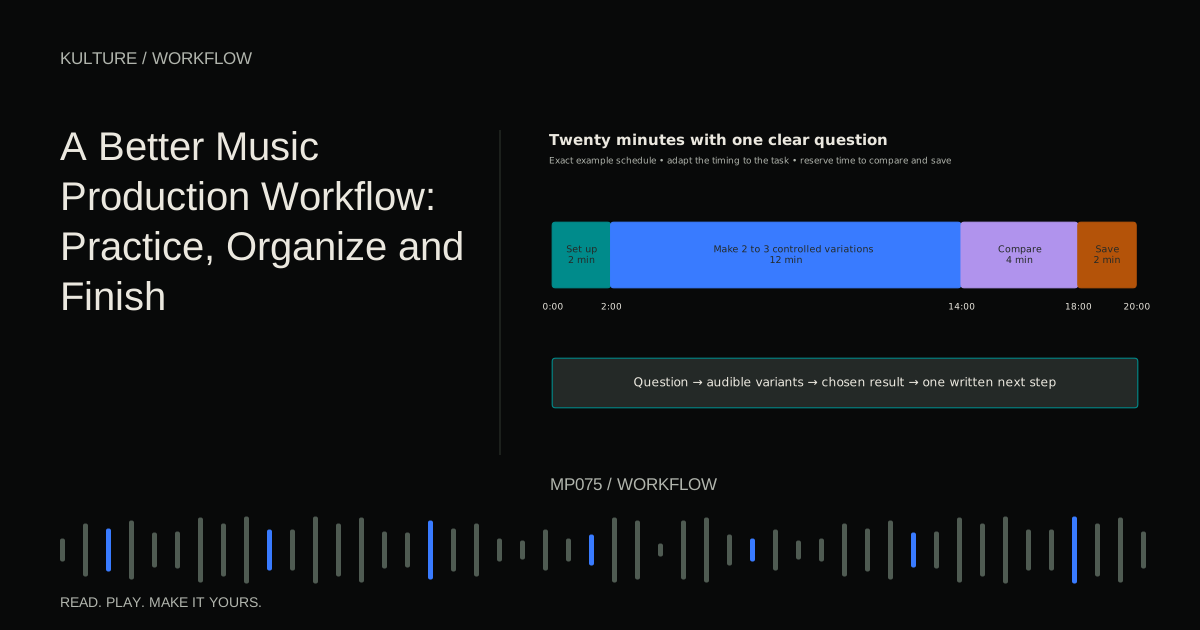
Keep experimenting in the beat maker LabA twenty minute session structure
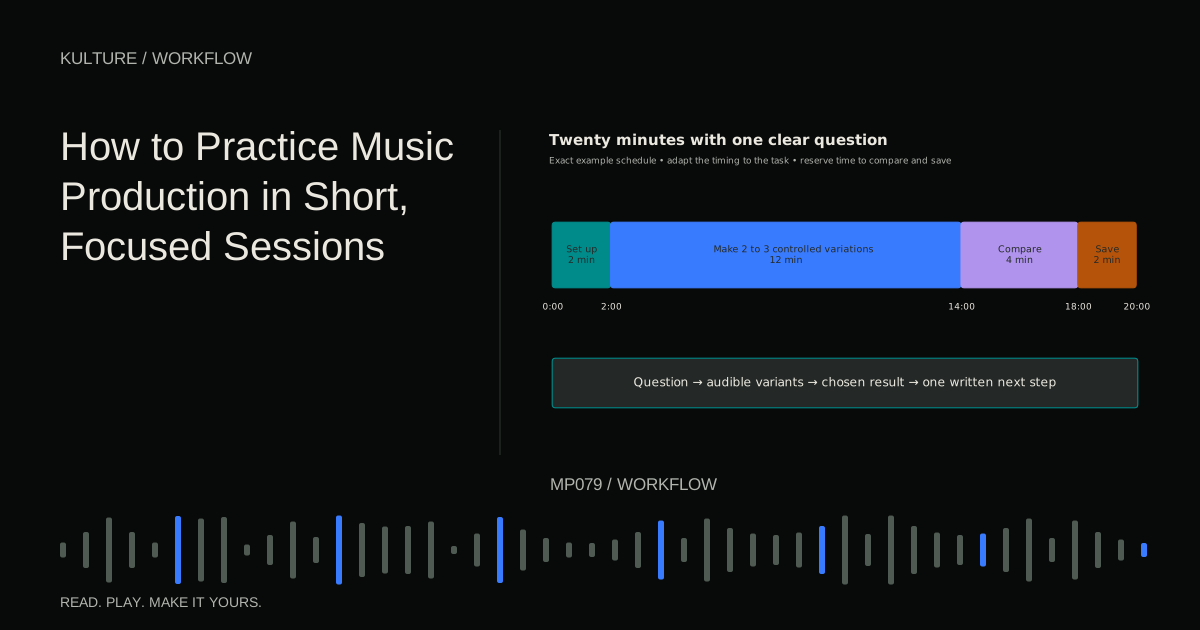
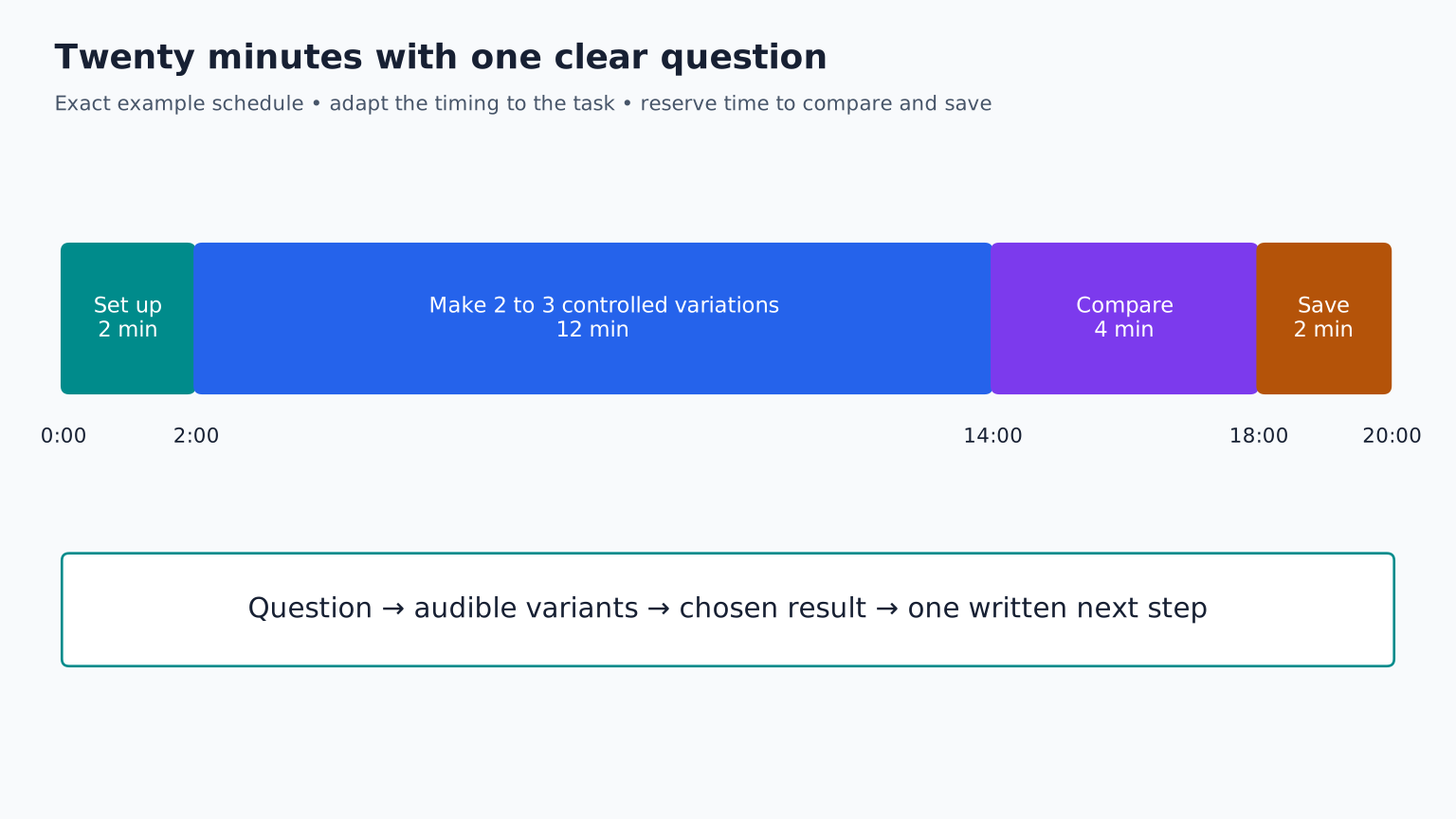
Use the first two minutes to open a prepared project and state the question. Spend twelve minutes making two or three controlled variations. Use four minutes to listen and compare, then two minutes to save the result and write the next step.
These times are an example, not a rule. A recording task may need longer setup, while an ear training exercise may need less. The key is reserving time for evaluation and saving, instead of ending just as the experiment becomes informative.
If a technical problem prevents the exercise, decide whether fixing it is now the session's useful outcome. Do not pretend you practiced harmony if the entire session was spent reconnecting an interface. Troubleshooting is valid work, but label it accurately.
Exercise one: bass length and groove
Set 100 beats per minute in 4/4. Put a kick on beats 1 and 3, snare on 2 and 4, and hats on eighth notes. Write a bass pattern with A on beat 1, A on 2 and, E on beat 3, and G on 4 and.
Create three versions with identical pitches and starts. In version A, every bass note lasts one sixteenth. In B, each lasts one eighth. In C, extend notes nearly to the next onset, allowing only deliberate gaps.
Listen to each with the same drum pattern and similar output level. Which version makes the kick clearer? Which feels more connected? Which leaves the most useful space before the next bar? Save the answer as a concrete observation, not “short is always better.”
The lesson is context specific. Another tempo, patch, or kick decay may favor a different duration. That is why controlled comparison is more useful than memorizing one setting.
Exercise two: chord movement
Use C major, A minor, F major, and G major, one bar each. First play every chord in root position: C, E, G, A, C, E, F, A, C, G, B, D.
Make a second version that keeps the upper notes near one another: C, E, G, C, E, A, C, F, A, B, D, G. Keep the same rhythm and instrument. Listen for the different movement of individual voices.
Do not judge only by how far the MIDI blocks move visually. Play each top line alone and hear its contour. Then restore the full chords. Write which version suits a smooth pad and which might suit an intentionally jumping rhythmic part.
This exercise trains voice leading without requiring a complete song or a complex theory session.
Exercise three: one transition, three solutions
Take sixteen bars of an existing loop and make a clear new section at bar 9. Version A uses a drum fill in bar 8. Version B uses one beat of silence before the arrival. Version C lets a delay tail cross the boundary.
Keep the destination identical. Listen from bar 5 so the transition has context. Choose the version that best prepares the change. If all three fail, the destination may not be sufficiently different; that is a useful finding.
Save the alternatives in the practice project rather than adding every transition to your actual song. Practice should create choices, not force you to keep all experiments.
Use repetition with variation
Repeat a focused exercise on several days with one changed condition. Practice bass lengths at a different tempo, chord movement in a different key, or transitions into a quieter section. The repeated question makes progress visible; the changed condition prevents memorizing one answer.
A small log might say: date, question, source material, variants tested, chosen result, and next question. Keep it short enough that writing it does not replace the music making.
Berklee's discussion of timed practice presents focused work intervals as one way to structure practice. You can adapt the interval length to your attention and task rather than treating a timer as a performance test.
Know when to stop the exercise
Stop when you can explain the audible difference and choose a version for a stated purpose. You do not need to explore every plugin setting. If the result is unclear, simplify: fewer instruments, larger differences between variants, or a shorter passage.
If you keep changing unrelated sounds, return to the original question. Changing the bass patch, drum kit, and tempo together makes it difficult to learn what note length did.
If you become tired or your judgment grows inconsistent, save the versions and compare later. Repeatedly forcing a decision when you no longer hear clearly can teach the wrong lesson. Keep listening comfortable and take breaks as needed.
Transfer the skill into real music
After several studies, apply one result to an active project. Ask whether it still helps in context. The exercise may reveal a principle, but the song decides the final choice.
For your next week, schedule three short sessions around one recurring weakness. End each with a saved result and one sentence of evidence. At the end of the week, compare the first and last versions. Continue with a broader production workflow to balance practice with writing and finishing actual tracks.
TAKE IT INTO YOUR OWN MUSIC
Your next session.
Watching a tutorial can explain a technique, but the learning becomes practical when you apply it, listen, and make a decision. Browsing presets may reveal a useful sound, but it does not automatically train a chosen skill.
Notes and progress stay in this browser.