These distinctions explain many surprises: a bass sample gets shorter when played higher, a drum loop becomes smeared after tempo matching, or a vocal changes character when transposed. The software is not necessarily broken; you may be using a different process from the one you intended.
Three operations, three different goals
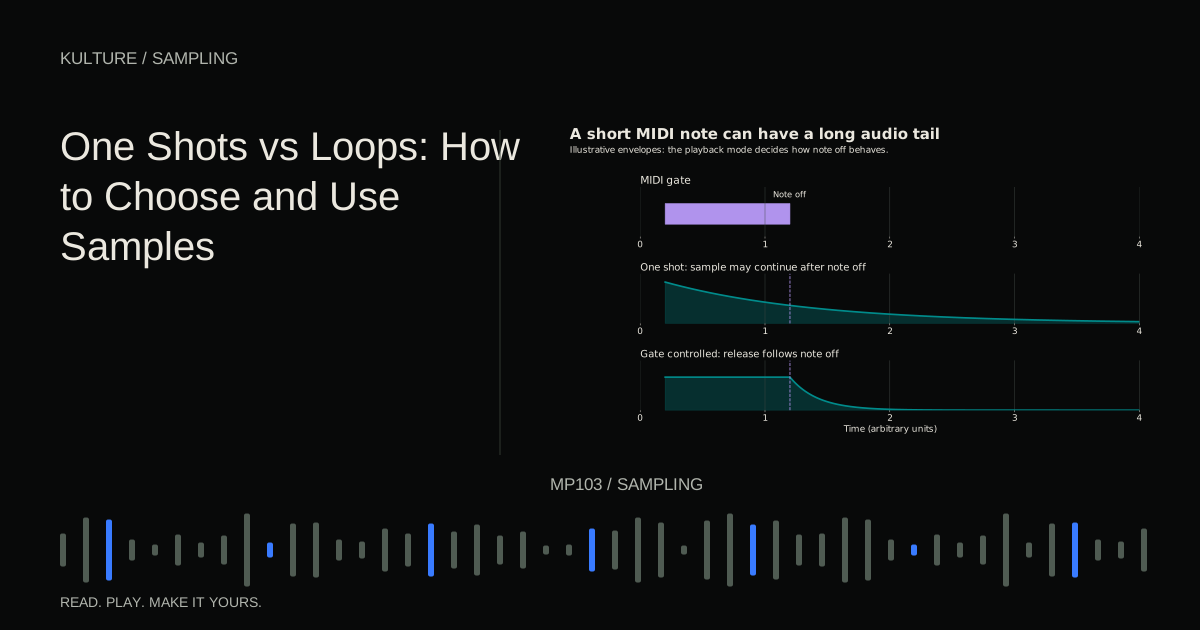
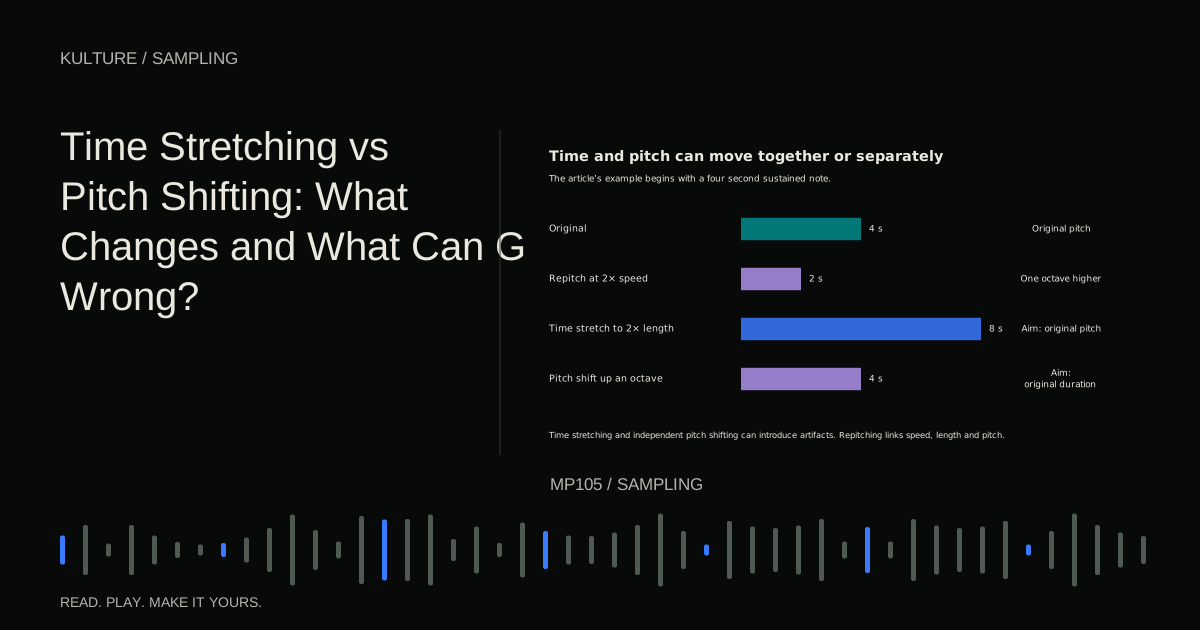
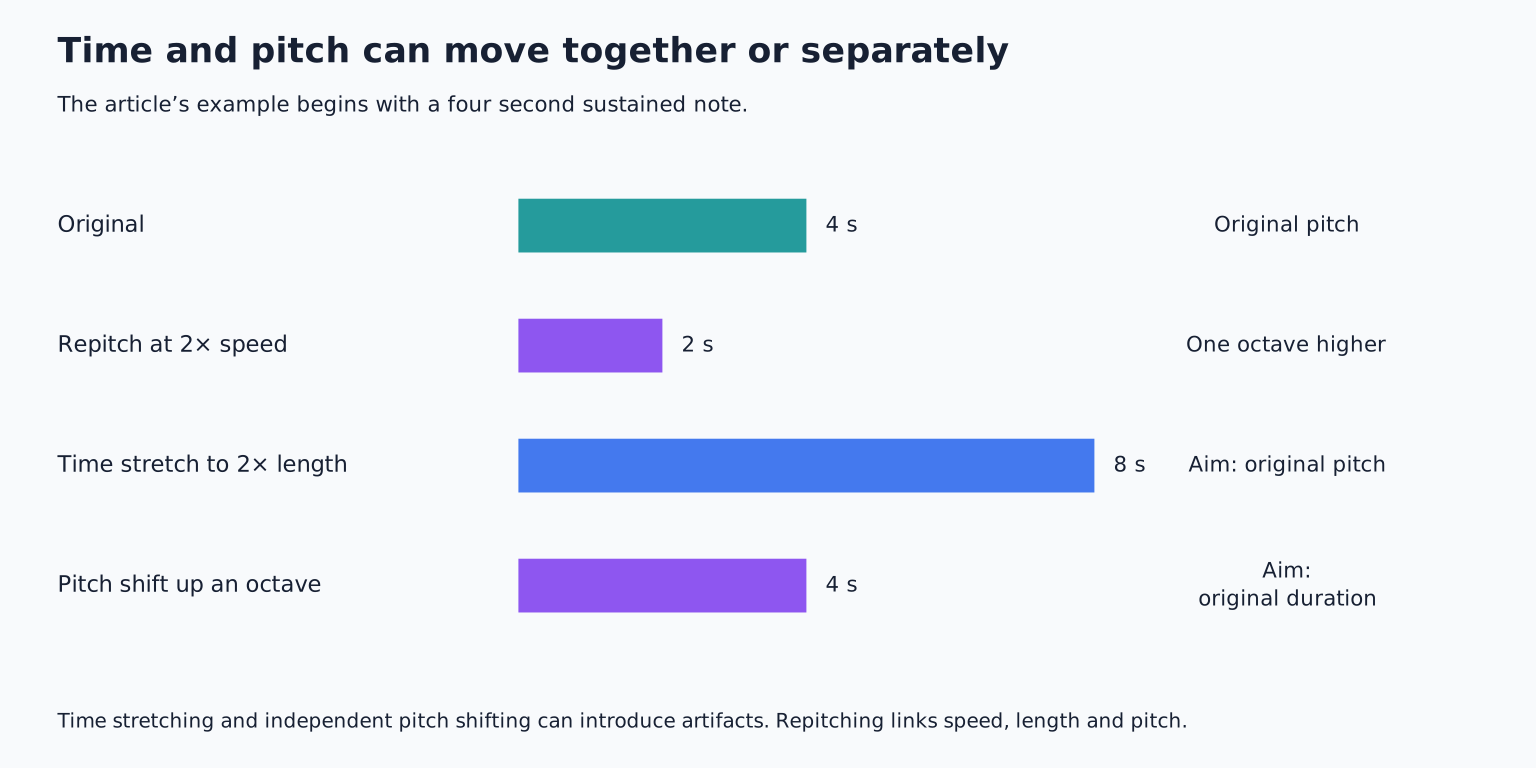
Imagine a four second recording of one sustained note. Play it at twice its original speed and it lasts two seconds while sounding one octave higher. Play it at half speed and it lasts eight seconds while sounding one octave lower. This is repitching, the behaviour associated with tape speed changes and traditional sample playback.
Time stretching can make the same recording eight seconds long while aiming to keep its original pitch. Pitch shifting can move it up an octave while aiming to keep it four seconds long. Both require more complex processing than simply changing the playback rate.
Ableton's warping documentation distinguishes its Re Pitch behaviour from modes that manage timing and pitch more independently. Other software uses different names, so check the actual behaviour rather than assuming a “transpose” control always preserves length.
TRY IT HERE
Rebuild the phrase
Reorder four slices of an original melody and play them back.
Ready when you are. Audio starts only when you press Play.
Keep experimenting in the sample pads LabCalculate the timing change correctly
For a fixed number of beats, duration is inversely related to tempo. A loop at 100 BPM moved to 125 BPM must become 100/125 of its original length, or 80 percent. A four second loop would become 3.2 seconds.
Moving the same loop from 100 BPM to 80 BPM makes it 100/80 as long, or 125 percent. Its four seconds become five seconds. The higher project tempo creates a shorter loop, not a longer one.
Before applying this relationship, verify the loop's beat count. If a two bar phrase is misidentified as one bar, the software may report a tempo that is doubled or halved. Correct the interpretation before judging the stretching algorithm.
Why stretching can create artifacts
A processor must redistribute audio over a new duration. Different algorithms analyse and reconstruct the signal in different ways, often treating attacks, sustained tones, and complex mixtures differently.
A drum attack contains a fast change that can become blurred. A sustained note contains periodic structure that can develop wavering or metallic texture. A full mix contains many simultaneous sources, making it harder to preserve every feature at once.
Extreme changes expose these compromises more clearly, but there is no universal safe percentage for every sound. A noisy texture may tolerate a huge stretch as an effect, while a small change to an exposed piano can reveal artifacts you dislike.
Match the algorithm to the source
For drums, try a transient- or beat oriented mode. Listen to the kick and snare attack, cymbal continuity, and gaps between hits. Some modes preserve attacks but repeat or truncate material between them, which may suit one loop and sound awkward on another.
For a single vocal or bass line, a monophonic or tonal mode may be more appropriate. Monophonic means one note line at a time. A chord progression or full mix needs a polyphonic or complex material approach if the software provides one.
Do not select the most CPU intensive mode automatically. It may be designed for a different source. Compare two appropriate modes at matched level and listen to the specific feature you need to preserve.
Transposition also changes character
A semitone is one step in the Western equal tempered chromatic scale. Twelve semitones form an octave. In pure repitching, the speed ratio for n semitones is 2 raised to n/12. You do not need to calculate that during normal production, but it explains why a small pitch change also changes sample length.
Pitch shifting with duration preservation avoids that length change, but the texture may still change. A voice's formants, the resonant patterns that shape vowel character, can make a shifted vocal sound smaller, larger, nasal, or unnatural.
A formant preserving option can help maintain identity, but it does not guarantee transparency at large shifts. Listen to consonants and sustained vowels separately. If a part needs a dramatically different range, a new performance may be better than increasingly extreme correction.
A drum loop comparison
Take a self recorded or licensed two bar drum loop at 100 BPM. Make three copies and fit them to 120 BPM: one by repitching, one with a transient oriented stretch mode, and one with a different suitable algorithm.
The repitched version will be higher in pitch because it plays faster. The stretched versions should aim to preserve pitch but may differ in attack and cymbal tails. Compare without adding EQ or compression initially.
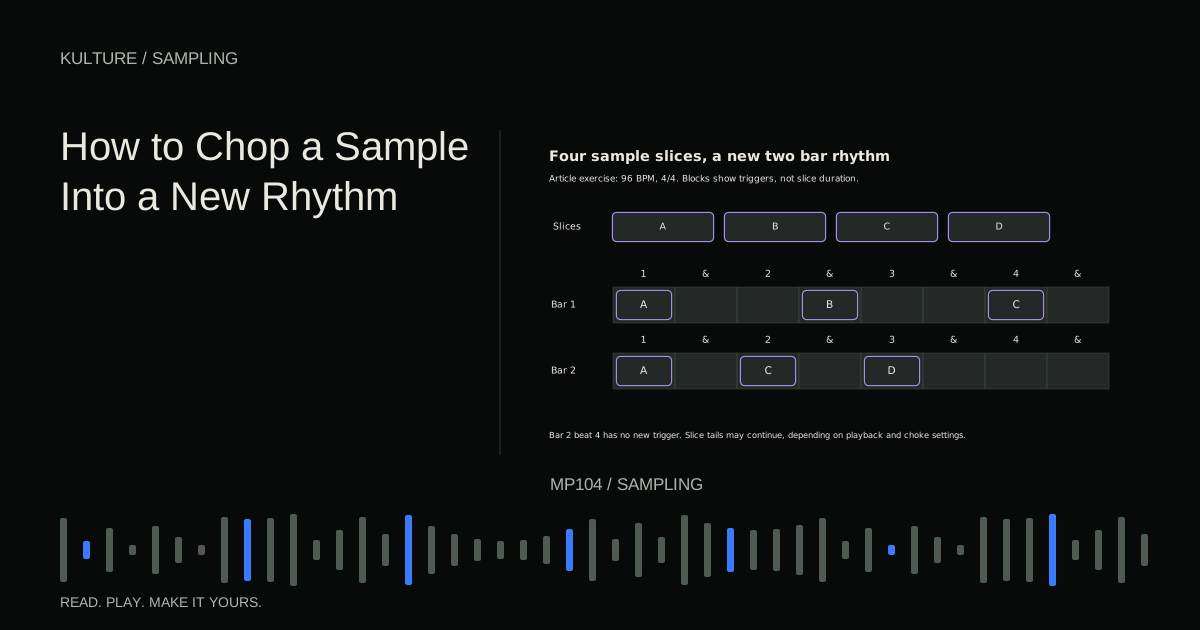
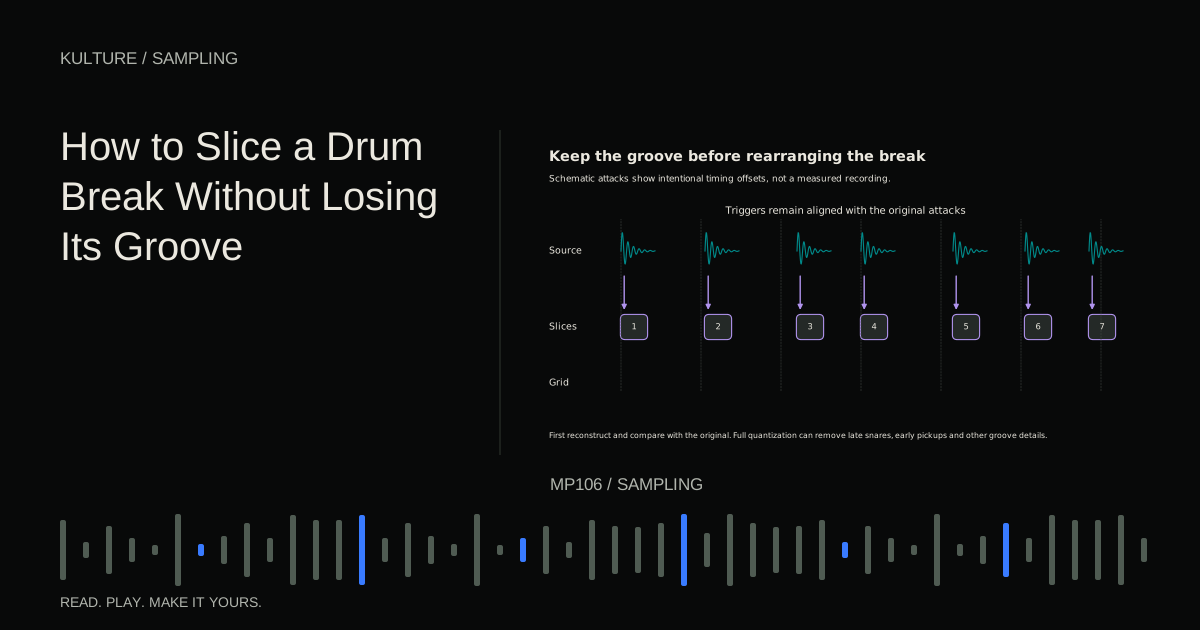
Choose based on the song. The brighter repitched version might be an intentional creative choice. If all stretched versions sound poor, slice the loop at meaningful hits and adjust their trigger timing instead. Drum break slicing explains that alternative and its own limitations.
A melodic sample comparison
Record one sustained note with a natural attack. Transpose it up five semitones using ordinary sampler repitching, then repeat with a duration preserving mode if available.
Listen for the attack length, decay, pitch stability, and tone. The repitched note may become shorter and brighter. The time independent version may preserve the envelope duration but introduce a different texture.
Ableton's Warping in Simpler guide illustrates that sampler playback can support independent time and pitch manipulation, with mode specific limitations. The lesson is to inspect the instrument's settings rather than assuming all samplers behave like tape.
Avoid processing the same material unnecessarily
Keep the original and try to make major time and pitch decisions from it. Repeatedly rendering, stretching, and shifting already processed audio can accumulate artifacts. Sometimes that degradation is the desired texture; if not, return to the clean source.
Set the original tempo and start marker correctly before adding many warp markers. Too many unnecessary anchors can create local timing distortions. Fix broad alignment first, then address genuine drift or expressive timing only where needed.
If a stereo source is processed, keep channels linked through the intended stereo algorithm. Independent left/right edits can disturb the image or phase relationship.
Troubleshoot by symptom
Metallic cymbals suggest an unsuitable algorithm or an excessive change. Soft drum attacks call for transient preservation, different markers, or slicing. A bass note that changes length on the keyboard may simply be repitching rather than stretching. A vocal that sounds oddly small may need formant aware processing or a smaller shift.
A loop that drifts off the grid may have the wrong original tempo, wrong bar length, or genuine performance variation. Do not keep changing pitch to fix a timing interpretation problem.
For practice, run the drum and melodic comparisons above and note which properties each process preserves. Then choose one transformation that serves a real arrangement. Continue with resampling when you want to commit a successful transformation and use it as fresh material.
TAKE IT INTO YOUR OWN MUSIC
Your next session.
Metallic cymbals suggest an unsuitable algorithm or an excessive change. Soft drum attacks call for transient preservation, different markers, or slicing. A bass note that changes length on the keyboard may simply be repitching rather than stretching. A vocal that sounds oddly small may need formant aware processing or a smaller shift.
Notes and progress stay in this browser.