A useful first kit contains one of each, but you do not have to play all four at once. Fewer sounds with clear roles are easier to arrange and mix.
Listen to the shape of a drum sound
A drum hit has a beginning, a body and a tail. The transient is the rapid initial attack. The body gives the sound weight and character. The tail describes how it fades or rings after the attack.
A short click heavy kick and a long booming kick can occupy the same rhythmic position while producing very different results. Likewise, a snare with a long noisy tail can fill space that a dry snare leaves open.
Ableton's drum sound introduction lets you compare these basic instrument families. In your own project, audition sounds at a similar perceived level; otherwise the louder sample may seem more exciting even when it is less suitable.
TRY IT HERE
Find the pocket
Tap the grid, change the tempo and hear your pattern.
Ready when you are. Audio starts only when you press Play.
Keep experimenting in the beat maker LabThe kick: impact and low frequency structure
The kick drum, also called the bass drum, frequently marks important beats. Its low frequency body can make the pattern feel grounded, while its higher attack helps it remain audible in a busy mix.
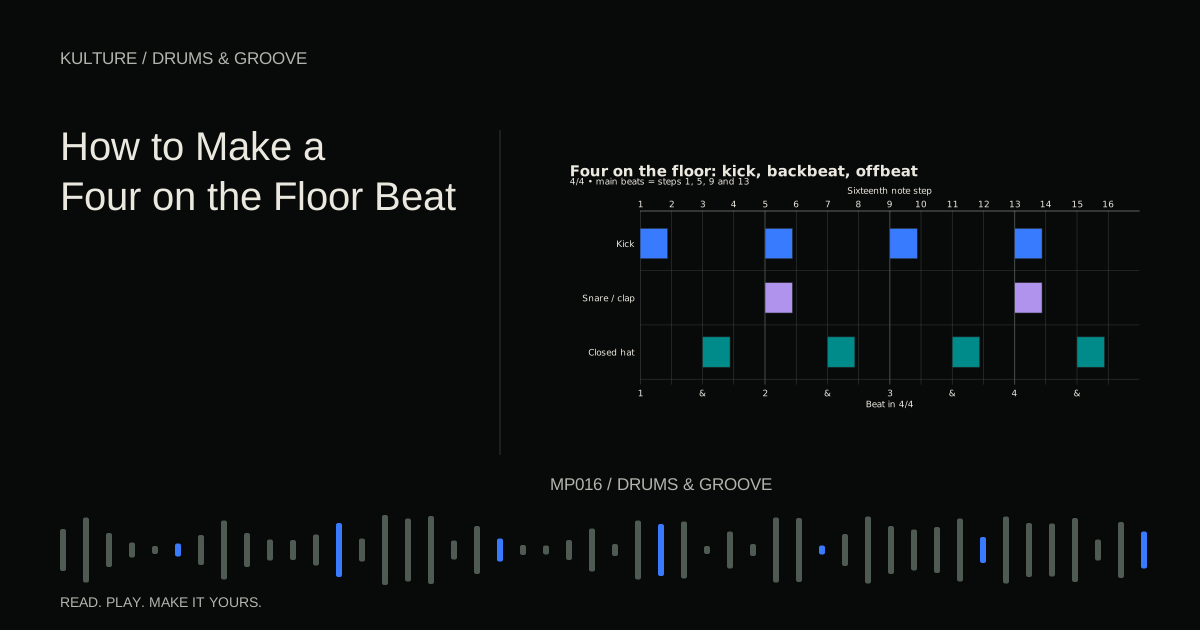
In a four on the floor pattern, it plays on beats 1, 2, 3 and 4. In a broken pattern, it might play on beat 1, the “and” after beat 2 and beat 3. Neither arrangement is intrinsically stronger. The surrounding bassline and accents determine the result.
A long kick tail can function partly like a pitched bass sound. A very short kick leaves more space for a separate bass instrument. Not every kick has a clear stable pitch, and not every kick needs tuning to a song's key. Listen for an actual harmonic conflict rather than imposing tuning as a ritual.
If the kick disappears when the bass enters, first compare their timing and decay. A shorter bass note or a different kick may solve the problem before equalization. Kick vs Bass explains this division of labor.
The snare: a recognizable accent
An acoustic snare combines the drum's resonant tone with the noisy response of its wires. Electronic snare sounds may imitate that mixture or exaggerate one component. A snare can be woody, sharp, metallic, soft or explosive.
In many 4/4 grooves, snare hits on beats 2 and 4 establish the backbeat. In a half time pattern, the strongest snare may occur on beat 3. These placements help the listener interpret the larger rhythmic feel.
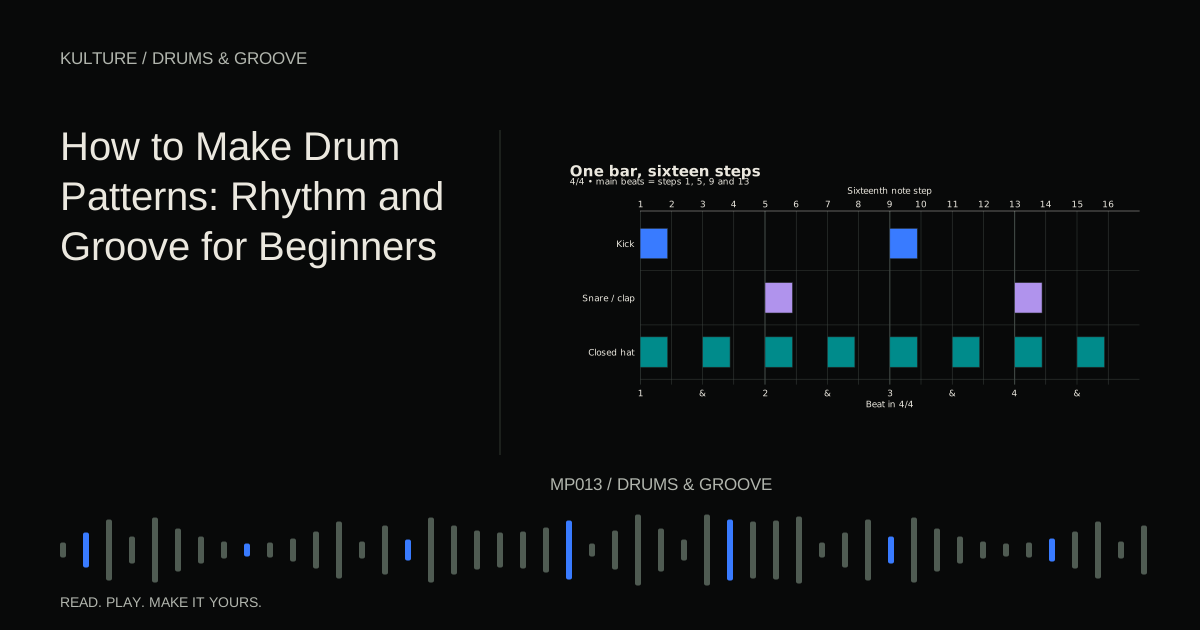
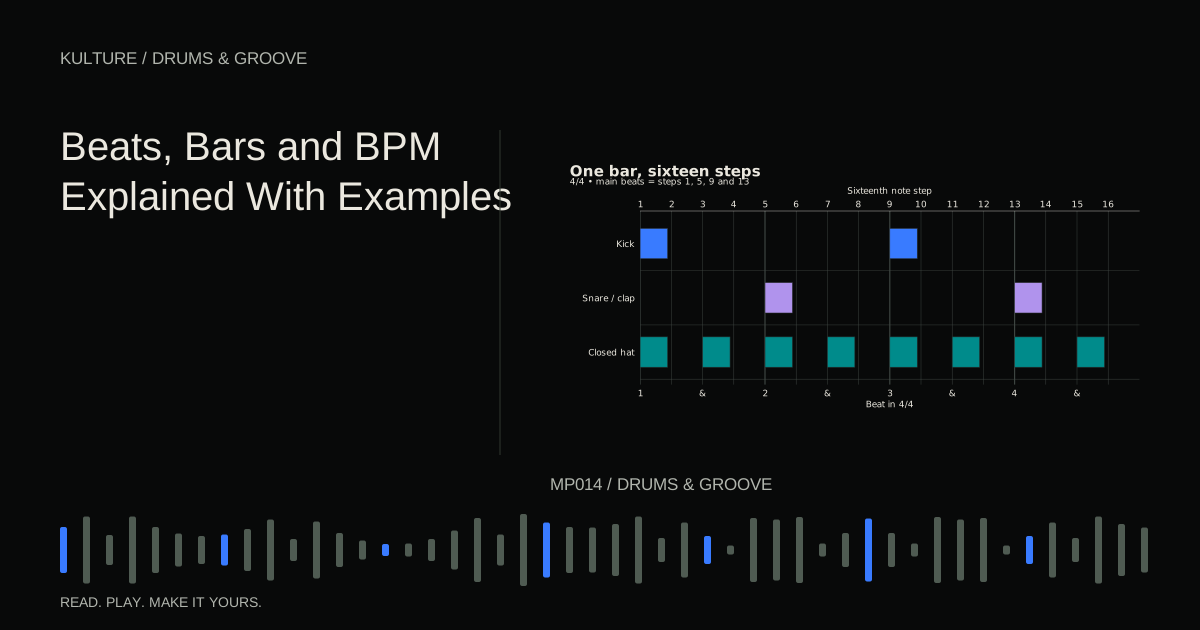
Try a kick on beats 1 and 3 with a snare on 2 and 4. Then move the snare to beat 3 and change the kick pattern so it does not merely duplicate every snare. The tempo stays the same, but the groove's apparent pace changes.
A snare does not need to be the loudest sound to define the rhythm. Its contrast with the low kick and its placement can make it perceptually prominent. If it feels harsh, choose a less aggressive sample or soften its level before assuming the entire beat needs more bass.
The clap: a different kind of width and texture
A handclap sound often contains several closely spaced noise bursts, giving it a less singular attack than a tight snare. Samples may include room ambience, multiple people or electronic synthesis, so the category covers many textures.
Use a clap instead of a snare when its softer or more spread attack fits the track. Layer it with a snare when each has a clear purpose: perhaps the snare supplies a central crack while the clap adds a diffuse tail.
Start with both on beats 2 and 4. Lower the clap until you mainly miss it when muted. If the combined hit sounds like two separate events, inspect their sample starts and timing. A small offset can be an intentional flam, but an accidental one may make the backbeat feel loose.
Do not layer just because a tutorial shows two tracks. If the snare already has the desired width and body, a clap can add clutter without adding a useful role.
Closed and open hi hats: motion and punctuation
A closed hi hat is usually short and crisp. Repeated eighths or sixteenths can communicate the subdivision even while the kick leaves gaps. An open hat rings longer and can emphasize an offbeat or phrase ending.
Try closed hats on “1 and 2 and 3 and 4 and.” Then remove the hats on the numbered beats, leaving only the four “ands.” The kick can occupy the main beats while the hats answer between them.
Replace the last closed hat with an open hat. If it rings into the next bar, decide whether that continuation helps. A choke group can let a closed hat trigger stop the open hat, mimicking a closing motion. The exact setup depends on the drum instrument.
Watch the balance. Constant bright hats can dominate attention even when their meter reading looks modest. Lower them until the kick and backbeat regain their intended roles, then bring them up only as far as needed.
Build a role based kit in four passes
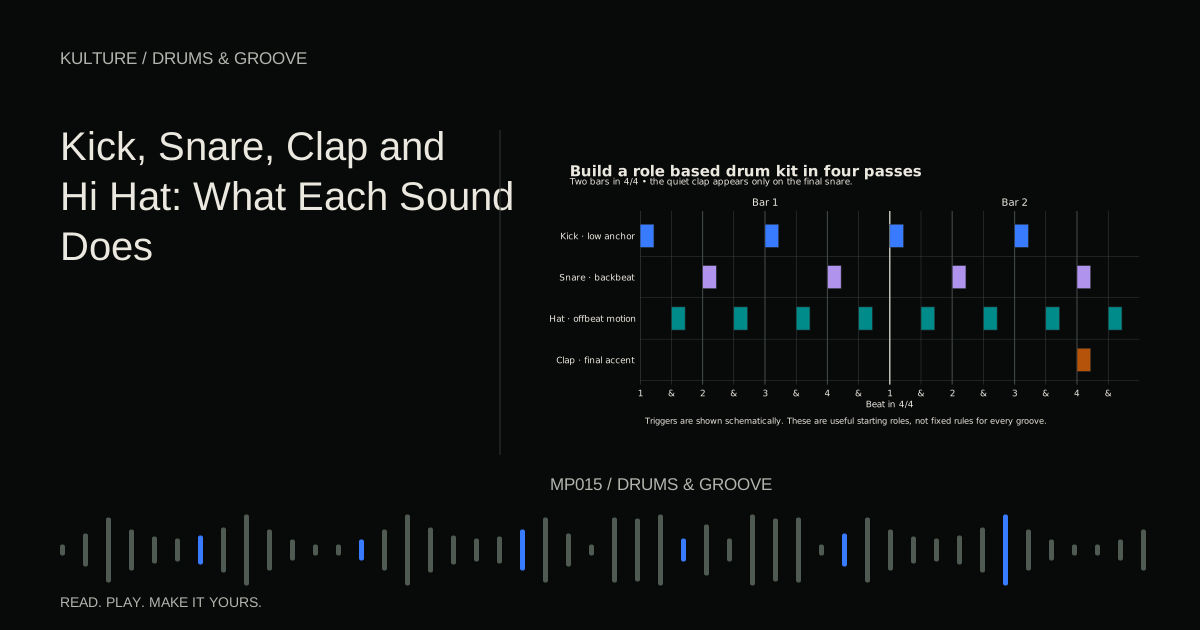
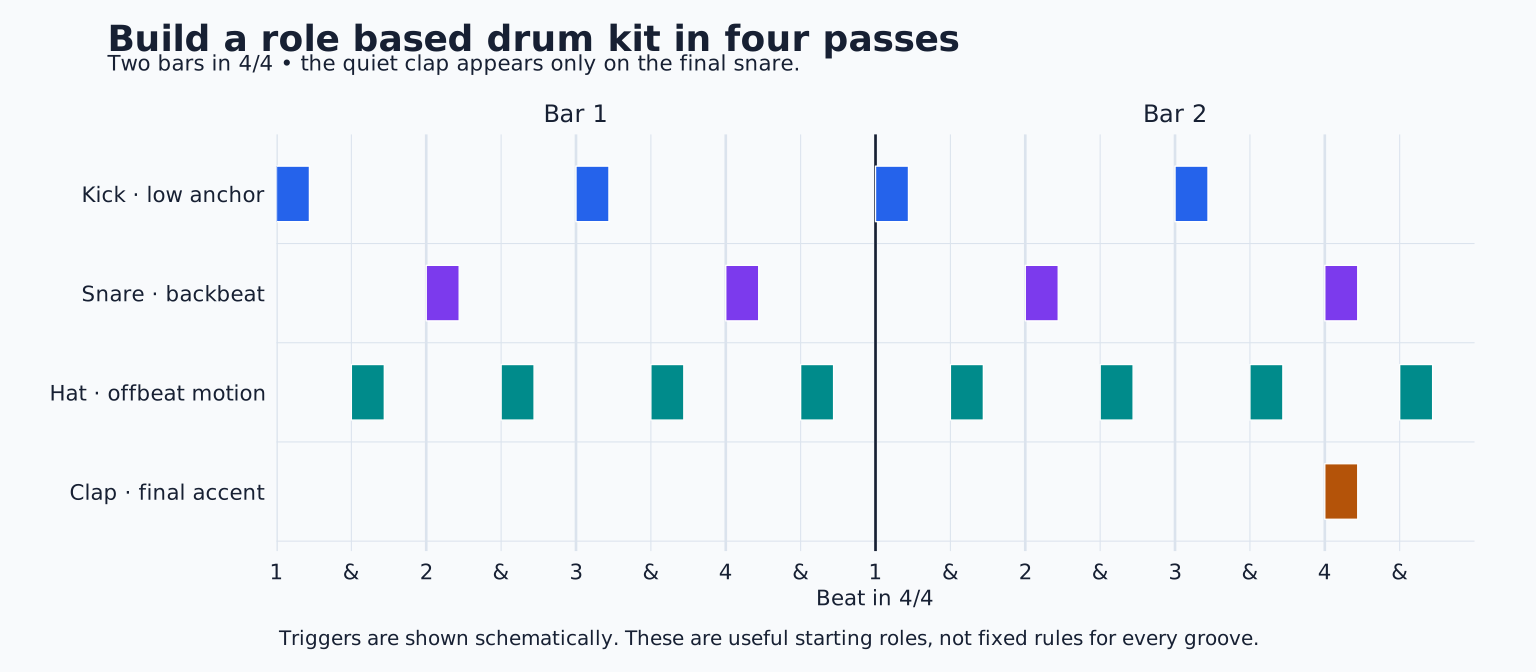
Create a two bar loop at 110 BPM with a sixteenth note grid. First add a kick on beats 1 and 3. Second, place a snare on beats 2 and 4. Third, add offbeat hats. Fourth, try a quiet clap layer only on the final snare of bar 2.
After each pass, ask what new information the sound contributes. The kick establishes weight, the snare divides the bar, the hats create forward motion, and the occasional clap marks a small variation.
Now swap the kick for a longer one. You may need to shorten the bass or reduce kick density. Swap the snare for a roomy clap. You may need less reverb elsewhere. Sound selection and pattern design are linked; a sample replacement is not always a neutral cosmetic change.
Ableton's backbeat lesson is a useful external listening reference for the accent relationship used here.
When the kit does not feel cohesive
If every hit seems to occupy a different room, reduce built in ambience or choose more compatible samples. A subtle shared reverb can help, but it cannot always hide radically different tails.
If the beat feels crowded, mute one sound rather than immediately processing everything. If removing the clap improves the snare, the layer was probably unnecessary. If removing half the hats improves the groove, the problem was density rather than sound quality.
If the drums feel weak, check whether all hits have equal importance. Give the main backbeat a clear role and make supporting notes quieter. Avoid adding a new instrument every time you want more energy; a stronger accent or a well placed rest can do more.
Exercise: make three kits from the same rhythm
Keep one MIDI pattern and create three sound combinations: dry and short, roomy and loose, and electronic and sustained. Adjust only levels and note tails enough to make each usable. Write one sentence describing how the sound choices change the groove.
Then choose the kit that supports your bass and melody. Continue with How to Make Drum Patterns to develop the rhythm beyond this basic role map.
TAKE IT INTO YOUR OWN MUSIC
Your next session.
Keep one MIDI pattern and create three sound combinations: dry and short, roomy and loose, and electronic and sustained. Adjust only levels and note tails enough to make each usable. Write one sentence describing how the sound choices change the groove.
Notes and progress stay in this browser.