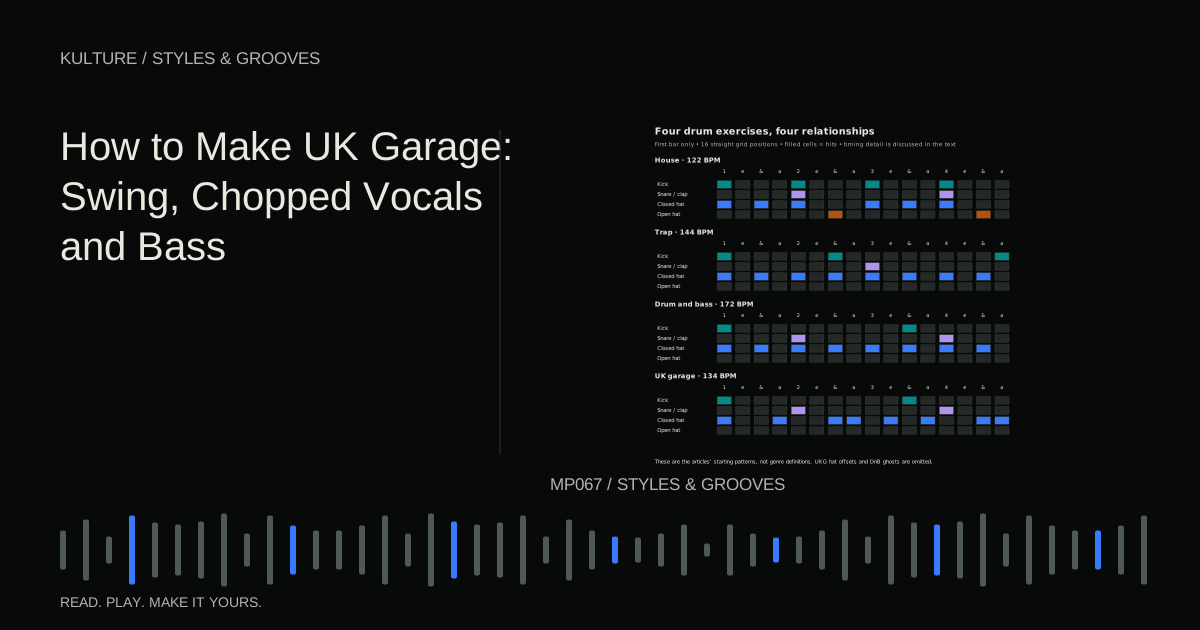
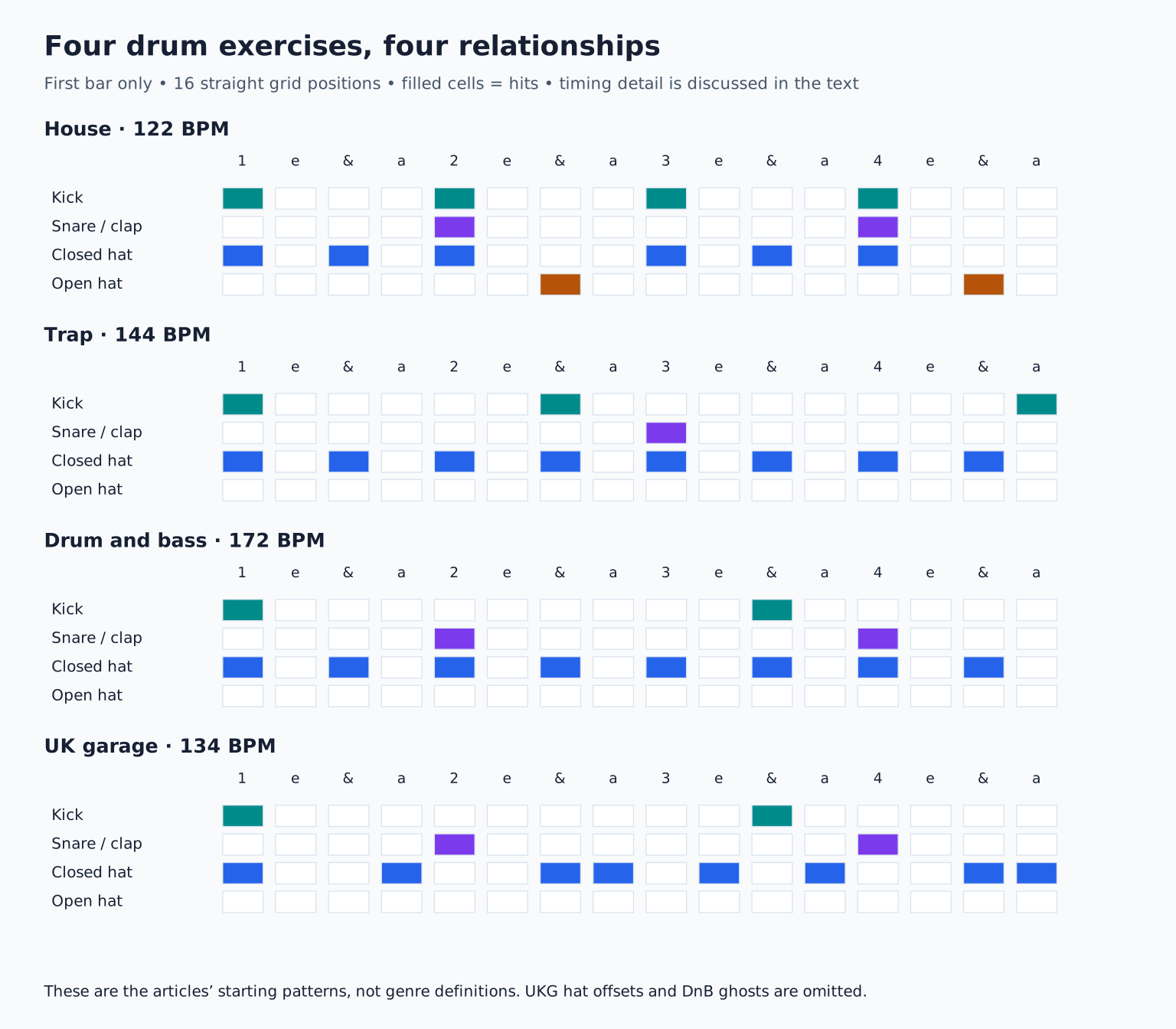
This original tutorial makes a two step sketch at 134 beats per minute in 4/4. UK garage also includes four to the floor approaches, so this is one branch of a broad style. Native Instruments' UK garage guide discusses both rhythmic approaches and their production context.
Program the skeleton before the shuffle
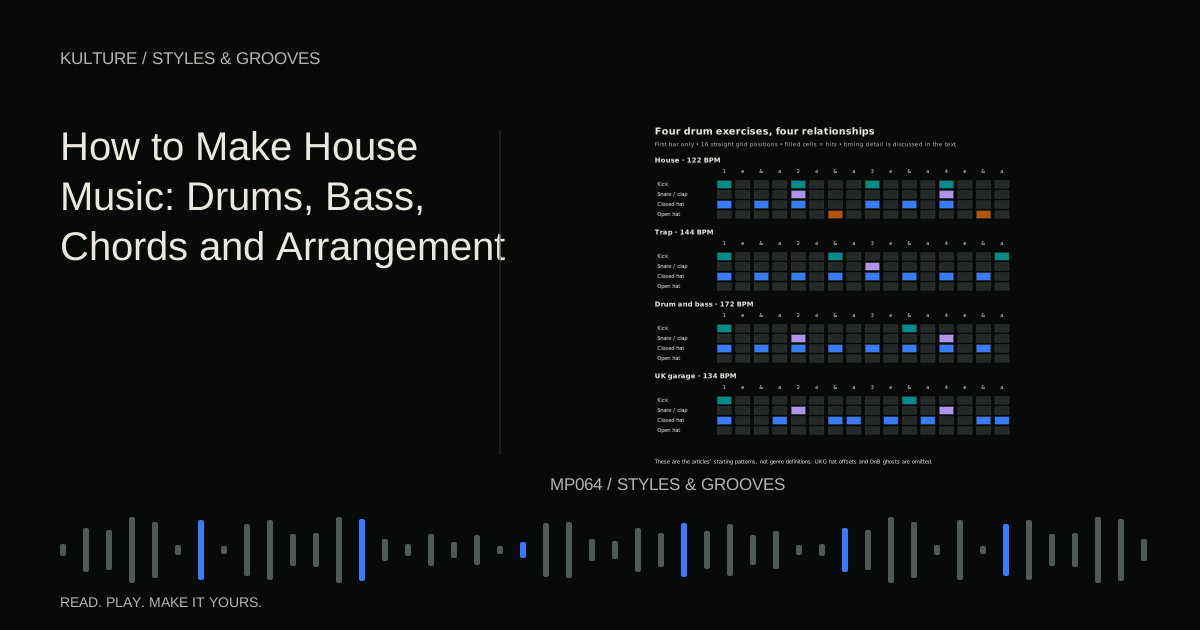
Create a two bar clip. Add snares or claps on beats 2 and 4 in both bars. Place kicks on bar 1, beats 1 and 3 and; in bar 2, use beats 1, 2 a, and 3 and. Count each beat as four sixteenths: “1 e and a.”
Keep these anchor hits on the grid initially. Choose a kick with a short enough tail that the bass can occupy some of the gaps. Use a snare with a clear attack rather than a very long wash of reverb.
Play the skeleton alone. It should already suggest a bouncing, broken pulse. If it does not, change the kick placement before adding a dozen percussion sounds. A complicated hat pattern cannot rescue an unclear foundation.
TRY IT HERE
Find the pocket
Tap the grid, change the tempo and hear your pattern.
Ready when you are. Audio starts only when you press Play.
Keep experimenting in the beat maker LabBuild shuffle through timing and accents
Add closed hats at sixteenth positions 1, 4, 7, 8, 10, 12, 15, and 16 of bar 1. Here, positions 1 to 4 belong to beat 1, 5 to 8 to beat 2, and so on. In bar 2, remove position 8 and add position 6.
Make positions 4, 8, 12, and 16 a little late relative to their straight grid locations. At this tempo, try a small offset around 10 to 20 milliseconds and adjust by ear. This is an illustrative timing experiment, not a universal garage swing value.
Make the quiet connecting hats noticeably softer than the main accents. Try an open hat on beat 1 and of bar 2, replacing any closed hat at that exact position. Let the next closed hat choke it if your sampler supports that behavior.
Swing delays alternating subdivisions within a repeating relationship. Triplets divide a span into three equal parts. They are related possibilities, not interchangeable labels. If you apply a DAW groove template, check which notes it moves and how much before applying it to the whole kit.
Give the bass a question and answer
Use E minor as a tonal center. Choose a rounded monophonic bass with a slightly rising filter envelope if you want a swelling attack. Keep the actual note onset clear enough to feel rhythmic.
Program this two bar phrase:
- Bar 1: E on 1 and for half a beat; B on 2 and for half a beat; D on 3 a for a quarter beat; E on 4 and for half a beat.
- Bar 2: G on beat 1 for one beat; E on 2 and for half a beat; B on beat 4 for half a beat.
The opening answers the first kick rather than always doubling it. The second bar starts with G, creating a different contour before returning to E. Listen with only drums and bass, then remove any note that makes the kick feel less clear.
A bass can be weighty without continuous sustain. Shorten the last B if it overlaps the next phrase. If a patch's release creates hidden overlap, adjust the envelope even when the MIDI notes appear separated.
Create a vocal instrument from your own recording
Record yourself singing a short “oh, stay” phrase on E and G, or use a vocal sample with suitable permission. For this exercise, your own simple recording avoids relying on a recognizable commercial acapella.
Cut three fragments: the vowel “oh,” the consonant and vowel attack of “stay,” and a sustained vowel from its ending. Add short fades to avoid clicks. Keep the original recording in a separate track so the edits remain reversible.
Arrange “oh” on bar 1, beat 1 and; “stay” on beat 3; and the sustained vowel on bar 2, beat 2 and. Leave the final beat of bar 2 empty for the bass response. Pitch a copied vowel up a minor third only if it still fits the harmony and sounds intentional.
Chopping is not just random slicing. Consonants create rhythmic edges; vowels carry pitch and sustain. Moving the sample start can change whether a chop feels like a word, a percussion hit, or a pad. Listen to those functions separately.
Add chords without filling every hole
Use E minor seventh, E, G, B, D, for two bars, followed by A minor seventh, A, C, E, G, for two. Play short upper register stabs on beat 2 and and 4 and, but remove a stab wherever the vocal needs space.
Voice the chords close together above the bass rather than doubling every root in the low register. If the vocal's G sits inside a dense chord, try omitting the chord's G or moving the voicing lower. You are arranging a conversation, not displaying every available note.
A soft organ or electric piano tone can contrast with the bass's round attack. Keep its effect tail short enough that the swung rhythm remains audible.
Arrange around the vocal reveal
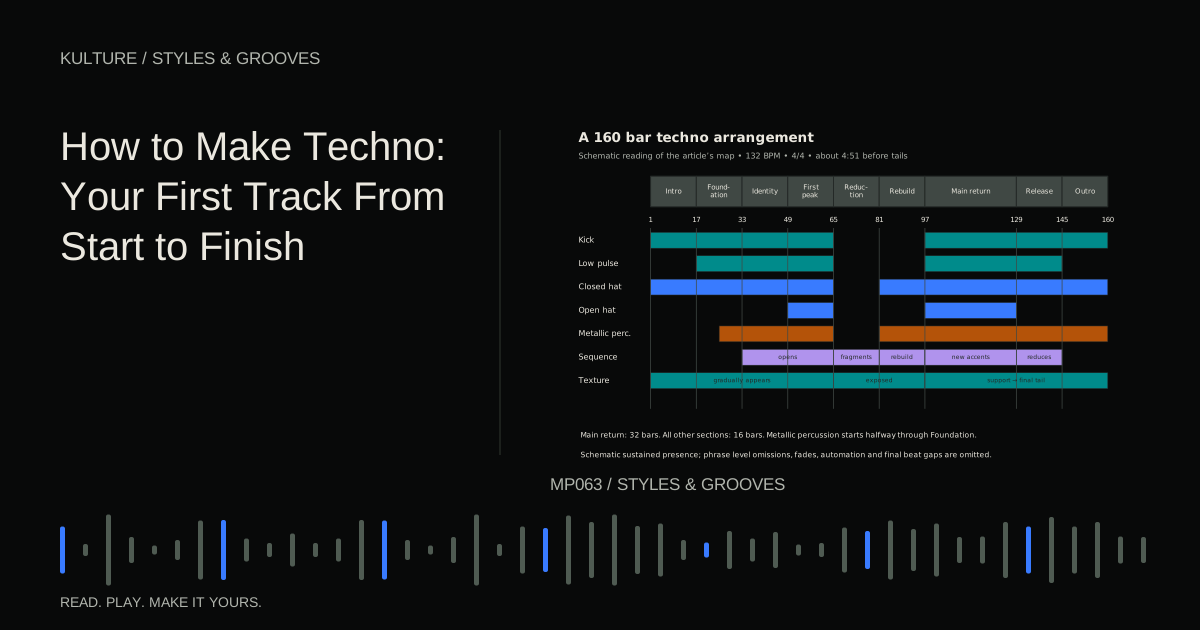
Build 112 bars, about 3 minutes 21 seconds at 134 BPM. Use 16 bars of drum introduction, 16 bars adding bass and chord fragments, 16 bars introducing the full vocal pattern, 16 bars of reduced texture, 32 bars of main return, and 16 bars of exit.
During the reduction, play a longer version of the original vocal phrase over sustained chords. On the return, switch back to rhythmic chops. This creates contrast from the same source instead of adding a new lead.
Every eight bars, change one bass response or remove a percussion accent. Keep the strongest groove intact long enough for listeners to settle into it. A shuffled style does not require a fill at every possible boundary.
Solve common problems
If the beat sounds clumsy, reduce timing offsets and re establish the kick and snare anchors. If it sounds robotic, adjust hat accents and selected note lengths before shifting everything late. If the vocal sounds unintelligible, decide whether intelligibility matters; if it does, preserve enough consonant and phrase context.
If bass and vocal both dominate the same moments, change their rhythms. If delay obscures the shuffle, shorten feedback or reduce the send. Check the full arrangement because a vocal effect that works in the breakdown may crowd the main groove.
Export a one minute draft and listen without the grid. Your exercise is to compare straight hats, lightly shuffled hats, and strongly shuffled hats over identical kick and bass parts. Choose the version that makes the whole pattern move. Then explore bass rests and syncopation and call and response.
TAKE IT INTO YOUR OWN MUSIC
Your next session.
If the beat sounds clumsy, reduce timing offsets and re establish the kick and snare anchors. If it sounds robotic, adjust hat accents and selected note lengths before shifting everything late. If the vocal sounds unintelligible, decide whether intelligibility matters; if it does, preserve enough consonant and phrase context.
Notes and progress stay in this browser.