An equalizer changes the level of selected frequency regions. It does not understand the song, distinguish good harmonics from bad ones or decide which instrument should lead. Your listening supplies that context.
Learn three controls and a few shapes
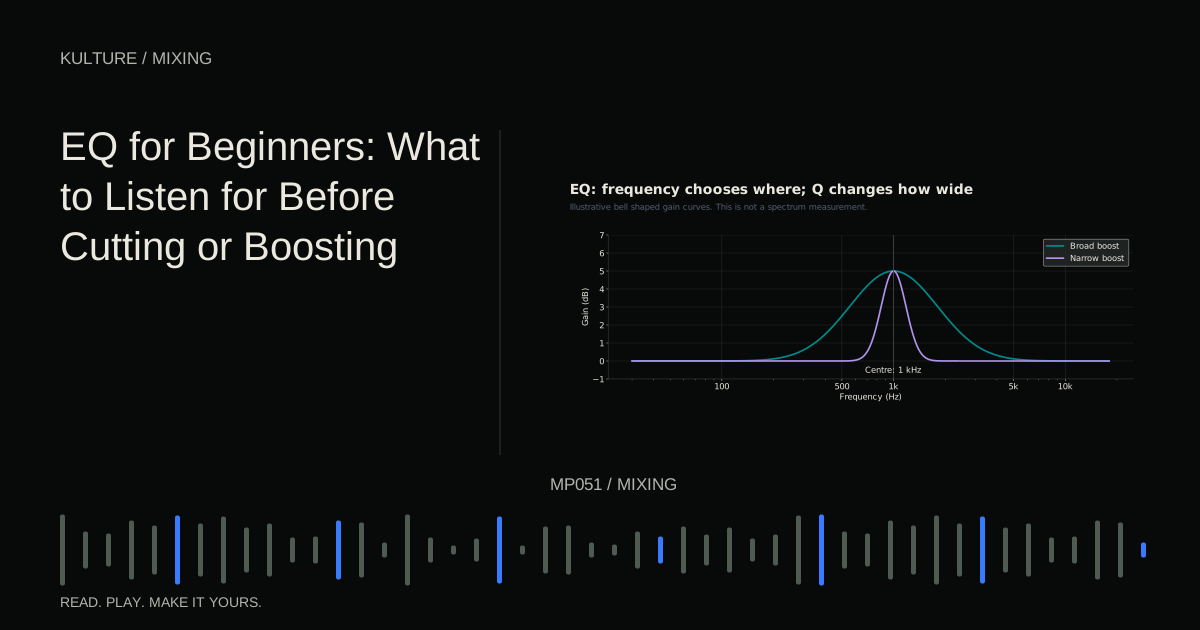
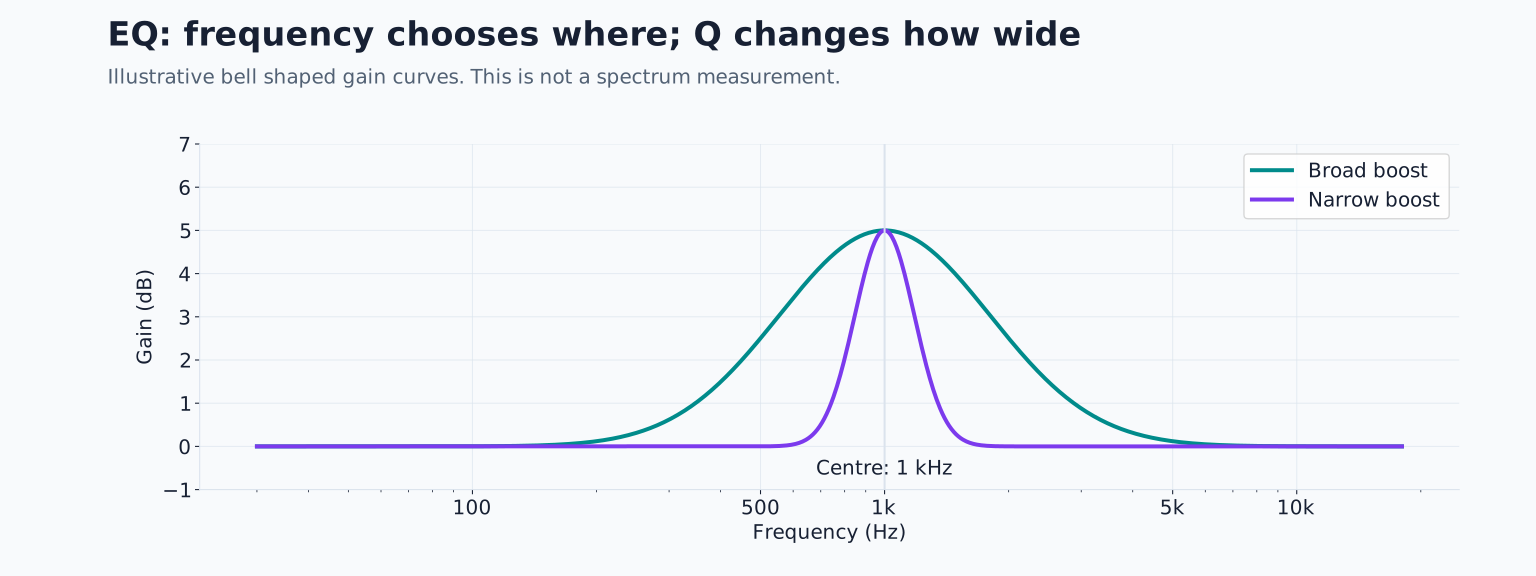
A parametric EQ band commonly has frequency, gain and Q. Frequency chooses the region, gain sets the amount of boost or cut, and Q controls how broad or narrow the band is. Higher Q commonly means a narrower band, though exact definitions and interactions can differ between processors.
A bell affects a region around a centre frequency. A low shelf changes a broad low frequency region; a high shelf changes a broad high frequency region. A high pass filter reduces low frequencies, while a low pass filter reduces high frequencies. The names describe what passes, not what is removed. FabFilter’s band control documentation provides a manufacturer’s reference for these shapes and notes differences in Q interpretation.
Begin with broad, modest moves when adjusting general tone. Use narrower bands when there is a specific resonance or ringing feature to address. A narrow cut is not automatically more professional or less audible.
TRY IT HERE
Find the frequency
Move a bell filter through a harmonic tone and compare bypass.
Ready when you are. Audio starts only when you press Play.
Keep experimenting in the synth LabListen before looking at the analyzer
A spectrum analyzer displays energy across frequency. It can help you find a persistent peak or understand where a source lives, but a tall peak may be the instrument’s fundamental rather than a fault.
Play the full arrangement and write one sentence about the problem. Then briefly solo the suspected source to understand it. Return to the full arrangement before deciding whether the change helps.
If the source sounds good alone but disappears in context, the issue may be masking: one sound makes another harder to perceive. Consider reducing the competing part rather than boosting the hidden one. Sometimes a fader change solves the same problem with fewer side effects.
A controlled low mid exercise
Create a short arrangement with bass, a sustained chord sound and a lead. Use a chord voicing with some low notes so the example contains potential overlap. First lower the chord fader slightly and listen. If this solves the problem without losing the harmony, stop there.
If the chords still feel too thick relative to their useful detail, add one broad bell cut. Begin around the low middle area where you hear the buildup, perhaps 250 to 400 Hz for this particular experiment, and use a small reduction such as 2 dB. These are audition values, not a prescription for every chord instrument.
Move the band slowly while the arrangement plays. Listen for the bass becoming easier to follow while the chords retain enough body. If the chords become hollow before the bass improves, undo the cut and investigate their notes, release or overall level.
Bypass the EQ and compare at similar perceived loudness. Cutting energy can make a sound quieter, so do not mistake quieter for cleaner without checking its musical contribution.
Learn a boost without creating a loudness trick
Use a dull pluck or guitar like sound. Add a broad upper mid bell or a gentle high shelf, starting with a modest boost. Listen for improved articulation. If the sound becomes aggressive instead, reduce the amount or move the band.
Lower the EQ output enough to make the processed and bypassed versions reasonably comparable in loudness. Now ask whether the notes are genuinely easier to follow. A brighter, louder version often wins an unfair comparison even when it will become tiring in the full mix.
A boost is not inherently worse than a cut. Both alter relationships between frequencies. Choose the move that expresses the desired result clearly and does not create unnecessary complications elsewhere.
High pass filters need a reason
A high pass filter can reduce rumble, handling noise or low energy that a supporting part does not need. It can also remove warmth and change the way layered sounds interact.
On a noisy recording, raise the cutoff while listening for the unwanted low sound to diminish. Stop and compare before the useful body weakens. On a synthesized part, consider adjusting the oscillator, filter or octave first, because the source may be generating unnecessary low content by design.
Do not high pass every non bass track at the same frequency. A low vocal, guitar or piano may carry important information below a generic recommendation. In a sparse arrangement, that body may be part of the song’s character.
Filter slope affects how sharply the response falls. A steeper filter can remove unwanted energy more decisively, but it can also create a more pronounced tonal change around the boundary. Listen to the actual result instead of assuming the steepest option is best.
Diagnose narrow ringing carefully
If one note or resonance sticks out, find it at a conservative listening level. You can use a temporary narrow boost to help identify a region, but avoid extreme boosted sweeps that make everything sound objectionable. Lower the monitor level first and return the band to a cut afterward.
Check whether the resonance is constant or appears only on certain notes. A permanent cut may weaken the entire instrument to fix one moment. Clip gain, automation or dynamic EQ may be more appropriate when the issue is intermittent.
Dynamic EQ versus multiband compression explains tools that respond over time. You do not need them for every small resonance; start with the simplest change that works.
Stop before the instrument loses its identity
Several individually small cuts can add up to a thin, lifeless sound. Bypass the entire EQ, not only the last band, and check the cumulative result. If you cannot explain what each band contributes, remove or disable it and listen again.
Also check the arrangement after adding new instruments. An EQ decision made for a sparse verse may not suit the chorus, but that does not mean every track needs a complicated automated curve. A local level change may be enough.
For practice, solve one problem using only a fader, then solve the same problem using one EQ band. Compare the tradeoffs. Finish by writing the frequency region, the audible reason and the context where the change helped. Continue with compression when the problem concerns changing level rather than steady tone.
TAKE IT INTO YOUR OWN MUSIC
Your next session.
Create a short arrangement with bass, a sustained chord sound and a lead. Use a chord voicing with some low notes so the example contains potential overlap. First lower the chord fader slightly and listen. If this solves the problem without losing the harmony, stop there.
Notes and progress stay in this browser.