Use a synthesizer with a sine oscillator, a noise source, amplitude envelopes, a filter and pitch envelope routing. You may need separate tracks if the synth cannot shape oscillator and noise independently. Ableton’s instrument reference documents examples of dedicated drum synthesis instruments; this exercise remains usable with a general purpose synth.
The kick: a falling pitch and a short body
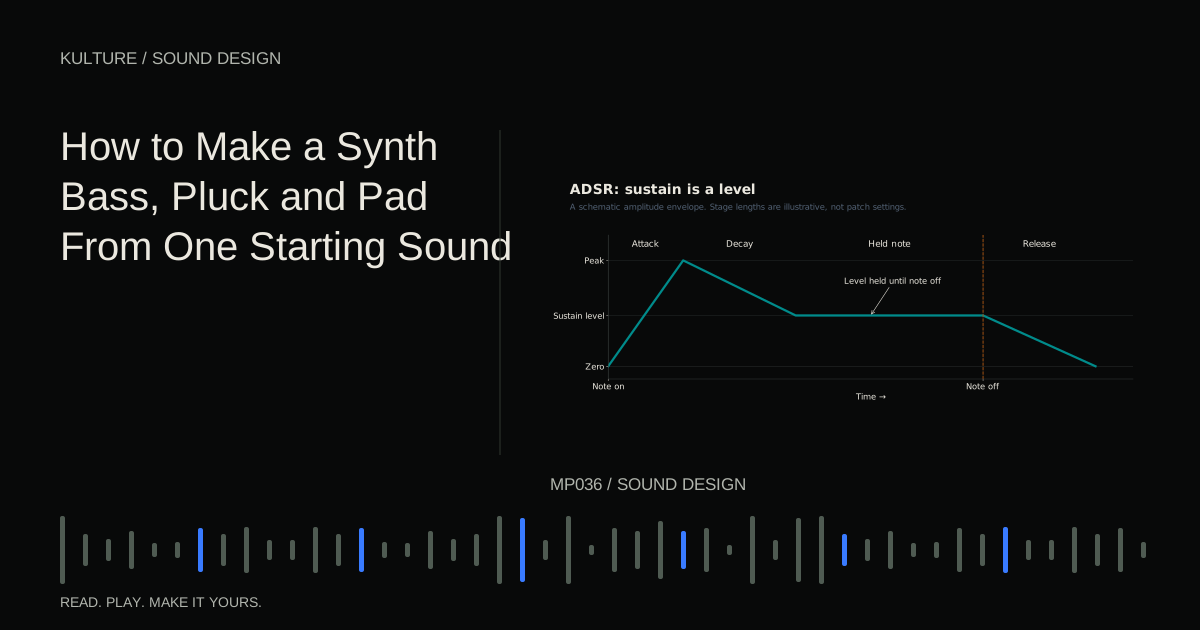
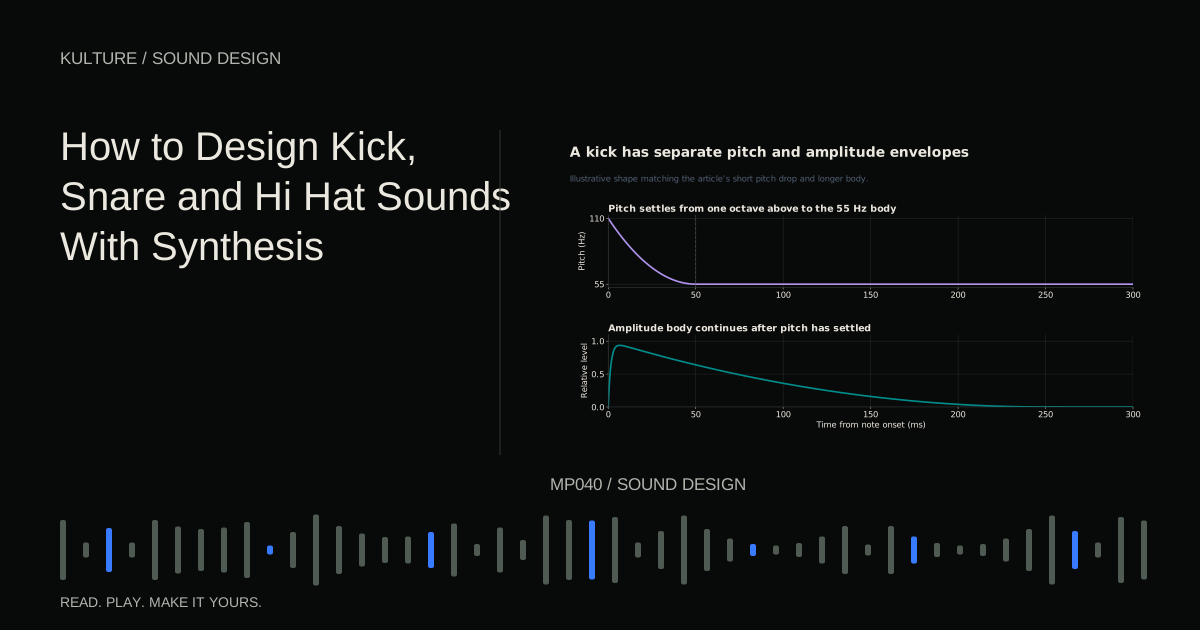
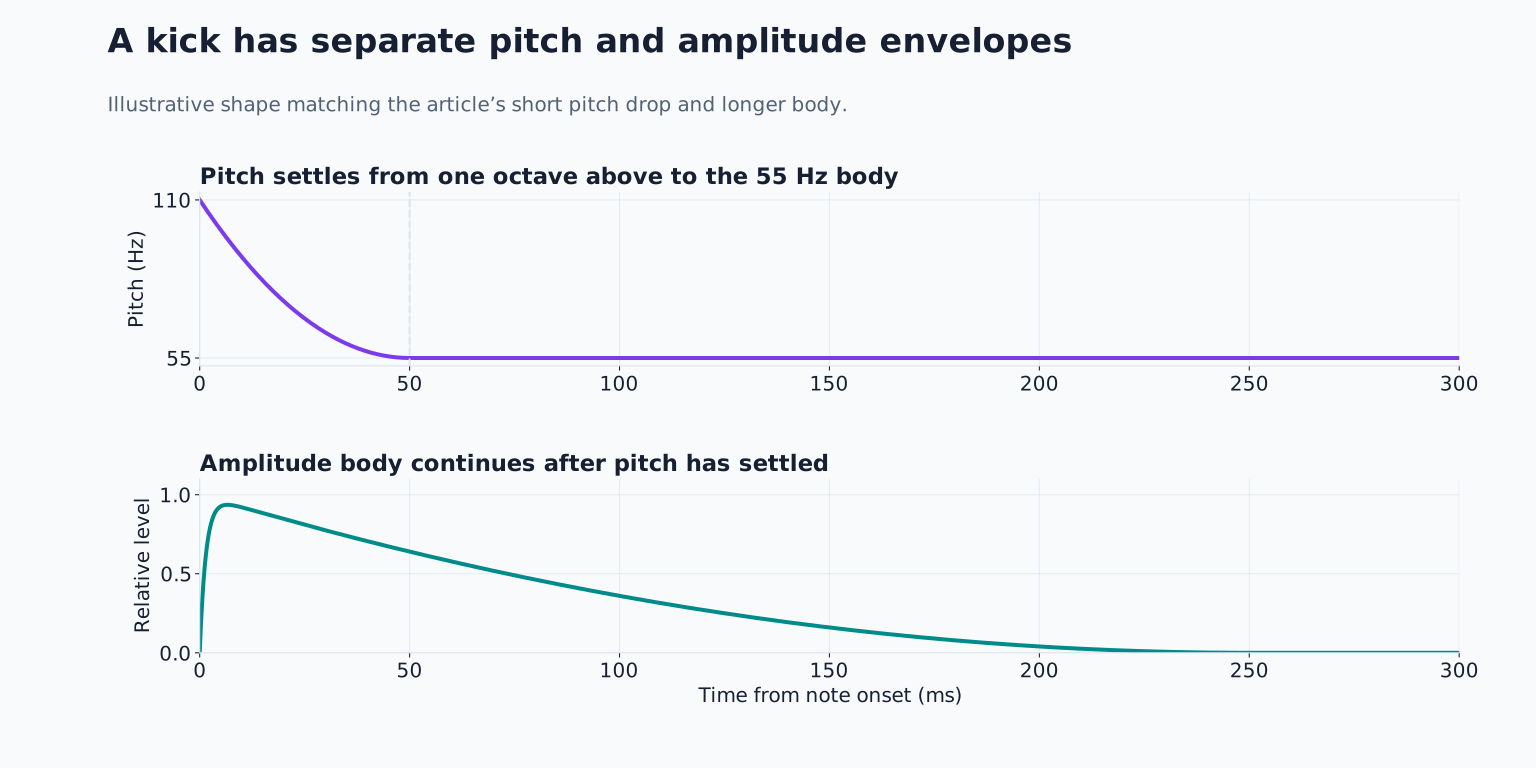
Start with one sine oscillator. Disable effects, unison and extra voices. Set the amplitude envelope to a quick attack, zero sustain and a decay of about 250 milliseconds. Use a short release so the ending does not stop abruptly when the MIDI note ends.
Choose a low note that gives a clear body on your monitoring system. A starting frequency around 55 Hz is reasonable for this example, but it is not a universal kick target. Avoid turning up monitoring just because a very low sine is difficult to hear.
Route an envelope to oscillator pitch. Give it a fast downward movement: begin roughly an octave or two above the final pitch and return over around 30 to 60 milliseconds. If the synth’s pitch envelope amount is expressed in semitones, 12 semitones means one octave.
Listen for a short thump at the start. Too little pitch movement may sound like a bass note; too much or too long may sound like a laser. Shorten the pitch decay first if the drop is obvious as a melody. The amplitude envelope determines how long the body remains after the pitch has settled.
A tiny noise burst can add attack if needed. Keep it much shorter than the body, perhaps 5 to 15 milliseconds as an experiment, and low in level. Do not add a bright click just because it is common in a preset. It must fit the style and leave space for other transients.
TRY IT HERE
Shape one sound
Compare the attack, tail and filter on the same note.
Ready when you are. Audio starts only when you press Play.
Keep experimenting in the synth LabThe snare: separate body from rattle
Create a new patch using noise and a pitched component. Noise spreads energy across a range of frequencies rather than producing a single stable note. Shape the noise with a fast attack, zero sustain and a decay around 150 milliseconds.
Filter the noise so it has a focused crack rather than unlimited low rumble and top end hiss. A band pass filter, which emphasizes a middle region while reducing frequencies above and below it, is useful for this experiment. Sweep its position at a conservative level while the snare repeats.
Add a sine or triangle oscillator above the kick’s register as a body layer. Try a frequency around 180 Hz only as a starting point, with a shorter decay than the noise. Raise its level until the snare gains weight, then back it down if you hear an obvious pitched tom.
Mute the body and listen to the noise alone. Then mute the noise and listen to the body. This makes the design decisions clear: one component provides a tonal impact, while the other provides the broader rattle or crack.
The two layers do not need identical envelopes. A very short body with a slightly longer noise tail often feels different from a long ringing body under a brief snap. Try both and choose by the rhythm’s needs.
The hi hat: a bright, short interruption
For a basic synthesized hat, use noise with a high pass filter, which reduces lower frequencies while retaining higher ones. Set the amplitude envelope to a fast attack, zero sustain and a short decay, perhaps 40 milliseconds initially.
Play repeated eighth notes. Raise the filter cutoff until the hat stops sounding like a small snare, then lower it slightly if it becomes thin and detached. The appropriate cutoff depends on the noise source and the surrounding drum sounds, so there is no fixed frequency to copy.
Create an open hat variation by extending decay to approximately 250 milliseconds. This is a duration comparison, not a full model of an acoustic cymbal. More complex synthesized hats may use several metallic oscillators, resonators or frequency modulation.
If an open hat should stop when the closed hat plays, use the instrument’s choke or exclusive group function if available. Otherwise shorten the open hat note or automate its level. A long release can keep sounding after a MIDI note ends, so inspect the actual envelope behaviour.
Assemble a pattern that reveals the sounds
At 120 BPM in 4/4, place kicks on beats one and three and snares on beats two and four. Put closed hats on eighth notes. In the second bar, replace the final closed hat with the open hat version.
Keep the pattern simple while balancing. If the kick and snare both feel too small, the hats may simply be too loud. Lower the hat first rather than increasing every drum’s level. Adjust the kick body so it ends before the next event where you want a clean gap.
Try alternating hat velocities, such as 85 and 60. If velocity affects only level, the quieter hits will still have the same tone. If the synth supports it, add a modest velocity influence to filter cutoff or decay for a more varied articulation.
Now change one envelope at a time. Double the kick decay, halve the snare noise decay and lengthen only the final open hat. You should hear how the groove changes even though none of the note positions moved.
Diagnose clicks, weak hits and excessive ringing
A click can be an intentional attack or an unwanted discontinuity. If the start sounds brittle, add a few milliseconds of attack and compare. If the ending clicks, lengthen release slightly or use a smoother envelope curve.
If consecutive kicks differ unexpectedly, oscillator phase or overlapping voices may be involved. Try monophonic operation or consistent oscillator retriggering if supported, then listen across the whole pattern. Consistency is useful, but a phase reset setting is not automatically superior in every patch.
Do not tune every short kick to a song’s root by rule. A long, clearly pitched electronic kick may interact harmonically with the bass, while a short transient can have a less definite pitch. Judge the audible body and arrangement.
Save the three patches, then create a second kit by changing only decay and filter settings. Continue with kick, snare, clap and hi hat roles and mixing kick and bass to make these sounds work as music.
TAKE IT INTO YOUR OWN MUSIC
Your next session.
A click can be an intentional attack or an unwanted discontinuity. If the start sounds brittle, add a few milliseconds of attack and compare. If the ending clicks, lengthen release slightly or use a smoother envelope curve.
Notes and progress stay in this browser.