This original exercise uses 142 beats per minute in 4/4, with a half time feel and an F sharp minor melodic center. It focuses on production, not on prescribing any lyrical subject. Native Instruments' drill guide identifies rhythmic displacement and portamento bass as useful distinctions in UK drill's production vocabulary.
Write a sparse melodic loop
Use a piano, plucked string like synth, or your own vocal recording. The F sharp natural minor notes are F sharp, G sharp, A, B, C sharp, D, and E.
Make a four bar phrase. In bar 1, play C sharp on beat 1, A on 2 and, and G sharp on beat 4. In bar 2, hold F sharp from beat 1 for two beats, then leave space. In bar 3, play D on beat 1, C sharp on 2 and, and A on beat 4. In bar 4, play G sharp on beat 1 and F sharp on beat 3.
Use F sharp, A, C sharp as a quiet underlying chord in bars 1 to 2 and D, F sharp, A in bars 3 to 4. The melody already supplies enough movement that you may not need a sustained pad.
If you reverse a rendered melodic fragment for atmosphere, preserve the original notes and check where the reversed swell lands. A long reverse tail should not conceal the drum entrance or the bass's first note.
TRY IT HERE
Find the pocket
Tap the grid, change the tempo and hear your pattern.
Ready when you are. Audio starts only when you press Play.
Keep experimenting in the beat maker LabMake the percussion skip
Start with a two bar pattern. Place the main snare on bar 1, beat 3. In bar 2, place it on beat 3 and. This displacement is one possible drill gesture, not a required snare position for every track.
Add a quieter rim on bar 2, beat 2 a. Listen to the two bars with a metronome until the second snare feels like an intentional variation rather than a lost beat. If the pattern feels too unstable, retain the main snare on beat 3 in both bars and use the later hit as a quieter response.
For hats, use sixteenth positions 1, 4, 7, 9, 12, and 15 in each bar. This creates uneven gaps with a recurring three step tendency. It is not the same as putting every note on a triplet grid. Keep some hits softer, especially those leading into a stronger accent.
In the fourth bar of a longer phrase, replace the final hat with two short thirty second hits. Use the roll as punctuation. If every bar has a different roll, the basic skip may become harder to hear.
Place kicks after the snare pattern makes sense
Use kicks on bar 1, beats 1, 2 and, and 4 a. In bar 2, use beats 1 and and 4. The gaps let the snare displacement and bass movement remain prominent.
Choose a short kick initially. A long kick can work, but it adds another sustained low element to coordinate. Listen to the kick and snare alone, then restore hats. If the pattern only works with a loud melody distracting you, repair the drum relationship first.
The kick does not need to follow every bass note. In fact, separating some attacks makes slides easier to hear and prevents the rhythm from becoming a continuous series of low impacts.
Tune and configure the bass instrument
Use a pitched 808 style sample or synth bass. In this context, “808” means a sustained bass sound associated with modern production, not necessarily a complete Roland TR 808 drum machine.
Verify the sample's root pitch after any initial pitch drop. Configure monophonic playback so new notes replace previous ones. Check whether MIDI note length controls the sound; a one shot sampler mode may keep playing after note off.
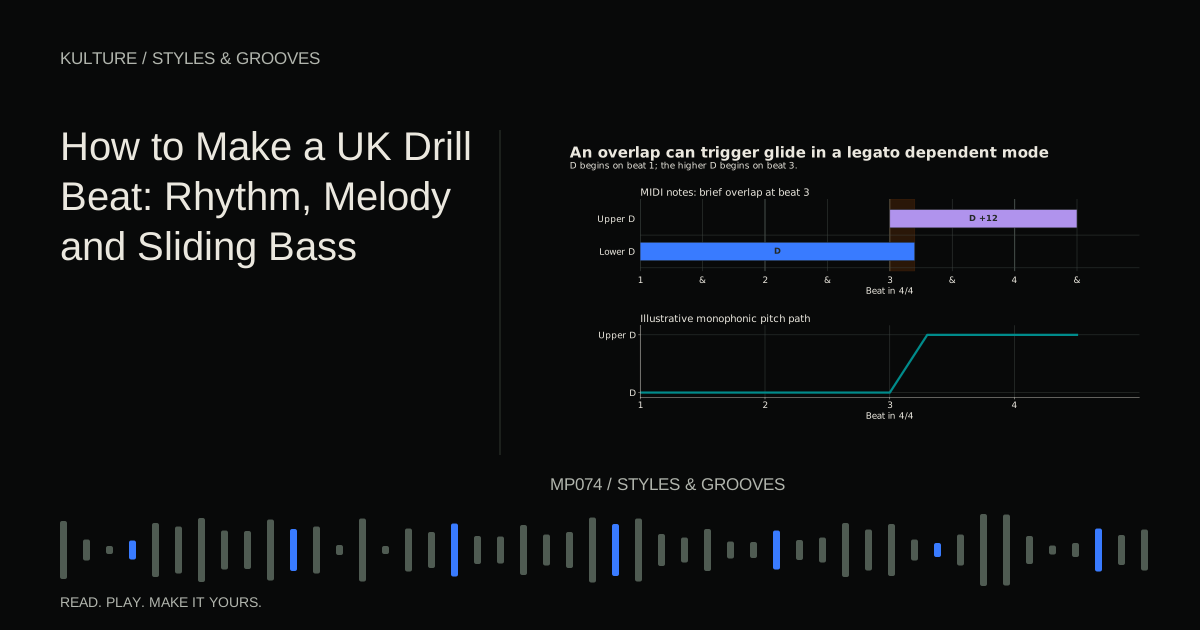
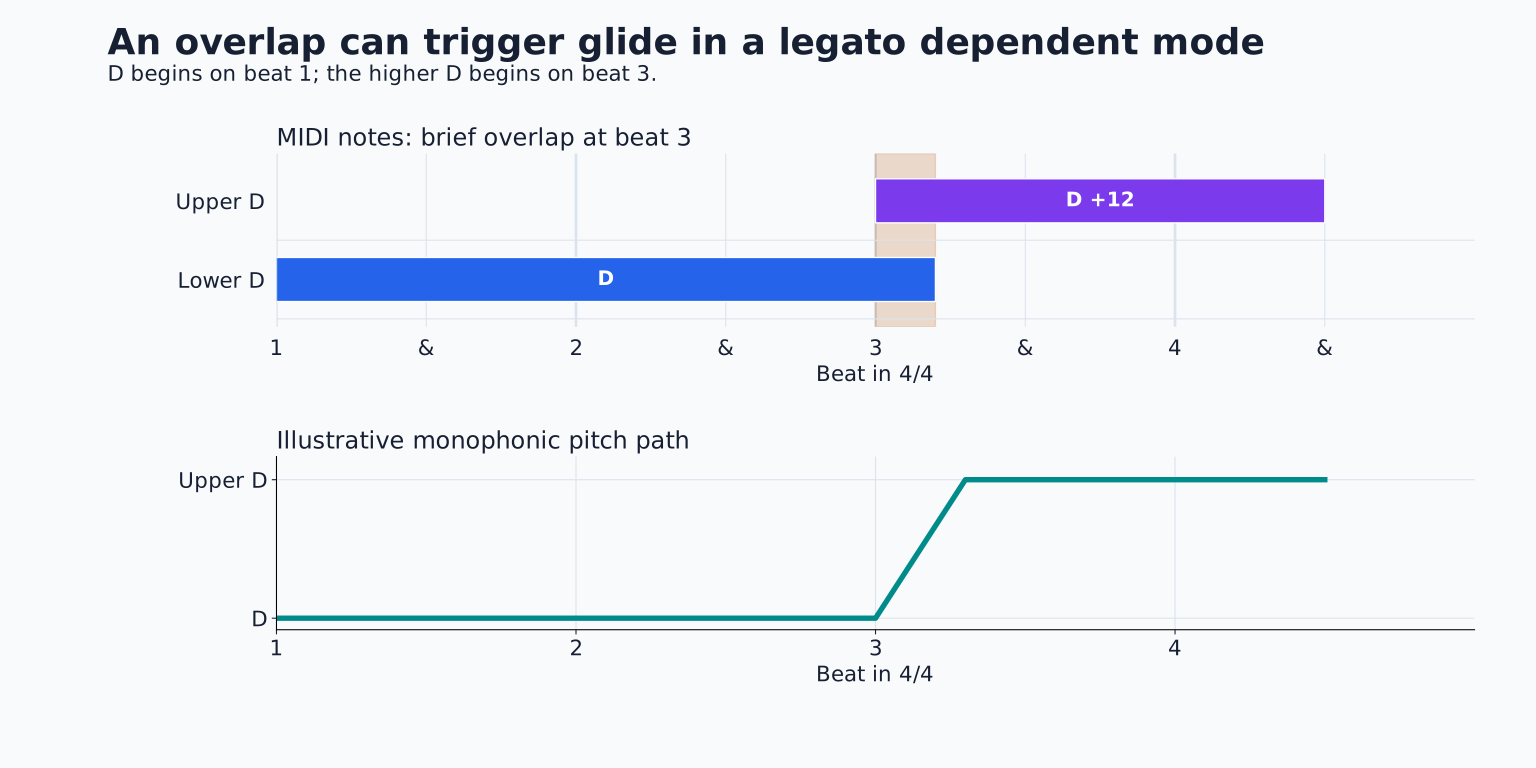
Enable glide or portamento, the continuous movement between pitches. Some instruments glide only when notes overlap in legato mode; others glide on every note or require a special slide command. Use the instrument's documented behavior and test two notes before programming the whole line.
Start with a clearly audible but not excessively slow glide, perhaps around 80 to 150 milliseconds as an experiment. The appropriate time depends on interval size, tempo, and the instrument's glide mode.
Write the bass without slides first
Across four bars, program:
| Bar | Notes and positions |
|---|---|
| 1 | F sharp on 1 for one beat; C sharp on 2 and for half a beat; F sharp on 4 a, short |
| 2 | F sharp on 1 and for one beat; E on 4 for half a beat |
| 3 | D on 1 for one and a half beats; A on 3 and for half a beat |
| 4 | E on 1 for one beat; F sharp on 3 for one beat |
Choose a low register where F sharp is clear rather than only felt. Octave naming differs between DAWs, so check actual sound. If a note is too low for useful pitch definition, move the entire line or that note up an octave.
Now add two slides. Near the end of bar 2, glide from E up to F sharp. In bar 4, glide the final F sharp briefly up an octave, then stop before the next phrase. Keep the first bass note of the loop stable so the return feels grounded.
If the line becomes an undifferentiated pitch sweep, shorten the slides and restore stable note durations. The listener needs destinations as well as motion.
Leave room for a performer
Build an 8 bar intro, 16 bar hook, 24 bar verse, 16 bar hook, 24 bar verse, and 8 bar ending. The 96 bars last about 2 minutes 42 seconds at 142 BPM.
In the verse, reduce the melodic layer and save the octave slide for phrase endings. In the hook, restore the full four bar motif and a quiet upper response. Use a guide rap or spoken rhythm to test whether instrumental accents clash with likely line endings.
A one beat pause before a hook can make the return strong. Keep it consistent with the surrounding rhythm so it sounds deliberate. Do not add a large fill every time a vocalist needs breathing room.
Check the low end and edits
If bass notes overlap unexpectedly, inspect release and polyphony. If slides fail, verify legato overlap or the instrument's slide mechanism. If the kick disappears, change attack timing or bass duration before applying extreme processing.
If the bass is inaudible on small speakers, try controlled saturation to add upper harmonics, matching output loudness for comparison. Keep the melodic effects out of the way of the snare and bass attacks. Check for clicks at reversed audio edits and abrupt bass endings.
Export the whole beat, then make a version with only one slide per four bars. Decide which has clearer phrasing. For deeper work, continue with 808 slides and glides and compare the rhythmic foundation with the trap tutorial.
TAKE IT INTO YOUR OWN MUSIC
Your next session.
If bass notes overlap unexpectedly, inspect release and polyphony. If slides fail, verify legato overlap or the instrument's slide mechanism. If the kick disappears, change attack timing or bass duration before applying extreme processing.
Notes and progress stay in this browser.