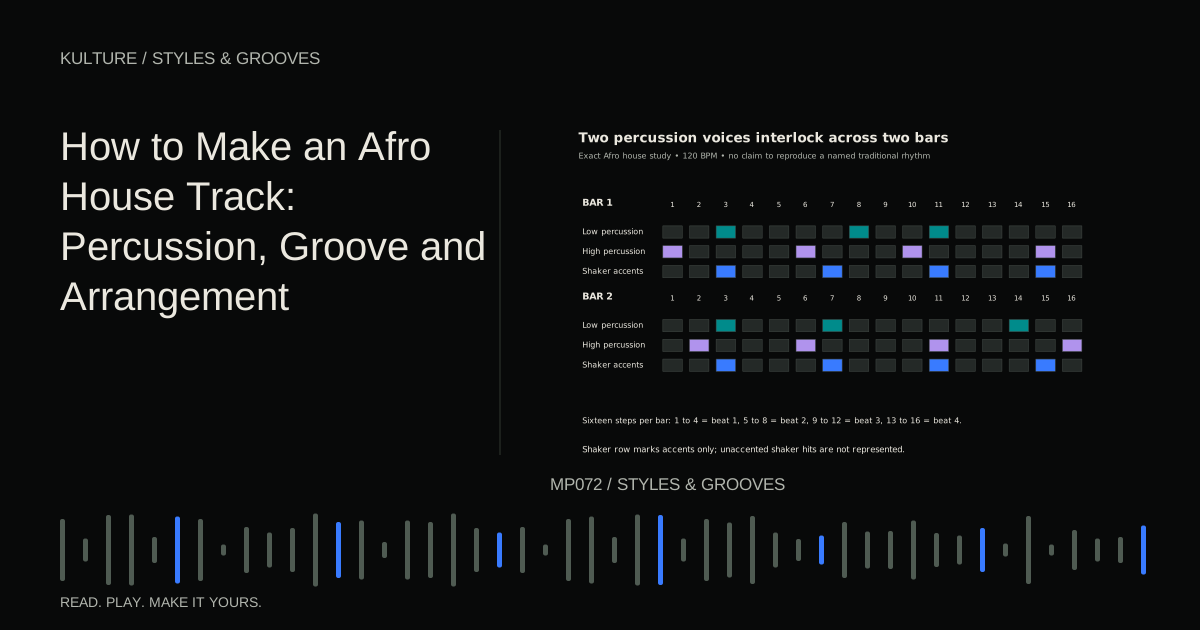
This original study uses 120 beats per minute, a steady kick, two complementary percussion voices, a restrained bass, and a short melodic call. It teaches interlocking arrangement without claiming to reproduce a named traditional rhythm.
For a producer's own perspective, read AMÉMÉ's discussion of Afro house drums. The value of an artist interview is hearing choices in context, rather than assuming every track should contain the same kit.
Start with a stable foundation
Place a short kick on beats 1, 2, 3, and 4 of a 4/4 bar. Choose a tone that leaves space for a separate bassline. Avoid a very long low tail if you already plan sustained bass notes.
Add a restrained clap or rim on beats 2 and 4 if it supports the direction. Keep it quieter than in a strongly backbeat led pop pattern. You may decide the percussion already establishes enough orientation without it.
Play this foundation for several bars and tap the pulse. The next layers should make it more expressive, not make the beat harder to locate. Keep the kick stable while exploring other timing relationships.
TRY IT HERE
Find the pocket
Tap the grid, change the tempo and hear your pattern.
Ready when you are. Audio starts only when you press Play.
Keep experimenting in the beat maker LabGive each percussion layer a role
Use a low, rounded hand drum like sound for weight and a higher wooden or skin like hit for articulation. If you use an instrument sample with cultural specificity, learn its name and context rather than relabelling it generically.
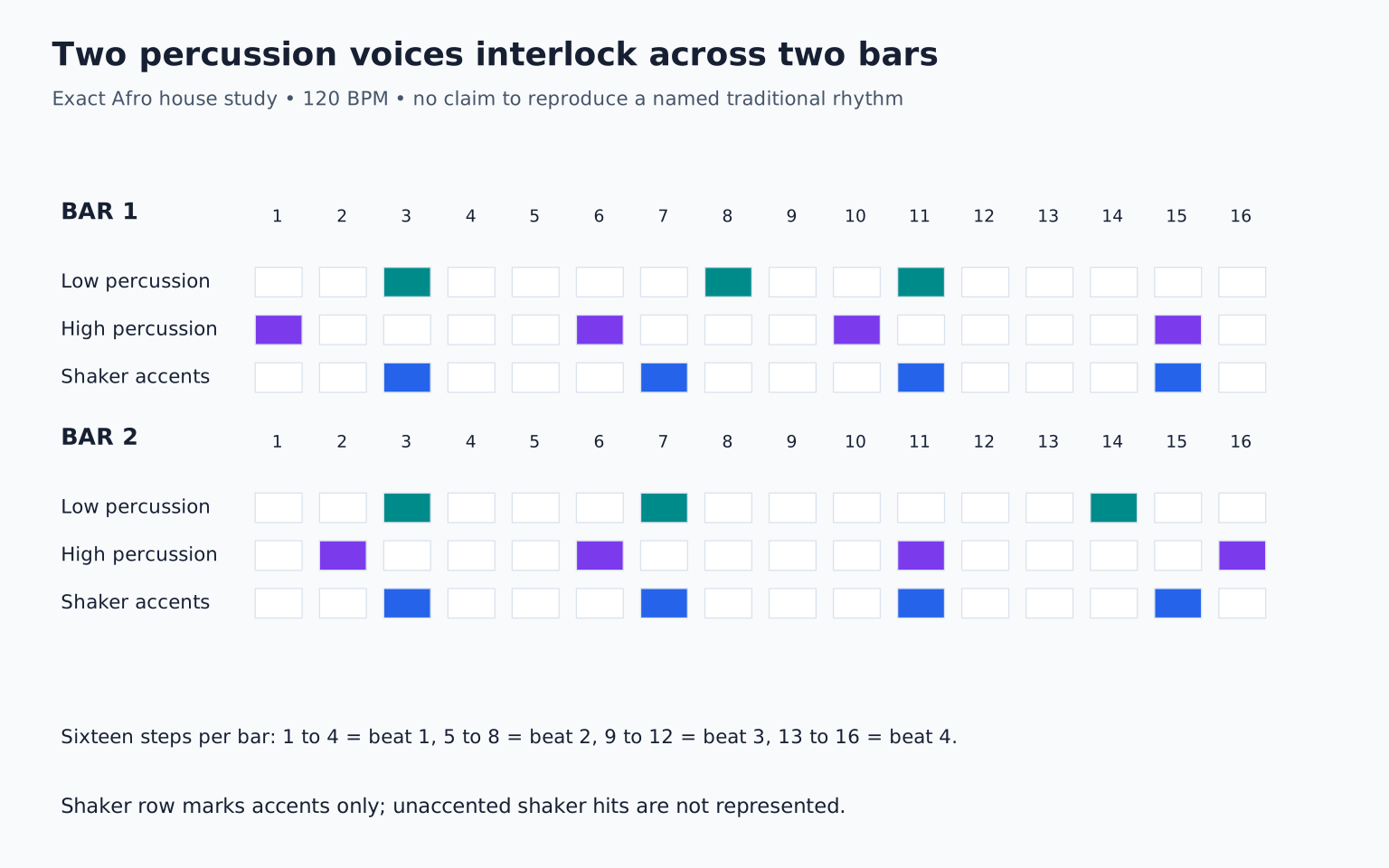
Create a two bar pattern using sixteenth step numbering, 1 to 16 per bar:
| Layer | Bar 1 steps | Bar 2 steps |
|---|---|---|
| Low percussion | 3, 8, 11 | 3, 7, 14 |
| High percussion | 1, 6, 10, 15 | 2, 6, 11, 16 |
| Shaker accents | 3, 7, 11, 15 | 3, 7, 11, 15 |
Fill the shaker's remaining eighth note positions more quietly if useful. Step 1 is beat 1; step 5 is beat 2; step 9 is beat 3; step 13 is beat 4. This makes the pattern reproducible without requiring drum notation.
The layers intentionally leave different gaps. Listen to low and high percussion without the kick, then add the kick back. If both layers seem to emphasize the same moments too often, remove one overlapping hit rather than spreading them with random timing.
Shape accents like phrases
Make the first low percussion hit strong, the second softer, and the final one a response. For the high layer, emphasize the last hit of bar 2 as a pickup into the next cycle. Velocity should describe a phrase, not merely alternate mechanically forever.
If your instrument has different articulations, alternate them intentionally. A muted hit and an open hit are not interchangeable versions of the same amplitude. Their decay and tone affect how they fit around the kick.
Try a small timing adjustment on one high percussion hit, then listen over several repetitions. Keep the main framework consistent. Human feel comes from coordinated relationships, not from making every hit inaccurate.
Write bass with enough space for the drums
Use A minor as a starting center. Program A on beat 1 and for half a beat, E on beat 2 and for half a beat, and G on beat 4 for one beat. In the second bar, use A on beat 1 for one beat and E on 3 and for half a beat, leaving the final beat empty.
Choose a rounded bass with a clear beginning and controlled release. The first bar moves around the kick; the second gives a more settled answer. If the low percussion occupies too much of the same range, move its pitch, shorten its decay, or reduce its level before boosting the bass.
For four bars of harmonic variation, change the bass anchor to F in bars 3 to 4 while retaining a similar rhythmic shape. Let the bass and percussion remain the primary conversation rather than adding a dense chord attack on every hit.
Add a melodic call with a deliberate answer
Use a pluck, mallet like synth, or your own recorded vocal. Over A minor, play E on beat 1, G on 2 and, and A on beat 3, then leave space. In the next bar, answer with C on beat 3 and B on 4 and, resolving to A at the next phrase.
Over F major, use C, E, F as the call and A, G as the response. Keep the notes above the bass and make the response softer or shorter. A sustained pad can support A, C, E and F, A, C, but it should not obscure the percussion's fine detail.
If adding a vocal in a language you do not speak, verify meaning, pronunciation, credits, and permission. A voice is not merely an exotic texture. For this practice track, recording a simple wordless phrase yourself is a straightforward option.
Develop the arrangement through percussion dialogue
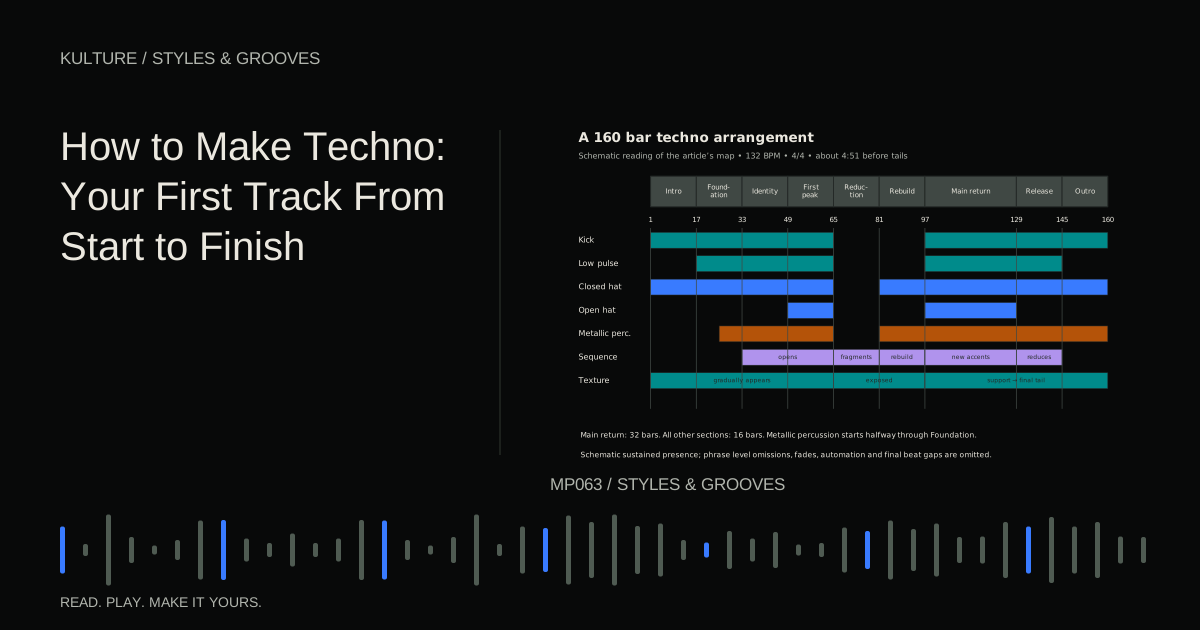
Try 128 bars, about 4 minutes 16 seconds at 120 BPM. Introduce kick and shaker for 16 bars, add low percussion and bass for 16, introduce high percussion and melody for 32, reduce to pad and selected percussion for 16, return with full groove for 32, then strip back for a 16 bar exit.
In the first full section, let the low percussion dominate. In the return, reduce one low hit and make the high response more audible. This creates development through changed interaction instead of simply adding more tracks.
At a major boundary, stop the bass for one bar while percussion continues. At another, remove the high layer and expose the melody. Avoid treating every transition as a long noise riser; the musical parts can signal change themselves.
Mix for separation without sterilizing the groove
Balance kick and bass first, then bring in the low percussion until its role is audible without overwhelming the low end. Add the high layer and shaker carefully; sustained upper percussion can become fatiguing or mask the melodic attack.
Use short shared ambience if it helps the percussion feel connected. Too much reverb can blur the interlocking pattern. Check whether stereo placement improves separation while the groove remains understandable in mono.
Export a full draft, then listen to a version with one percussion layer muted. If the muted version grooves better, revise the interaction instead of defending the extra complexity. Your exercise is to make a second two bar percussion answer using the same sounds and fewer hits. Continue with call and response and arrangement development.
TAKE IT INTO YOUR OWN MUSIC
Your next session.
Balance kick and bass first, then bring in the low percussion until its role is audible without overwhelming the low end. Add the high layer and shaker carefully; sustained upper percussion can become fatiguing or mask the melodic attack.
Notes and progress stay in this browser.